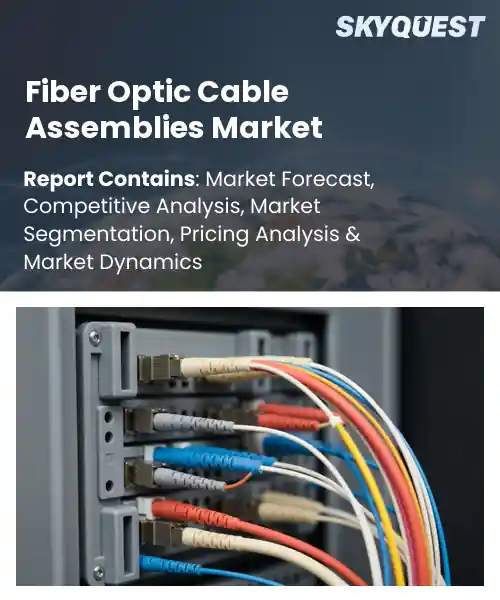
Fiber Optic Cable Assemblies Market
Report ID: SQMIG45H2151
Report ID: SQMIG45H2151
[email protected]
USA +1 351-333-4748
Report ID:
SQMIG45H2151 |
Region:
Global |
Published Date: February, 2026
Pages:
157
|Tables:
116
|Figures:
77


Global Fiber Optic Cable Assemblies Market size was valued at USD 6.0 Billion in 2024 and is poised to grow from USD 6.39 Billion in 2025 to USD 10.58 Billion by 2033, growing at a CAGR of 6.5% during the forecast period (2026-2033).
Rising data traffic, expansion of cloud computing, rapid 5G deployment, increasing FTTH rollouts, and growing demand for high-speed, low-latency connectivity are driving sales of fiber optic cable assemblies. Explosive growth in global data consumption coupled with the need for reliable, high-capacity optical interconnects is expected to primarily drive fiber optic cable assembliesmarket growth. Historically, the industry evolved from bulky single-fiber patching systems to high-density multimode and single-mode solutions as hyperscale data centers and telecom carriers required scalable and space-efficient cabling. Large-scale hyperscale deployments and national FTTH initiatives have significantly reshaped product specifications and manufacturing practices. As telecom operators expand 5G infrastructure and cloud providers increase data center capacity, demand for MPO trunk cables and ribbon fibers continues to rise. Manufacturers are investing in automated polishing and advanced testing technologies to improve production efficiency and reduce unit costs.
On the contrary, high initial deployment costs, complexity in installation and maintenance, vulnerability to physical damage, and supply chain disruptions in raw materials are predicted to hamper fiber optic cable assemblies market penetration across the study period and beyond.
AI-based optical design tools help engineers fit more fibers into smaller, high-density assemblies without compromising performance. In production, machine vision systems detect microscopic defects in real time, improving quality control and increasing manufacturing yield. Manufacturers and network operators are increasingly adopting automated inspection and analytics systems to improve consistency and accelerate deployments.
Market snapshot - 2026-2033
Global Market Size
USD 6.0 Billion
Largest Segment
Assembled Products
Fastest Growth
Fiber Jumpers
Growth Rate
6.5% CAGR
To get more insights on this market click here to Request a Free Sample Report
Global fiber optic cable assemblies market is segmented by product type, mode types, cable length, end users,and region. Based on product type, the market is segmented into assembled products and fiber jumpers. Based on mode types, the market is segmented into single mode and multiple mode. Based on cable length, the market is segmented into custom length and standard length. Based on end users, the market is segmented into automotive, healthcare, defense & government, IT & Telecommunications, and others. Based on region, the market is segmented into North America, Europe, Asia Pacific, Latin America, and Middle East & Africa.
Single Mode segment dominates because its capability to support very high bandwidth and low signal attenuation meets the rigorous requirements of long distance and high-speed networks. Its compatibility with advanced light sources and dense wavelength multiplexing enables service providers and enterprise networks to achieve higher capacity with fewer repeaters. This technical superiority drives preference among designers and installers, reducing total cost of ownership and accelerating migration to higher performance optical infrastructures.
By becoming the default choice for backbone and metro links, Single Mode expands market demand through scalable upgrade paths and long-term value creation. Its wide applicability to emerging high bandwidth applications encourages investment in fiber plant and component ecosystems, enabling manufacturers and service providers to introduce higher margin products and services.
Custom Length segment leads because tailored cable assemblies address diverse installation environments and complex routing requirements, minimizing excess cabling and simplifying deployment. The ability to specify exact lengths reduces site termination needs and compatibility issues, improving reliability and installation speed. Manufacturers offering customization foster closer collaboration with integrators, which encourages design optimization and reduces waste, making customized offerings preferable for projects with varied physical constraints.
Custom Length contributes to market expansion by unlocking demand for project specific solutions and reducing churn from returns and modifications. Its adoption enables service providers and system integrators to bid more competitively on complex deployments, supporting higher value contracts and predictable production cycles, which in turn motivates manufacturers to expand configurable production capabilities and auxiliary service offerings.
To get detailed segments analysis, Request a Free Sample Report
Robust fiber optic cable manufacturing and system integration capabilities are helping Asia Pacific lead to the demand for fiber optic cable assemblies on a global level. Manufacturers within Asia Pacific have large scale and specialized expertise in optical connector designs, precision polishing, miniaturization of products, which is also cementing the dominance of this region. Increasing 5G deployment and growing digitization are expected to rapidly boost the adoption of fiber optic cable assemblies across this region. Increase in collaboration drives local R&D, and production intensity is amplified by government support. Strategic partnerships between equipment makers, research institutions and subsystem suppliers are also crucial in boosting revenue generation among fiber optic cable assemblies companies.
Fiber Optic Cable Assemblies Market in Japan reflects a culture of high emphasis on precision engineering and stringent quality control are slated to govern the sales of fiber optic cable assemblies in Japan. Close collaboration between optical component makers and system integrators supports innovation in the country. Research organizations and manufacturers work together on material and process R&D, and the domestic market demand for sophisticated networking and industrial automation drives incremental innovation. Fiber optic cable assemblies companies are focused on improving certification and long-term supply partnership capabilities in the country.
Robust integration of fiber optic cable assemblies with major electronics and network equipment manufacturers is shaping market development in South Korea. Domestic carriers and equipment vendors work together to implement dense network topologies, which drive the need for high-density and small form factor assemblies. Rising investments in improvement of testing and interoperability capabilities is in line with export goals thereby driving sales of certified and tested fiber optic cable assemblies.
Adoption of fiber optic cable assemblies in the region is slated to be governed by cloud and hyperscale data infrastructure. Rising investments in modernization of telecom infrastructure and high demand for low-latency communication from defense sector are also creating new opportunities. Growing innovation ecosystem of start-ups, establishedOEMs, and research labs also positions North America as a hub for fiber optic cable assemblies innovation on a global level. Emphasis on improving supply chain resiliency and nearshoring are also attracting new investments in the manufacturing of fiber optic cable assemblies. Increased regulatory focus on secure and reliable communications, in conjunction with the demand for lifecycle services and integration expertise ensure sustained demand for fiber optic cable assemblies in the long run.
Quick adoption of advanced fiber optic cable assemblies by large cloud providers, telecommunication companies, and advanced defense programs are governing growth in the United States. Focus on supply chain security and service levels promotes partnerships that combine local manufacturing with worldwide sourcing to address complex project needs. Regional companies concentrate on high-reliability assemblies with rigorous testing and validation processes, providing customized solutions for data center, telecom, and military applications.
High emphasis on expansion of connectivity across the massive geography of Canada is primarily boosting sales of fiber optic cable assemblies in the future. Upgradation of enterprise and public networks are also expected to boost the deployment of advanced fiber optic cable assemblies. Partnerships with technology partners in neighboring markets provide access to innovative designs, thereby opening up scope for customization and innovation specific to Canadian requirements in the long run.
Emphasis on improving supply chain resilience and launch of new industrial modernization strategies support consistent demand for fiber optic cable assemblies in Europe. Growing demand for automation, advanced manufacturing, and enhanced certification infrastructures are also forecasted to create new business scope for fiber optic cable assemblies vendors. Increasing cross-border collaboration between companies and universities via research consortia is also promoting innovation in the region. The majority ofsales of fiber optic cable assemblies are expected to come from telecommunications, automotive, and aerospace industries going forward. Sustainability-oriented products produced in compliance with rigorous testing standards ensure that European products meet or exceed the quality requirements of the most demanding customers.
Robust ties to automotive and manufacturing sectors and presence of an advanced industrial infrastructure govern the demand for fiber optic cable assemblies across Germany. Fiber optic cable assemblies companies operating in the country are expected to emphasize engineering excellence and traceable quality systems to meet stringent requirements of German end users. Investment in cutting-edge production equipment and testing allows companies to address demanding industrial applications and integrate optical solutions with complex engineered systems.
Expansion of data center infrastructure and growing financial technology sector are shaping the demand for fiber optic cable assemblies in the country. Domestic innovation centers and testing facilities support the development of modular and maintainable assembly solutions that are also compliant with the defense sector of the United Kingdom. Preferences for fiber optic cable assemblies that can be quickly deployed, assembled, and maintain acoustic and mechanical durability in urban and harsh environments is high in the country.
High demand for reliability, certified optical interconnects, and an established aerospace and defense industrial base are expected to drive growth in France. The presence of leading domestic telecom operators and industrial groups is also projected to promote the uptake of modern fiber optic cable assemblies. Research initiatives and partnerships between the public and private sectors promote the development of high-value, niche assembly solutions favoring durability, traceability, and integration into complex systems.
To know more about the market opportunities by region and country, click here to
Buy The Complete Report
Rising Demand for High Bandwidth Applications
The surge in demand for high bandwidth applications across the world is pushing network providers to invest in advanced fiber optic cable assemblies. Fiber optic cable assemblies that can handle higher capacity and signal integrity are gaining prominence among end users. As services such as cloud computing, streaming media, and real-time collaboration emphasize performance and reliability, organizations prefer fiber solutions to meet latency and bandwidth expectations. This preference stimulates vendor innovation in connector design and testing practices, and expands procurement of standardized assemblies across enterprise and carrier segments.
Expansion of Data Center Infrastructure
The growing need for data center infrastructure at a rapid pace forces providers to adopt high-performance interconnects, thus fueling the adoption of fiber optic cable assemblies that provide consistent performance and efficient use of space. Providers are keen to adopt reliable and scalable cabling solutions to support high rack density and modular designs, thus forcing the purchase of pre-terminated and high-density assemblies.
Complexity of Supply Chain Logistics
The complexity of supply chain logistics has led to delays in the delivery of fiber optic cable assemblies and longer lead times, despite demand for these products. The variability in sourcing components, availability of connectors, and specialized capabilities to manufacture cable assemblies create difficulties for coordinating inventory management and procurement decisions, creating operational frictions that lead buyers to seek local sources or standard products and slow the adoption of custom assemblies and reduce market agility.
High Costs of Deployment and Installation
Fiber infrastructure requires significant capital investment in cabling, connectors, testing equipment, and skilled labor for proper installation and maintenance. Additionally, network upgrades often involve replacing legacy copper systems, which increases project complexity and expenses. For small and mid-sized enterprises or developing regions, these upfront costs can delay adoption decisions, limiting market penetration despite the long-term performance and bandwidth advantages of fiber optic solutions.
Request Free Customization of this report to help us to meet your business objectives.
Competition centers on consolidation, strategic partnerships, and product innovation driven by hyperscale data center and AI bandwidth demand. For example, Amphenol completed its acquisition of Carlisle Interconnect Technologies in May 2024 to broaden cable assembly and harsh environment optical offerings. Ranovus’ 2024 partnership with MediaTek and startup photonics advances such as Celestial AI’s photonic fabric increase pressure on incumbents to adopt co packaged optics and higher density interconnects.
Network Densification and Capacity: Operators and enterprises are prioritizing denser, higher-capacity fiber deployments to support broadband, edge computing, and next-generation mobile backhaul. This drives demand for compact, high-fiber-count modular cable assemblies that simplify field termination and enable flexible routing in confined urban and campus environments. Suppliers focus on scalable designs, plug-and-play modules, and improved environmental resilience to meet varied deployment scenarios. The emphasis on rapid service activation and maintainability is steering innovation toward standardized, interoperable assemblies that reduce installation time and overall lifecycle complexity.
Automation and Manufacturing Digitization: Manufacturers are adopting automation, robotics, and digital twins to scale assembly and accelerate customization of fiber optic cable assemblies. Digitized production lines enable consistent optical performance through inline testing, reduce human error, and support configuration changes for diverse end-market needs. Integration of software-driven process controls and predictive maintenance increases yield and lowers rework rates while enabling traceability required by enterprise and hyperscale customers. This trend fosters flexible, localized production footprints and collaboration between design and manufacturing for faster product iteration.
SkyQuest’s ABIRAW (Advanced Business Intelligence, Research & Analysis Wing) is our Business Information Services team that Collects, Collates, Correlates, and Analyses the Data collected by means of Primary Exploratory Research backed by robust Secondary Desk research.
As per SkyQuest analysis, explosive growth in data traffic and rapid expansion of cloud computing and 5G networks are anticipated to drive the demand for fiber optic cable assemblies going forward. However, high initial deployment costs, installation complexity, and supply chain disruptions are slated to slow down the adoption of fiber optic cable assemblies in the future. North America is slated to spearhead the demand for fiber optic cable assemblies owing to strong hyperscale data center investments and advanced telecom infrastructure. Development of high-density pre-terminated assemblies and integration with AI-driven network monitoring tools are anticipated to be key trends driving the fiber optic cable assemblies sector in the long run.
| Report Metric | Details |
|---|---|
| Market size value in 2024 | USD 6.0 Billion |
| Market size value in 2033 | USD 10.58 Billion |
| Growth Rate | 6.5% |
| Base year | 2024 |
| Forecast period | 2026-2033 |
| Forecast Unit (Value) | USD Billion |
| Segments covered |
|
| Regions covered | North America (US, Canada), Europe (Germany, France, United Kingdom, Italy, Spain, Rest of Europe), Asia Pacific (China, India, Japan, Rest of Asia-Pacific), Latin America (Brazil, Rest of Latin America), Middle East & Africa (South Africa, GCC Countries, Rest of MEA) |
| Companies covered |
Fiber Optic Cable Assemblies Market Company Profile
|
| Customization scope | Free report customization with purchase. Customization includes:-
|
To get a free trial access to our platform which is a one stop solution for all your data requirements for quicker decision making. This platform allows you to compare markets, competitors who are prominent in the market, and mega trends that are influencing the dynamics in the market. Also, get access to detailed SkyQuest exclusive matrix.
Table Of Content
Executive Summary
Market overview
Parent Market Analysis
Market overview
Market size
KEY MARKET INSIGHTS
COVID IMPACT
MARKET DYNAMICS & OUTLOOK
Market Size by Region
KEY COMPANY PROFILES
Methodology
For the Fiber Optic Cable Assemblies Market, our research methodology involved a mixture of primary and secondary data sources. Key steps involved in the research process are listed below:
1. Information Procurement: This stage involved the procurement of Market data or related information via primary and secondary sources. The various secondary sources used included various company websites, annual reports, trade databases, and paid databases such as Hoover's, Bloomberg Business, Factiva, and Avention. Our team did 45 primary interactions Globally which included several stakeholders such as manufacturers, customers, key opinion leaders, etc. Overall, information procurement was one of the most extensive stages in our research process.
2. Information Analysis: This step involved triangulation of data through bottom-up and top-down approaches to estimate and validate the total size and future estimate of the Fiber Optic Cable Assemblies Market.
3. Report Formulation: The final step entailed the placement of data points in appropriate Market spaces in an attempt to deduce viable conclusions.
4. Validation & Publishing: Validation is the most important step in the process. Validation & re-validation via an intricately designed process helped us finalize data points to be used for final calculations. The final Market estimates and forecasts were then aligned and sent to our panel of industry experts for validation of data. Once the validation was done the report was sent to our Quality Assurance team to ensure adherence to style guides, consistency & design.
Analyst Support
Customization Options
With the given market data, our dedicated team of analysts can offer you the following customization options are available for the Fiber Optic Cable Assemblies Market:
Product Analysis: Product matrix, which offers a detailed comparison of the product portfolio of companies.
Regional Analysis: Further analysis of the Fiber Optic Cable Assemblies Market for additional countries.
Competitive Analysis: Detailed analysis and profiling of additional Market players & comparative analysis of competitive products.
Go to Market Strategy: Find the high-growth channels to invest your marketing efforts and increase your customer base.
Innovation Mapping: Identify racial solutions and innovation, connected to deep ecosystems of innovators, start-ups, academics, and strategic partners.
Category Intelligence: Customized intelligence that is relevant to their supply Markets will enable them to make smarter sourcing decisions and improve their category management.
Public Company Transcript Analysis: To improve the investment performance by generating new alpha and making better-informed decisions.
Social Media Listening: To analyze the conversations and trends happening not just around your brand, but around your industry as a whole, and use those insights to make better Marketing decisions.
REQUEST FOR SAMPLE
 REQUEST FREE CUSTOMIZATION
Global Fiber Optic Cable Assemblies Market size was valued at USD 6.0 Billion in 2024 and is poised to grow from USD 6.39 Billion in 2025 to USD 10.58 Billion by 2033, growing at a CAGR of 6.5% during the forecast period (2026-2033).
Competition centers on consolidation, strategic partnerships, and product innovation driven by hyperscale data center and AI bandwidth demand. For example, Amphenol completed its acquisition of Carlisle Interconnect Technologies in May 2024 to broaden cable assembly and harsh environment optical offerings. Ranovus’ 2024 partnership with MediaTek and startup photonics advances such as Celestial AI’s photonic fabric increase pressure on incumbents to adopt co packaged optics and higher density interconnects. 'Corning', 'CommScope', 'Prysmian Group', 'Nexans', 'Furukawa Electric', 'Sumitomo Electric', 'Belden', 'TE Connectivity', '3M', 'OFS Fitel', 'Radiall', 'Molex', 'Amphenol', 'Leviton', 'CommScope Ruckus', 'C2G', 'Fibertronics', 'General Cable', 'Sanmina', 'Viavi Solutions'
The surge in demand for high bandwidth applications compels network operators and equipment manufacturers to deploy fiber optic cable assemblies that support greater capacity and improved signal integrity, thereby driving market growth. As services such as cloud computing, streaming media, and real-time collaboration emphasize performance and reliability, organizations prefer fiber solutions to meet latency and bandwidth expectations. This preference encourages investment in advanced assembly types, stimulates vendor innovation in connector design and testing practices, and expands procurement of standardized assemblies across enterprise and carrier segments.
Asia Pacific Dominates the Global Fiber Optic Cable Assemblies Market


Want to customize this report? This report can be personalized according to your needs. Our analysts and industry experts will work directly with you to understand your requirements and provide you with customized data in a short amount of time. We offer $1000 worth of FREE customization at the time of purchase.
Feedback From Our Clients


 USA (+1) 351-333-4748

