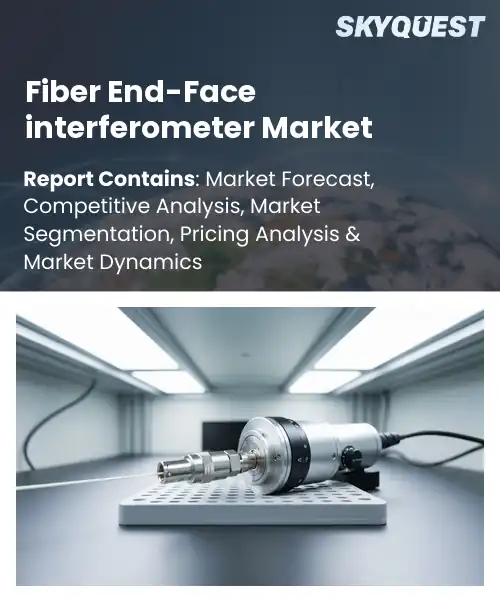
Fiber End-Face interferometer Market
Report ID: SQMIG20D2539
Report ID: SQMIG20D2539
[email protected]
USA +1 351-333-4748
Report ID:
SQMIG20D2539 |
Region:
Global |
Published Date: February, 2026
Pages:
157
|Tables:
121
|Figures:
77


Global Fiber End-Face Interferometer Market size was valued at USD 254.60 Million in 2024 and is poised to grow from USD 270.64 Million in 2025 to USD 441.22 Million by 2033, growing at a CAGR of 6.3% during the forecast period (2026-2033).
There is a steady rise in the global fiber end-face interferometer industry due to the increasing need in telecoms telecommunication and advanced industrial applications for accurate optical fibre inspection and measurement technologies. The end-face interferometer is a device which measures the geometry and surface quality of optical fibre connectors, including factors like radius of curvature, apex offset, and height of fibre. These types of measurements are critical to ensuring that optical signals can be reliably transmitted through optical fibre cabling and to prevent performance problems such as reflection and insertion loss. As the global infrastructure for optical communications is continuing to grow, telecom consumers and equipment manufacturers have increasingly utilized interferometric inspection equipment to support and maintain compliant quality standards in fibre optic connectors.
An additional factor influencing the fiber end-face interferometer market growth is the speed at which hyperscale data centres and the cloud computing infrastructure are expanding and the subsequent demand for highly dense fibre optic networks that support high speed data transfer. Minor defects on optical fibre connectors in these environments can result in performance degradation in networks, making accurate inspection tools a key requirement to ensure optimal functioning of the network and to reduce the amount of time the network is out of service.
How is AI Enhancing Measurement Accuracy in the Fiber End-face Interferometer Market?
AI is positively impacting the global fiber end-face interferometer market and will continue to provide improvements in fibre optic inspection and measurement through increasing the accuracy and productivity of those processes. Most interferometer systems performed the required tests by using a manual process to analyze connector geometry and surface defects. Unfortunately, this can be both time-consuming and susceptible to the user's errors. With the advent of AI-based image recognition systems and the integration of machine-learning algorithms into modern-day interferometers, today's instruments can be programmed to automatically analyze images of fibre end-faces. This increased level of automation allows manufacturers of optical fibre connectors and telecommunication carriers to speed up their quality-control processes, decrease inspection times, and consistently comply with international standards.
Market snapshot - (2026-2033)
Global Market Size
USD 254.6 Million
Largest Segment
Single-mode Systems
Fastest Growth
Specialized Systems
Growth Rate
6.3% CAGR
To get more insights on this market click here to Request a Free Sample Report
Global fiber end-face interferometer market is segmented into interferometer type, application area, end-users, sales channel, and region. Based on interferometer type, the market is segmented into single-mode systems, multi-mode systems, and specialized systems. Based on application area, the market is segmented into telecommunications, data centers, aerospace & defense, medical & healthcare devices, industrial manufacturing and others. Based on end-users, the market is segmented into telecommunication service providers, network & equipment manufacturers (OEMs), research laboratories & universities, healthcare & medical device makers, and aerospace & defense contractors. Based on sales channel, the market is segmented into direct sales and distributors. Based on region, the market is segmented into North America, Europe, Asia Pacific, Latin America and Middle East & Africa.
As per global fiber end-face interferometer market analysis, the single-mode systems segment leads because of the alignment between majorly long haul and metro fiber infrastructures. Original equipment manufacturers (OEMs) & service providers prefer single mode compatible interferometers, as they will lower the amount of insertion loss failures that occur with inconsistent connector qualifications. Thus, leading to an increased demand for the integration of precision metrology into manufacturing and field workflows across the fiber end-face interferometer market.
As per global fiber end-face interferometer market forecast, multi-mode systems have been rapidly growing due to the demand for cost-effective inspections on short reach enterprise and data center links. Innovative automated, high throughput interferometers that have been designed for use with multi-mode fiber and the explosion of multi-mode optical interconnects is allowing for volume testing and reducing testing costs. Thereby, opening the door for broader usage and new adoption opportunities.
As per global fiber end-face interferometer market outlook, the data centers segment is leading the market as rigorous connector and cable qualifications means that fast and repeatable interferometric measurements of the end face are essential for maintaining uptime and signal integrity. Operators and system integrators are looking for automated tools that can provide them with a consistent result and reduce their need for costly rework efforts. Therefore, there is an increased demand for inline and benchtop interferometers that are designed for these high-volume environments throughout the fiber end-face interferometer market.
On the other hand, there is growing interest in the medical & healthcare devices segment, which is the fastest growing due to the focus on patient safety and improving the quality of care. Through new technologies, continuing to drive demand for specialized Interferometers providing values for validating the clinical instruments sold into this Industry segment, as well as addressing the need for aftermarket service on these same products.
To get detailed segments analysis, Request a Free Sample Report
The fiber end-face interferometer market is being led by the Asia-Pacific region as a result of the area's extensive manufacturing capabilities, concentration of optical components, and rapid development of fiber networks across many different countries. The abundance of original equipment manufacturers and specialized suppliers of testing instruments also creates an environment conducive to innovative products at the local level.
Japan's fiber-end face interferometer market is characterized by high-precision manufacturing, large-scale research facilities for optics, and a large electronics slant that places a high level of importance on strict inspection standards. Manufacturers and research facilities located in Japan are working to develop answers to the demands of manufacturing compact, high-density products by developing solutions that meet the needs of how the components will be fabricated. Furthermore, the focus on quality control, certifications, and the integration of manufacturing systems with automated production lines enables manufacturers to implement product refinements within their service networks and with their original equipment manufacturers.
The South Korea end-face interferometer market benefits from its geographic proximity to semiconductor and LCD-manufacturing companies, its concentrated supply chain for electronics, and; photonic research centers located in the country. Domestic instrument manufacturers work with these manufacturing firms to provide automated mass inspection systems that are configured specifically for evaluating how a module assembly is manufactured. The focus on creating feedback loops, automation, and establishing quality standards for the products manufactured has encouraged manufacturers to implement the system throughout their manufacturing processes.
The fiber end-face interferometer market in North America is experiencing growth as it combines advanced research capabilities with high demand from telecommunication and a well-developed network of instrument manufacturers and system integrators. The aerospace, defence and precision electronics industries require high-performance solutions, increasing the need for versatile, automated inspection systems. Universities, private laboratories and commercial vendors are collaborating to speed up adoption of new approaches to metrology.
The fiber end-face interferometer market in the USA is supported by a strong foundation of telecommunication operators, hyper-scale data centre builders, and advanced manufacturing facilities that require stringent inspection protocols for production quality assurance. The instrumentation manufacturers and system integrator are concentrated on high-performance, modular systems that will integrate into automated production systems.
The fiber end-face interferometer market in canada leverages strong canadian academic research in photonics and telecommunication operators who are looking for a reliable method of inspecting and testing newly installed optical fibres. Vendors are focused on producing equipment that is portable and can be adapted for low volume production, as well as building partnerships that connect laboratory innovation to manufacturing applications. The availability of national testing agencies and services supports the calibration and validation of test equipment, while cross border collaboration with other markets provides access to advanced supply chains and contributes to future development of instrumentation.
The fiber end-face interferometer market in Europe benefits from collaborative industrial strategies, collaborative standards of development, and strong expertise in photonics and precision engineering. The development of regional clusters allows for collaboration between manufacturers of FEF instruments, automotive and telecommunications manufacturers (OEMs) to create rapid pathways from laboratory advances to fully developed, commercially viable inspection systems. Global buyers develop trust with suppliers based on a focus on interoperability, certification of measurement procedures and high levels of after-sales support. Cross border supply networks and public private partnerships are being built to support the scaling of specialized tooling and validation centres. Customization and sustainable practices will also drive tailored solutions required for high performance production environments while delivering long-term performance expectations.
The Germany market benefits from strong expertise in precision engineering and its connections to automotive and industrial manufacturer supply chains. Many of the local suppliers of FEF instruments have made it their primary focus to produce rugged, accurate instruments that can be integrated into automated production lines and inline metrology systems. As a result, suppliers have concentrated their efforts on creating certification and traceable measurement practices that can be supported by robust after sales service, enabling manufacturers to meet their strict quality requirements. Collaborative test centres and special service providers further enhance the ability of manufacturers to test and validate inspection technologies.
The fiber end-face interferometer market in the UK is propelled by an active research community in photonics, several specialized manufacturers of measurement instrumentation providing calibration provision services. Supplier focus, on functionality and modularity, software-based analysis, and compatibility with diverse production settings. The partnership between universities and industry assists in acceleration of developing inspection methodologies. The trade channels available for these solutions provide the necessary marketing support to enable solutions to be position for export globally. Manufacturers development of user-friendly interfaces and rapid integration will allow them to meet expectations on quality of optical components.
The fiber end-face interferometer market in France leverages highly developed research in photonics, specialized SMEs and strong connections to the telecommunications and aerospace industries that require optical measurements with a great deal of accuracy. The vendors in this market usually develop adaptable measurement instruments that may be manually used, laboratory validated and integrated into production cells. The focus placed on certification of measurement instruments and the provision of user training and aftersales service will help to increase manufacturers of measurement instruments adoption by industrial users. The development of partnerships across all manufacturing sectors and regional innovation centres will produce highly tailored measurement solutions and measurement expertise for the respective partner companies.
To know more about the market opportunities by region and country, click here to
Buy The Complete Report
Expansion of High-Speed Networks
Increased Demand for Precision Inspection in Manufacturing
High Equipment Costs and Complexity
Limited Skilled Technical Personnel
Request Free Customization of this report to help us to meet your business objectives.
The fiber end-face interferometer market share shows a moderately concentrated market structure. A few, specialized, optical measurement firms constitute a relatively large portion (albeit small compared to total revenues) of the overall revenue generated by this segment of the overall optical measurement systems industry. Some of the leading companies in the market, including Thorlabs, EXFO, and VIAVI Solutions, have collectively captured a significant market share based upon their extensive experience.
SkyQuest’s ABIRAW (Advanced Business Intelligence, Research & Analysis Wing) is our Business Information Services team that Collects, Collates, Correlates, and Analyses the Data collected by means of Primary Exploratory Research backed by robust Secondary Desk research.
As per SkyQuest analysis, the global fiber end-face interferometer market is propelled primarily by the proliferation of high-speed optical links driving demand for precise connector inspection and alignment. A restraint is high equipment costs and operational complexity that hinder adoption among smaller labs and field service providers. The dominating region is Asia Pacific supported by concentrated optical manufacturing and rapid fiber infrastructure deployment, and the dominating segment is single-mode systems driven by long-haul and metro network precision needs. A second driver is the move toward automation, and AI enabled inline inspection which boosts throughput, repeatability and predictive maintenance, opening opportunities for portable and cloud connected solutions.
| Report Metric | Details |
|---|---|
| Market size value in 2024 | USD 254.6 Million |
| Market size value in 2033 | USD 441.22 Million |
| Growth Rate | 6.3% |
| Base year | 2024 |
| Forecast period | (2026-2033) |
| Forecast Unit (Value) | USD Million |
| Segments covered |
|
| Regions covered | North America (US, Canada), Europe (Germany, France, United Kingdom, Italy, Spain, Rest of Europe), Asia Pacific (China, India, Japan, Rest of Asia-Pacific), Latin America (Brazil, Rest of Latin America), Middle East & Africa (South Africa, GCC Countries, Rest of MEA) |
| Companies covered |
|
| Customization scope | Free report customization with purchase. Customization includes:-
|
To get a free trial access to our platform which is a one stop solution for all your data requirements for quicker decision making. This platform allows you to compare markets, competitors who are prominent in the market, and mega trends that are influencing the dynamics in the market. Also, get access to detailed SkyQuest exclusive matrix.
Table Of Content
Executive Summary
Market overview
Parent Market Analysis
Market overview
Market size
KEY MARKET INSIGHTS
COVID IMPACT
MARKET DYNAMICS & OUTLOOK
Market Size by Region
KEY COMPANY PROFILES
Methodology
For the Fiber End-Face interferometer Market, our research methodology involved a mixture of primary and secondary data sources. Key steps involved in the research process are listed below:
1. Information Procurement: This stage involved the procurement of Market data or related information via primary and secondary sources. The various secondary sources used included various company websites, annual reports, trade databases, and paid databases such as Hoover's, Bloomberg Business, Factiva, and Avention. Our team did 45 primary interactions Globally which included several stakeholders such as manufacturers, customers, key opinion leaders, etc. Overall, information procurement was one of the most extensive stages in our research process.
2. Information Analysis: This step involved triangulation of data through bottom-up and top-down approaches to estimate and validate the total size and future estimate of the Fiber End-Face interferometer Market.
3. Report Formulation: The final step entailed the placement of data points in appropriate Market spaces in an attempt to deduce viable conclusions.
4. Validation & Publishing: Validation is the most important step in the process. Validation & re-validation via an intricately designed process helped us finalize data points to be used for final calculations. The final Market estimates and forecasts were then aligned and sent to our panel of industry experts for validation of data. Once the validation was done the report was sent to our Quality Assurance team to ensure adherence to style guides, consistency & design.
Analyst Support
Customization Options
With the given market data, our dedicated team of analysts can offer you the following customization options are available for the Fiber End-Face interferometer Market:
Product Analysis: Product matrix, which offers a detailed comparison of the product portfolio of companies.
Regional Analysis: Further analysis of the Fiber End-Face interferometer Market for additional countries.
Competitive Analysis: Detailed analysis and profiling of additional Market players & comparative analysis of competitive products.
Go to Market Strategy: Find the high-growth channels to invest your marketing efforts and increase your customer base.
Innovation Mapping: Identify racial solutions and innovation, connected to deep ecosystems of innovators, start-ups, academics, and strategic partners.
Category Intelligence: Customized intelligence that is relevant to their supply Markets will enable them to make smarter sourcing decisions and improve their category management.
Public Company Transcript Analysis: To improve the investment performance by generating new alpha and making better-informed decisions.
Social Media Listening: To analyze the conversations and trends happening not just around your brand, but around your industry as a whole, and use those insights to make better Marketing decisions.
REQUEST FOR SAMPLE
 REQUEST FREE CUSTOMIZATION
Global Fiber End-Face Interferometer Market size was valued at USD 254.6 Million in 2024 and is poised to grow from USD 270.64 Million in 2025 to USD 441.22 Million by 2033, growing at a CAGR of 6.3% during the forecast period (2026-2033).
Competition in the global fiber end face interferometer market is concentrated among established test and measurement firms and specialized optics OEMs, with recent consolidation and vertical integration shaping supplier capabilities; companies are pursuing targeted acquisitions to add PIC and automated testing capabilities and partnering with contract manufacturers to embed interferometric inspection in production lines, while product innovation focuses on faster automated scanning and multiport handling. Search summary: I reviewed vendor product pages, recent acquisition announcements and industry reports to identify startups founded 2019 or later that commercialize fiber end face interferometers and found none that could be verified; the market activity instead shows incumbents expanding by acquisition, product innovation and partnerships. 'Thorlabs', 'Newport Corporation', 'ZYGO Corporation', 'Veeco Instruments Inc.', 'Keysight Technologies', 'OptoTest Corporation', 'EXFO Inc.', 'Agilent Technologies', 'NKT Photonics', 'Lumentum Operations LLC', '3M Company', 'Fiberon Technologies', 'JDS Uniphase Corporation (Lumentum)', 'FemtoTools AG', 'Corning Incorporated', 'VIAVI Solutions Inc.', 'OptiFibre', 'Hewelett Packard Enterprise', 'Anritsu Corporation', 'Spirent Communications'
Rapid expansion of high speed fiber networks increases the need for reliable end face assessment to ensure signal integrity and reduce connection losses during deployment and maintenance. End face interferometers enable precise inspection and alignment, supporting service providers and installers in validating connector quality and preventing field failures. By facilitating consistent quality assurance practices across installations and supporting faster fault isolation, these tools become essential in deployment workflows, encouraging procurement by network builders and technicians and thereby driving market demand for interferometric inspection solutions.
Automation Integration: Demand for higher throughput and repeatability in fiber optic production and field deployments is encouraging integration of end-face interferometers into automated inspection and assembly lines. Manufacturers and service providers value instruments that support programmable measurements, remote monitoring, and seamless data exchange with production management systems, enabling consistent quality control with reduced human intervention. This trend nurtures partnerships between optical test equipment makers and automation vendors, and expands use cases from laboratory validation to continuous inline inspection across manufacturing and network rollout environments.
Why does Asia Pacific Dominate the Global Fiber End-Face interferometer Market? |@12


Want to customize this report? This report can be personalized according to your needs. Our analysts and industry experts will work directly with you to understand your requirements and provide you with customized data in a short amount of time. We offer $1000 worth of FREE customization at the time of purchase.
Feedback From Our Clients


 USA (+1) 351-333-4748

