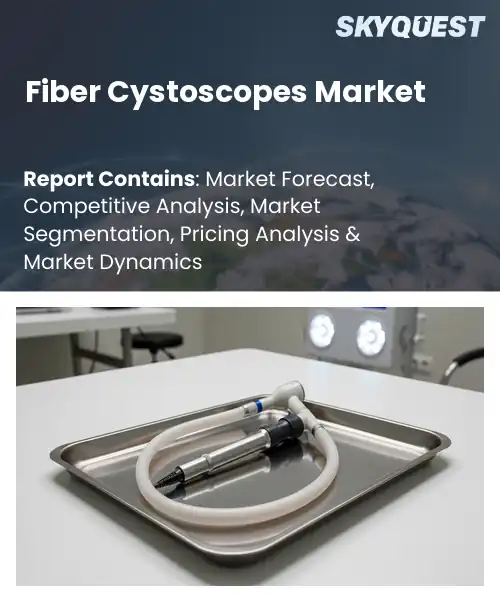
Fiber Cystoscopes Market
Report ID: SQMIG35A3335
Report ID: SQMIG35A3335
[email protected]
USA +1 351-333-4748
Report ID:
SQMIG35A3335 |
Region:
Global |
Published Date: March, 2026
Pages:
157
|Tables:
114
|Figures:
77


Global Fiber Cystoscopes Market size was valued at USD 971.0 Million in 2024 and is poised to grow from USD 1038.0 Million in 2025 to USD 1770.18 Million by 2033, growing at a CAGR of 6.9% during the forecast period (2026-2033).
Key Takeaways: Market Trends & Insights
Growing prevalence of urological disorders, increasing demand for minimally invasive diagnostic procedures, rising aging population, advancements in endoscopic technologies, and emphasis on early disease detection are driving sales of fiber cystoscopes.
In comparison with digital cystoscopy technologies, the fiber cystoscope represents an effective solution from a cost perspective, thus enabling the device to be deployed in developed and developing medical care markets. The relatively low initial investment helps in expanding the availability of routine procedures like bladder cancer monitoring and urology checks, which helps in decreasing waiting periods and patient admission rates. Moreover, the high demand in less developed countries, where the price issue is crucial, is also facilitating adoption. Growing burden of bladder cancer, urinary tract infections, and other urological conditions coupled with a shift toward less invasive diagnostic approaches is expected to primarily drive fiber cystoscopes market growth.
On the contrary, limited image quality compared to digital systems, risk of device wear and tear, infection control challenges with reusable devices, high maintenance requirements, and growing competition from advanced digital cystoscopy technologies are slated to impede fiber cystoscopes market penetration going forward.
How is AI Improving Diagnostic Accuracy in the Fiber Cystoscopes Market?
With advancements in AI, the accuracy in diagnosis through fiber cystoscopes is enhancing due to real-time video analysis, automatic detection of lesions, and standardization of decision-making processes. There is a trend of incorporating AI technology in both reusable and disposable fiber scopes. This would help provide better diagnostic solutions and improve consistency in health facilities. Frame-by-frame image processing for identifying abnormal tissues, image enhancement for detecting abnormal images, and AI models that are trained with curated cystoscopy images to minimize variability among physicians will soon become popular.
In January 2026, Intelligent Scopes Corp. received regulatory clearance in Singapore for CystoSmart. This system integrates AI with flexible and single-use cystoscopes to highlight tumors in real time and assist clinicians during follow-up procedures. Its device-agnostic approach makes AI adoption easier and improves efficiency in clinical practice.
Market snapshot - 2026-2033
Global Market Size
USD 971.0 Million
Largest Segment
Flexible Cystoscopes
Fastest Growth
Flexible Cystoscopes
Growth Rate
6.9% CAGR
To get more insights on this market click here to Request a Free Sample Report
Global fiber cystoscopes market is segmented by product type, end-user, application, distribution channel, and region. Based on product type, the market is segmented into flexible cystoscopes and rigid cystoscopes. Based on end-user, the market is segmented into hospitals, ambulatory surgical centers, and specialty clinics. Based on application, the market is segmented into diagnostic procedures and therapeutic procedures. Based on distribution channel, the market is segmented into direct sales and third-party distributors. Based on region, the market is segmented into North America, Europe, Asia Pacific, Latin America, and Middle East & Africa.
The flexible cystoscopes segment is projected to lead the global fiber cystoscopes market revenue generation through 2033. Preference for superior maneuverability and patient comfort among patients and clinicians is enabling high adoption of these cytoscopes for diagnostic and therapeutic procedures. The manufacturers’ efforts towards improving their products through sterilization techniques and training have made the institutions favor their purchase. The devices are also helpful in simplifying procedures and making them possible even as outpatient operations.
However, rigid cystoscopes are emerging as the fastest growing segment as per this fiber cystoscopes market forecast. Renewed interest in durable optics for complex therapeutic interventions and stronger instrument stability for tissue manipulation is creating new opportunities. Their growth is propelled by specialty procedure demand and procurement cycles favoring durable, procedure-specific instruments.
The third-party distributors segment is expected to account for the highest global fiber cystoscopes market share going forward. Extensive channel reach and logistical efficiency, enable broad product availability across diverse care settings, which has helped this segment hold sway over others. Better training and customer services along with good inventory management will also help reduce barriers of entry for vendors and promote rapid acceptance by different end-users. The networking approach employed in their sales model allows for scalability in ensuring regular penetration into the market and familiarity among clinicians.
In contrast, direct sales represent the fastest-growing distribution channel because of manufacturers’ drive for direct connections to secure margins, provide specialized training, and facilitate online ordering. This results in closer collaboration with doctors, more frequent product iterations, and package deals that expedite market penetration and generate additional income streams.
To get detailed segments analysis, Request a Free Sample Report
Advanced healthcare infrastructure, strong clinical expertise, and concentrated industry presence allows North America to lead the global sales of fiber cystoscopes. The presence of strong regulations concerning cystoscopy equipment and a robust system of reimbursement for cystoscopy procedures allows manufacturers to quickly implement new technologies and develop more skilled trained clinicians that perform cystoscopy exams. A strong presence of major manufacturers with regional headquarters and representatives that manufacture, distribute, and service their products and equipment in North America guarantees availability of products and service after the sale. Collaboration between clinical opinion leaders and manufacturers has resulted in significant advances in technology and the ability to measure clinical outcomes to build trust in both end users and manufacturers. New services and/or partnership opportunities offered by service providers allow for better lifecycle management of products and flexibility with procurement, further strengthening North America's position as the primary global market hub.
The high concentration of medical channels and adoption of the device by specialists contributes to the leading position of the United States in fiber cystoscope sales in this market segment. Academic hospitals and large urology clinics pilot the latest cystoscopy tools, creating case scenarios that facilitate the adoption process. Successful channel management and efficient service activities reduce downtime and handle complex purchasing processes, while payment mechanisms create opportunities to fund training and renewal programs.
Healthcare procurement processes and centralization of purchase plans focused on life cycle management play a critical role in determining the fiber cystoscopes market trends in Canada. Collaborative efforts between clinical networks and equipment producers enable more effective training of clinicians as well as development of advanced technology. Value-based approach and knowledge dissemination ensure sustainable adoption of fiber cystoscopes. Provincial hospitals and specialty clinics target the procurement of durable cystoscope devices.
Emphasis on clinical innovation, strong hospital networks, and collaborative health technology assessment drives high demand for fiber cystoscopes across Europe. Regional manufacturers and specialized distributors have established local services, while pan-European collaborations and registries provide case studies to advance adoption through evidence-based procurement methods. Together with the focus on minimally invasive procedures, a growing emphasis on the patient experience, and efforts aimed at standardizing procedures in urology have contributed to this trend. Variability in reimbursement methods and purchasing systems will influence the rate of growth between countries; however, the wide spectrum of services available for evidence-based procurement and clinician involvement will continue to benefit throughout Europe.
The adoption process by hospitals and cooperation between clinical research centers and the private sector are determining the demand for fiber cystoscopes in Germany. German companies are well-known for their reliable technical support and fast maintenance service. Technology evaluations and purchasing involve comparative effectiveness analysis to ensure procurement of the fiber cystoscope device that is proven effective. Demand for fiber cystoscopes arises from dedicated urology departments that need clinically proven devices and high-quality service agreements.
Expanding outpatient services and a strong culture of clinical innovation among urology specialists helps boost adoption of fiber cystoscopes across the United Kingdom. Purchasing from the public and private sectors is gradually becoming more receptive to value-driven products, while training sessions initiated by industry stakeholders boost clinician comfort levels. Growing instances of outpatient procedures and specialty hospitals generate increased interest in cystoscopy equipment that improves both patient and procedural satisfaction.
Regional hospital networks and specialty clinics modernizing urology services support consistent demand for fiber cystoscopes. Societies of clinicians and educational programs make doctors familiar with the technology, while partnerships between distributors and hospital chains ensure wider availability. The process of procurement involves finding a compromise between the quality of equipment and costs, encouraging the purchase of cystoscopy systems that require minimal maintenance.
Emphasis on technological innovation, growing clinical capability, and expanding manufacturing and service ecosystems are supporting high demand for fiber cystoscopes in Asia Pacific. A renewed focus on minimally invasive urology care along with increased access to specialists in urology has further created opportunities for the usage of fiber cystoscopes in more locations than just major cities. The regulatory harmonization efforts and collaborative approach taken to design, manufacture and deliver new devices will help provide better market access for new companies wanting to enter the fiber cystoscope market. The ability to produce devices at a lower cost, and the ability of companies to develop adaptable products that fit within different regional clinical workflows, will allow manufacturers to sell more devices to their local markets and improve their ability to export products made in the Asia Pacific region. Development of new training initiatives and the establishment of partnerships between hospitals and manufacturers will help further stimulate practical usage of fiber cystoscopes in hospitals throughout the Asia Pacific region and build long-term resilience in the fiber cystoscope market on a regional basis. Japan and South Korea are at the forefront of device development and creating clinical evidence.
Robust domestic device innovation, rigorous clinical evaluation and a well-established network of specialist centers are supporting high demand for fiber cystoscopes in Japan. Hospitals work alongside manufacturers in improving performance and establishing clinical validation for their products to earn the trust of clinicians. The focus on high standards of engineering in cystoscopy systems creates demand for robust platforms, while the existence of excellent service support facilitates a clinical approach and purchasing criteria.
Strong manufacturing capabilities, focused clinical research, and industry collaborations support steady sales of fiber cystoscopes in South Korea. Hospitals organize educational programs and trainings demonstrating benefits, while distributors provide efficient maintenance services. Thus, manufacturers have created a system where fiber cystoscopes can be easily used in South Korea and exported in other regions. Manufacturers create efficient cystoscopy systems based on preferences of physicians and their performance.
To know more about the market opportunities by region and country, click here to
Buy The Complete Report
Advancements In Optical Imaging
Progress in fiber optics technology as well as advances in image processing has significantly helped in improving visibility during the process of cystoscopy allowing better visualization of the changes in the bladder lining. Better visualization makes diagnosis more certain and encourages the use of fiber cystoscopes by physicians who require a trusted device for endoscopic examination. Better optics make the devices more valuable to physicians as well as healthcare institutions. This leads to increased purchases of the devices as well as greater market acceptance of the technology.
Growing Adoption Of Minimally Invasive Procedures
With the rising trend of minimally invasive procedures within the urology field, there is an inclination towards the need for devices that provide both comfort and accuracy in diagnosing and treating patients. Due to their portable and flexible nature, fiber cystoscopes are compatible with ambulatory settings, which makes them an ideal choice for situations where minimally invasive methods take precedence. Compatibility fosters procurement in favor of fiber cystoscopes, as well as training for urologists and the development of a growing demand for them.
High Cost Of Disposable Components
Both the perceived and real expenses involved with disposable parts and maintenance of the device may discourage hospitals and medical centers from purchasing fiber cystoscopes, especially when budgets are limited and purchasing must focus on economic feasibility. The increasing cost related to using disposable parts or regularly replacing parts would pose questions regarding the sustainability of such a product and its value for money. This could lead to hesitation in making the purchase decision, which ultimately hurts the global fiber cystoscopes market outlook.
Limited Availability Of Skilled Operators
Constraints in qualified personnel and specialized operating techniques could hinder the application of the fiber cystoscope as clinics could lack physicians well versed in using the instrument and interpreting the endoscopic images. The need for continuous education and maintenance of competence in order to operate this instrument effectively could lead to adoption delays in organizations with little available time or funds for such endeavors, and instead they could opt to buy instruments that do not require much training to use.
Request Free Customization of this report to help us to meet your business objectives.
The competitive landscape for global fiber cystoscopes is tightening as incumbents and new entrants battle on single-use platforms, adjunct imaging and AI. Notable tactics include targeted acquisitions to broaden urology portfolios, distribution and GPO contracts to secure clinic access, and novel imaging approvals that challenge legacy fiber optics; examples include Ambu’s urology contract and single-use rollouts, Creo Medical’s Albyn Medical acquisition, and OCT imaging advances from new entrants.
SkyQuest’s ABIRAW (Advanced Business Intelligence, Research & Analysis Wing) is our Business Information Services team that Collects, Collates, Correlates, and Analyses the Data collected by means of Primary Exploratory Research backed by robust Secondary Desk research.
As per SkyQuest analysis, rising prevalence of urological disorders, increasing demand for minimally invasive diagnostic procedures, and growing adoption of cost-effective endoscopic solutions are anticipated to drive the demand for fiber cystoscopes going forward. However, limited image quality compared to digital systems, risk of device wear and tear, infection control concerns, and high maintenance requirements are slated to slow down the adoption of fiber cystoscopes in the future. North America is slated to spearhead the demand for fiber cystoscopes owing to the strong presence of advanced healthcare infrastructure, high volume of urological procedures, and early adoption of innovative diagnostic technologies. Integration of AI-assisted imaging, development of single-use cystoscopes, and advancements in image enhancement technologies are anticipated to be key trends driving the fiber cystoscopes industry over the coming years.
| Report Metric | Details |
|---|---|
| Market size value in 2024 | USD 971.0 Million |
| Market size value in 2033 | USD 1770.18 Million |
| Growth Rate | 6.9% |
| Base year | 2024 |
| Forecast period | 2026-2033 |
| Forecast Unit (Value) | USD Million |
| Segments covered |
|
| Regions covered | North America (US, Canada), Europe (Germany, France, United Kingdom, Italy, Spain, Rest of Europe), Asia Pacific (China, India, Japan, Rest of Asia-Pacific), Latin America (Brazil, Rest of Latin America), Middle East & Africa (South Africa, GCC Countries, Rest of MEA) |
| Companies covered |
|
| Customization scope | Free report customization with purchase. Customization includes:-
|
To get a free trial access to our platform which is a one stop solution for all your data requirements for quicker decision making. This platform allows you to compare markets, competitors who are prominent in the market, and mega trends that are influencing the dynamics in the market. Also, get access to detailed SkyQuest exclusive matrix.
Table Of Content
Executive Summary
Market overview
Parent Market Analysis
Market overview
Market size
KEY MARKET INSIGHTS
COVID IMPACT
MARKET DYNAMICS & OUTLOOK
Market Size by Region
KEY COMPANY PROFILES
Methodology
For the Fiber Cystoscopes Market, our research methodology involved a mixture of primary and secondary data sources. Key steps involved in the research process are listed below:
1. Information Procurement: This stage involved the procurement of Market data or related information via primary and secondary sources. The various secondary sources used included various company websites, annual reports, trade databases, and paid databases such as Hoover's, Bloomberg Business, Factiva, and Avention. Our team did 45 primary interactions Globally which included several stakeholders such as manufacturers, customers, key opinion leaders, etc. Overall, information procurement was one of the most extensive stages in our research process.
2. Information Analysis: This step involved triangulation of data through bottom-up and top-down approaches to estimate and validate the total size and future estimate of the Fiber Cystoscopes Market.
3. Report Formulation: The final step entailed the placement of data points in appropriate Market spaces in an attempt to deduce viable conclusions.
4. Validation & Publishing: Validation is the most important step in the process. Validation & re-validation via an intricately designed process helped us finalize data points to be used for final calculations. The final Market estimates and forecasts were then aligned and sent to our panel of industry experts for validation of data. Once the validation was done the report was sent to our Quality Assurance team to ensure adherence to style guides, consistency & design.
Analyst Support
Customization Options
With the given market data, our dedicated team of analysts can offer you the following customization options are available for the Fiber Cystoscopes Market:
Product Analysis: Product matrix, which offers a detailed comparison of the product portfolio of companies.
Regional Analysis: Further analysis of the Fiber Cystoscopes Market for additional countries.
Competitive Analysis: Detailed analysis and profiling of additional Market players & comparative analysis of competitive products.
Go to Market Strategy: Find the high-growth channels to invest your marketing efforts and increase your customer base.
Innovation Mapping: Identify racial solutions and innovation, connected to deep ecosystems of innovators, start-ups, academics, and strategic partners.
Category Intelligence: Customized intelligence that is relevant to their supply Markets will enable them to make smarter sourcing decisions and improve their category management.
Public Company Transcript Analysis: To improve the investment performance by generating new alpha and making better-informed decisions.
Social Media Listening: To analyze the conversations and trends happening not just around your brand, but around your industry as a whole, and use those insights to make better Marketing decisions.
REQUEST FOR SAMPLE
 REQUEST FREE CUSTOMIZATION
Global Fiber Cystoscopes Market size was valued at USD 971.0 Million in 2024 and is poised to grow from USD 1038.0 Million in 2025 to USD 1770.18 Million by 2033, growing at a CAGR of 6.9% during the forecast period (2026-2033).
The competitive landscape for global fiber cystoscopes is tightening as incumbents and new entrants battle on single-use platforms, adjunct imaging and AI. Notable tactics include targeted acquisitions to broaden urology portfolios, distribution and GPO contracts to secure clinic access, and novel imaging approvals that challenge legacy fiber optics; examples include Ambu’s urology contract and single-use rollouts, Creo Medical’s Albyn Medical acquisition, and OCT imaging advances from new entrants. 'Olympus Corporation', 'Karl Storz SE & Co. KG', 'Boston Scientific Corporation', 'Richard Wolf GmbH', 'Medtronic plc', 'Stryker Corporation', 'Conmed Corporation', 'Urotec AG', 'American Medical Systems, Inc.', 'Hoya Corporation', 'Baxter International Inc.', 'Merit Medical Systems, Inc.', 'Teleflex Incorporated', 'Puma Biotechnology, Inc.', 'Fresenius SE & Co. KGaA', 'C.R. Bard, Inc.', 'Endo International plc', 'Aqueous Surgical Corporation', 'Surna Inc.', 'ENDOLOGIX, INC.'
Advances in fiber optic design and image processing have markedly improved visualization during cystoscopic procedures, enabling clearer identification of bladder mucosal abnormalities and facilitating more confident clinical decision making. Enhanced image quality reduces diagnostic uncertainty and supports wider clinical adoption of fiber cystoscopes by physicians seeking reliable tools for endoscopic evaluation. Improved optics also contribute to perceived value by clinicians and healthcare facilities, encouraging procurement and integration into urology practice, which in turn supports market demand and broader acceptance among care providers.
Digital Imaging Integration: The market is increasingly shaped by integration of high-resolution imaging with cystoscopes, enabling improved visualization, image documentation, and interoperability with hospital information systems. Manufacturers focus on enhancing digital capture, image archiving, and seamless transfer to electronic records, while enabling remote review and multidisciplinary collaboration. This trend supports clinical decision-making, facilitates training and quality assurance, and raises demand for devices compatible with advanced endoscopy platforms and software ecosystems, encouraging partnerships between device makers and health IT providers globally.
North America Dominate the Global Fiber Cystoscopes Market.
The market is segmented by product type (flexible fiber cystoscopes, rigid cystoscopes), application (urology, gynecology), end user (hospitals, ambulatory surgical centers, diagnostic clinics), and region.
AI is contributing to advancements in fiber cystoscopy by improving imaging quality, assisting in real-time diagnosis, and enhancing procedural precision through integration with advanced endoscopic and urology technologies. These innovations support better visualization and efficiency in diagnostic and therapeutic procedures.


Want to customize this report? This report can be personalized according to your needs. Our analysts and industry experts will work directly with you to understand your requirements and provide you with customized data in a short amount of time. We offer $1000 worth of FREE customization at the time of purchase.
Feedback From Our Clients


 USA (+1) 351-333-4748

