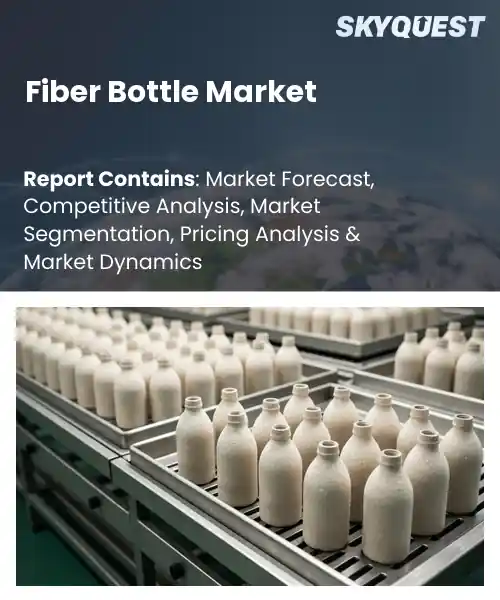
Fiber Bottle Market
Report ID: SQMIG15H2187
Report ID: SQMIG15H2187
[email protected]
USA +1 351-333-4748
Report ID:
SQMIG15H2187 |
Region:
Global |
Published Date: March, 2026
Pages:
157
|Tables:
89
|Figures:
77


Global Fiber Bottle Market size was valued at USD 3.00 Billion in 2024 and is poised to grow from USD 3.19 Billion in 2025 to USD 5.20 Billion by 2033, growing at a CAGR of 6.3% during the forecast period (2026-2033).
The global fiber bottle market growth is driven because businesses adopt environmentally friendly practices, and funding needs. The protective-coated fiber bottles which use wood pulp or molded fiber as their base material provide a resource-efficient choice to replace plastic and aluminum products because they enable superior recycling processes. The category progressed through the last decade from its initial stage into pilot production, which included the paper bottle company and major beverage and personal care companies working together to assess their bottle designs.
Scalable manufacturing with barrier innovation drives fiber bottle market expansion because companies create reliable molding processes with recyclable coatings, which enable their products to meet food-safety standards and shelf-life requirements. The pilot projects in the industry lead to increased funding which results in reduced manufacturing expenses that enable fiber bottles to match plastic pricing. Retailers look for paper-based solutions because regulatory requirements such as extended producer responsibility and plastics taxes drive product demand in the market. Real-world use cases include pilot beverage, and personal care launches where sustainable claims boost brand value, creating a feedback loop that expands applications into non-carbonated drinks and beauty products.
How is IoT Enhancing Supply Chain Transparency in the Fiber Bottle Market?
The IoT system enhances transparency for the fiber bottle industry because it connects physical materials and production steps with ongoing digital documentation. The system contains three main components: track the origin of fiber through integrated sensors and RFID, monitor the status of materials during pulping and forming, and use cloud-based analytics to identify progress violations. The current state shows manufacturers and brand owners using these tools to verify sustainable sourcing and ensure consistent barrier and coating quality. The system establishes transparent audit processes from forest to finished bottle while it provides trustworthy return and recycling data, which enhances supply chain management through better control and security.
Market snapshot - 2026-2033
Global Market Size
USD 3.0 Billion
Largest Segment
Blow Molding
Fastest Growth
Blow Molding
Growth Rate
6.3% CAGR
To get more insights on this market click here to Request a Free Sample Report
The global fiber bottle market is segmented based on production technology, material type, end use, and region. By production technology, the market is categorized into injection molding and blow molding. In terms of material type, it is divided into plant-based fiber, synthetic fiber, and recycled fiber. Based on end use, the market includes food and beverages, personal care products, and other applications. Geographically, the market is segmented into North America, Europe, Asia Pacific, Latin America, and the Middle East and Africa.
As per the global fiber bottle market analysis, the Injection molding segment leads the market because manufacturers prefer its advanced technology which creates precise fiber bottle parts that maintain uniform wall thickness throughout the production process, which leads to better product quality and reduced material waste. The process enables the simultaneous application of barrier layers with thin-walled designs, which protect product integrity while its high production consistency reduces production expenses and facilitates manufacturing expansion. The operational benefits drive OEMs to adopt the technology, which leads to supplier investments and faster market entry for fiber-based packaging products.
However, the strongest market growth currently occurs in blow molding because it provides the best method for producing hollow and lightweight fiber bottles, which enables companies to quickly develop new products and create different bottle styles. The combined effects of improved mold design and compatible fiber blend together with increased demand for reusable and refillable formats, which create new market opportunities, boost business growth through expanded product ranges.
According to the global fiber bottle market forecast, the plant-based fiber segment leads the market because natural materials enable brands to create sustainable products that reduce their need for fossil fuel resources. The superior biodegradability of plant-based fiber bottles together with their natural material appeal drives retailers and manufacturers to invest in supply chain agricultural development and customized processing methods. The three main factors which enable companies to sustain their market dominance include consumer product demand together with bio-based solution regulatory support and the industry supply chain response.
The recycled fiber category will dominate the fiber bottle market because its advanced purification and decontamination methods deliver safe food contact for recycled fibers. The combination of corporate circular economy goals and procurement requirements raises demand, while processing advancements reduce operational expenses and enable companies to establish closed-loop systems, thus driving market growth and creating new partnerships with suppliers and brands.
To get detailed segments analysis, Request a Free Sample Report
As per the fiber bottle market regional forecast, European countries maintain their top position in the sector because of three factors which include regulatory requirements that promote sustainable packaging practices, developed recycling systems, and consumer demand for products which have minimal environmental impact. The top manufacturers together with new startups work together with material scientists and converters to develop better fiber-based products which serve as alternatives to standard plastics. The established supply chains combined with the packaging converter sites enable swift transitions from pilot projects to commercial production.
The food and beverage and personal care industries choose fiber bottles to establish their unique brand identity and fulfill their social accountability commitments while trade groups and standard organizations assist product launch through their certification and guideline systems. Europe achieves dominance in circular economy investments because of its extensive support for public-private initiatives which establish a system that combines design elements with material recycling and market distribution capability.
Germany Fiber Bottle Market
The German fiber bottle sector combines advanced paper and packaging engineering expertise with strong industrial design capabilities which enable companies to develop pilot projects and scalable production tests. The material validation and end-use qualification process are accelerated by joint efforts between brand owners and converters and research institutions. The two systems which operate together in the circular economy support sustainability goals through their recycling programs and policy incentives while consumer awareness together with premium brand adoption creates favorable demand conditions for fiber-based packaging in beverage and personal care products.
United Kingdom Fiber Bottle Market
The United Kingdom fiber bottle industry obtains benefits from its strong design-led consumer brand base and active startup system which both work to develop sustainable packaging options. The material innovators together with converters and retailers from various industries form partnerships to test fiber bottle ideas through their barrier system development process. Retailers and government regulations drive adoption through their support of recyclability education, which helps consumers understand product performance. The elements which exist in this environment create a space where businesses can develop new products and establish their unique brand identities.
France Fiber Bottle Market
The fiber bottle market trends in France uses its design heritage and premium packaging aesthetics to create interest in its fiber bottle products. The material scientists and converters and luxury brands work together to develop new finishing techniques and functional barrier systems. Consumer acceptance of products increases through distributor and retailer programs and their environmental initiatives. France serves as a testing site for fiber-based beverage and care packaging because its combination of artisanal design methods and industrial packaging systems creates an ideal environment for testing.
The fiber bottle market in North America experiences fast growth because of three factors which include retailer sustainability commitments, rising interest in alternative packaging options, and private sector funding which supports the development of commercial conversion methods. Companies that operate in the beverage and personal care markets prefer to launch products which use renewable and recyclable packaging formats. The technical challenges associated with shelf-stable applications decrease when barrier coatings and lamination technologies advance through supply chain partnerships between material suppliers and converters.
The consumer demand for fiber bottles increases when retailers offer products with visible sustainability attributes because customers seek less plastic usage. Collaborative innovation platforms in conjunction with supportive procurement practices help supply chains reach alignment which accelerates product launch and market entry at retail stores. The manufacturing cluster development and municipal circularity programs establish local supply chains which help decrease freight costs through enhanced logistical efficiency.
United States Fiber Bottle Market
The United States fiber bottle market develops commercially through the sustainable packaging practices which major retailers and national brands follow to conduct pilot tests throughout their operations. The conversion equipment and barrier technology scale-up process receives financing from venture capital and corporate investors while industry consortia develop standards to facilitate supply chain integration. The two factors which exist in this ecosystem drive demand for sustainable packaging products because consumers prefer brands which make sustainability claims while retailers select products based on these sustainability claims.
Canada Fiber Bottle Market
The Canadian fiber bottle market develops through three groups which include converters and sustainable packaging startups and retailers who all want to decrease plastic packaging use. The two systems which operate together in the circular economy support sustainability goals through their recycling programs and policy incentives while consumer awareness together with premium brand adoption creates favorable demand conditions for fiber-based packaging in beverage and personal care products.
The two systems which operate together in the circular economy support sustainability goals through their recycling programs and policy incentives while consumer awareness together with premium brand adoption creates favorable demand conditions for fiber-based packaging in beverage and personal care products. The system enables the transition between prototype development and the production of market-ready fiber bottle designs which apply to beverage and personal care products.
The fiber bottle market share in Asia Pacific develops through focused financial support for material science research and establishment of domestic manufacturing plants and joint ventures between local producers and international technology partners. Premium beverage brands and quick-service restaurants want to test new products to serve their regional customer needs. New barrier coating technologies and new processing techniques enable product development which meets the requirements of humid environments and multiple distribution systems.
Markets which have industrial policies that support business operations and markets which have increased supplier networks and rapid technological progress enable businesses to bring their products to market. The sustainability implementation studies from advanced economies plus the worldwide sustainability pathway studies help link regional rules with both business and environmental needs.
Japan Fiber Bottle Market
The fiber bottle market in Japan develops fiber bottle products through advanced materials research and precision manufacturing which matches high quality and safety standards. The three groups of academia and converters, and existing packaging companies cooperate to study barrier performance together with sensory attributes which local consumers find important. Beverage and personal care brands prefer minimalist packaging designs which provide premium presentations and retailers help brands create better fiber bottle designs through their testing process which moves designs toward marketable fiber bottle products.
South Korea Fiber Bottle Market
The fiber bottle market in South Korea develops its fiber bottle products through its strong packaging innovation culture which establishes direct ties between material developers and converters and design studios. Premium eco-friendly packaging needs consumer demand through its two main product requirements which include functional performance and refined aesthetic appearance. Retailers and e-commerce businesses create fast feedback systems which enable testing new ideas while local manufacturers use their flexible processes to develop efficient production methods. South Korea demonstrates flexible adoption of fiber bottle solutions which maximize operational benefits.
To know more about the market opportunities by region and country, click here to
Buy The Complete Report
Growing Demand for Sustainable Packaging
Regulatory Push For Plastic Reduction
High Production And Processing Costs
Limited Recycling Infrastructure Support
Request Free Customization of this report to help us to meet your business objectives.
The global fiber bottle market competes through brand partnerships, licensing agreements, and capital funding, which drive business growth. The Pulpex company uses a funding strategy and licensing method to start its commercial production process. Paboco created a consortium with major FMCG brands and suppliers to develop paper bottle technology for industrial use. Companies achieve competitive advantage through their technology innovations and their supply chain partnerships.
Sustainable Packaging Demand Surge
Premium Brand Differentiation Opportunity
SkyQuest’s ABIRAW (Advanced Business Intelligence, Research & Analysis Wing) is our Business Information Services team that Collects, Collates, Correlates, and Analyses the Data collected by means of Primary Exploratory Research backed by robust Secondary Desk research.
As per SkyQuest analysis, the fiber bottle market is growing because brands and regulators are working to reduce plastic waste from single-use items. The market growth is driven by two main factors, which are the shift towards sustainable packaging solutions and the introduction of new manufacturing techniques that use advanced barrier technologies to create cost-efficient products with extended shelf life. Price-sensitive brands cannot use technology because they face high production and processing costs which function as an obstacle. Europe maintains its status as the leading region because strong regulations and effective recycling systems together with high brand demand support its dominance. The Plant-Based Fiber segment dominates material choices because consumers prefer bio-based solutions, while market penetration will progress according to ongoing investment and pilot commercialization activities.
| Report Metric | Details |
|---|---|
| Market size value in 2024 | USD 3.00 Billion |
| Market size value in 2033 | USD 5.20 Billion |
| Growth Rate | 6.3% |
| Base year | 2024 |
| Forecast period | 2026-2033 |
| Forecast Unit (Value) | USD Billion |
| Segments covered |
|
| Regions covered | North America (US, Canada), Europe (Germany, France, United Kingdom, Italy, Spain, Rest of Europe), Asia Pacific (China, India, Japan, Rest of Asia-Pacific), Latin America (Brazil, Rest of Latin America), Middle East & Africa (South Africa, GCC Countries, Rest of MEA) |
| Companies covered |
|
| Customization scope | Free report customization with purchase. Customization includes:-
|
To get a free trial access to our platform which is a one stop solution for all your data requirements for quicker decision making. This platform allows you to compare markets, competitors who are prominent in the market, and mega trends that are influencing the dynamics in the market. Also, get access to detailed SkyQuest exclusive matrix.
Table Of Content
Executive Summary
Market overview
Parent Market Analysis
Market overview
Market size
KEY MARKET INSIGHTS
COVID IMPACT
MARKET DYNAMICS & OUTLOOK
Market Size by Region
KEY COMPANY PROFILES
Methodology
For the Fiber Bottle Market, our research methodology involved a mixture of primary and secondary data sources. Key steps involved in the research process are listed below:
1. Information Procurement: This stage involved the procurement of Market data or related information via primary and secondary sources. The various secondary sources used included various company websites, annual reports, trade databases, and paid databases such as Hoover's, Bloomberg Business, Factiva, and Avention. Our team did 45 primary interactions Globally which included several stakeholders such as manufacturers, customers, key opinion leaders, etc. Overall, information procurement was one of the most extensive stages in our research process.
2. Information Analysis: This step involved triangulation of data through bottom-up and top-down approaches to estimate and validate the total size and future estimate of the Fiber Bottle Market.
3. Report Formulation: The final step entailed the placement of data points in appropriate Market spaces in an attempt to deduce viable conclusions.
4. Validation & Publishing: Validation is the most important step in the process. Validation & re-validation via an intricately designed process helped us finalize data points to be used for final calculations. The final Market estimates and forecasts were then aligned and sent to our panel of industry experts for validation of data. Once the validation was done the report was sent to our Quality Assurance team to ensure adherence to style guides, consistency & design.
Analyst Support
Customization Options
With the given market data, our dedicated team of analysts can offer you the following customization options are available for the Fiber Bottle Market:
Product Analysis: Product matrix, which offers a detailed comparison of the product portfolio of companies.
Regional Analysis: Further analysis of the Fiber Bottle Market for additional countries.
Competitive Analysis: Detailed analysis and profiling of additional Market players & comparative analysis of competitive products.
Go to Market Strategy: Find the high-growth channels to invest your marketing efforts and increase your customer base.
Innovation Mapping: Identify racial solutions and innovation, connected to deep ecosystems of innovators, start-ups, academics, and strategic partners.
Category Intelligence: Customized intelligence that is relevant to their supply Markets will enable them to make smarter sourcing decisions and improve their category management.
Public Company Transcript Analysis: To improve the investment performance by generating new alpha and making better-informed decisions.
Social Media Listening: To analyze the conversations and trends happening not just around your brand, but around your industry as a whole, and use those insights to make better Marketing decisions.
REQUEST FOR SAMPLE
 REQUEST FREE CUSTOMIZATION
Global Fiber Bottle Market size was valued at USD 3.0 Billion in 2024 and is poised to grow from USD 3.19 Billion in 2025 to USD 5.2 Billion by 2033, growing at a CAGR of 6.3% during the forecast period (2026-2033).
Key vendors in the Fiber Bottle market include major sustainable packaging and materials companies such as Tetra Pak, Ball Corporation, Mondi Group, Stora Enso, Amcor plc, WestRock Company, Graphic Packaging International, and Smurfit Kappa Group, along with emerging eco‑friendly bottle manufacturers driving innovation in biodegradable and plant‑based packaging solutions.
The key driver of the Fiber Bottle market is the growing demand for eco-friendly and sustainable packaging solutions. Increasing consumer preference for biodegradable, plant-based materials, coupled with stringent environmental regulations and corporate sustainability initiatives, is accelerating the adoption of fiber bottles across industries.
A key market trend in the Fiber Bottle market is the shift toward fully biodegradable and compostable packaging materials, driven by increasing environmental awareness and sustainability goals. Additionally, innovations in fiber‑based manufacturing and lightweight, recyclable designs are expanding use in beverages, personal care, and consumer goods.
Europe accounted for the largest share in the Fiber Bottle market, driven by strong adoption of sustainable packaging, stringent environmental regulations, and growing consumer preference for eco-friendly and biodegradable bottles across the region.


Want to customize this report? This report can be personalized according to your needs. Our analysts and industry experts will work directly with you to understand your requirements and provide you with customized data in a short amount of time. We offer $1000 worth of FREE customization at the time of purchase.
Feedback From Our Clients


 USA (+1) 351-333-4748

