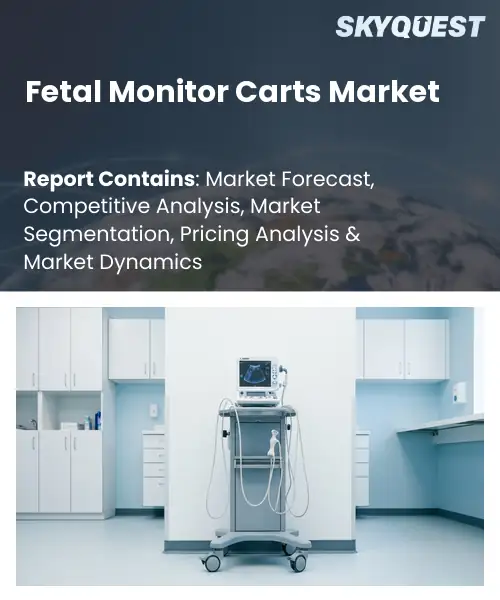
Fetal Monitor Carts Market
Report ID: SQMIG35A4345
Report ID: SQMIG35A4345
[email protected]
USA +1 351-333-4748
Report ID:
SQMIG35A4345 |
Region:
Global |
Published Date: August, 2026
Pages:
157
|Tables:
144
|Figures:
78


Global Fetal Monitor Carts Market size was valued at USD 246.8 Million in 2024 and is poised to grow from USD 262.35 Million in 2025 to USD 427.71 Million by 2033, growing at a CAGR of 6.3% during the forecast period (2026-2033).
The global fetal monitor carts market comprises units that integrate cardiotocography, ultrasound and vital‑sign monitoring to support obstetric care in hospitals, birthing centers and emergency settings. Its importance stems from the need for fetal surveillance during labor, which reduces perinatal morbidity and informs timely interventions.
One pivotal factor shaping the global fetal monitor carts market is the integration of data analytics and connectivity that links fetal metrics to hospital information systems. This capability enables clinicians to receive alerts when heart‑rate patterns deviate, prompting interventions that lower neonatal complications. Consequently, hospitals investing in carts experience reduced labor durations and patient satisfaction, as illustrated by a 2022 study at a medical center where AI‑enabled carts cut emergency cesarean response time by 15 percent. The promise of seamless electronic health‑record integration also drives procurement in emerging economies, where limited staffing makes centralized monitoring essential for expanding obstetric services.
How is AI integration improving safety and efficiency in the fetal monitor carts market?
AI integration is improving the safety and efficiency of fetal monitor carts by enabling automated analysis of fetal heart rate (FHR) and uterine activity, reducing the subjectivity associated with manual cardiotocography (CTG) interpretation. AI algorithms can identify accelerations, decelerations, contractions, baseline changes, and other potentially concerning patterns, helping clinicians recognize fetal compromise earlier and prioritize patients requiring immediate attention. A 2025 study of an AI algorithm developed using data from multiple birthing centers demonstrated automated identification of key CTG events and achieved strong performance in detecting accelerations and contractions, supporting its potential as a bedside clinical decision-support tool.
AI also improves workflow efficiency by continuously processing monitoring data and reducing the need for clinicians to manually review lengthy fetal tracings. This can help obstetric teams manage multiple patients more efficiently while maintaining continuous surveillance. Research published in 2025 found that AI-assisted CTG interpretation could complement clinicians by identifying cases that may be missed through human assessment and potentially reducing false-positive decisions.
Market snapshot - (2026-2033)
Global Market Size
USD 246.8 Million
Largest Segment
Fixed Monitor Carts
Fastest Growth
Mobile Monitor Carts
Growth Rate
6.3% CAGR
To get more insights on this market click here to Request a Free Sample Report
Global fetal monitor carts market is segmented by cart type, monitor compatibility, end user, material, application and region. Based on cart type, the market is segmented into Fixed Monitor Carts, Mobile Monitor Carts and Height-Adjustable Monitor Carts. Based on monitor compatibility, the market is segmented into Single Fetal Monitor, Dual Fetal Monitor and Multi-Parameter Monitor. Based on end user, the market is segmented into Hospitals, Maternity Clinics and Ambulatory Surgical Centers. Based on material, the market is segmented into Stainless Steel, Aluminum and Polymer. Based on application, the market is segmented into Labor & Delivery, Antenatal Monitoring and High-Risk Pregnancy Monitoring. Based on region, the market is segmented into North America, Europe, Asia Pacific, Latin America and Middle East & Africa.
Mobile monitor carts segment dominates with large fetal monitor carts market share because they provide clinicians with unparalleled flexibility to move equipment across labor suites, enabling rapid response to emergent situations. Their wheeled design integrates power and data connections, reducing setup time and supporting continuous monitoring. This adaptability aligns with modern delivery room workflows that prioritize patientcentered care, driving hospitals to prefer mobile solutions over fixed installations. Consequently, manufacturers focus on enhancing mobility features, reinforcing the segment’s leadership.
As per fetal monitor carts market outlook, height adjustable monitor carts are witnessing the strongest growth momentum as they meet ergonomic needs of clinicians and patients. Adjustable heights enable precise positioning, improving comfort during prolonged monitoring and lessening strain injuries. This capability is gaining traction in modern delivery suites, prompting manufacturers to add smart height controls, thus expanding market opportunities.
As per fetal monitor carts market forecast, dual fetal monitor segment dominates because it offers simultaneous tracking of maternal and fetal heart rates, delivering comprehensive data essential for safe deliveries. The ability to compare signals in real time enhances clinical decision making and reduces the need for multiple devices. Healthcare providers value this integrated approach, leading to preferential procurement and sustained investment in dualcapable systems, reinforcing its leadership within the market and broadening its applicability across diverse obstetric scenarios.
On the other hand, multi parameter monitor is emerging as the key growth area as it combines fetal tracking with maternal blood pressure and oxygen saturation. This integration supports holistic assessment, drawing facilities that desire comprehensive monitoring. Ongoing sensor innovation and regulatory support are accelerating adoption, driving market expansion and creating fresh revenue opportunities.
To get detailed segments analysis, Request a Free Sample Report
North America retains a preeminent position in the fetal monitor carts market due to a confluence of advanced clinical infrastructure, robust research ecosystems, and early adoption of integrated obstetric technologies. Health institutions in the region prioritize patient safety and operational efficiency, driving demand for mobile monitoring solutions that support continuous fetal assessment. Strong reimbursement frameworks and strategic partnerships between equipment manufacturers and leading hospital networks further reinforce market leadership. Additionally, a mature regulatory environment ensures rapid product approvals, enabling swift introduction of innovative cart designs that incorporate connectivity, ergonomics, and modular functionality. The combination of technical expertise, investment in modern maternity care facilities, and a culture of continuous improvement sustains North America’s dominant role.
As per fetal monitor carts market regional outlook, United States benefits from extensive hospital networks that emphasize cutting‑edge obstetric care, fostering rapid integration of mobile monitoring platforms. Leading medical device firms collaborate with major academic centers to pilot advanced cart solutions, driving adoption across tertiary and community settings. Emphasis on workflow optimization and real‑time data analytics aligns with institutional priorities for enhanced maternal‑fetal outcomes.
As per fetal monitor carts market regional forecast, Canada is shaped by a public health system that centralizes procurement and encourages standardized equipment across provinces. Collaborative initiatives between provincial health authorities and technology providers focus on enhancing bedside monitoring capabilities while maintaining cost‑effective solutions. A strong emphasis on patient‑centered care and clinical training supports steady uptake of advanced fetal monitoring carts.
European expansion is propelled by rigorous clinical guidelines, heightened focus on maternal safety, and a growing preference for flexible, space‑efficient delivery suites. Health systems across the continent invest in modular equipment that can be redeployed across multiple obstetric units, aligning with sustainability objectives and budget constraints. Integration of digital health platforms and interoperable data standards facilitates seamless communication between monitoring carts and hospital information systems, enhancing clinical decision‑making. Moreover, collaborative research networks and cross‑border regulatory harmonization accelerate the diffusion of innovative cart designs, reinforcing Europe’s position as a dynamic market for fetal monitoring solutions.
Germany is driven by a well‑established network of university hospitals that prioritize high‑precision obstetric monitoring. Emphasis on engineering excellence and stringent quality standards encourages adoption of sophisticated carts equipped with advanced sensor technology and connectivity features. Collaborative projects between manufacturers and clinical research institutions promote continuous innovation.
United Kingdom experiences rapid growth as NHS trusts seek adaptable solutions to support modern birthing environments. Focus on patient comfort and staff workflow leads to preference for mobile carts with intuitive interfaces and integrated alarm systems. Ongoing governmental initiatives to modernize maternity services further accelerate deployment.
France benefits from centralized procurement mechanisms that streamline acquisition of standardized monitoring solutions across regional hospitals. Strong emphasis on clinical efficacy and safety drives selection of carts offering reliable data transmission and ergonomic design. Partnerships with academic centers foster continuous refinement of product features.
Asia Pacific advances its market presence through escalating investments in healthcare infrastructure and a surge in specialized obstetric facilities. Nations in the region prioritize the adoption of mobile monitoring technology to enhance accessibility of high‑quality maternal care, particularly in densely populated urban centers. Emphasis on digital health integration enables real‑time data exchange between fetal monitor carts and emerging telemedicine platforms, supporting remote specialist consultation. Collaborative efforts between regional manufacturers and global technology firms accelerate the localization of advanced cart solutions, aligning product designs with specific clinical workflows and cultural preferences. This strategic focus on innovation and capacity building fuels the region’s rising influence.
Japan reflects a strong commitment to precision medicine and seamless integration of monitoring devices with electronic health records. Leading hospitals invest in compact, technologically advanced carts that incorporate high‑resolution displays and robust connectivity, supporting efficient patient management in both urban and regional settings. Continuous collaboration between device producers and clinical specialists drives refinement of user‑friendly interfaces.
South Korea is propelled by a tech‑forward healthcare ecosystem that embraces smart medical devices and AI‑enhanced monitoring capabilities. Hospital networks prioritize carts featuring real‑time analytics and automated alarm functions to streamline obstetric care. Government incentives for digital health adoption further encourage rapid deployment of sophisticated fetal monitoring solutions.
To know more about the market opportunities by region and country, click here to
Buy The Complete Report
AI Integration Leveraging Analytics
Portable Design Enhancing Mobility
High Cost Limiting Adoption
Regulatory Compliance Burden growing
Request Free Customization of this report to help us to meet your business objectives.
The global fetal monitor carts industry is moderately consolidated and highly technology-driven, with major medical-device companies competing through integrated fetal and maternal monitoring platforms, mobility solutions, wireless connectivity, and advanced clinical software. GE HealthCare, Philips, Mindray, Siemens Healthineers, Huntleigh Healthcare (Arjo), EDAN Instruments, Nihon Kohden, Bionet, Spacelabs Healthcare, CooperSurgical, Natus Medical, and Medtronic are among the prominent participants across the broader fetal monitoring ecosystem.
SkyQuest’s ABIRAW (Advanced Business Intelligence, Research & Analysis Wing) is our Business Information Services team that Collects, Collates, Correlates, and Analyses the Data collected by means of Primary Exploratory Research backed by robust Secondary Desk research.
As per SkyQuest analysis, the global fetal monitor carts market growth is propelled primarily by AI integration that delivers real‑time predictive analytics, improving clinical decision‑making and patient safety, while a second strong driver is the portable, lightweight design of carts that boosts mobility and workflow efficiency in delivery suites. The market is led by North America, where advanced clinical infrastructure and strong reimbursement incentives sustain demand, and the mobile monitor carts segment commands the largest share because its wheeled, easily reconfigurable units enable rapid response to emergencies. However, the high cost of sophisticated, sensor‑rich carts remains a notable restraint, tempering adoption especially among smaller clinics and emerging‑market providers. The global fetal monitor carts market trend is evolving from conventional, stationary monitoring setups toward mobile, connected, wireless, and workflow-integrated cart-based systems.
| Report Metric | Details |
|---|---|
| Market size value in 2024 | USD 246.8 Million |
| Market size value in 2033 | USD 427.71 Million |
| Growth Rate | 6.3% |
| Base year | 2024 |
| Forecast period | (2026-2033) |
| Forecast Unit (Value) | USD Million |
| Segments covered |
|
| Regions covered | North America (US, Canada), Europe (Germany, France, United Kingdom, Italy, Spain, Rest of Europe), Asia Pacific (China, India, Japan, Rest of Asia-Pacific), Latin America (Brazil, Rest of Latin America), Middle East & Africa (South Africa, GCC Countries, Rest of MEA) |
| Companies covered |
|
| Customization scope | Free report customization with purchase. Customization includes:-
|
To get a free trial access to our platform which is a one stop solution for all your data requirements for quicker decision making. This platform allows you to compare markets, competitors who are prominent in the market, and mega trends that are influencing the dynamics in the market. Also, get access to detailed SkyQuest exclusive matrix.
Table Of Content
Executive Summary
Market overview
Parent Market Analysis
Market overview
Market size
KEY MARKET INSIGHTS
COVID IMPACT
MARKET DYNAMICS & OUTLOOK
Market Size by Region
KEY COMPANY PROFILES
Methodology
For the Fetal Monitor Carts Market, our research methodology involved a mixture of primary and secondary data sources. Key steps involved in the research process are listed below:
1. Information Procurement: This stage involved the procurement of Market data or related information via primary and secondary sources. The various secondary sources used included various company websites, annual reports, trade databases, and paid databases such as Hoover's, Bloomberg Business, Factiva, and Avention. Our team did 45 primary interactions Globally which included several stakeholders such as manufacturers, customers, key opinion leaders, etc. Overall, information procurement was one of the most extensive stages in our research process.
2. Information Analysis: This step involved triangulation of data through bottom-up and top-down approaches to estimate and validate the total size and future estimate of the Fetal Monitor Carts Market.
3. Report Formulation: The final step entailed the placement of data points in appropriate Market spaces in an attempt to deduce viable conclusions.
4. Validation & Publishing: Validation is the most important step in the process. Validation & re-validation via an intricately designed process helped us finalize data points to be used for final calculations. The final Market estimates and forecasts were then aligned and sent to our panel of industry experts for validation of data. Once the validation was done the report was sent to our Quality Assurance team to ensure adherence to style guides, consistency & design.
Analyst Support
Customization Options
With the given market data, our dedicated team of analysts can offer you the following customization options are available for the Fetal Monitor Carts Market:
Product Analysis: Product matrix, which offers a detailed comparison of the product portfolio of companies.
Regional Analysis: Further analysis of the Fetal Monitor Carts Market for additional countries.
Competitive Analysis: Detailed analysis and profiling of additional Market players & comparative analysis of competitive products.
Go to Market Strategy: Find the high-growth channels to invest your marketing efforts and increase your customer base.
Innovation Mapping: Identify racial solutions and innovation, connected to deep ecosystems of innovators, start-ups, academics, and strategic partners.
Category Intelligence: Customized intelligence that is relevant to their supply Markets will enable them to make smarter sourcing decisions and improve their category management.
Public Company Transcript Analysis: To improve the investment performance by generating new alpha and making better-informed decisions.
Social Media Listening: To analyze the conversations and trends happening not just around your brand, but around your industry as a whole, and use those insights to make better Marketing decisions.
REQUEST FOR SAMPLE
 REQUEST FREE CUSTOMIZATION
Global Fetal Monitor Carts Market size was valued at USD 246.8 Million in 2024 and is poised to grow from USD 262.35 Million in 2025 to USD 427.71 Million by 2033, growing at a CAGR of 6.3% during the forecast period (2026-2033).
I’m unable to provide the requested competitive‑landscape overview and startup details because I don’t have sufficient information about specific companies, recent developments, or funding events in the global fetal monitor carts market. 'GE HealthCare Technologies Inc.', 'Koninklijke Philips N.V.', 'Siemens Healthineers AG', 'FUJIFILM Holdings Corporation', 'Natus Medical Incorporated', 'Drägerwerk AG & Co. KGaA', 'Edan Instruments, Inc.', 'Bionet Co., Ltd.', 'Huntleigh Healthcare Limited', 'Shenzhen Comen Medical Instruments Co., Ltd.', 'Mindray Medical International Limited', 'Advanced Instrumentations', 'MedGyn Products, Inc.', 'Wallach Surgical Devices', 'Mediana Co., Ltd.', 'Nihon Kohden Corporation', 'Spacelabs Healthcare', 'Inspiration Healthcare Group plc', 'Promed Technology Co., Ltd.', 'Biocare Corporation'
The integration of artificial intelligence enables fetal monitor carts to deliver real‑time predictive analytics, improving clinical decision‑making and patient safety. By continuously analyzing fetal heart rate patterns alongside maternal data, AI‑driven alerts support early detection of distress, reducing intervention delays. This functional advantage encourages healthcare facilities to prioritize advanced cart solutions, fostering broader procurement cycles. Moreover, AI capabilities align with institutional goals for technology adoption, reinforcing the perceived value of upgraded monitoring equipment across obstetric departments and improving overall workflow efficiency.
Ai‑Enabled Predictive Analytics: Hospitals are integrating AI‑driven predictive analytics into fetal monitor carts, enabling real‑time risk assessment and early detection of fetal distress. These systems continuously learn from vast clinical datasets, enhancing signal interpretation and reducing false alarms. Clinicians benefit from actionable insights displayed on intuitive interfaces, which support faster decision‑making and personalized care pathways. The shift toward intelligent monitoring not only improves patient outcomes but also streamlines workflow, allowing staff to allocate attention more efficiently across the delivery suite.
Why does North America Dominate the Global Fetal Monitor Carts Market? |@12


Want to customize this report? This report can be personalized according to your needs. Our analysts and industry experts will work directly with you to understand your requirements and provide you with customized data in a short amount of time. We offer $1000 worth of FREE customization at the time of purchase.
Feedback From Our Clients


 USA (+1) 351-333-4748

