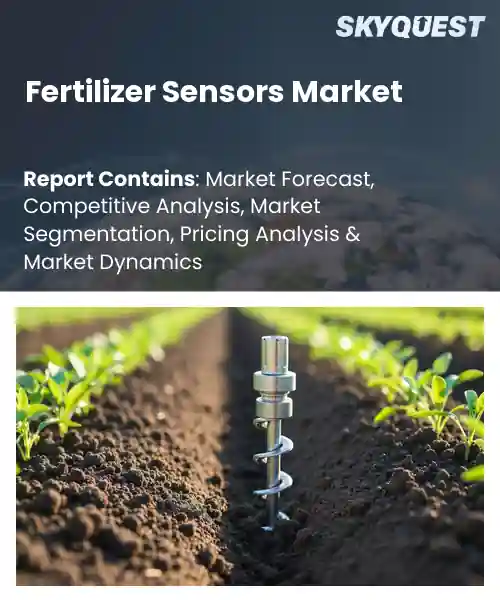
Fertilizer Sensors Market
Report ID: SQMIG45N2184
Report ID: SQMIG45N2184
[email protected]
USA +1 351-333-4748
Report ID:
SQMIG45N2184 |
Region:
Global |
Published Date: February, 2026
Pages:
157
|Tables:
155
|Figures:
78


Global Fertilizer Sensors Market size was valued at USD 1.8 Billion in 2024 and is poised to grow from USD 2.04 Billion in 2025 to USD 5.58 Billion by 2033, growing at a CAGR of 13.4% during the forecast period (2026-2033).
Growing adoption of precision agriculture practices, increasing demand for efficient fertilizer management, rising focus on sustainable farming methods, advancements in soil and nutrient sensing technologies, and integration of IoT-based agricultural monitoring systems are driving sales of fertilizer sensors.
Increasing regulatory pressure to reduce agricultural pollution and rising fertilizer prices are also encouraging farmers to adopt precision tools that reduce input costs while ensuring regulatory compliance. As a result, farmers are increasingly using sensor-driven variable-rate fertilizer application systems that deliver nutrients only where needed, improving productivity and environmental sustainability across greenhouse operations and large-scale row crop farming. Rise in popularity of precision agriculture technologies, along with the need to accurately monitor nutrients in real time are bolstering fertilizer sensors market growth. Fertilizer sensor solutions assist farmers in optimizing the usage of fertilizers, maximizing crop yield, as well as limiting nutrient runoff that can lead to water pollution.
On the contrary, high costs of advanced sensor technologies, limited awareness among small-scale farmers, challenges related to sensor calibration and maintenance, and lack of reliable connectivity infrastructure in rural areas are anticipated to slow down fertilizer sensors market penetration in the future.
How are AI and IoT Improving Precision in the Fertilizer Sensors Market?
AI and IoT are improving precision in the fertilizer sensors market by connecting continuous field sensing with intelligent data analytics. IoT probes and tank sensors also monitor the real-time soil nutrient levels and fertilizer levels through IoT technology. The AI systems analyze the data on the edge devices as well as in the cloud to remove the noise from the data, detect trends, and develop fertilizer application recommendations. These integrations make it easier to implement VRA systems. Farmers can apply inputs only where they are needed, improving efficiency and reducing waste.
Market snapshot - 2026-2033
Global Market Size
USD 1.8 Billion
Largest Segment
In-Field Sensors
Fastest Growth
Smartphone-Integrated Sensors
Growth Rate
13.4% CAGR
To get more insights on this market click here to Request a Free Sample Report
The fertilizer sensors market is segmented by product type, type of sensor, technology adoption, application area, end-user and region. Based on product type, the market is segmented into portable sensors, stationary sensors, in-field sensors, laboratory sensors and smartphone-integrated sensors. Based on type of sensor, the market is segmented into chemical sensors, optical sensors, electrical sensors, soil moisture sensors, temperature sensors, and multi-parameter sensors. Based on technology adoption, the market is segmented into traditional methods, precision agriculture, automation and IoT, remote sensing and data analytics and AI.
Based on application area, the market is segmented into crop monitoring, soil quality assessment, irrigation management, nutrient needs assessment and pest and disease management. Based on end-user, the market is segmented into farms, research institutions, agricultural cooperatives, government agencies and fertilizer manufacturers. Based on region, the market is segmented into North America, Europe, Asia Pacific, Latin America, and Middle East & Africa.
The portable sensors segment is forecasted to account for the highest global fertilizer sensors market share in the future. High mobility allowing on site nutrient measurement and rapid decision making at field level is helping cement the dominance of this segment going forward. This convenience drives adoption across diverse farm sizes, reduces reliance on lab turnaround, and stimulates demand for easy to use hardware that integrates with advisory services, thereby creating a broad installation base and reinforcing their central position in fertilizer sensors market.
However, smartphone-integrated sensors are expected to witness hike in demand at a robust CAGR as per this fertilizer sensors industry analysis. Growing use of smartphones and expanding availability of applications enable on device analysis, streamlined data sharing, and simple calibration, thereby creating new business scope. Their compatibility with cloud analytics and advisory platforms drives quick uptake among digitally engaged growers and service providers, unlocking scalable precision recommendations and recurring digital service opportunities.
The multi-parameter sensors segment is slated to lead the global fertilizer sensors market revenue generation in the future. Capability of integrated measurement of nutrients, pH, moisture, and temperature delivers a holistic understanding of field conditions and cements the dominance of this segment. By consolidating multiple sensing modalities into a single platform, these systems reduce operational complexity and data fragmentation, improving decision confidence for advisors and enabling seamless integration with management platforms, which strengthens their central role in advancing data driven fertilizer management.
Meanwhile, optical sensors are emerging as the fastest growing area because noninvasive spectral measurements enable rapid nutrient and crop health estimation across canopies, compatible with drone and aerial platforms. Advances in miniaturized optics, machine learning for spectral interpretation, and integration with mapping workflows are accelerating adoption and opening new high resolution monitoring and prescription opportunities.
To get detailed segments analysis, Request a Free Sample Report
Expansion of commercial agriculture and quick adoption of advanced technologies are expected to cement the dominance of this region in terms of fertilizer sensors adoption. The presence of leading sensor manufacturers, precision equipment OEMs, and data analytics providers allows for quick adoption of integrated solutions across North America. There is considerable collaboration between production agriculture, universities, and government agencies, leading to the fast refinement and commercialization of new or improved products. Rising financial backing for extension services, on-farm research trials, and independent testing facilities is also expanding the scope of innovation.
United States Fertilizer Sensors Market
Presence of leading large grain and specialty crop producers, extensive field validation infrastructure, and a dense network of precision agriculture service providers are governing fertilizer sensors adoption in the country. Proximity to technology or data analytics companies facilitates system integration. Investment support from venture or corporate partners accelerates fertilizer sensors innovation in the United States. Emphasis is given to system integration with farm management systems or service support to increase adoption among diverse agricultural operations.
Canada Fertilizer Sensors Market
Sales of fertilizer sensors in Canada are expected to be governed by a mix of large commercial operations and innovative smallholders. Emphasis on sensor product development that is rugged or cold-tolerant, with mobile connectivity in remote areas is high in the country. An increase in collaboration between agricultural research centers, provincial extension services, and private vendors is helping boost the applicability of fertilizer sensors with localized calibration potential as well.
High emphasis on sustainable agriculture practices and the presence of massive agriculture-dependent industries are shaping the adoption of fertilizer sensors across the region. Efforts to maximize food security while reducing the negative impact on the environment are also boosting the sales of fertilizer sensors going forward. These initiatives are aided by a highly developed ecosystem of agtech companies, cooperatives, and professionally trained consultants who have engaged in an extensive pilot program and field demonstration projects that promote farmer buy-in. Well-established standards and certification systems offer consumers greater confidence about sensor accuracy and the ability to work with one another.
Germany Fertilizer Sensors Market
A robust industrial and agricultural research sector is primarily influencing fertilizer sensors demand in Germany. Fertilizer sensors manufacturers in the country are expected to be highly focused on opting for standardized testing and quality assurance ensures the trust of end-users. High collaboration between machinery manufacturers, equipment providers, and agricultural cooperatives is also expected to boost the adoption of advanced fertilizer sensors in the long run.
United Kingdom Fertilizer Sensors Market
We forecast a lively agtech startup scene, active pilot programs, and strong advisory networks to boost the sales of fertilizer sensors in the country. Demand for modular and interoperable products is bolstering revenue generation potential from large-scale arable farms and progressive agricultural operations in the United Kingdom. End users in the country prioritize fertilizer sensors that focus on data security, farm-level decision support, and integration with supply chain traceability systems.
France Fertilizer Sensors Market
High adoption of advanced nutrient management technologies to improve environmental performance by farmers and large cooperatives in France is boosting fertilizer sensors adoption. Rising emphasis on traceability, soil health, and minimizing nutrient loss is also expected to promote the sales of fertilizer sensors going forward. Growing partnership between research institutions and cooperatives is also helping expand the scope of innovation in the country.
Presence of expansive agricultural activity, high investments in precision technologies, and localized manufacturing capacity are shaping fertilizer sensors demand in the region. Regional developers focus on developing cost efficient sensor designs that can withstand humid and varying climatic conditions using regional supply chains for increased production levels and shorter lead times. Publicly funded agri-research organizations and privately held companies continue to collaborate on new crop-specific calibration initiatives as a way to build confidence among farmers. Developing practical, scalable fertilizer sensing technologies for both small and commercial farmers remains the prime emphasis of market players focusing on Asia Pacific region. Rising mobile connectivity and platform ecosystems support widespread data collection and decision support through fertilizer sensors as well.
Japan Fertilizer Sensors Market
Presence of a strong electronics and precision engineering sector is responsible for R&D of advanced and miniaturized fertilizer sensors in Japan. Collaborations between esearch institutes, agtech companies, and machinery manufacturers are focused on the development of refined sensors that are suitable for vegetable and orchard farms. Emphasis on reliability, rigorous field testing, and integration with automation is prioritized by fertilizer sensors manufacturers focusing on this country.
South Korea Fertilizer Sensors Market
High advanced semiconductor and sensor manufacturing expertise enables the development of high precision fertilizer sensors in the country. The presence of leading technology firms, startups, and smart farming initiatives is also creating a new business scope for fertilizer sensors companies. Emphasis is placed on the creation of products that have the capacity for IoT integration, which serves urban agriculture, controlled environment agriculture, and the broader agriculture sectors.
To know more about the market opportunities by region and country, click here to
Buy The Complete Report
Precision Agriculture Adoption Driving Demand
Government Policies Supporting Sustainability
High Implementation Complexity Limits Adoption
Data Privacy and Interoperability Concerns
Request Free Customization of this report to help us to meet your business objectives.
Competitive landscape in the global fertilizer sensors market is consolidating as incumbents and agile agtech challengers pursue targeted M&A, platform integrations, and sensor partnerships to secure fertigation contracts. CropX's 2024 acquisition of EnGeniousAg to add in-field nitrogen sensing and Orbia Netafim’s more recent move to embed direct plant sensing from Treetoscope are concrete examples of dealmaking and co-development shaping competitive differentiation.
IoT and Edge Analytics
Sustainability Driven Adoption
SkyQuest’s ABIRAW (Advanced Business Intelligence, Research & Analysis Wing) is our Business Information Services team that Collects, Collates, Correlates, and Analyses the Data collected by means of Primary Exploratory Research backed by robust Secondary Desk research.
As per SkyQuest analysis, rising adoption of precision agriculture and increasing need for real-time soil nutrient monitoring are anticipated to drive the demand for fertilizer sensors going forward. However, high costs of advanced sensing technologies and limited awareness among small-scale farmers are slated to slow down the adoption of fertilizer sensors in the future. North America is expected to drive the demand for fertilizer sensors, as it is expected to be at the forefront of the fertilizer sensors market, driven by the adoption of precision farming technologies, advanced agricultural infrastructure, and the presence of key agritech players. The use of IoT-based systems for monitoring the soil, as well as the adoption of variable fertilizer application technologies are anticipated to be key trends driving the fertilizer sensors sector across the study period and beyond.
| Report Metric | Details |
|---|---|
| Market size value in 2024 | USD 1.8 Billion |
| Market size value in 2033 | USD 5.58 Billion |
| Growth Rate | 13.4% |
| Base year | 2024 |
| Forecast period | 2026-2033 |
| Forecast Unit (Value) | USD Billion |
| Segments covered |
|
| Regions covered | North America (US, Canada), Europe (Germany, France, United Kingdom, Italy, Spain, Rest of Europe), Asia Pacific (China, India, Japan, Rest of Asia-Pacific), Latin America (Brazil, Rest of Latin America), Middle East & Africa (South Africa, GCC Countries, Rest of MEA) |
| Companies covered |
|
| Customization scope | Free report customization with purchase. Customization includes:-
|
To get a free trial access to our platform which is a one stop solution for all your data requirements for quicker decision making. This platform allows you to compare markets, competitors who are prominent in the market, and mega trends that are influencing the dynamics in the market. Also, get access to detailed SkyQuest exclusive matrix.
Table Of Content
Executive Summary
Market overview
Parent Market Analysis
Market overview
Market size
KEY MARKET INSIGHTS
COVID IMPACT
MARKET DYNAMICS & OUTLOOK
Market Size by Region
KEY COMPANY PROFILES
Methodology
For the Fertilizer Sensors Market, our research methodology involved a mixture of primary and secondary data sources. Key steps involved in the research process are listed below:
1. Information Procurement: This stage involved the procurement of Market data or related information via primary and secondary sources. The various secondary sources used included various company websites, annual reports, trade databases, and paid databases such as Hoover's, Bloomberg Business, Factiva, and Avention. Our team did 45 primary interactions Globally which included several stakeholders such as manufacturers, customers, key opinion leaders, etc. Overall, information procurement was one of the most extensive stages in our research process.
2. Information Analysis: This step involved triangulation of data through bottom-up and top-down approaches to estimate and validate the total size and future estimate of the Fertilizer Sensors Market.
3. Report Formulation: The final step entailed the placement of data points in appropriate Market spaces in an attempt to deduce viable conclusions.
4. Validation & Publishing: Validation is the most important step in the process. Validation & re-validation via an intricately designed process helped us finalize data points to be used for final calculations. The final Market estimates and forecasts were then aligned and sent to our panel of industry experts for validation of data. Once the validation was done the report was sent to our Quality Assurance team to ensure adherence to style guides, consistency & design.
Analyst Support
Customization Options
With the given market data, our dedicated team of analysts can offer you the following customization options are available for the Fertilizer Sensors Market:
Product Analysis: Product matrix, which offers a detailed comparison of the product portfolio of companies.
Regional Analysis: Further analysis of the Fertilizer Sensors Market for additional countries.
Competitive Analysis: Detailed analysis and profiling of additional Market players & comparative analysis of competitive products.
Go to Market Strategy: Find the high-growth channels to invest your marketing efforts and increase your customer base.
Innovation Mapping: Identify racial solutions and innovation, connected to deep ecosystems of innovators, start-ups, academics, and strategic partners.
Category Intelligence: Customized intelligence that is relevant to their supply Markets will enable them to make smarter sourcing decisions and improve their category management.
Public Company Transcript Analysis: To improve the investment performance by generating new alpha and making better-informed decisions.
Social Media Listening: To analyze the conversations and trends happening not just around your brand, but around your industry as a whole, and use those insights to make better Marketing decisions.
REQUEST FOR SAMPLE
 REQUEST FREE CUSTOMIZATION
Global Fertilizer Sensors Market size was valued at USD 1.8 Billion in 2024 and is poised to grow from USD 2.04 Billion in 2025 to USD 5.58 Billion by 2033, growing at a CAGR of 13.4% during the forecast period (2026-2033).
Netafim, Sentek Technologies, Isaria, Valmont Industries, Teralytic, Trimble Agriculture, Yara Grows Knowledge, Pessl Instruments, Step Systems, Meter Group, Horiba, DIGITROL, Flowline, Spectrum Tech, Shandong Renke Control Technology, Aglow Technology, CropX, Smart Fertilizer Management, Topcon Agriculture, SoilOptix
The key driver of the Fertilizer Sensors Market is the increasing adoption of precision agriculture to improve crop productivity and optimize fertilizer usage. Farmers are using sensor-based technologies to monitor soil nutrient levels in real time, enabling efficient fertilizer application, reducing waste, and enhancing overall farm productivity.
A key market trend in the Fertilizer Sensors Market is the increasing integration of smart farming technologies such as IoT-enabled sensors and data analytics platforms. These solutions allow real-time soil nutrient monitoring, helping farmers apply fertilizers more precisely, reduce environmental impact, and improve overall agricultural productivity.
Asia-Pacific accounted for the largest share in the Fertilizer Sensors Market, driven by the region’s large agricultural base, growing adoption of precision farming technologies, increasing focus on crop yield optimization, and government initiatives promoting smart agriculture in countries like China, India, and Japan.


Want to customize this report? This report can be personalized according to your needs. Our analysts and industry experts will work directly with you to understand your requirements and provide you with customized data in a short amount of time. We offer $1000 worth of FREE customization at the time of purchase.
Feedback From Our Clients


 USA (+1) 351-333-4748

