Fertility Services Market
Report ID: SQMIG35D2292
Report ID: SQMIG35D2292
[email protected]
USA +1 351-333-4748
Report ID:
SQMIG35D2292 |
Region:
Global |
Published Date: February, 2025
Pages:
196
|Tables:
95
|Figures:
71


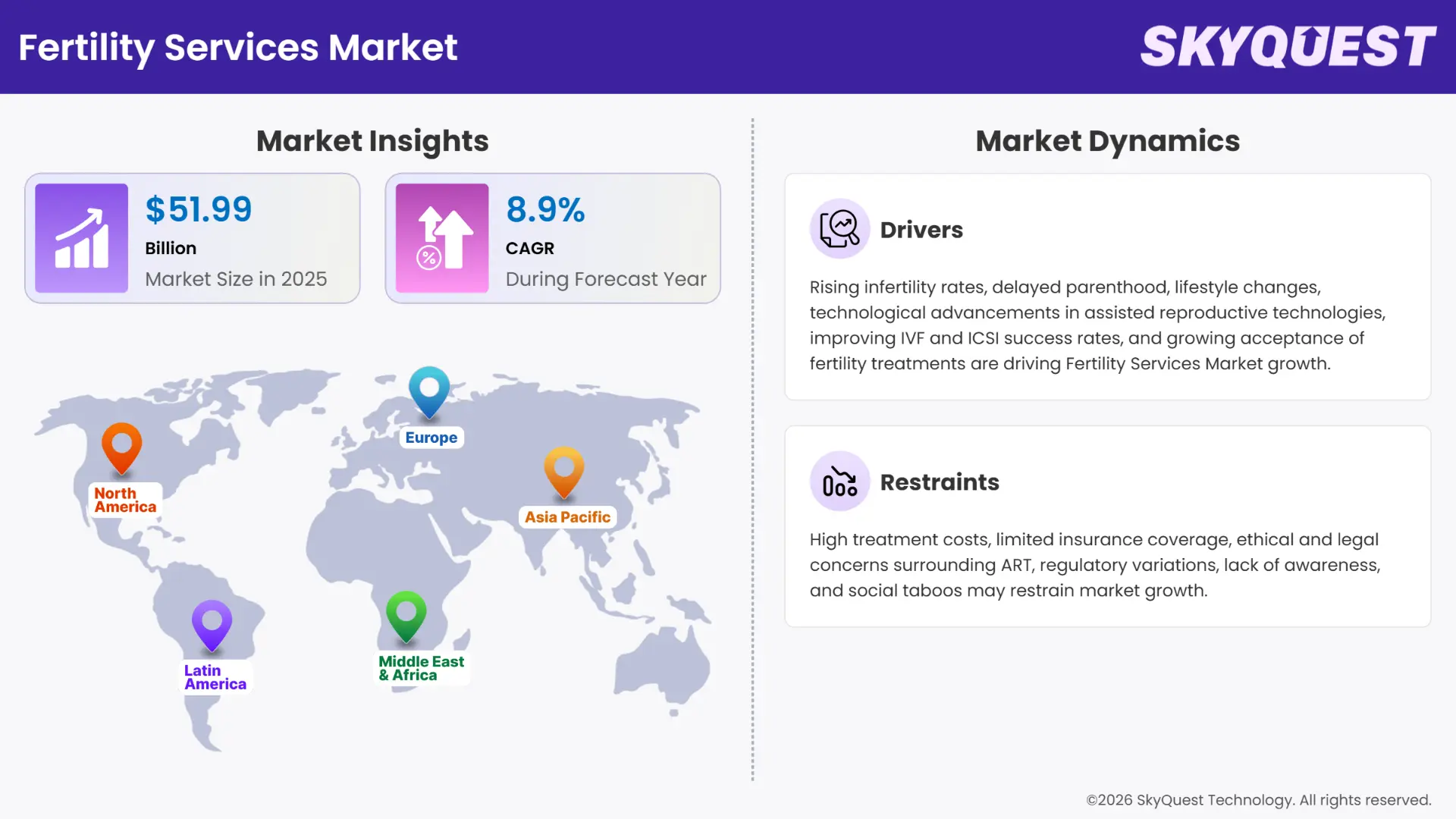
Global Fertility Services Market size was valued at USD 47.74 billion in 2024 and is poised to grow from USD 51.99 billion in 2025 to USD 102.84 billion by 2033, growing at a CAGR of 8.9% during the forecast period (2026-2033).
Key Takeaways: Market Trends & Insights
Significant changes in societal tendencies have led to an increase in demand for fertility services. The median age at which women become first-time moms has increased due to factors like postponed marriages, improved birth control, and women prioritizing their careers over raising a family. The United Nations Department of Economic and Social Affairs confirms evidence in the World Fertility Report that the average time of a woman's first pregnancy has gone up, mostly in her late twenties or early thirties, in countries such as France. Higher rates in infertility incidences emerge as women are unable to conceive naturally, due to the fact that the average first-time mother age is increasing.
The number of women seeking Assisted Reproductive Technology (ART) treatments is directly impacted by the declining fertility rate, which propels the fertility services market to expand. Some couples who may have issues with natural conception due to factors such as postponed pregnancies may find ART therapies beneficial in the form of a bouquet of assisted conception techniques. Societal trends are putting off motherhood as the woman pursues various personal and even career endeavors, which means an ever-increasing need for fertility treatments. The biological difficulties of conception rise as more women put off having children, leading to an increase in the need of ART techniques to treat infertility.
To get more insights on this market click here to Request a Free Sample Report
Global Fertility Services Market is segmented by Service Type, Procedure, End User and region. Based on Service Type, the market is segmented into Diagnosis, Treatment, Preservation. Based on Procedure, the market is segmented into In Vitro Fertilization, Intracytoplasmic Sperm Injection, Artificial Insemination, Donor Egg, Surrogacy and Others. Based on End User, the market is segmented into Fertility Clinics, Hospitals, Surgical Centers and Clinical Research Institutes. Based on region, the market is segmented into North America, Europe, Asia Pacific, Latin America and Middle East & Africa.
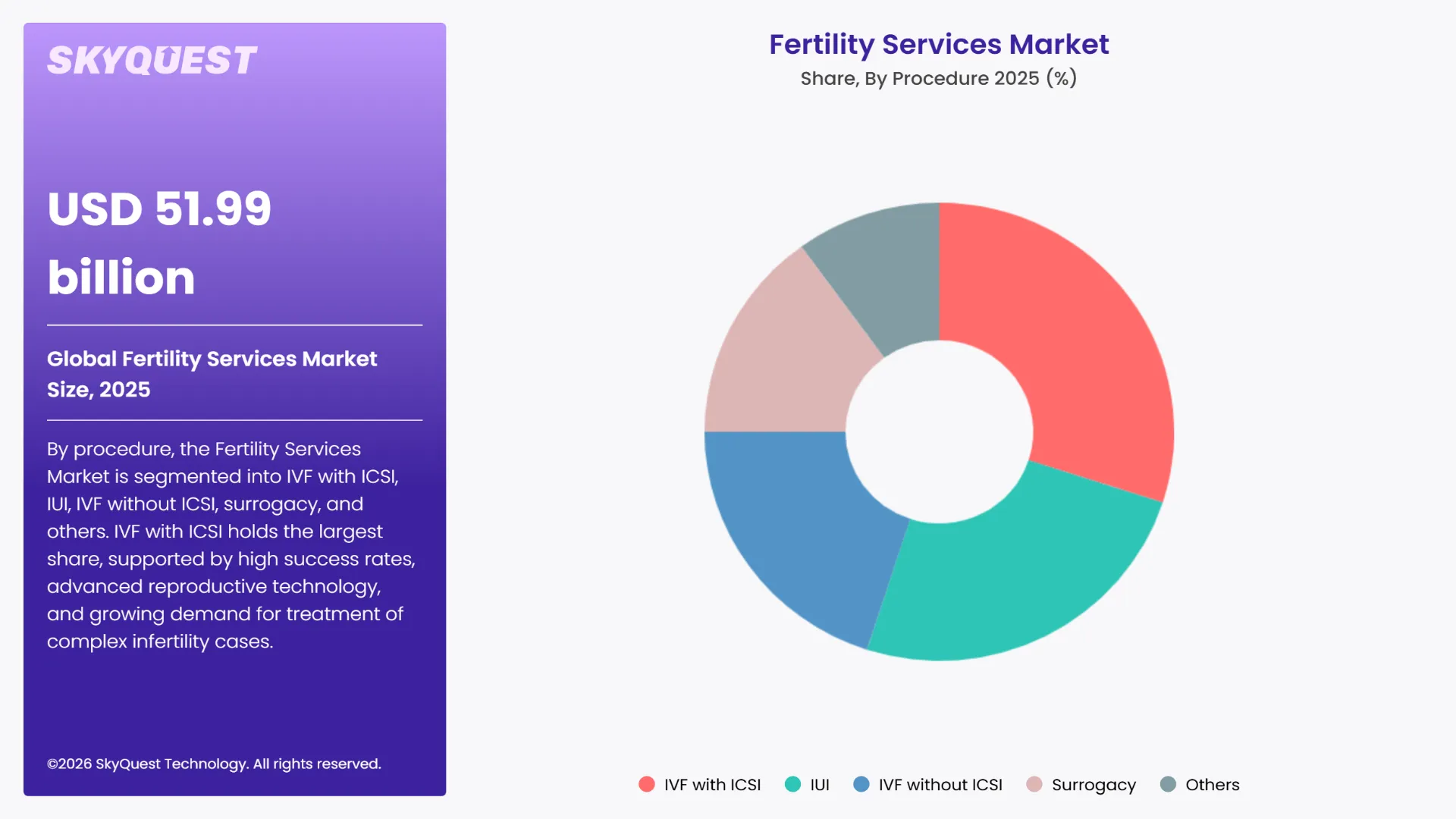
As per categorization by procedure, the market is classified as IVF with ICSI, IUI, IVF without ICSI, surrogacy, and others. Among these, IVF with ICSI earned the largest share and continue to hold the dominant global fertility services market share. In the global fertility services market, IVF with ICSI (intracytoplasmic sperm injection) is a dominant procedure due to its high success rates in overcoming severe male infertility and enhancing fertilization. An advanced method was implemented to permeate an egg with sperm, especially in cases where couples are faced with the most complicated reproductive issues. Its market acceptance grew due to advances in reproductive technology, an increased awareness regarding therapeutic treatments for infertility, and currently surging infertility demands.
IVF without ICSI is projected to be the fastest-growing segment in the global fertility services market due to its cost-effectiveness and suitability for cases where male infertility is not a concern. The way couples adopt a new approach to the older system of fertility treatment that has become a common phenomenon among those without a diagnosis, low grade reproductive problems.
New laboratory procedures-improved management of egg and sperm-will improve success rates, which will make patients more self-assured. Awareness of eventuality of the fertility treatments and need to reduce interventions in other ways has made the present time popular in accepting standard IVF, as it is widely appreciated by many as a common reproductive tool to be used for manageable costs that are evidenced by many other disadvantages.
Fresh non-donor services dominate the global fertility services market due to their high success rates and preference among couples desiring a genetic connection with their child. It is an approach which involves the utilization of recently procured eggs and sperm derived from the intended parents, thus assuring that fertilization and implantation may proceed in the best possible manner with quality. Innovations such as advanced embryo culture and new real-time monitoring systems enhance efficiency, due to improved hormonal agents for fresh cycles. The emotional and ethical appeal of using one's genetic material and reduced logistical complexities are distinct benefits for Fresh Non-Donor services as compared to programs using donor material, while making them preferred choices solidifying the market leader.
Frozen non-donor services are expected to be the fastest-growing segment in the global fertility services market due to their flexibility, convenience, and advancements in cryopreservation techniques. Embryo storage was left as a future plan for them, but it will be done to allow repeated stimulation cycles. There are improved freezing technologies like vitrification to improve success in this area with high rates of post-thaw survival. In addition, frozen cycles give more reasonable costs-more financially manageable than fresh cycles, making them more appealing to such patients. A growing trend towards having children at more advanced ages, together with increasingly popular fertility preservation from medical or personal perspectives, further boosts the demand for Frozen Non-Donor treatments.
To get detailed segments analysis, Request a Free Sample Report
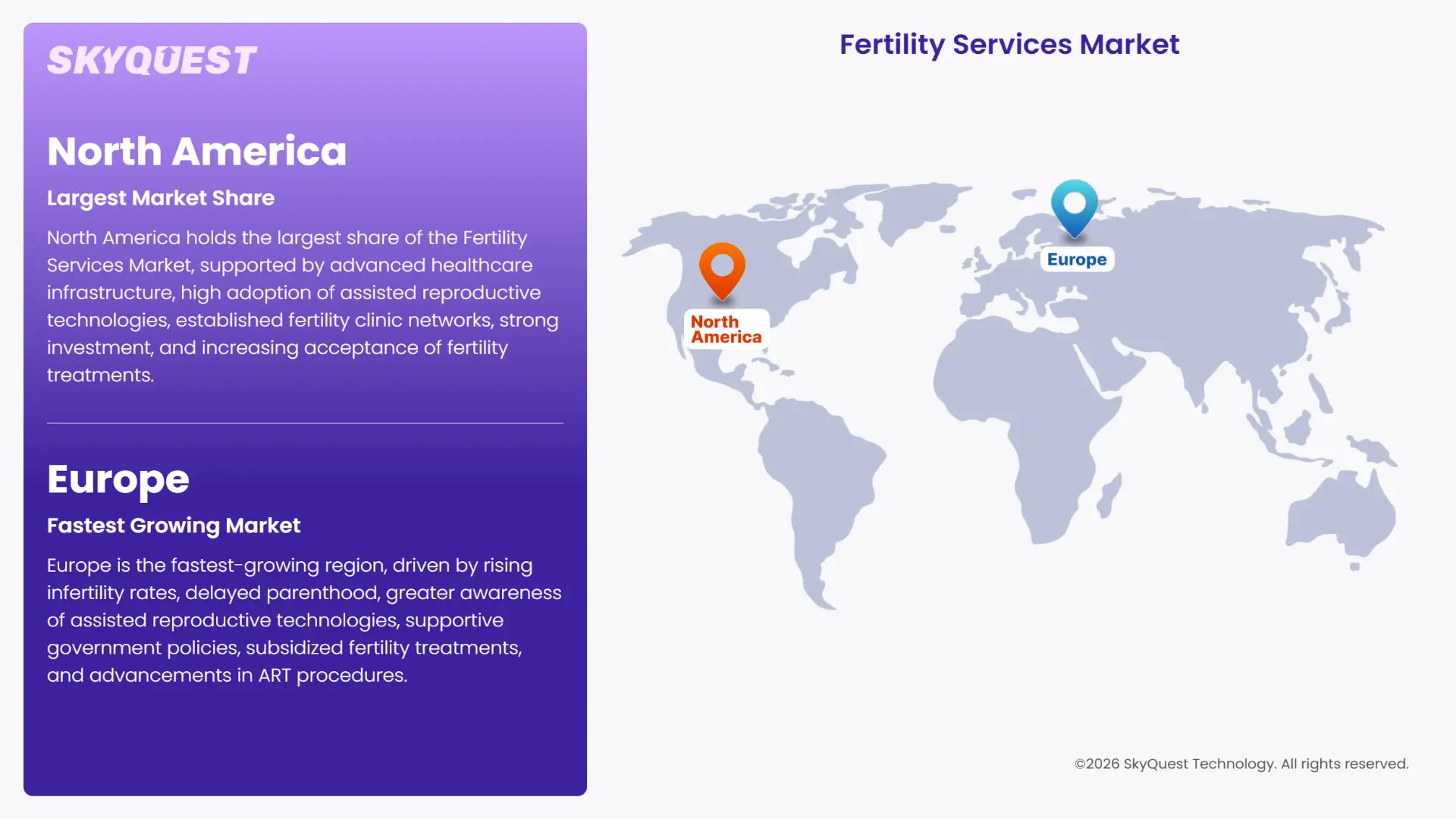
North America dominates the global fertility services market due to advanced healthcare infrastructure, high adoption of cutting-edge fertility technologies, and a well-established network of fertility clinics. North America has seen a lot of investment in the reproductive biology industry and a great deal of knowledge. It is rising young infertility-breeding lifestyles and delayed parenthood that beg for services like IFV and egg freezing. This demand is bolstered by friendly insurance coverage policies and government's support for doing so. In addition, the presence of leading fertility service providers and increasing acceptance of assisted reproductive technologies (ART) among individuals and couples also firmly solidify the sector's leadership in North America.
Europe is the fastest-growing region in the global fertility services market due to increasing infertility rates, delayed parenthood, and rising awareness of assisted reproductive technologies (ART). Subsidized fertility treatments in countries like Denmark and those in much of Europe are bolstered by having supportive government policies, which further promote accessibility and adoption. In addition to the creation of a wider network of special ART clinics, technological advances in assisted reproductive technology maximize the success rate and support patient confidence.
The present cultural transformation is leading to the acceptance of fertility treatments, encouraging medical tourism to a country that does what it considers high-quality, affordable treatment, and the accessibility of the facility is significantly more fueling its growth. Europe's commitment to innovation is making it the key player in the global fertility services market outlook.
To know more about the market opportunities by region and country, click here to
Buy The Complete Report
Rising Infertility Rates
Technological Advancements in ART
Ethical and Legal Concerns
Lack of Awareness and Education
Request Free Customization of this report to help us to meet your business objectives.
There is intense competition in the global fertility services market, with various companies concentrating on developing advanced technologies, enlarging their treatment branches, and establishing well-planned partnerships. Global key businesses that should be mentioned are CooperSurgical, Inc., Vitrolife AB, Cook Medical, Inc., The Cooper Companies Inc., and EMD Serono, Inc. These companies have been at the forefront of technological advancement in the assisted reproduction segment, applying this to both IVF, ICSI, and cryopreservation modules. Competitiveness has been increased through heightened investment in research and development, geographic expansion, and refocusing on patient-centric solutions in order to improve service provision globally.
Growing Adoption of Fertility Preservation Techniques
Rising Popularity of Personalized Fertility Treatments
SkyQuest's ABIRAW (Advanced Business Intelligence, Research & Analysis Wing) is our Business Information Services team that Collects, Collates, Correlates, and Analyses the Data collected by means of Primary Exploratory Research backed by robust Secondary Desk research.
As per SkyQuest analysis, the global fertility services industry is witnessing significant growth due to factors such as delayed parenthood, increasing infertility rates, and advancements in assisted reproductive technologies (ART). Innovations in procedures like IVF with ICSI and the growing preference for services such as Fresh Non-Donor and Frozen Non-Donor are driving market expansion.
Furthermore, dominance in North America and rapid rise in Europe underpin global desire for pedogenesis procedures and services. There would be stumbling blocks, of course, ethical issues and lack of-so much awareness-technological advancement and the adoption of ART. Consequently, the market will emerge in a clearer way to genetic services worldwide.
| Report Metric | Details |
|---|---|
| Market size value in 2024 | USD 47.74 billion |
| Market size value in 2033 | USD 102.84 billion |
| Growth Rate | 8.9% |
| Base year | 2024 |
| Forecast period | 2026-2033 |
| Forecast Unit (Value) | USD Billion |
| Segments covered |
|
| Regions covered | North America (US, Canada), Europe (Germany, France, United Kingdom, Italy, Spain, Rest of Europe), Asia Pacific (China, India, Japan, Rest of Asia-Pacific), Latin America (Brazil, Rest of Latin America), Middle East & Africa (South Africa, GCC Countries, Rest of MEA) |
| Companies covered |
|
| Customization scope | Free report customization with purchase. Customization includes:-
|
To get a free trial access to our platform which is a one stop solution for all your data requirements for quicker decision making. This platform allows you to compare markets, competitors who are prominent in the market, and mega trends that are influencing the dynamics in the market. Also, get access to detailed SkyQuest exclusive matrix.
Table Of Content
Executive Summary
Market overview
Parent Market Analysis
Market overview
Market size
KEY MARKET INSIGHTS
COVID IMPACT
MARKET DYNAMICS & OUTLOOK
Market Size by Region
KEY COMPANY PROFILES
Methodology
For the Fertility Services Market, our research methodology involved a mixture of primary and secondary data sources. Key steps involved in the research process are listed below:
1. Information Procurement: This stage involved the procurement of Market data or related information via primary and secondary sources. The various secondary sources used included various company websites, annual reports, trade databases, and paid databases such as Hoover's, Bloomberg Business, Factiva, and Avention. Our team did 45 primary interactions Globally which included several stakeholders such as manufacturers, customers, key opinion leaders, etc. Overall, information procurement was one of the most extensive stages in our research process.
2. Information Analysis: This step involved triangulation of data through bottom-up and top-down approaches to estimate and validate the total size and future estimate of the Fertility Services Market.
3. Report Formulation: The final step entailed the placement of data points in appropriate Market spaces in an attempt to deduce viable conclusions.
4. Validation & Publishing: Validation is the most important step in the process. Validation & re-validation via an intricately designed process helped us finalize data points to be used for final calculations. The final Market estimates and forecasts were then aligned and sent to our panel of industry experts for validation of data. Once the validation was done the report was sent to our Quality Assurance team to ensure adherence to style guides, consistency & design.
Analyst Support
Customization Options
With the given market data, our dedicated team of analysts can offer you the following customization options are available for the Fertility Services Market:
Product Analysis: Product matrix, which offers a detailed comparison of the product portfolio of companies.
Regional Analysis: Further analysis of the Fertility Services Market for additional countries.
Competitive Analysis: Detailed analysis and profiling of additional Market players & comparative analysis of competitive products.
Go to Market Strategy: Find the high-growth channels to invest your marketing efforts and increase your customer base.
Innovation Mapping: Identify racial solutions and innovation, connected to deep ecosystems of innovators, start-ups, academics, and strategic partners.
Category Intelligence: Customized intelligence that is relevant to their supply Markets will enable them to make smarter sourcing decisions and improve their category management.
Public Company Transcript Analysis: To improve the investment performance by generating new alpha and making better-informed decisions.
Social Media Listening: To analyze the conversations and trends happening not just around your brand, but around your industry as a whole, and use those insights to make better Marketing decisions.
REQUEST FOR SAMPLE
 REQUEST FREE CUSTOMIZATION
Fertility Services Market size was valued at USD 47.74 Billion in 2024 and is poised to grow from USD 51.99 Billion in 2025 to USD 102.84 Billion by 2033, growing at a CAGR of 8.9% during the forecast period (2026–2033).
Key vendors include Merck KGaA, Vitrolife AB, The Cooper Companies, CooperSurgical, Ferring Pharmaceuticals, Progyny, Monash IVF Group, Virtus Health, Genea Limited, Cryos International, IVI-RMA Global, Medicover Fertility, Shady Grove Fertility, Kindbody, Boston IVF, Apollo Fertility, and Bloom IVF Centre.
The key driver of the Fertility Services Market is rising infertility rates, driven by delayed parenthood, lifestyle changes, stress, obesity, and environmental factors. Increasing demand for assisted reproductive technologies such as IVF and ICSI is further supporting market growth.
A key trend is the growing adoption of fertility preservation techniques, including egg and sperm freezing. Delayed parenthood and medical considerations are increasing demand for cryopreservation technologies, particularly among younger adults and millennials.
North America accounted for the largest share of the Fertility Services Market, supported by advanced healthcare infrastructure, high adoption of assisted reproductive technologies, established fertility clinic networks, strong investment, supportive insurance policies, and increasing acceptance of fertility treatments.


Want to customize this report? This report can be personalized according to your needs. Our analysts and industry experts will work directly with you to understand your requirements and provide you with customized data in a short amount of time. We offer $1000 worth of FREE customization at the time of purchase.
Feedback From Our Clients


 USA (+1) 351-333-4748

