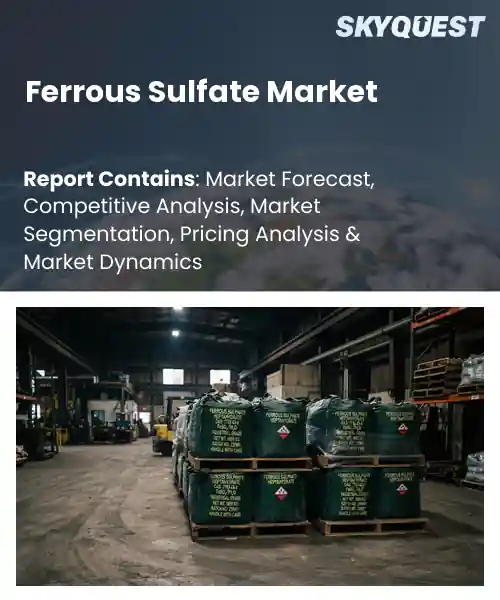
Ferrous Sulfate Market
Report ID: SQMIG15A2848
Report ID: SQMIG15A2848
[email protected]
USA +1 351-333-4748
Report ID:
SQMIG15A2848 |
Region:
Global |
Published Date: August, 2026
Pages:
157
|Tables:
94
|Figures:
76


Global Ferrous Sulfate Market size was valued at USD 4.21 Billion in 2024 and is poised to grow from USD 4.35 Billion in 2025 to USD 5.64 Billion by 2033, growing at a CAGR of 3.3% during the forecast period (2026-2033).
The global ferrous sulfate market revolves around a soluble iron salt widely used in water treatment, agriculture, and steelmaking. Its importance stems from the need to control phosphorus precipitation in power‑plant cooling systems and to supply iron nutrients to crops, actions that directly affect operational efficiency and food security. Demand surged in the 1990s as environmental regulations tightened, prompting utilities to replace lime‑based inhibitors with ferrous sulfate. Adoption by fertilizer producers in Brazil and India amplified consumption, while advances in production lowered costs and expanded applications. Consequently, the market evolved from a niche chemical to a commodity essential for industries. Among the forces shaping the ferrous sulfate market, the expanding demand for sustainable water‑treatment solutions stands out as the principal growth catalyst. When utilities replace chlorine‑based biocides with ferrous sulfate, the chemical precipitates dissolved phosphates, reducing algal blooms and complying with stricter discharge limits; this environmental benefit directly translates into lower treatment‑plant operating costs. In regions such as United States Gulf Coast and northern China, cooling‑tower retrofits have sparked supply contracts, prompting producers to invest in plants and adopt production routes. These developments unlock revenue streams for manufacturers and create export opportunities for producers in Southeast Asia, reinforcing market’s trajectory
How is AI-driven automation influencing pricing strategies in the global ferrous sulfate market?
AI-driven automation is reshaping pricing in the global ferrous sulfate market by feeding real‑time production data into dynamic pricing engines. Machine learning models analyze raw material costs, energy consumption and logistics variables, allowing producers to adjust prices instantly as conditions shift. This reduces the lag between cost changes and price updates, improving margin protection. Automation also supports demand forecasting, so sellers can anticipate seasonal spikes and set tiered pricing that reflects anticipated inventory levels. The result is a more responsive pricing landscape that aligns closely with operational efficiency and market signals, making the sector more competitive and transparent.In June 2024, a leading ferrous sulfate manufacturer integrated an AI pricing platform, streamlining price adjustments and enhancing market responsiveness, supporting growth and operational efficiency.
Market snapshot - (2026-2033)
Global Market Size
USD 4.21 Billion
Largest Segment
Continuous Mining Longwall Systems
Fastest Growth
Ground Support Roof Bolting Equipment
Growth Rate
3.3% CAGR
To get more insights on this market click here to Request a Free Sample Report
Global ferrous sulfate market is segmented by product type, grade, application and region. Based on product type, the market is segmented into Ferrous Sulfate Heptahydrate, Ferrous Sulfate Monohydrate and Ferrous Sulfate Anhydrous. Based on grade, the market is segmented into Pharmaceutical Grade, Food Grade, Industrial Grade and Agricultural Grade. Based on application, the market is segmented into Iron Supplements, Water & Wastewater Treatment, Agriculture & Fertilizers, Food & Feed Additives, Chemical Processing and Other Applications. Based on region, the market is segmented into North America, Europe, Asia Pacific, Latin America and Middle East & Africa.
Ferrous Sulfate Heptahydrate segment dominates because its high solubility and stable crystalline form make it the preferred choice for oral iron supplements. Manufacturers value its consistent bioavailability, which simplifies dosage design and enhances patient compliance. The ease of handling and lower dust generation further reduce processing costs, encouraging widespread adoption across pharmaceutical producers. These technical advantages align with regulatory expectations for purity, reinforcing its leading position in the market.
However, Ferrous Sulfate Monohydrate is witnessing the strongest growth momentum as manufacturers seek a lower hydration form that offers higher iron density while maintaining acceptable solubility. Emerging demand from fortified food products and cost sensitive formulations drives its rapid uptake, creating new opportunities for suppliers to expand production capacity.
Ferrous Sulfate Monohydrate segment leads because its moderate hydration level provides an optimal balance between solubility and iron concentration for water and wastewater treatment applications. The compound efficiently precipitates phosphates and sulfates, improving water quality while remaining easy to store and transport. Its predictable reaction kinetics simplify dosing strategies, reducing operational complexity for treatment facilities and aligning with environmental compliance standards, thereby securing its preferred status among treatment providers.
Meanwhile, Ferrous Sulfate Anhydrous emerges as the fastest expanding subcategory, driven by its high iron content and minimal water footprint, which appeal to chemical processors seeking efficient raw material utilization. Growing interest in green manufacturing and the need for compact storage solutions accelerate its adoption, opening fresh avenues for market growth.
To get detailed segments analysis, Request a Free Sample Report
North America benefits from a mature industrial infrastructure that supports extensive use of ferrous sulfate across water treatment, agricultural, and manufacturing applications. Strong regulatory frameworks encourage the adoption of environmentally responsible chemicals, positioning ferrous sulfate as a preferred option for corrosion control and nutrient supplementation. Robust research and development capabilities foster continuous product improvement, while well‑established distribution networks ensure reliable supply to end users. Collaborative partnerships between producers and key industry sectors enhance technical expertise, reinforcing market confidence. The region’s emphasis on sustainability and cost‑effective solutions further solidifies its leadership role in the global ferrous sulfate landscape.
Ferrous Sulfate Market in the United States is driven by sophisticated water treatment facilities that prioritize corrosion inhibition and heavy metal removal. Advanced agricultural practices integrate ferrous sulfate as a soil amendment to improve nutrient balance and promote crop health. Continuous innovation within chemical manufacturing reinforces product quality, while strategic logistics networks enable efficient distribution across diverse industrial sectors.
Ferrous Sulfate Market in Canada supports a broad array of applications, from municipal water purification to mining operations that require precise mineral processing. Emphasis on environmental stewardship drives the selection of ferrous sulfate for sustainable remediation projects. Collaborative research initiatives between academia and industry enhance understanding of its efficacy, fostering confidence among users and reinforcing market stability.
Europe’s rapid expansion of ferrous sulfate is propelled by stringent environmental regulations that favor low‑impact chemical solutions for water and soil management. Growing demand for sustainable agricultural inputs aligns with the metal’s role in correcting iron deficiencies and enhancing plant resilience. Industrial sectors across the continent adopt ferrous sulfate for corrosion control and effluent treatment, benefitting from its efficiency and cost‑effectiveness. Strong collaboration among manufacturers, research institutions, and policy makers accelerates knowledge sharing and product refinement. The region’s commitment to circular economy principles further encourages the integration of ferrous sulfate into environmentally conscious processes, reinforcing its expanding market presence.
Ferrous Sulfate Market in Germany reflects a dominant position supported by advanced wastewater treatment plants that rely on iron‑based solutions for pollutant removal. Agricultural enterprises leverage the compound to address micronutrient gaps, optimizing yields under precise nutrient management strategies. Ongoing collaboration between chemical producers and technical institutes sustains product innovation, ensuring high standards that meet rigorous regulatory expectations.
Ferrous Sulfate Market in the United Kingdom experiences fast growth driven by intensive water infrastructure upgrades and an increasing focus on sustainable farming practices. The compound’s versatility in mitigating corrosion and enhancing soil iron availability resonates with industry stakeholders seeking efficient and environmentally responsible solutions. Dynamic partnerships between suppliers and end users foster rapid adoption across multiple sectors.
Ferrous Sulfate Market in France is emerging as a key component in both municipal water treatment initiatives and progressive agricultural programs. The emphasis on ecological stewardship encourages the use of ferrous sulfate for its low toxicity and effective contaminant control. Collaborative research efforts enhance understanding of its benefits, supporting gradual market penetration across diverse applications.
Asia Pacific is strengthening its position through a combination of expanding industrial bases and heightened awareness of environmental protection. Rapid development of infrastructure projects demands reliable corrosion inhibitors, positioning ferrous sulfate as a preferred chemical. Agricultural sectors in the region are increasingly adopting iron supplementation to improve soil health and crop productivity, aligning with sustainability objectives. Technological advancements in chemical processing enhance product purity and performance, while government initiatives promote the use of eco‑friendly solutions. Cross‑border collaborations and knowledge exchange among regional manufacturers accelerate market penetration, establishing Asia Pacific as a burgeoning hub for ferrous sulfate utilization.
Ferrous Sulfate Market in Japan supports sophisticated water treatment facilities that prioritize precise iron dosing for contaminant removal. Agricultural producers incorporate the compound to address iron deficiency in soils, enhancing plant vigor under intensive cultivation practices. Continuous research partnerships drive improvements in formulation, reinforcing confidence among industrial users.
Ferrous Sulfate Market in South Korea underpins a range of applications including mining, metal finishing, and advanced irrigation systems. Emphasis on eco‑compatible chemical solutions encourages adoption of ferrous sulfate for its effectiveness in corrosion control and nutrient delivery. Collaborative efforts between manufacturers and academic institutions foster ongoing product optimization.
To know more about the market opportunities by region and country, click here to
Buy The Complete Report
Increasing Demand in Water Treatment
Adoption in Agricultural Fertilizers
Stringent Environmental Regulations
Volatile Raw Material Prices
Request Free Customization of this report to help us to meet your business objectives.
The competitive landscape of the global ferrous sulfate market is shaped by intense rivalry among chemical producers who are accelerating growth through strategic mergers, joint ventures, and technology-driven process improvements. Recent activity includes several companies forming partnerships to enhance liquid ferrous sulfate production efficiency and adopting advanced plant designs to lower energy consumption, thereby strengthening their positions in both bulk and specialty segments.
Top Player’s Company Profile
Recent Developments
SkyQuest’s ABIRAW (Advanced Business Intelligence, Research & Analysis Wing) is our Business Information Services team that Collects, Collates, Correlates, and Analyses the Data collected by means of Primary Exploratory Research backed by robust Secondary Desk research. As per SkyQuest analysis, the global ferrous sulfate market is being propelled primarily by rising demand for water‑treatment solutions, where the chemical’s ability to precipitate phosphates and control scaling makes it a preferred choice for utilities upgrading cooling‑tower and wastewater systems. A secondary boost comes from its growing use in agricultural fertilizers, supplying essential iron to improve crop yields and supporting sustainable farming practices. The market’s strongest foothold remains in North America, driven by mature infrastructure and strict sustainability standards, while the heptahydrate form dominates the product‑type segment thanks to its high solubility and bioavailability in iron‑supplement applications. However, tighter environmental regulations pose a restraint by increasing compliance costs and limiting rapid capacity expansions.
| Report Metric | Details |
|---|---|
| Market size value in 2024 | USD 4.21 Billion |
| Market size value in 2033 | USD 5.64 Billion |
| Growth Rate | 3.3% |
| Base year | 2024 |
| Forecast period | (2026-2033) |
| Forecast Unit (Value) | USD Billion |
| Segments covered |
|
| Regions covered | North America (US, Canada), Europe (Germany, France, United Kingdom, Italy, Spain, Rest of Europe), Asia Pacific (China, India, Japan, Rest of Asia-Pacific), Latin America (Brazil, Rest of Latin America), Middle East & Africa (South Africa, GCC Countries, Rest of MEA) |
| Companies covered |
|
| Customization scope | Free report customization with purchase. Customization includes:-
|
To get a free trial access to our platform which is a one stop solution for all your data requirements for quicker decision making. This platform allows you to compare markets, competitors who are prominent in the market, and mega trends that are influencing the dynamics in the market. Also, get access to detailed SkyQuest exclusive matrix.
Table Of Content
Executive Summary
Market overview
Parent Market Analysis
Market overview
Market size
KEY MARKET INSIGHTS
COVID IMPACT
MARKET DYNAMICS & OUTLOOK
Market Size by Region
KEY COMPANY PROFILES
Methodology
For the Ferrous Sulfate Market, our research methodology involved a mixture of primary and secondary data sources. Key steps involved in the research process are listed below:
1. Information Procurement: This stage involved the procurement of Market data or related information via primary and secondary sources. The various secondary sources used included various company websites, annual reports, trade databases, and paid databases such as Hoover's, Bloomberg Business, Factiva, and Avention. Our team did 45 primary interactions Globally which included several stakeholders such as manufacturers, customers, key opinion leaders, etc. Overall, information procurement was one of the most extensive stages in our research process.
2. Information Analysis: This step involved triangulation of data through bottom-up and top-down approaches to estimate and validate the total size and future estimate of the Ferrous Sulfate Market.
3. Report Formulation: The final step entailed the placement of data points in appropriate Market spaces in an attempt to deduce viable conclusions.
4. Validation & Publishing: Validation is the most important step in the process. Validation & re-validation via an intricately designed process helped us finalize data points to be used for final calculations. The final Market estimates and forecasts were then aligned and sent to our panel of industry experts for validation of data. Once the validation was done the report was sent to our Quality Assurance team to ensure adherence to style guides, consistency & design.
Analyst Support
Customization Options
With the given market data, our dedicated team of analysts can offer you the following customization options are available for the Ferrous Sulfate Market:
Product Analysis: Product matrix, which offers a detailed comparison of the product portfolio of companies.
Regional Analysis: Further analysis of the Ferrous Sulfate Market for additional countries.
Competitive Analysis: Detailed analysis and profiling of additional Market players & comparative analysis of competitive products.
Go to Market Strategy: Find the high-growth channels to invest your marketing efforts and increase your customer base.
Innovation Mapping: Identify racial solutions and innovation, connected to deep ecosystems of innovators, start-ups, academics, and strategic partners.
Category Intelligence: Customized intelligence that is relevant to their supply Markets will enable them to make smarter sourcing decisions and improve their category management.
Public Company Transcript Analysis: To improve the investment performance by generating new alpha and making better-informed decisions.
Social Media Listening: To analyze the conversations and trends happening not just around your brand, but around your industry as a whole, and use those insights to make better Marketing decisions.
REQUEST FOR SAMPLE
 REQUEST FREE CUSTOMIZATION


Want to customize this report? This report can be personalized according to your needs. Our analysts and industry experts will work directly with you to understand your requirements and provide you with customized data in a short amount of time. We offer $1000 worth of FREE customization at the time of purchase.
Feedback From Our Clients


 USA (+1) 351-333-4748

