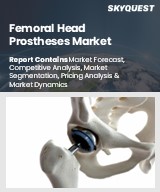
Femoral Head Prostheses Market
Report ID: SQMIG35A3033
Report ID: SQMIG35A3033
[email protected]
USA +1 351-333-4748
Report ID:
SQMIG35A3033 |
Region:
Global |
Published Date: June, 2025
Pages:
192
|Tables:
141
|Figures:
71


Global Femoral Head Prostheses Market size was valued at USD 12.26 Billion in 2024 and is poised to grow from USD 12.96 Billion in 2025 to USD 20.19 Billion by 2033, growing at a CAGR of 5.7% during the forecast period (2026–2033).
The femoral head prostheses market is witnessing steady expansion driven by the global rise in geriatric populations and the growing incidence of orthopedic conditions such as osteoarthritis, hip fractures, and rheumatoid arthritis. As these conditions increasingly affect mobility and quality of life, the demand for surgical interventions like hip replacements has surged. Technological advancements, including the development of more durable materials like ceramic-on-ceramic implants, computer-assisted surgeries, and the integration of 3D printing technologies, are enhancing both patient outcomes and surgeon precision, contributing to the market's momentum.
Hospitals continue to dominate the market as key end-users due to the high volume of complex hip replacement procedures they perform. However, orthopedic clinics and ambulatory surgical centers are gaining prominence owing to their specialized care offerings and cost-effective treatment options. This market trend is also supported by a broader push toward outpatient surgical care, especially in developed regions.
Regionally, North America holds a significant market share, attributed to its advanced healthcare infrastructure, established reimbursement frameworks, and a large elderly population.
How Is AI Revolutionizing Implant Design and Surgical Planning?
AI is playing a transformative role in designing patient-specific femoral head prostheses and assisting surgeons with precise surgical planning. For instance, in 2024, automated systems capable of processing CT scans to generate custom implant designs in under 15 minutes have emerged, helping improve anatomical fit and reduce complications. Tools like Enhatch and PeekMed are also streamlining preoperative planning using standard X-rays, especially benefiting high-volume healthcare facilities like ambulatory surgical centers.
AI-enabled smart implants are changing the way postoperative care is managed. These next-gen implants integrate sensors and wireless connectivity to monitor real-time parameters such as load balance and bone integration. AI algorithms analyze this data to provide early alerts on implant failure, loosening, or infection risk—supporting proactive care and reducing revision surgery rates.
In orthopedics, AI-driven diagnostic systems are achieving high accuracy in identifying complex conditions such as avascular necrosis of the femoral head (AVNFH) from radiographs. These deep learning models are even outperforming junior radiologists, offering valuable support in both clinical and educational settings. Furthermore, AI applications in detecting femoral fractures have reached accuracy levels of up to 98%, making diagnosis faster and more reliable.
Market snapshot - 2026-2033
Global Market Size
USD 11.6 billion
Largest Segment
Cemented
Fastest Growth
Uncemented
Growth Rate
5.7% CAGR
To get more insights on this market click here to Request a Free Sample Report
Global Femoral Head Prostheses Market is segmented by Implant Material, Application, Design, Size, End User and region. Based on Implant Material, the market is segmented into Metal-on-Metal, Ceramic-on-Polyethylene, Ceramic-on-Ceramic and Metal-on-Polyethylene. Based on Application, the market is segmented into Primary Total Hip Arthroplasty (THA), Revision Total Hip Arthroplasty and Hip Resurfacing. Based on Design, the market is segmented into Cemented, Uncemented and Hybrid. Based on Size, the market is segmented into Small, Medium, Large and Extra-Large. Based on End User, the market is segmented into Hospitals, Ambulatory Surgical Centers and Private Orthopedic Clinics. Based on region, the market is segmented into North America, Europe, Asia Pacific, Latin America and Middle East & Africa.
As per the global femoral head prostheses market analysis, primary total hip arthroplasty (THA) is the dominant segment. This is primarily due to the increasing prevalence of hip osteoarthritis and fractures, particularly among the aging population. THA procedures are widely performed for patients suffering from advanced arthritis or hip joint damage, making it the go-to solution for primary hip replacement. The dominance of this segment is also supported by advancements in prosthesis materials and surgical techniques that improve patient outcomes.
However, revision total hip arthroplasty is the growing segment within the market. This growth can be attributed to the increasing number of patients requiring revision surgeries due to the wear and tear of implants, implant failures, or complications arising from primary hip replacements. As the population ages and more people undergo primary THA, the demand for revision procedures naturally increases, fueling the growth of this segment.
As per global femoral head prostheses market outlook, the cemented segment is the dominant one. This dominance is primarily due to its long-established use in hip replacement surgeries, especially for elderly patients with poor bone quality. Cemented prostheses provide strong fixation, making them a reliable choice for a broad range of patients. This segment has been favored for its proven success and predictable outcomes, contributing to its continued dominance in the market.
As per the global femoral head prostheses market forecast, the uncemented segment is the growing segment. Uncemented prostheses, which rely on biological fixation through bone ingrowth, are becoming increasingly popular, particularly among younger and more active patients. The growth of this segment is attributed to the advances in material technologies and the increasing preference for longer-lasting, more durable solutions. Additionally, as patients demand implants that can withstand greater physical activity and longer lifespans, uncemented prostheses are gaining traction.
To get detailed segments analysis, Request a Free Sample Report
As per regional forecast, North America, particularly the United States and Canada, is a dominant region in the market. The demand for femoral head prostheses in this region is driven by a combination of factors, including an aging population, high rates of hip osteoarthritis, and fractures, particularly among the elderly. Furthermore, the presence of leading manufacturers and continuous technological advancements in prosthetics enhance femoral head prostheses market growth.
In the United States, the femoral head prostheses market is driven by a rapidly growing elderly population, which is highly susceptible to hip-related diseases such as osteoarthritis and fractures. The U.S. is also a leader in technological advancements for prosthetics, with many of the world’s largest orthopedic manufacturers headquartered here. With a strong focus on healthcare innovation, the market is expected to see continued growth as new materials, robotic surgery techniques, and 3D printing technologies improve the outcomes of hip replacement surgeries.
As per industry analysis, Canada's femoral head prostheses market is growing steadily, bolstered by the country’s aging demographic and an increased focus on healthcare innovation. The Canadian healthcare system provides comprehensive coverage for joint replacement surgeries, which has led to wider accessibility for patients. Moreover, advancements in surgical techniques, including the increasing use of minimally invasive hip replacement procedures, have contributed to greater demand for femoral head prostheses. The growing number of elderly individuals at risk of hip fractures further boosts the market potential.
As per regional outlook, Asia-Pacific, with its rapidly aging population, especially in countries like Japan and South Korea, is seeing an uptick in demand for femoral head prostheses. These countries have well-developed healthcare systems, which are increasingly adopting advanced medical technologies, including those used in orthopedic surgeries. As more individuals in these regions are living longer, the demand for joint replacements, including femoral head prostheses, continues to grow.
Japan’s aging population is the primary factor driving the demand for femoral head prostheses. With one of the highest proportions of elderly citizens in the world, the country has a high incidence of hip fractures and osteoarthritis, making hip replacement surgeries common. Japan has made great strides in developing cutting-edge medical technologies, and the healthcare system offers strong support for elderly individuals undergoing surgeries. The market is expanding rapidly, as Japan also has a high level of healthcare access, with many facilities utilizing the latest in prosthetics and surgical tools.
South Korea is also experiencing growth in the femoral head prostheses market due to its aging population and highly advanced healthcare infrastructure. South Korea's healthcare system is one of the best in the world, and the country has a growing number of elderly patients requiring hip replacement surgeries. With improvements in orthopedic surgical techniques, the country’s femoral head prostheses market is expected to continue to expand. Increased awareness about joint health and the rising preference for less invasive procedures are further driving this market.
Europe, consisting of countries such as Germany, the UK, and Italy, holds a significant share of the femoral head prostheses market. The aging population, combined with advanced healthcare systems and increasing access to orthopedic procedures, makes this region a key player in the market. As people in Europe live longer, the demand for hip replacements is expected to rise further.
Germany is a major player in the femoral head prostheses market, owing to its robust healthcare system and large aging population. The prevalence of hip-related conditions such as osteoarthritis and fractures is rising, and as a result, the demand for joint replacement surgeries is increasing. Germany is also home to several global medical device manufacturers, contributing to innovations in prosthetic designs and technologies. The market is driven by a strong focus on minimally invasive surgical techniques and personalized prosthetic solutions.
The United Kingdom is seeing an increase in femoral head prostheses usage, driven by the country’s aging population and rising rates of hip osteoarthritis. The UK’s National Health Service (NHS) plays a critical role in providing access to joint replacement surgeries, making femoral head prostheses more accessible to a large portion of the population. Additionally, the UK has made advancements in healthcare policies that improve access to hip replacement surgeries and other orthopedic procedures. Technological innovations, such as robotic-assisted surgeries, are expected to further drive growth in the market.
Italy, with its growing elderly population, is another key contributor to the femoral head prostheses market in Europe. The demand for femoral head prostheses is increasing, driven by the high prevalence of hip-related conditions and a focus on improving healthcare delivery. The country’s healthcare system continues to enhance access to hip replacement procedures, and advancements in surgical techniques are contributing to the adoption of femoral head prostheses.
To know more about the market opportunities by region and country, click here to
Buy The Complete Report
Aging Global Population and Rising Hip Fractures
Technological Advancements and AI Integration
High Cost of Implants and Surgical Procedures
Risk of Implant Failure and Post-Surgical Complications
Request Free Customization of this report to help us to meet your business objectives.
In 2024, the global femoral head prostheses industry remains highly competitive, driven by innovation, strategic collaborations, and product enhancement. Leading medical device companies are focusing on R&D to develop advanced materials that improve implant longevity and reduce complication risks.
As per market strategies, for instance, Zimmer Biomet and Stryker have strengthened their portfolios with the introduction of next-gen ceramic femoral heads that promise greater wear resistance and biocompatibility.
These startups are pioneering next-generation orthopedic implants through a blend of additive manufacturing and biomedical engineering. Focused on developing femoral head prostheses tailored to individual anatomy, the company uses 3D printing to improve implant precision, durability, and integration with natural bone. Their mission is to address challenges in joint replacement surgeries, especially in an aging population by reducing recovery time and enhancing implant longevity through custom-fit solutions.
SkyQuest’s ABIRAW (Advanced Business Intelligence, Research & Analysis Wing) is our Business Information Services team that Collects, Collates, Correlates, and Analyses the Data collected by means of Primary Exploratory Research backed by robust Secondary Desk research.
As per SkyQuest analysis, key drivers leading the growth of the femoral head prostheses market include rising prevalence of orthopedic conditions such as hip arthritis, fractures, and other degenerative joint diseases, particularly among the aging global population. As the demand for joint replacement surgery increases, innovation in prosthetic technology is running market expansion. Aging population, increasing prevalence of hip osteoarthritis, and rising demand for minimally invasive procedures drive market growth. The global femoral head prostheses market is being driven by the factors such as the increased incidences of osteoarthritis (OA), rheumatoid arthritis, and trauma, the increase in the number of hip replacement surgeries, the rising investment in R&D concerning prostheses technology, and the progression in femoral head prostheses technology. The industry is receiving further impetus with the introduction of robotic hip replacement techniques, which are aiding clinicians in customizing surgeries to closely meet the patient’s requirements, further providing improved surgical outcomes with reduced blood loss and less time requirements, which will aid the growth of the femoral head prostheses market.
| Report Metric | Details |
|---|---|
| Market size value in 2024 | USD 12.26 Billion |
| Market size value in 2033 | USD 20.19 Billion |
| Growth Rate | 5.7% |
| Base year | 2024 |
| Forecast period | 2026-2033 |
| Forecast Unit (Value) | USD Billion |
| Segments covered |
|
| Regions covered | North America (US, Canada), Europe (Germany, France, United Kingdom, Italy, Spain, Rest of Europe), Asia Pacific (China, India, Japan, Rest of Asia-Pacific), Latin America (Brazil, Rest of Latin America), Middle East & Africa (South Africa, GCC Countries, Rest of MEA) |
| Companies covered |
|
| Customization scope | Free report customization with purchase. Customization includes:-
|
To get a free trial access to our platform which is a one stop solution for all your data requirements for quicker decision making. This platform allows you to compare markets, competitors who are prominent in the market, and mega trends that are influencing the dynamics in the market. Also, get access to detailed SkyQuest exclusive matrix.
Table Of Content
Executive Summary
Market overview
Parent Market Analysis
Market overview
Market size
KEY MARKET INSIGHTS
COVID IMPACT
MARKET DYNAMICS & OUTLOOK
Market Size by Region
KEY COMPANY PROFILES
Methodology
For the Femoral Head Prostheses Market, our research methodology involved a mixture of primary and secondary data sources. Key steps involved in the research process are listed below:
1. Information Procurement: This stage involved the procurement of Market data or related information via primary and secondary sources. The various secondary sources used included various company websites, annual reports, trade databases, and paid databases such as Hoover's, Bloomberg Business, Factiva, and Avention. Our team did 45 primary interactions Globally which included several stakeholders such as manufacturers, customers, key opinion leaders, etc. Overall, information procurement was one of the most extensive stages in our research process.
2. Information Analysis: This step involved triangulation of data through bottom-up and top-down approaches to estimate and validate the total size and future estimate of the Femoral Head Prostheses Market.
3. Report Formulation: The final step entailed the placement of data points in appropriate Market spaces in an attempt to deduce viable conclusions.
4. Validation & Publishing: Validation is the most important step in the process. Validation & re-validation via an intricately designed process helped us finalize data points to be used for final calculations. The final Market estimates and forecasts were then aligned and sent to our panel of industry experts for validation of data. Once the validation was done the report was sent to our Quality Assurance team to ensure adherence to style guides, consistency & design.
Analyst Support
Customization Options
With the given market data, our dedicated team of analysts can offer you the following customization options are available for the Femoral Head Prostheses Market:
Product Analysis: Product matrix, which offers a detailed comparison of the product portfolio of companies.
Regional Analysis: Further analysis of the Femoral Head Prostheses Market for additional countries.
Competitive Analysis: Detailed analysis and profiling of additional Market players & comparative analysis of competitive products.
Go to Market Strategy: Find the high-growth channels to invest your marketing efforts and increase your customer base.
Innovation Mapping: Identify racial solutions and innovation, connected to deep ecosystems of innovators, start-ups, academics, and strategic partners.
Category Intelligence: Customized intelligence that is relevant to their supply Markets will enable them to make smarter sourcing decisions and improve their category management.
Public Company Transcript Analysis: To improve the investment performance by generating new alpha and making better-informed decisions.
Social Media Listening: To analyze the conversations and trends happening not just around your brand, but around your industry as a whole, and use those insights to make better Marketing decisions.
REQUEST FOR SAMPLE
 REQUEST FREE CUSTOMIZATION


Want to customize this report? This report can be personalized according to your needs. Our analysts and industry experts will work directly with you to understand your requirements and provide you with customized data in a short amount of time. We offer $1000 worth of FREE customization at the time of purchase.
Feedback From Our Clients


 USA (+1) 351-333-4748

