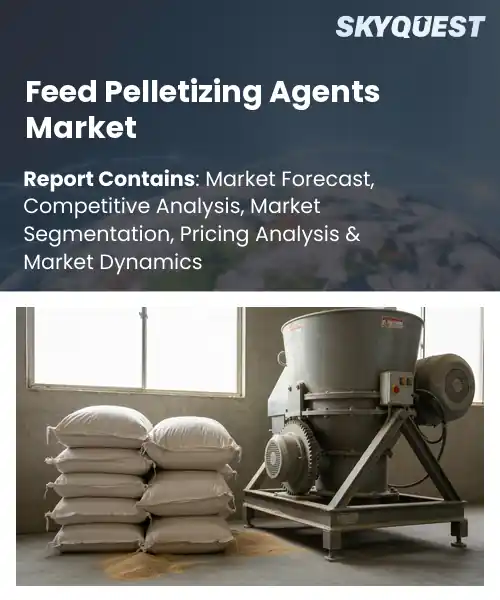
Feed Pelletizing Agents Market
Report ID: SQMIG30H2376
Report ID: SQMIG30H2376
[email protected]
USA +1 351-333-4748
Report ID:
SQMIG30H2376 |
Region:
Global |
Published Date: February, 2026
Pages:
157
|Tables:
206
|Figures:
80


Global Feed Pelletizing Agents Market size was valued at USD 1.86 Billion in 2024 and is poised to grow from USD 1.96 Billion in 2025 to USD 3.04 Billion by 2033, growing at a CAGR of 5.6% during the forecast period (2026-2033).
The feed pelletizing agents market revolves around additives, binders, lubricants and conditioners used to form durable animal feed pellets, and it matters because pellet quality affects feed conversion, storage and transport efficiency. The sector has evolved from simple binders (lignosulfonates and clay) to multi-functional solutions with the use of polymers, enzymes, and organic acids to produce intensively raised poultry, swine, and aquaculture; as demand for uniform pellets increased, feed mills invested in conditioning technology, and regulatory focus on feed safety accelerated the implementation of these chemistries, creating a market that has redefined technical performance, cost pressures and sustainability concerns for product portfolio development.
Building on those industry dynamics, one key trend driving the global feed pelletizing agents sector growth is the pursuit of pellet durability and process efficiency, because stronger pellets reduce fines, lower feed waste and improve animal intake which in turn raises feed conversion ratios and profitability. As mills adopt advanced conditioning, steam injection and targeted binders like polymers or enzymes, energy consumption per tone falls and throughput increases, creating an opportunity for suppliers of performance additives. Measurable cost savings can be realized through the implementation of practical examples such as reducing feed waste for large poultry companies due to the use of automation in their feeding activities.
How is AI Enhancing Quality Control in the Feed Pelletizing Agents Market?
AI is improving quality control in the feed pelletizing agents market by enabling continuous monitoring of pellet formation moisture and density and by optimizing additive dosing through real time sensor and vision data. Models of machine learning can recognize defects in products' surfaces, allowing operators to alter the amount of binder and conditioner being used with the intention of maintaining the integrity of the product being produced. Some examples of this include employing a computer vision system to inspect pelletized products while on the conveyor belt and establishing feedback systems that help modify the ratio of materials being combined to develop pellets in order to achieve consistent binding performance with varying raw materials.
In April 2025, ANDRITZ introduced ACE advanced control expert that integrates AI to adjust process variables in real time and provide an intelligent copilot for operators supporting consistent pellet quality less rework and automated dosing which helps additive suppliers and mills improve yield and support growth by lowering downtime and variation.
Market snapshot - (2026-2033)
Global Market Size
USD 1.86 Billion
Largest Segment
Lignin-based Binders/ Lignosulfonates
Fastest Growth
Specialty Binders
Growth Rate
5.6% CAGR
To get more insights on this market click here to Request a Free Sample Report
Global feed pelletizing agents market is segmented by type, animal type, feed form, delivery format, binder type, raw material, distribution channel and region. Based on type, the market is segmented into lignin-based binders/ lignosulfonates, hemi-cellulose binders, mineral binders (Clays), specialty binders and others. Based on animal type, the market is segmented into ruminant, poultry, swine, aquaculture, pets and others. Based on feed form, the market is segmented into pellets, crumbles and mash. Based on delivery format, the market is segmented into powder, liquid, granules and others.
Based on binder type, the market is segmented into organic binders, inorganic binders and synthetic binders. Based on raw material, the market is segmented into lignocellulosic biomass, starch, animal proteins and synthetic polymers. Based on distribution channel, the market is segmented into direct sales, hypermarkets / supermarkets, specialty agro stores and e‑commerce platforms. Based on region, the market is segmented into North America, Europe, Asia Pacific, Latin America and Middle East & Africa.
Based on the global feed pelletizing agents market share, lignin-based binders/ lignosulfonates segment dominates because these chemistries provide inherently strong adhesion, thermal resilience and moisture tolerance that directly improve pellet durability and feed integrity during processing and transport. Their compatibility with diverse raw materials and ability to reduce energy needs during pelleting drives mill-level adoption. Strong existing supply chains; feed formulators are also familiar with the use of this binder; therefore, it continues to be used as a reliable, low-cost binder in animal feed formulations.
However, Specialty Binders are witnessing the strongest growth momentum as formulators seek tailored performance and clean-label solutions. The combination of new polymer blends with bioactive additives has made possible the development of new types of high-value, sensitive feed ingredients that have the potential to attract a significant amount of investment and regulatory scrutiny. This growing market for premium quality feed has created new business opportunities as well as rapid adoption rates for innovative feed products and applications.
Lignocellulosic biomass segment leads because it supplies versatile feedstock components such as lignin and hemicellulose that can be refined into effective natural binders while aligning with sustainability and circular economy priorities. The vast availability of the product and its compatibility with current pelletizing processes lowers raw material source risk for producers. Increasing use of renewable, as well as low-impact inputs and studies looking into fractionation techniques provide additional motivation to use organic.
However, starch is witnessing the strongest growth momentum as formulators adopt modified starches for cost-effective adhesion and clean-label appeal. Advances in modification techniques improve performance in moisture-sensitive pelleting, enabling wider uptake in poultry and pet feeds. This trend accelerates product innovation and near-term commercialization opportunities for binder manufacturers.
To get detailed segments analysis, Request a Free Sample Report
As per the global feed pelletizing agents market share, Asia Pacific dominates due to a confluence of structural and operational advantages that support broad adoption of pelletizing agents. Producing livestock and aquaculture at a regional level develops a concentrated market, which gives feed manufacturers the incentive to develop a standard quality for their products and to optimize feed conversions. Since there are existing ingredient supply chains, and the manufacturers of feed ingredients are located close by, there is a decrease in procurement friction. Furthermore, investments in technology development, such as processing equipment, and applied research, will accelerate the development of new feed products.
Policy frameworks which have instituted a focus on food safety and efficiency are likely to favour the use of best practice implementation guidelines, and the existence of many specialised suppliers and services within a region can accelerate commercialization. Strong connectivity from the trade links also facilitates knowledge transfer and helps manufacturers develop scale production and marketing in other markets.
Feed pelletizing agents market in Japan emphasizes high quality standards and advanced feed processing. Domestic manufacturers prefer refined formulations that support pellet durability and nutrient retention for livestock and aquaculture. Collaboration between feed companies, equipment makers, and research centers promotes steady improvement in agent performance. The regulatory emphasis on both traceability of feed and safety of feed promotes the use of well-characterized feed additives and supports the continuing investment in improved methods for manufacturing premium quality animal feed through the use of optimized solutions in pelletizing.
Feed pelletizing agents market in South Korea features integrated feed and livestock chains that require consistent pellet quality. Poultry and swine producers incorporate enhanced durability and nutrients into their livestock via advanced additives. Manufacturers and equipment suppliers form relationships that facilitate the rapid transfer of technology; therefore, research partners will adapt formulations based on local raw materials. Productivity and efficiency at all levels of the supply chain will continue to create demand for specialty pelletizing agents in both large scale and small scale operations.
Based on global feed pelletizing agents regional forecast, rapid expansion in North America reflects a combination of structural shifts and innovation within feed production and animal agriculture. The consolidation within feed mills and the move towards more integrated production systems have led to an overall trend of standardized pellet formulations that enhance the capability for improved nutritional uniformity through their handling, which increases the demand for high-quality, consistent pelletizing agents. Continued focus on improvements in productivity and reduction of feed wastage has led many feed manufacturers to utilize agents that can increase the integrity of their pellets and increase feed conversion efficiency.
Close collaboration between ingredient suppliers, equipment suppliers, and large feed manufacturers has expedited the commercial development of new solutions, while regulatory considerations and quality assurance standards have prompted ingredient suppliers to demonstrate transparency in sourcing as well as performance evaluation. At the same time, the focus on sustainable production practices, the welfare of animals, and a resilient feed manufacturing operation have inspired investment in technologies which enable the creation of consistently produced and scalable quantities of quality feed.
Feed pelletizing agents market in United States is driven by advanced feed manufacturing infrastructure and diverse livestock sectors requiring consistent pellet performance. Feed mills have a focus on enhancing pellet durability and nutrient retention through the use of various feed additives in their production of poultry and swine feeds. This process can benefit from collaboration between feed ingredient suppliers, feed equipment manufacturers and researchers to enable validation of feed additive products as well as their scaling for commercial use.
Feed pelletizing agents market in Canada balances industrial feed production with specialized operations that require adaptable formulations. Producers focus on agents maintaining the quality of pellets during various handling and weather conditions while meeting the nutrients for both dairy and beef for all industry purposes. Close collaboration with universities and research centres helps adapt agents to local grains and byproducts. Market preferences for traceability, product consistency, and efficiency underpin selection of tested pelletizing solutions across regions.
As per global feed pelletizing agents regional outlook, Europe is strengthening its position through a combination of stringent quality frameworks, active research collaboration, and a strong focus on sustainability that reshapes formulation priorities. The regulations concerning food safety and proper sourcing have regulated suppliers into verifying the consistency and purity of their products. The initiatives started by companies in the industry toward more pellets and less feed wastage have contributed to this uniformity. With the new adaptive sources of feed and the use of recycle feed applications, there is a need for a customized pelletizing agent capable of handling multiple ingredient profiles.
Products and ideas that are exchanged between various countries and stakeholders (regional organizations, government agencies, and commercial businesses) have stimulated innovation overall as well as made us a leader in environmentally conscious and technically capable pelletizing processes. Increasingly, providers of market services are providing training and application support to give farmers the ability to achieve consistent production results regardless of the size/type of farm or processing facility.
Feed pelletizing agents market trends in Germany reflects high demand for technically robust solutions that integrate with precision feed processing equipment. Equipment manufacturers and feed manufacturers work together to improve agent performance so that pellets are of consistent quality and have a high level of energy efficiency when passing through the pellet mill. Due to stringent regulatory requirements and quality assurance practices, there is an increasing demand for validated formulas (supported by lab testing) and for inputs used to manufacture those validated formulas (i.e., input materials must be traceable).
Feed pelletizing agents market growth in United Kingdom is shaped by active innovation and diverse feed manufacturing models that range from large scale mills to local formulators. Demand centers on agents that balance pellet integrity with flexibility for alternative ingredients and sustainability driven sourcing. Partnerships among suppliers and academic groups advance application guidance and product testing. Market emphasis on traceability, nutritional efficacy, and operational adaptability supports uptake of specialist pelletizing solutions.
Feed pelletizing agents market in France blends traditional agricultural strengths with modern feed technology, generating demand for versatile pelletizing solutions. Cooperative structures and regional feed clusters encourage trials and adaptation of formulations for local crops and processing methods. Suppliers provide environmentally-friendly solutions, along with traceability of the product and consistent pellet integrity (that is, regardless of feed type). Research institutions are closely related to the industry, enabling validation and optimization of agents used in domestic operations.
To know more about the market opportunities by region and country, click here to
Buy The Complete Report
Rising Global Animal Protein Demand
Technological Improvements In Formulations
Variability In Raw Material Quality
Stringent Regulatory Compliance Requirements
Request Free Customization of this report to help us to meet your business objectives.
Competition in the global feed pelletizing agents market outlook is concentrated among specialty chemical and animal nutrition firms vying to supply water stable, bio-based pellet binders and processing aids to feed mills and aquaculture processors. Competition is driven by demand for sustainable, region specific solutions and feed mill qualification cycles. Firms pursue capacity expansions, targeted partnerships and M&A and co development deals to secure long term supply contracts, for example Borregaard capacity growth and ADM co development activity.
SkyQuest’s ABIRAW (Advanced Business Intelligence, Research & Analysis Wing) is our Business Information Services team that Collects, Collates, Correlates, and Analyses the Data collected by means of Primary Exploratory Research backed by robust Secondary Desk research.
As per SkyQuest analysis, the global feed pelletizing agents industry is primarily driven by rising global animal protein demand that compels feed mills to boost pellet durability and feed conversion efficiency, and a second important driver is ongoing technological improvements in formulations and AI-enabled quality control that optimize dosing and reduce process variability. A key restraint remains in variability in raw material quality which forces frequent reformulation and hampers standardization. Asia Pacific dominates the market due to large livestock and aquaculture production and tight ingredient supply chains, while the lignin-based binders/lignosulfonates segment leads because of cost-effectiveness, thermal resilience and compatibility with diverse feed inputs.
| Report Metric | Details |
|---|---|
| Market size value in 2024 | USD 1.86 Billion |
| Market size value in 2033 | USD 3.04 Billion |
| Growth Rate | 5.6% |
| Base year | 2024 |
| Forecast period | (2026-2033) |
| Forecast Unit (Value) | USD Billion |
| Segments covered |
|
| Regions covered | North America (US, Canada), Europe (Germany, France, United Kingdom, Italy, Spain, Rest of Europe), Asia Pacific (China, India, Japan, Rest of Asia-Pacific), Latin America (Brazil, Rest of Latin America), Middle East & Africa (South Africa, GCC Countries, Rest of MEA) |
| Companies covered |
|
| Customization scope | Free report customization with purchase. Customization includes:-
|
To get a free trial access to our platform which is a one stop solution for all your data requirements for quicker decision making. This platform allows you to compare markets, competitors who are prominent in the market, and mega trends that are influencing the dynamics in the market. Also, get access to detailed SkyQuest exclusive matrix.
Table Of Content
Executive Summary
Market overview
Parent Market Analysis
Market overview
Market size
KEY MARKET INSIGHTS
COVID IMPACT
MARKET DYNAMICS & OUTLOOK
Market Size by Region
KEY COMPANY PROFILES
Methodology
For the Feed Pelletizing Agents Market, our research methodology involved a mixture of primary and secondary data sources. Key steps involved in the research process are listed below:
1. Information Procurement: This stage involved the procurement of Market data or related information via primary and secondary sources. The various secondary sources used included various company websites, annual reports, trade databases, and paid databases such as Hoover's, Bloomberg Business, Factiva, and Avention. Our team did 45 primary interactions Globally which included several stakeholders such as manufacturers, customers, key opinion leaders, etc. Overall, information procurement was one of the most extensive stages in our research process.
2. Information Analysis: This step involved triangulation of data through bottom-up and top-down approaches to estimate and validate the total size and future estimate of the Feed Pelletizing Agents Market.
3. Report Formulation: The final step entailed the placement of data points in appropriate Market spaces in an attempt to deduce viable conclusions.
4. Validation & Publishing: Validation is the most important step in the process. Validation & re-validation via an intricately designed process helped us finalize data points to be used for final calculations. The final Market estimates and forecasts were then aligned and sent to our panel of industry experts for validation of data. Once the validation was done the report was sent to our Quality Assurance team to ensure adherence to style guides, consistency & design.
Analyst Support
Customization Options
With the given market data, our dedicated team of analysts can offer you the following customization options are available for the Feed Pelletizing Agents Market:
Product Analysis: Product matrix, which offers a detailed comparison of the product portfolio of companies.
Regional Analysis: Further analysis of the Feed Pelletizing Agents Market for additional countries.
Competitive Analysis: Detailed analysis and profiling of additional Market players & comparative analysis of competitive products.
Go to Market Strategy: Find the high-growth channels to invest your marketing efforts and increase your customer base.
Innovation Mapping: Identify racial solutions and innovation, connected to deep ecosystems of innovators, start-ups, academics, and strategic partners.
Category Intelligence: Customized intelligence that is relevant to their supply Markets will enable them to make smarter sourcing decisions and improve their category management.
Public Company Transcript Analysis: To improve the investment performance by generating new alpha and making better-informed decisions.
Social Media Listening: To analyze the conversations and trends happening not just around your brand, but around your industry as a whole, and use those insights to make better Marketing decisions.
REQUEST FOR SAMPLE
 REQUEST FREE CUSTOMIZATION
Global Feed Pelletizing Agents Market size was valued at USD 1.86 Billion in 2024 and is poised to grow from USD 1.96 Billion in 2025 to USD 3.04 Billion by 2033, growing at a CAGR of 5.6% during the forecast period (2026-2033).
Competition is concentrated among specialty chemical and animal nutrition firms vying to supply water stable, bio based pellet binders and processing aids to feed mills and aquaculture processors. Competition is driven by demand for sustainable, region specific solutions and feed mill qualification cycles. Firms pursue capacity expansions, targeted partnerships and M&A and co development deals to secure long term supply contracts, for example Borregaard capacity growth and ADM co development activity. 'BASF SE', 'Cargill, Incorporated', 'ADM', 'Evonik Industries AG', 'Kemin Industries, Inc.', 'Nutreco N.V.', 'Alltech, Inc.', 'Bentonite Performance Minerals LLC', 'Brenntag Group', 'Pancosma SA', 'Borregaard LignoTech', 'Lallemand Inc.', 'Ashapura Group', 'Hemi-cellulose Binders', 'Mineral Binders (Clays)', 'Specialty Binders', 'Uniscope Inc', 'FeedWorks', 'Ingrepro', 'Sika Corporation'
Improved consumer demand for diverse and higher-quality animal protein has intensified pressure on feed manufacturers to produce nutritionally consistent, durable pellets that enhance feed conversion and minimize wastage; pelletizing agents play a crucial role by improving pellet integrity, reducing fines, and enabling uniform nutrient delivery across batches. As producers prioritize operational efficiency and product quality to meet consumer expectations and retailer standards, the adoption of effective pellet binders and conditioners grows, supporting market expansion for specialized pelletizing formulations and supplier innovation.
Circular Feed Formulation: The feed pelletizing agents market is aligning with circular economy priorities as manufacturers reformulate products to incorporate agricultural byproducts and process residues. Demand grows for binders and conditioners that maintain pellet integrity while accommodating variable input streams. Suppliers are collaborating with processors to develop adaptable chemistries and closed loop sourcing models that reduce waste and enhance traceability. This transition supports brand sustainability claims, enables cost efficiencies across supply chains, and drives innovation in biodegradable and renewable additive technologies for nutrition.
As per the global feed pelletizing agents market share, Asia Pacific dominates due to a confluence of structural and operational advantages that support broad adoption of pelletizing agents. Producing livestock and aquaculture at a regional level develops a concentrated market, which gives feed manufacturers the incentive to develop a standard quality for their products and to optimize feed conversions.


Want to customize this report? This report can be personalized according to your needs. Our analysts and industry experts will work directly with you to understand your requirements and provide you with customized data in a short amount of time. We offer $1000 worth of FREE customization at the time of purchase.
Feedback From Our Clients


 USA (+1) 351-333-4748

