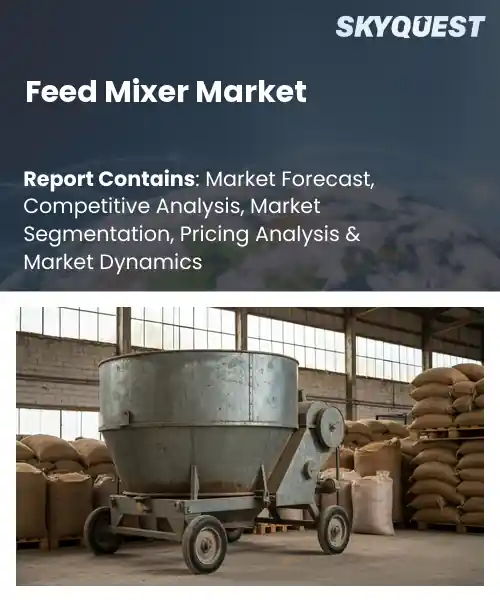
Feed Mixer Market
Report ID: SQMIG20I3062
Report ID: SQMIG20I3062
[email protected]
USA +1 351-333-4748
Report ID:
SQMIG20I3062 |
Region:
Global |
Published Date: June, 2026
Pages:
157
|Tables:
181
|Figures:
79


Global Feed Mixer Market size was valued at USD 781.2 Million in 2024 and is poised to grow from USD 813.85 Million in 2025 to USD 1129.33 Million by 2033, growing at a CAGR of 4.18% during the forecast period (2026-2033).
Animal production drives the feed mixer industry leading to market demands for efficient, accurate formulations and distributions of animal feed. The overall market contains machinery for mixing all types of ingredients and delivering customized rations of feed for poultry, swine, dairy, and aquaculture. Since feed represents the largest portion of an animal’s total production costs, it is very important that all ingredients in the feed be evenly mixed and that they yield positive results in terms of the animals’ health and performance. Historically, the feed mixer sector has evolved from being a manual process of hand mixing ingredients together, sometimes utilizing very basic stationary machinery, to the use of complex high capacity, vertical and horizontal mixers with an integrated scale and PLC control. For example, in North America, mobile truck mixers, and in Europe, high capacity paddle mixers are used to deliver customized rations of feed to animals.
An important aspect of the global feed mixer market is the continuing role automation and increased levels of accuracy are playing in driving growth in the industry. With tight profit margins and more stringent environmental regulations, producers of agri-food products are seeking to extract more value from their inputs. In addition, as farms consolidate, larger farms are installing and using higher-capacity mixers with integrated scales and IoT so that contract mills are investing in throughput and traceability to meet the needs of their customers.
How is AI optimizing formulation accuracy in the feed mixer market?
The formulation accuracy of the feed mixer industry has improved due to the use of artificial intelligence, which utilizes predictive modeling with sensor feedback and real-time process control. Optimizing recipe changes dynamically based on the variability of ingredients is a major benefit of using this technology, as well as making adjustments to mix times and mixing order automatically, and providing batch inventory management integration. Currently, AI works by producing a robust starting point for a given formula and noting deviations from that formula, while operators are relied upon to provide oversight of raw material shifts that are not typical. There have been many reports published in the industry regarding the improved productivity of both the formulation and downstream extrusion processes as a result of implementing proper data pipeline management and model training.
In March 2026, BESTMIX announced the launch of their AI-driven recipe support systems to assist mills in refining their feed formulations and adjusting their production parameters based on ingredient changes in real time while minimizing the need for rework and improving variation and providing faster time-to-market for new feed formulations. By improving efficiency in the feed manufacturing process, companies will benefit from increased operational efficiency and be able to take advantage of growth opportunities within the marketplace.
Market snapshot - (2026-2033)
Global Market Size
USD 781.2 Million
Largest Segment
Horizontal Feed Mixers
Fastest Growth
Self-propelled Feed Mixers
Growth Rate
4.18% CAGR
To get more insights on this market click here to Request a Free Sample Report
Global feed mixer market is segmented by by product type, by capacity, by power source, by application, by operation type, by end user and region. Based on by product type, the market is segmented into Vertical Feed Mixers, Horizontal Feed Mixers, Reel Feed Mixers, Paddle Feed Mixers, Twin-shaft Feed Mixers, Self-propelled Feed Mixers, Trailed Feed Mixers and Stationary Feed Mixers. Based on by capacity, the market is segmented into Below 10 m³, 10 m³ to 20 m³ and Above 20 m³. Based on by power source, the market is segmented into Electric Feed Mixers, Diesel-powered Feed Mixers and PTO-driven Feed Mixers. Based on by application, the market is segmented into Dairy Cattle Feed, Poultry Feed, Swine Feed, Aquaculture Feed, Sheep & Goat Feed and Others. Based on by operation type, the market is segmented into Manual Feed Mixers, Semi-automatic Feed Mixers and Fully Automatic Feed Mixers. Based on by end user, the market is segmented into Livestock Farms, Feed Manufacturing Plants, Agricultural Cooperatives, Research Institutes and Others. Based on region, the market is segmented into North America, Europe, Asia Pacific, Latin America and Middle East & Africa.
Vertical feed mixers segment dominates with feed mixer market share because their compact gravity assisted design delivers consistent blending of diverse ingredients with low power and maintenance needs, making them well suited for varied farm operations. Their ability to handle small batch sizes and frequent mix changes drives operator preference, while simple construction reduces downtime and service costs, which encourages replacement and adoption across farm scales and establishes them as a reliable cost effective choice for feed preparation workflows.
As per feed mixer market outlook, horizontal feed mixers are the most rapidly expanding area due to their superior mixing uniformity and suitability for larger batch volumes, which attracts commercial operations seeking efficiency and consistent total mixed rations. Enhanced automation, faster cycle times and compatibility with precision dosing technologies fuel adoption and open opportunities in larger scale and industrial feed preparation.
As per feed mixer market outlook, fully automatic feed mixers segment stands out because they integrate precise dosing, programmable recipes and closed loop controls to deliver repeatable ration quality with minimal human intervention. This reduces labor burden and human error while enabling traceability and compliance, leading large producers and service providers to prioritize automated systems for consistency. Their interoperability with herd management and sensor systems further reinforces adoption by creating efficient, data driven feed production workflows.
As per feed mixer market outlook, semi-automatic feed mixers are witnessing the strongest growth as they offer a practical automation entry point for medium sized operations, combining manual oversight with automated mixing routines. Incremental upgrades, lower capital requirements and retrofit friendly designs accelerate adoption, enabling wider diffusion of digital controls and creating a stepping stone toward full automation across feed production.
To get detailed segments analysis, Request a Free Sample Report
As per feed mixer market regional forecast, Asia Pacific dominates the market because to the presence of large-scale livestock and aquaculture operations, concentrated clusters of feed production facilities, and a manufacturing environment that supports equipment innovation and customisation. Our extensive supplier networks and local service skills enable rapid adoption of modern mixing technologies and configurations customized to different feed compositions. Close cooperation between machinery manufacturers and feed producers enables continual product development, operational efficiency and aftermarket support. Favorable industrial policy settings and logistics linkages allow for scalability and distribution across regional markets. Competitive manufacturing costs and expanding engineering know-how drive investments in automation and integration of digital control . The presence of established OEMs and a dense supplier base ensures quick customization, reliable availability of spare parts and good local technical support, enhancing the regional leadership in feed mixer supply and services.
As per feed mixer market regional outlook, In Japan, the outlook for the feed mixer market is shaped by sophisticated manufacturing accuracy, a focus on automation, and research partnerships between equipment makers and feed processors. Develop small, efficient designs that are suitable in limited space operations. Specialty feed formulas. Operators wanting low downtime are backed by strong service networks and an emphasis on reliability. Thanks to continuous technical refinement and electronic controls integration, Japanese manufacturers now supply high quality feed mixing solutions for the local market.
South Korea emphasizes compact, efficient equipment designed for livestock clusters. Local engineering focuses on modular designs, straightforward maintenance, and rapid parts availability to reduce operational interruptions. Close cooperation between manufacturers and feed companies supports specialized configurations and improved material handling. Rising adoption of automation and digital monitoring enhances process consistency. Strong aftersales networks and local fabrication capability enable timely customization and dependable service across domestic production hubs.
As per feed mixer industry analysis, the expansion in North America is driven by big commercial livestock and dairy enterprises requiring efficient, scalable feed processing solutions, as well as by well-developed distribution and service networks that facilitate extensive equipment deployment. Focus on feed quality control, consistency and labor savings promote implementation of modern mixing technology and process automation. A strong OEM presence, integration with grain handling and batching systems, and strong aftermarket support allow operators to enhance throughput and eliminate operating friction. Sustainability and ingredient flexibility focus boosts demand for mixers that can handle different formulations. The region has a vibrant market for feed mixing equipment and services, with systems being adapted and implemented quickly in a variety of production systems through close cooperation between equipment vendors, integrators and end users.
United States features large commercial operations, integration with grain handling and batching systems, and demand for high throughput durable machinery. Suppliers and integrators focus on customization, rugged construction, and ease of maintenance to meet operational intensity. Adoption of automation and data driven control supports consistent feed quality. Established distribution and aftermarket networks provide rapid support and parts availability, enabling efficient installation and operational reliability across production systems.
Canada reflects a mix of family farms and commercial operations, valuing versatility, reliability, and ease of maintenance. Manufacturers tailor equipment for varied feed types, material handling challenges, and seasonal cycles. Emphasis on efficiency, durable construction, and simple controls supports remote operations. Strong local dealer networks and service providers ensure parts availability and assistance. Collaboration between suppliers and end users yields adaptable solutions suited to regional production needs.
Europe is strengthening its position through a combination of engineering excellence, regulatory emphasis on feed safety, and a push toward precision feeding and sustainability. Manufacturers prioritize robust, modular designs that can be tailored to diverse feed formulations and production scales, while integration with automation and traceability systems addresses quality assurance demands. Retrofit and modernization programs keep older operations competitive, and cross border supply chains support parts and technical service availability. Cross border supply chains enable parts and technical service availability. Retrofit and modernization initiatives maintain older plants competitive. Such cooperation between equipment manufacturers, research organizations and feed companies helps speed up innovation in the field of material handling, energy efficiency and control systems, and highlights Europe as a region where technical refinement, compliance and aftermarket support are coming together to improve the capabilities of feed mixers. Specialized specialty manufacturers and system integrators with service contracts that include operator training to increase uptime and operational outcomes provide customized solutions for different animal industries.
Germany blends engineering precision with a focus on automation and lasting fabrication. Manufacturers offer modular equipment for applications in livestock and feed mill applications with an emphasis on energy efficient drives and rugged material handling. Particularly, close cooperation with system integrators offers customized plant systems and retrofit alternatives. Dependable spare parts and field assistance are efficiently supported by reliable aftermarket networks and experienced technical service to enable consistent performance and operational resilience in industrial feed operations.
United Kingdom is driven by different farm architecture and the need for versatile and easy to handle equipment. For manufacturers, modularity is king, and being able to move material around in flexible ways is key to serving small farms and big businesses. Retrofit services and integration with automated batching systems to modernize existing operations. Dealer networks and technical support help to supply parts and do field maintenance. Emissions reduction and energy efficient drives influence equipment design and specification.
France combines feed mill craftsmanship with focus on modular, configurable equipment for varied livestock sectors. Manufacturers and cooperatives prefer solutions that balance robustness, ease of cleaning, and flexibility for formulations. Integration with batching systems and emphasis on energy efficient drives support operational efficiency. Local service networks and development with feed companies deliver tailored machines and retrofit options that enhance uptime and sustain feed quality across production systems.
To know more about the market opportunities by region and country, click here to
Buy The Complete Report
Rising Demand For Precision Feeding
Automation And Process Integration
High Capital Investment Requirements
Operational Complexity And Training
Request Free Customization of this report to help us to meet your business objectives.
Competitive dynamics in the global feed mixer industry are driven by consolidation, OEM distribution agreements and product differentiation through automation and telematics. Recent M&A activity such as Vermeer’s acquisition of Schuler illustrates consolidation. Distributor and OEM tie-ups expand geographic reach, as seen in Kverneland’s Siloking listings. Technology leadership from self-propelled, sensor-enabled mixers such as SILOKING SelfLine 4.0 forces rivals to invest in telematics and autonomous feed-distribution capabilities.
SkyQuest’s ABIRAW (Advanced Business Intelligence, Research & Analysis Wing) is our Business Information Services team that Collects, Collates, Correlates, and Analyses the Data collected by means of Primary Exploratory Research backed by robust Secondary Desk research.
As per SkyQuest analysis, the global feed mixer market growth is being driven primarily by intensification of animal production which increases demand for accurate, efficient feed formulation and distribution, and is further propelled by automation and precision technologies that enable tighter margins and traceability. A major restraint remains high capital investment requirements that limit uptake among small and medium producers. Asia Pacific dominates the market due to large livestock and aquaculture sectors and strong manufacturing ecosystems. Vertical feed mixers lead product-type adoption due to compact, gravity-assisted design and low operating costs. Together these dynamics create opportunities for retrofit services, data-driven maintenance and regional expansion into developing markets. The feed mixer market trend shows steady growth, driven by increasing demand for livestock and poultry products, rising adoption of intensive farming practices, and the need for efficient, uniform feed preparation to improve animal productivity.
| Report Metric | Details |
|---|---|
| Market size value in 2024 | USD 781.2 Million |
| Market size value in 2033 | USD 1129.33 Million |
| Growth Rate | 4.18% |
| Base year | 2024 |
| Forecast period | (2026-2033) |
| Forecast Unit (Value) | USD Million |
| Segments covered |
|
| Regions covered | North America (US, Canada), Europe (Germany, France, United Kingdom, Italy, Spain, Rest of Europe), Asia Pacific (China, India, Japan, Rest of Asia-Pacific), Latin America (Brazil, Rest of Latin America), Middle East & Africa (South Africa, GCC Countries, Rest of MEA) |
| Companies covered |
|
| Customization scope | Free report customization with purchase. Customization includes:-
|
To get a free trial access to our platform which is a one stop solution for all your data requirements for quicker decision making. This platform allows you to compare markets, competitors who are prominent in the market, and mega trends that are influencing the dynamics in the market. Also, get access to detailed SkyQuest exclusive matrix.
Table Of Content
Executive Summary
Market overview
Parent Market Analysis
Market overview
Market size
KEY MARKET INSIGHTS
COVID IMPACT
MARKET DYNAMICS & OUTLOOK
Market Size by Region
KEY COMPANY PROFILES
Methodology
For the Feed Mixer Market, our research methodology involved a mixture of primary and secondary data sources. Key steps involved in the research process are listed below:
1. Information Procurement: This stage involved the procurement of Market data or related information via primary and secondary sources. The various secondary sources used included various company websites, annual reports, trade databases, and paid databases such as Hoover's, Bloomberg Business, Factiva, and Avention. Our team did 45 primary interactions Globally which included several stakeholders such as manufacturers, customers, key opinion leaders, etc. Overall, information procurement was one of the most extensive stages in our research process.
2. Information Analysis: This step involved triangulation of data through bottom-up and top-down approaches to estimate and validate the total size and future estimate of the Feed Mixer Market.
3. Report Formulation: The final step entailed the placement of data points in appropriate Market spaces in an attempt to deduce viable conclusions.
4. Validation & Publishing: Validation is the most important step in the process. Validation & re-validation via an intricately designed process helped us finalize data points to be used for final calculations. The final Market estimates and forecasts were then aligned and sent to our panel of industry experts for validation of data. Once the validation was done the report was sent to our Quality Assurance team to ensure adherence to style guides, consistency & design.
Analyst Support
Customization Options
With the given market data, our dedicated team of analysts can offer you the following customization options are available for the Feed Mixer Market:
Product Analysis: Product matrix, which offers a detailed comparison of the product portfolio of companies.
Regional Analysis: Further analysis of the Feed Mixer Market for additional countries.
Competitive Analysis: Detailed analysis and profiling of additional Market players & comparative analysis of competitive products.
Go to Market Strategy: Find the high-growth channels to invest your marketing efforts and increase your customer base.
Innovation Mapping: Identify racial solutions and innovation, connected to deep ecosystems of innovators, start-ups, academics, and strategic partners.
Category Intelligence: Customized intelligence that is relevant to their supply Markets will enable them to make smarter sourcing decisions and improve their category management.
Public Company Transcript Analysis: To improve the investment performance by generating new alpha and making better-informed decisions.
Social Media Listening: To analyze the conversations and trends happening not just around your brand, but around your industry as a whole, and use those insights to make better Marketing decisions.
REQUEST FOR SAMPLE
 REQUEST FREE CUSTOMIZATION
Global Feed Mixer Market size was valued at USD 781.2 Million in 2024 and is poised to grow from USD 813.85 Million in 2025 to USD 1129.33 Million by 2033, growing at a CAGR of 4.18% during the forecast period (2026-2033).
Competitive dynamics in the global feed mixer market are driven by consolidation, OEM distribution agreements and product differentiation through automation and telematics. Recent M&A activity such as Vermeer’s acquisition of Schuler illustrates consolidation. Distributor and OEM tie-ups expand geographic reach, as seen in Kverneland’s Siloking listings. Technology leadership from self-propelled, sensor-enabled mixers such as SILOKING SelfLine 4.0 forces rivals to invest in telematics and autonomous feed-distribution capabilities. 'KUHN Group', 'Trioliet', 'SILOKING Mayer Maschinenbau', 'Faresin Industries', 'Seko Industries', 'Supreme International', 'NDEco', 'Roto-Mix', 'HIMEL Maschinen', 'B. Strautmann & Söhne', 'Vermeer Corporation', 'Jaylor Fabricating', 'Lucas G', 'Tatoma', 'Alltech', 'BvL Maschinenfabrik', 'Anderson Group', 'Zago', 'RMH Lachish Industries', 'Storti'
Precision feed formulations reduce ingredient variability and improve animal performance, prompting livestock producers to invest in modern feed mixers that can accurately blend nutrients and ensure consistent rations. Improved feed efficiency and product uniformity are perceived as direct contributors to herd health and production outcomes, encouraging widespread adoption among commercial operations. Equipment suppliers respond by offering customizable, scalable systems, which further stimulates procurement. The perception of long term operational reliability and feed quality reinforcement motivates farm managers to upgrade existing mixing infrastructure.
Automation And Connectivity Uptake: Feed mixer manufacturers and integrators are advancing automation and connectivity to improve process consistency, reduce feed variability, and enable remote diagnostics. Integration of sensors, control systems, and networked platforms allows real time monitoring of mixing uniformity, component flow, and equipment health, supporting predictive maintenance and operational efficiency. This shift fosters closer collaboration between equipment suppliers and producers, accelerates adoption of smart factory practices, and enhances decision making across feed formulation and production workflows without heavy reliance on manual interventions overall.
Why does Asia Pacific Dominate the Global Feed Mixer Market? |@12


Want to customize this report? This report can be personalized according to your needs. Our analysts and industry experts will work directly with you to understand your requirements and provide you with customized data in a short amount of time. We offer $1000 worth of FREE customization at the time of purchase.
Feedback From Our Clients


 USA (+1) 351-333-4748

