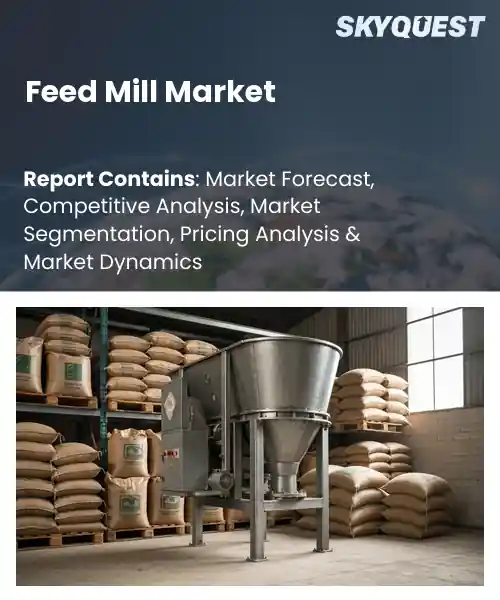
Feed Mill Market
Report ID: SQMIG20I2902
Report ID: SQMIG20I2902
[email protected]
USA +1 351-333-4748
Report ID:
SQMIG20I2902 |
Region:
Global |
Published Date: April, 2026
Pages:
157
|Tables:
89
|Figures:
76


Global Feed Mill Market size was valued at USD 28.5 Billion in 2024 and is poised to grow from USD 29.7 Billion in 2025 to USD 28.6 Billion by 2033, growing at a CAGR of 4.2% during the forecast period (2026-2033).
Rising demand for affordable animal protein is the primary driver of the feed mill market, propelled by population growth and urbanization. The sector converts grains and byproducts into formulated feeds for poultry, swine, ruminants and aquaculture, thereby underpinning livestock productivity and food security. Because feed represents the largest cost, improvements in feed quality and consistency directly influence farm profitability and environmental emissions. Historically the industry shifted from small farm mixers toward large, mechanized, vertically integrated mills as companies adopted pelleting, extrusion and quality control systems. For instance, global agribusinesses expanded regional feed networks to serve intensifying poultry and swine production.One key factor shaping the global feed mill market is raw material cost volatility, which forces mills to adopt flexible formulation strategies and seek alternative ingredients. When soybean and corn prices spike, mills respond by reformulating rations to include coproducts such as distillers grains or by adding amino acid supplements to preserve animal performance. This pressure drives ingredient innovation, evidenced by insect protein trials and algae oils, and encourages investment in formulation software that optimizes nutrition to prices. In practice feed producers that integrate procurement, onsite testing and digital traceability reduce margin risk and capture revenue from niche sustainability customers.
How is IoT enhancing operational efficiency in the feed mill market?
IoT is transforming feed mill operations by linking sensors and controls across ingredient handling, milling and pelleting. Real time data on moisture temperature and machine vibration enables precise recipe management and consistent product quality. Operators now use remote monitoring and predictive maintenance to reduce unplanned downtime and to extend equipment life. In the current market pressure from input costs and tighter regulations drives mills to adopt connected platforms. OEMs and service teams increasingly offer cloud based mill management tools that tie process control to energy management and service support, making operations more responsive and more efficient.Cargill February 2026, the company opened a modern dairy feed plant that exemplifies industry focus on digitalised production. IoT enabled controls and remote monitoring in such facilities support smoother supply chain workflows and faster recipe adjustments, which in turn sustain market growth and operational efficiency.
Market snapshot - (2026-2033)
Global Market Size
USD 28.5 Billion
Largest Segment
Raw/Granular Bee Pollen
Fastest Growth
Capsules & Tablets (Nutraceuticals)
Growth Rate
4.2% CAGR
To get more insights on this market click here to Request a Free Sample Report
Global feed mill market is segmented by product form, application vertical, nature and region. Based on product form, the market is segmented into Raw/Granular Bee Pollen, Powdered Bee Pollen and Capsules & Tablets (Nutraceuticals). Based on application vertical, the market is segmented into Human Nutrition & Supplements, Cosmetics & Personal Care and Animal Feed Additives. Based on nature, the market is segmented into Conventional Bee Pollen and Organic/Certified Bee Pollen. Based on region, the market is segmented into North America, Europe, Asia Pacific, Latin America and Middle East & Africa.
Powdered Bee Pollen segment leads because its fine, uniform particle size and high mixability enable consistent nutrient distribution across batch processes, simplifying formulation and reducing segregation in pelleting operations. This ease of incorporation minimizes handling variability, enhances product uniformity, and supports diverse feed recipes, prompting mills to favor powdered forms to maintain process efficiency and predictable feed quality across production lines.
However, Raw/Granular Bee Pollen is emerging as the fastest growing area because its coarse form lowers processing demands and appeals to producers of textured or minimally processed feeds. Growing interest in clean-label and less-processed ingredients is driving mills to invest in handling adaptations and blending innovations that expand product offerings and open niche opportunities in specialty livestock rations.
Organic/Certified Bee Pollen segment dominates because certification delivers traceability and credibility that align with premium feed positioning and stricter safety expectations, encouraging mills to source verified inputs for health-focused and specialty nutrition products. Certification supports long-term procurement relationships and allows producers to command differentiated positioning in crowded markets, driving formulation strategies that prioritize certified ingredients for market distinction and customer trust.
Conversely, Conventional Bee Pollen is the fastest growing area because its wider availability and lower cost promote rapid adoption in mainstream feeds where affordability and steady supply matter most. Fewer certification barriers accelerate sourcing and uptake, pushing mills to upgrade handling and quality controls that broaden product ranges and enable more producers to incorporate functional pollen ingredients into commercial feed portfolios.
To get detailed segments analysis, Request a Free Sample Report
Asia Pacific dominance in the global feed mill market is driven by a convergence of robust livestock industries, technological adoption, and integrated supply chain ecosystems across key economies. High demand for efficient animal nutrition solutions, investments in feed processing modernization, and proximity to major feed ingredient sources reinforce regional leadership. Public and private stakeholders emphasize quality control, feed safety, and research collaboration, strengthening competitive advantage. Regional manufacturers benefit from scale, diversified feed formulations, and strategic trade linkages that support export oriented operations while enabling rapid adaptation to changing consumer preferences and sustainability expectations across varied agricultural contexts. Supportive regulatory frameworks and expanding research and development networks foster innovation in feed additives and processing technologies, while investments in logistics and cold chain infrastructure reduce bottlenecks. Collaboration between universities, industry and government promotes best practices in animal health and resource efficiency, consolidating the region as a focal point for feed mill expertise.
Feed Mill Market in Japan is characterized by advanced processing technologies, stringent quality assurance practices and close coordination between feed producers and livestock integrators. Emphasis on feed safety, traceability and specialized formulations for high value aquaculture and poultry sectors supports technical sophistication. Domestic producers focus on efficiency improvements, supplier certification and niche product development while aligning with regulatory expectations and consumer demand for sustainable and transparent supply chains and innovation.
Feed Mill Market in South Korea benefits from integrated animal production systems, strong sector investment and uptake of automation in feed processing. Focus on specialty feeds for swine and poultry, combined with rigorous quality controls and supplier traceability, supports premium product positioning. Collaboration among feed companies, research institutes and government agencies encourages development of efficient formulations and adoption of sustainability practices to meet evolving domestic consumption patterns and export opportunities.
Rapid expansion of the feed mill market in North America is propelled by integrated livestock production platforms, innovation in feed formulations and widespread adoption of precision manufacturing practices. Strong collaboration between large commercial producers and ingredient suppliers accelerates supply chain efficiency while emphasis on animal health, feed safety and regulatory compliance enhances market credibility. Technological investments in automation, data driven process control and sustainability measures enable cost effective production across diverse farming systems. Growing interest in specialty feeds and value added additives, along with close industry research partnerships, fosters continuous product development and responsiveness to shifting consumer preferences and environmental standards. Robust logistics networks and proximity to major ingredient sources reduce supply chain friction, while trade channels support domestic demand and shipments. Policy frameworks and industry guidelines emphasize traceability and product integrity, supporting market expansion. Investment in workforce training and cross sector knowledge transfer strengthens operational resilience and scalability.
Feed Mill Market in United States is shaped by commercial operations, advanced automation and strong integration with meat and dairy supply chains. Emphasis on feed safety, ingredient diversification and specialized formulations supports high productivity. Industry research partnerships and vendors drive continuous improvements in nutrient optimization and manufacturing efficiency. Focus on sustainability initiatives and regulatory compliance encourages adoption of waste reduction practices and alternative ingredient use while effectively maintaining product traceability.
Feed Mill Market in Canada is influenced by agricultural regions, emphasis on feed safety protocols and linkages with grain supply chains. Producers prioritize quality assurance, supplier certification and development of regionally tailored formulations for ruminant and poultry systems. Investments in automation and chain logistics enhance operational reliability, while collaborative research programs support innovation in feed efficiency and sustainable ingredient sourcing. Policy guidance and farm level integration further support market resilience.
Europe is strengthening its position in the feed mill market through a coordinated focus on regulatory harmonization, sustainability standards and technological modernization. Industry stakeholders invest in precision manufacturing, ingredient traceability and circular feed solutions that incorporate co products and alternative raw materials. Strong public private research partnerships support feed additive innovation and nutrient efficiency, while harmonized quality frameworks enhance market confidence across borders. Advanced logistics, emphasis on animal welfare and targeted product differentiation for high value livestock sectors reinforce regional competitiveness and enable adaptation to evolving consumer and environmental expectations. National and regional initiatives support digitalization and workforce training to increase operational resilience among medium scale mill operators. Certification schemes and stakeholder audits promote transparency while enabling access to supply chains. Cross border cooperation in research and trade facilitation allows European feed manufacturers to scale advanced solutions and respond to stricter sustainability requirements, strengthening market positioning and stakeholder trust.
Feed Mill Market in Germany combines high automation, strict regulatory oversight and strong industrial linkages with large livestock and aquaculture producers. Emphasis on feed safety, ingredient traceability and certification supports premium market access. Research partnerships with academic institutions encourage additive innovation and nutrient efficiency, while investment in modular equipment and process control enables flexibility for varied feed types. German producers lead in integrating circular feed practices and industrial byproduct utilization.
Feed Mill Market in United Kingdom emphasizes innovation in specialty feeds, quality assurance and strong linkages with high value livestock and aquaculture sectors. Operators prioritize traceability, supplier certification and tailored formulations for premium product segments. Investment in digital monitoring and process optimisation enhances production efficiency, while collaborative networks among feed firms, research centres and policy bodies support adoption of sustainable ingredients and circular economy approaches to further strengthen market credibility.
Feed Mill Market in France emphasizes quality driven feed production and close integration with varied livestock systems. Producers focus on traceability, supplier verification and tailored formulations for dairy and poultry sectors. Investment in automation, additive research and circular feed initiatives enhances resource efficiency. Industry associations, research institutes and regulators collaborate to promote innovation, market differentiation and compliance with sustainability and food safety expectations and resilience across domestic and export channels.
To know more about the market opportunities by region and country, click here to
Buy The Complete Report
Rising Demand For Animal Protein
Advancements In Milling Technology
Volatility In Raw Material Costs
Stringent Food Safety and Standards
Request Free Customization of this report to help us to meet your business objectives.
Competitive landscape is driven by consolidation among equipment and automation vendors and rising competition from alternative ingredient startups. Feed cost volatility and traceability demands push incumbent mill operators into M&A and strategic partnerships, for example automation suites from Bühler and CPM and offtake agreements with insect ingredient firms. Technology differentiation including cloud mill control and novel protein inputs is reshaping buyer choices and partner networks.
Top Player’s Company Profile
Recent Developments
SkyQuest’s ABIRAW (Advanced Business Intelligence, Research & Analysis Wing) is our Business Information Services team that Collects, Collates, Correlates, and Analyses the Data collected by means of Primary Exploratory Research backed by robust Secondary Desk research. As per SkyQuest analysis, the global feed mill market is driven primarily by rising demand for affordable animal protein, supported by a second key driver in advancements in milling technology that enhance efficiency, consistency and formulation capability. Asia Pacific remains the dominating region thanks to large livestock sectors, ingredient access and investment in modernization, while the powdered bee pollen product form is the dominating segment due to its mixability and processing advantages. A major restraint is volatility in raw material costs, which squeezes margins and forces flexible sourcing. Overall the market balances strong technological and demand tailwinds with supply side cost and regulatory challenges.
| Report Metric | Details |
|---|---|
| Market size value in 2024 | USD 28.5 Billion |
| Market size value in 2033 | USD 28.6 Billion |
| Growth Rate | 4.2% |
| Base year | 2024 |
| Forecast period | (2026-2033) |
| Forecast Unit (Value) | USD Billion |
| Segments covered |
|
| Regions covered | North America (US, Canada), Europe (Germany, France, United Kingdom, Italy, Spain, Rest of Europe), Asia Pacific (China, India, Japan, Rest of Asia-Pacific), Latin America (Brazil, Rest of Latin America), Middle East & Africa (South Africa, GCC Countries, Rest of MEA) |
| Companies covered |
|
| Customization scope | Free report customization with purchase. Customization includes:-
|
To get a free trial access to our platform which is a one stop solution for all your data requirements for quicker decision making. This platform allows you to compare markets, competitors who are prominent in the market, and mega trends that are influencing the dynamics in the market. Also, get access to detailed SkyQuest exclusive matrix.
Table Of Content
Executive Summary
Market overview
Parent Market Analysis
Market overview
Market size
KEY MARKET INSIGHTS
COVID IMPACT
MARKET DYNAMICS & OUTLOOK
Market Size by Region
KEY COMPANY PROFILES
Methodology
For the Feed Mill Market, our research methodology involved a mixture of primary and secondary data sources. Key steps involved in the research process are listed below:
1. Information Procurement: This stage involved the procurement of Market data or related information via primary and secondary sources. The various secondary sources used included various company websites, annual reports, trade databases, and paid databases such as Hoover's, Bloomberg Business, Factiva, and Avention. Our team did 45 primary interactions Globally which included several stakeholders such as manufacturers, customers, key opinion leaders, etc. Overall, information procurement was one of the most extensive stages in our research process.
2. Information Analysis: This step involved triangulation of data through bottom-up and top-down approaches to estimate and validate the total size and future estimate of the Feed Mill Market.
3. Report Formulation: The final step entailed the placement of data points in appropriate Market spaces in an attempt to deduce viable conclusions.
4. Validation & Publishing: Validation is the most important step in the process. Validation & re-validation via an intricately designed process helped us finalize data points to be used for final calculations. The final Market estimates and forecasts were then aligned and sent to our panel of industry experts for validation of data. Once the validation was done the report was sent to our Quality Assurance team to ensure adherence to style guides, consistency & design.
Analyst Support
Customization Options
With the given market data, our dedicated team of analysts can offer you the following customization options are available for the Feed Mill Market:
Product Analysis: Product matrix, which offers a detailed comparison of the product portfolio of companies.
Regional Analysis: Further analysis of the Feed Mill Market for additional countries.
Competitive Analysis: Detailed analysis and profiling of additional Market players & comparative analysis of competitive products.
Go to Market Strategy: Find the high-growth channels to invest your marketing efforts and increase your customer base.
Innovation Mapping: Identify racial solutions and innovation, connected to deep ecosystems of innovators, start-ups, academics, and strategic partners.
Category Intelligence: Customized intelligence that is relevant to their supply Markets will enable them to make smarter sourcing decisions and improve their category management.
Public Company Transcript Analysis: To improve the investment performance by generating new alpha and making better-informed decisions.
Social Media Listening: To analyze the conversations and trends happening not just around your brand, but around your industry as a whole, and use those insights to make better Marketing decisions.
REQUEST FOR SAMPLE
 REQUEST FREE CUSTOMIZATION


Want to customize this report? This report can be personalized according to your needs. Our analysts and industry experts will work directly with you to understand your requirements and provide you with customized data in a short amount of time. We offer $1000 worth of FREE customization at the time of purchase.
Feedback From Our Clients


 USA (+1) 351-333-4748

