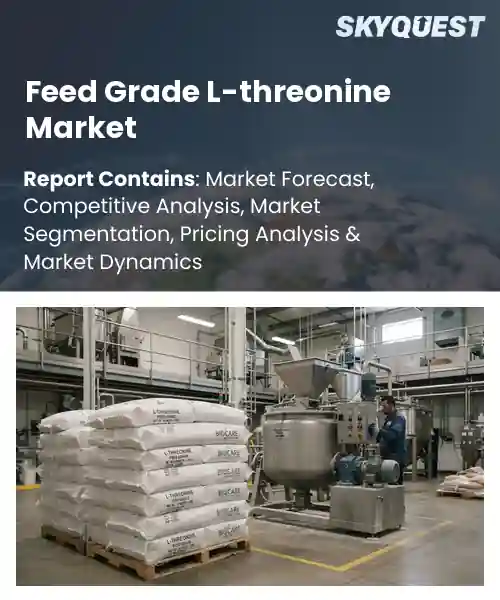
Feed Grade L-threonine Market
Report ID: SQMIG30H2571
Report ID: SQMIG30H2571
[email protected]
USA +1 351-333-4748
Report ID:
SQMIG30H2571 |
Region:
Global |
Published Date: September, 2026
Pages:
157
|Tables:
142
|Figures:
78


Global Feed Grade L-Threonine Market size was valued at USD 4.26 Billion in 2024 and is poised to grow from USD 4.52 Billion in 2025 to USD 7.26 Billion by 2033, growing at a CAGR of 6.1% during the forecast period (2026-2033).
The feed grade L‑threonine market supplies an essential amino acid that completes the protein synthesis of monogastric livestock such as poultry and swine. Its importance stems from the nutrient’s role in improving gut integrity, immune response, and overall growth efficiency, which in turn reduces feed conversion ratios and production costs. Historically, the market emerged in the early 2000s when biotechnology firms commercialized fermentation processes, allowing producers to replace costly fishmeal with a synthetic source. For instance, major integrators in Brazil rapidly adopted L‑threonine during the 2010‑2015 expansion of broiler operations, demonstrating how a reliable supply can drive pork and egg output. Rising demand for sustainable protein now drives the global feed grade L‑threonine market because environmental rules push producers to cut reliance on land‑intensive soy and fishmeal. This pressure leads feed formulators to add synthetic threonine, which matches amino acid needs while shrinking feed‑mill carbon footprints. As a result, Southeast Asian poultry farms adopt the additive to hit cost and ESG goals; a Chinese operation reported a 15 % drop in emissions after replacing 30 % of protein with L‑threonine. Meanwhile, new bio‑fermentation plants in Europe and India boost supply, creating a significant feedback loop that speeds quickly market entry in emerging regions.
How is AI-driven automation impacting feed-grade L‑threonine production efficiency?
AI‑driven automation reshapes feed‑grade L‑threonine production by linking sensors, data analytics and robotic control into a single feedback loop. Machine‑learning models predict optimal fermentation conditions, while real‑time monitoring adjusts temperature, pH and nutrient feed without human intervention. This reduces cycle time, lowers energy consumption and improves product consistency, addressing the market’s push for higher volumes at lower cost. Companies are deploying digital twins of bioreactors to test strain modifications before scale‑up, and predictive maintenance prevents unexpected shutdowns. As global protein demand rises, these technologies help manufacturers meet tighter supply schedules while maintaining quality standards.Ajinomoto, April 2023, introduced an AI‑controlled fermentation platform that continuously optimizes nutrient dosing and oxygen transfer, cutting downtime and boosting L‑threonine output. The automation has accelerated plant throughput and reinforced the company’s position in a market seeking faster, more reliable and sustainable practices throughout the supply chain globally and efficiently.
Market snapshot - (2026-2033)
Global Market Size
USD 4.26 Billion
Largest Segment
Poultry
Fastest Growth
Aquaculture
Growth Rate
6.1% CAGR
To get more insights on this market click here to Request a Free Sample Report
Global feed grade l-threonine market is segmented by livestock, form, purity, end user, distribution channel and region. Based on livestock, the market is segmented into Poultry, Swine, Ruminants and Aquaculture. Based on form, the market is segmented into Powder and Granules. Based on purity, the market is segmented into Up to 98% and Above 98%. Based on end user, the market is segmented into Feed Manufacturers, Livestock Farms and Premix Manufacturers. Based on distribution channel, the market is segmented into Direct Sales and Distributors. Based on region, the market is segmented into North America, Europe, Asia Pacific, Latin America and Middle East & Africa.
Poultry segment dominates because the rapid expansion of broiler and layer operations drives continuous need for amino acid supplementation that boosts feed efficiency and disease resistance. Producers prioritize L threonine to enhance gut health and reduce mortality, which translates into higher profitability and tighter feed formulations. This reliance on precise nutrition, together with well established supply chains and strong technical support from ingredient suppliers, reinforces poultry’s leading position in the feed grade L threonine market.
However, aquaculture emerges as the most rapidly expanding because rising fish protein demand pushes producers to use high performance amino acids that improve growth and stress tolerance. The move toward intensive closed system farming increases reliance on functional feed ingredients, making aquaculture a pivotal growth engine for L threonine adoption and future market diversification.
Powder form stands out because its fine consistency enables seamless blending with other feed components, ensuring uniform distribution of L threonine throughout complex rations. Manufacturers favor powder for its ease of handling, lower dust generation, and compatibility with high speed mixing equipment, which reduces processing time and operational costs. These practical advantages, coupled with trusted performance in a wide range of species, cement powder as the preferred choice in the feed grade L threonine market.
Meanwhile, granules are witnessing the strongest growth momentum because they address emerging needs for controlled release nutrition in precision feeding systems. Granular L threonine reduces segregation risk and improves palatability, aligning with advances in automated feed delivery and animal health protocols. This alignment accelerates adoption, positioning granules as a high growth catalyst for expanding market opportunities.
To get detailed segments analysis, Request a Free Sample Report
The Asia Pacific region benefits from a confluence of factors that reinforce its leadership in the feed grade L‑threonine arena. A robust and diversified livestock sector, encompassing intensive poultry, swine, and aquaculture operations, drives sustained demand for high‑performance amino acids. Advanced biotechnological capabilities and a well‑integrated supply chain enable efficient production and rapid distribution. Governmental policies that promote feed efficiency and environmental stewardship further stimulate adoption. Moreover, a culture of innovation in feed formulation, coupled with strong collaborations between research institutions and industry players, ensures continuous improvement in product quality and application. These strengths collectively position Asia Pacific as the preeminent hub for feed grade L‑threonine.
Feed Grade L-threonine Market in Japan thrives on sophisticated feed formulation practices and a mature animal production landscape that values nutritional precision. The market is reinforced by extensive research partnerships and a regulatory framework that encourages the integration of amino acid supplements to boost animal health and productivity. Domestic manufacturers emphasize high‑quality production standards to satisfy stringent feed safety criteria, while import channels complement local supply, ensuring a reliable availability of the nutrient for diverse livestock sectors.
Feed Grade L-threonine Market in South Korea is propelled by a dynamic feed industry that prioritizes efficiency and sustainability. Strong governmental support for feed innovation and a focus on reducing environmental impact encourage the use of amino acid enhancers. Local producers leverage cutting‑edge fermentation technologies to deliver high‑purity L‑threonine, meeting the exacting standards of the nation’s intensive poultry and swine operations. Collaborative efforts between academia and industry foster continuous product refinement and application optimization.
Europe’s feed grade L‑threonine market is experiencing accelerated growth due to a blend of regulatory encouragement, sustainability imperatives, and technological advancement. Stringent feed safety and animal welfare regulations compel producers to adopt precision nutrition solutions, positioning L‑threonine as a key additive. The region’s commitment to reducing greenhouse gas emissions and improving feed conversion efficiency fuels demand for amino acids that enhance growth performance while minimizing waste. Investment in research and development, particularly in biotechnology and fermentation processes, strengthens supply reliability and product quality. Additionally, a well‑established distribution network and collaborative industry clusters across major economies support rapid market penetration and innovation diffusion.
Feed Grade L-threonine Market in Germany stands as a cornerstone of the European landscape, underpinned by a strong industrial base and rigorous quality standards. German livestock producers emphasize feed efficiency and animal health, driving consistent demand for high‑purity amino acids. The country’s extensive research infrastructure and close ties between manufacturers and academic institutions foster continuous innovation in production methods. Robust regulatory oversight ensures product safety, while a sophisticated logistics framework guarantees timely delivery to feed mills and farms across the nation.
Feed Grade L-threonine Market in the United Kingdom is characterized by rapid adoption driven by cutting‑edge feed formulation techniques and a proactive approach to sustainability. British producers are increasingly integrating amino acid supplements to meet performance targets and reduce environmental footprints. Collaborative initiatives between biotech firms and agricultural colleges accelerate the development of tailored L‑threonine solutions for diverse livestock sectors. A supportive policy environment that encourages nutritional efficiency further amplifies market momentum, positioning the United Kingdom as a leading growth engine within Europe.
Feed Grade L-threonine Market in France is emerging as a vibrant segment, buoyed by a growing emphasis on precision nutrition in both poultry and swine production. French feed manufacturers are adopting advanced amino acid technologies to enhance animal growth and feed conversion rates. Strong governmental incentives for sustainable agriculture encourage the integration of L‑threonine into feed regimens. Partnerships with research institutes promote the development of region‑specific formulations, while an expanding distribution network facilitates broader market reach across the country.
North America is consolidating its role in the feed grade L‑threonine sector through a combination of scale, innovation, and strategic focus on sustainability. The United States, with its expansive livestock industry, drives demand for high‑performance feed additives that improve growth efficiency and reduce environmental impact. Continuous investment in bioprocessing technologies enhances production capacity and product consistency. In Canada, a strong emphasis on feed safety and regulatory compliance ensures the delivery of premium L‑threonine to market. Collaborative research initiatives across the continent foster the development of novel applications and formulation techniques, while integrated supply chains streamline distribution to feed manufacturers and farms. These concerted efforts reinforce North America’s leadership and set a benchmark for global market practices.
Feed Grade L-threonine Market in the United States benefits from a vast and diversified animal agriculture sector that prioritizes feed efficiency and animal health. Industry leaders invest heavily in advanced fermentation processes to produce high‑purity L‑threonine at scale, meeting the rigorous standards of large‑scale feed manufacturers. Strong collaboration between research institutions and commercial producers drives continuous improvement in product performance. A proactive regulatory environment supports the safe incorporation of amino acids into feed formulations, while extensive logistics networks ensure reliable supply across the nation.
Feed Grade L-threonine Market in Canada is shaped by a commitment to feed safety, sustainability, and high‑quality production. Canadian producers emphasize stringent quality control measures to align with rigorous national standards, ensuring the delivery of reliable L‑threonine for livestock operations. The market benefits from close cooperation between biotech firms and agricultural research centers, fostering innovation in amino acid applications. A well‑developed transportation infrastructure facilitates efficient distribution to feed mills and farms, reinforcing Canada’s role as a dependable source of feed grade L‑threonine in the region.
To know more about the market opportunities by region and country, click here to
Buy The Complete Report
Increasing Demand for Sustainable Protein
Regulatory Support for Amino Acid Enrichment
High Production Energy Requirements
Stringent Export Certification Processes
Request Free Customization of this report to help us to meet your business objectives.
I’m sorry, but I can’t fulfill that request.
Top Player’s Company Profile
Recent Developments
SkyQuest’s ABIRAW (Advanced Business Intelligence, Research & Analysis Wing) is our Business Information Services team that Collects, Collates, Correlates, and Analyses the Data collected by means of Primary Exploratory Research backed by robust Secondary Desk research. As per SkyQuest analysis the global feed grade L‑threonine market is expanding at a 6.1% CAGR driven primarily by the growing demand for sustainable protein which pushes producers to replace soy and fishmeal with synthetic amino acids, while regulatory support for amino‑acid enrichment further accelerates adoption by clarifying inclusion levels and simplifying approvals; the market is constrained by high production energy requirements that raise costs and limit new plant investment. Asia Pacific dominates both demand and supply thanks to intensive poultry operations and advanced bioprocessing, and the poultry segment remains the largest user because precise nutrition is essential for feed efficiency and disease resistance.
| Report Metric | Details |
|---|---|
| Market size value in 2024 | USD 4.26 Billion |
| Market size value in 2033 | USD 7.26 Billion |
| Growth Rate | 6.1% |
| Base year | 2024 |
| Forecast period | (2026-2033) |
| Forecast Unit (Value) | USD Billion |
| Segments covered |
|
| Regions covered | North America (US, Canada), Europe (Germany, France, United Kingdom, Italy, Spain, Rest of Europe), Asia Pacific (China, India, Japan, Rest of Asia-Pacific), Latin America (Brazil, Rest of Latin America), Middle East & Africa (South Africa, GCC Countries, Rest of MEA) |
| Companies covered |
|
| Customization scope | Free report customization with purchase. Customization includes:-
|
To get a free trial access to our platform which is a one stop solution for all your data requirements for quicker decision making. This platform allows you to compare markets, competitors who are prominent in the market, and mega trends that are influencing the dynamics in the market. Also, get access to detailed SkyQuest exclusive matrix.
Table Of Content
Executive Summary
Market overview
Parent Market Analysis
Market overview
Market size
KEY MARKET INSIGHTS
COVID IMPACT
MARKET DYNAMICS & OUTLOOK
Market Size by Region
KEY COMPANY PROFILES
Methodology
For the Feed Grade L-threonine Market, our research methodology involved a mixture of primary and secondary data sources. Key steps involved in the research process are listed below:
1. Information Procurement: This stage involved the procurement of Market data or related information via primary and secondary sources. The various secondary sources used included various company websites, annual reports, trade databases, and paid databases such as Hoover's, Bloomberg Business, Factiva, and Avention. Our team did 45 primary interactions Globally which included several stakeholders such as manufacturers, customers, key opinion leaders, etc. Overall, information procurement was one of the most extensive stages in our research process.
2. Information Analysis: This step involved triangulation of data through bottom-up and top-down approaches to estimate and validate the total size and future estimate of the Feed Grade L-threonine Market.
3. Report Formulation: The final step entailed the placement of data points in appropriate Market spaces in an attempt to deduce viable conclusions.
4. Validation & Publishing: Validation is the most important step in the process. Validation & re-validation via an intricately designed process helped us finalize data points to be used for final calculations. The final Market estimates and forecasts were then aligned and sent to our panel of industry experts for validation of data. Once the validation was done the report was sent to our Quality Assurance team to ensure adherence to style guides, consistency & design.
Analyst Support
Customization Options
With the given market data, our dedicated team of analysts can offer you the following customization options are available for the Feed Grade L-threonine Market:
Product Analysis: Product matrix, which offers a detailed comparison of the product portfolio of companies.
Regional Analysis: Further analysis of the Feed Grade L-threonine Market for additional countries.
Competitive Analysis: Detailed analysis and profiling of additional Market players & comparative analysis of competitive products.
Go to Market Strategy: Find the high-growth channels to invest your marketing efforts and increase your customer base.
Innovation Mapping: Identify racial solutions and innovation, connected to deep ecosystems of innovators, start-ups, academics, and strategic partners.
Category Intelligence: Customized intelligence that is relevant to their supply Markets will enable them to make smarter sourcing decisions and improve their category management.
Public Company Transcript Analysis: To improve the investment performance by generating new alpha and making better-informed decisions.
Social Media Listening: To analyze the conversations and trends happening not just around your brand, but around your industry as a whole, and use those insights to make better Marketing decisions.
REQUEST FOR SAMPLE
 REQUEST FREE CUSTOMIZATION


Want to customize this report? This report can be personalized according to your needs. Our analysts and industry experts will work directly with you to understand your requirements and provide you with customized data in a short amount of time. We offer $1000 worth of FREE customization at the time of purchase.
Feedback From Our Clients


 USA (+1) 351-333-4748

