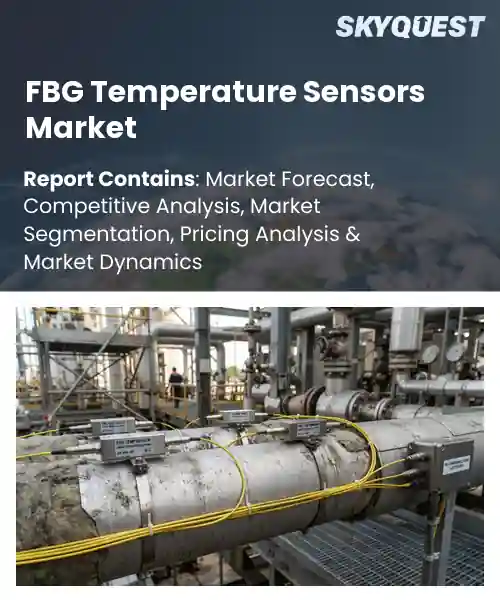
FBG Temperature Sensors Market
Report ID: SQMIG45J2955
Report ID: SQMIG45J2955
[email protected]
USA +1 351-333-4748
Report ID:
SQMIG45J2955 |
Region:
Global |
Published Date: September, 2026
Pages:
157
|Tables:
127
|Figures:
77


Global Fbg Temperature Sensors Market size was valued at USD 119.0 Million in 2024 and is poised to grow from USD 125.19 Million in 2025 to USD 187.8 Million by 2033, growing at a CAGR of 5.2% during the forecast period (2026-2033).
The fiber Bragg grating (FBG) temperature sensor market comprises devices that translate wavelength shifts in an optical fiber into accurate temperature readings, enabling distributed monitoring across harsh environments. Its importance stems from the need for reliable, electromagnetic‑interference‑free measurement in sectors such as power generation, oil‑gas pipelines, and aerospace testing. Historically, the market emerged in the late 1990s when telecom‑grade fibers were repurposed for sensing, but adoption accelerated after 2010 as twins and predictive maintenance gained traction. For example, a European nuclear plant integrated FBG arrays to detect hot‑spot formation, demonstrating safety benefits and cost reductions, thereby cementing the technology’s relevance. This foundational role fuels a second key factor: the convergence of smart‑grid initiatives and Industry 4.0 standards, which demand real‑time thermal data to optimize asset performance. As utilities retrofit aging infrastructure, FBG sensors replace legacy thermocouples because their multiplexing capability reduces wiring complexity while delivering sub‑degree accuracy. Consequently, projects such as a Chinese offshore wind farm now embed FBG strings along turbine blades, enabling predictive blade‑de‑icing and extending service life by up to 15 percent. The ripple effect creates significant opportunities for system integrators to offer end‑to‑end monitoring platforms, while manufacturers continually scale production to meet rising rapidly volume, reinforcing global market momentum.
How is AI-driven automation influencing the accuracy and adoption of FBG temperature sensors?
AI‑driven automation is reshaping fiber Bragg grating temperature sensing by embedding real‑time data analytics directly into interrogation units. Machine‑learning models filter noise, correct drift and predict sensor behavior, which lifts measurement fidelity and reduces calibration effort. Manufacturers now embed AI chips that learn from each deployment, making sensors easier to install and maintain. End‑users benefit from faster commissioning and higher confidence in harsh environments, encouraging broader adoption in energy, aerospace and process industries. The tighter integration of AI also streamlines remote monitoring, turning raw optical signals into actionable temperature insights without manual interpretation.HBM June 2023, introduced an AI‑enabled interrogation platform that auto‑calibrates FBG temperature sensors and predicts aging effects, accelerating rollout and boosting confidence in large‑scale projects.
Market snapshot - (2026-2033)
Global Market Size
USD 119.0 Million
Largest Segment
Fiber Bragg Grating Temperature Sensors
Fastest Growth
Distributed FBG Temperature Sensors
Growth Rate
5.2% CAGR
To get more insights on this market click here to Request a Free Sample Report
Global fbg temperature sensors market is segmented by sensor type, measurement range, application, end user and region. Based on sensor type, the market is segmented into Fiber Bragg Grating Temperature Sensors, Multiplexed FBG Temperature Sensors, Distributed FBG Temperature Sensors, High-Temperature FBG Sensors and Others. Based on measurement range, the market is segmented into Below 100°C, 100–300°C, 301–600°C and Above 600°C. Based on application, the market is segmented into Structural Health Monitoring, Power Generation, Oil and Gas, Aerospace, Industrial Process Monitoring, Medical and Others. Based on end user, the market is segmented into Utilities, Oil and Gas Companies, Aerospace Companies, Industrial Manufacturers, Healthcare Providers and Others. Based on region, the market is segmented into North America, Europe, Asia Pacific, Latin America and Middle East & Africa.
Fiber Bragg Grating Temperature Sensors segment dominates because they represent the foundational technology that offers proven reliability, high sensitivity, and ease of integration into existing monitoring systems, making them the default choice for most customers seeking accurate temperature measurement. Their established manufacturing base, mature interrogation units, and cost‑effective deployment drive widespread adoption across diverse industries, reinforcing their market leadership and creating a strong preference over newer, less proven alternatives.
However, Distributed FBG Temperature Sensors are witnessing the strongest growth momentum because their ability to provide continuous temperature profiling along extensive fiber runs enables spatial resolution for large‑scale infrastructure, attracting investments in smart grids, pipeline monitoring, and advanced manufacturing. This capability fuels rapid adoption and expands market opportunities for next‑generation monitoring solutions.
Structural Health Monitoring segment leads because it demands real‑time, high‑accuracy temperature data to assess material integrity, predict fatigue, and prevent catastrophic failures in critical assets such as bridges, wind turbines, and reactors. The safety‑critical nature of these structures drives stringent monitoring standards, and FBG sensors meet these requirements with low latency, multiplexing capability, and immunity to electromagnetic interference, cementing their preferred status.
Meanwhile, aerospace applications emerge as the key high‑growth area because the sector’s shift toward lighter, more reliable avionics and hypersonic testing creates demand for temperature sensors that can endure extreme thermal cycles while adding minimal weight. Integration of FBG sensors into composite structures and engine components accelerates performance monitoring, encouraging manufacturers to adopt the technology across new aircraft platforms.
To get detailed segments analysis, Request a Free Sample Report
Asia Pacific commands the global FBG Temperature Sensors market through a confluence of advanced manufacturing capabilities, deep expertise in fiber‑optic technologies, and strong demand from high‑growth sectors such as energy, telecommunications, and automotive. The region benefits from an extensive supply chain that links component producers, system integrators, and end‑users, enabling rapid product iteration and cost efficiencies. Government initiatives that promote digital transformation and smart infrastructure further accelerate adoption, while leading research institutions drive continuous innovation in sensor design and calibration. Collaborative ecosystems between multinational corporations and local start‑ups foster agile development, positioning the region as a hub for both volume production and cutting‑edge research, which together reinforce its dominant market standing.
FBG Temperature Sensors Market in Japan is driven by a mature industrial base that emphasizes precision engineering and high reliability standards. Strong demand emerges from semiconductor manufacturing, rail transport monitoring, and offshore energy projects, where temperature accuracy is critical. Close ties between sensor suppliers and automotive OEMs promote customized solutions, while academic research centers contribute to continual performance enhancements, reinforcing Japan’s reputation as a leader in high‑performance fiber‑optic sensing.
FBG Temperature Sensors Market in South Korea thrives on the country’s emphasis on advanced electronics and renewable energy infrastructure. High adoption rates are observed in photovoltaic plant monitoring, smart factory applications, and defense systems that require resilient temperature measurement. Robust collaboration between conglomerates and specialized sensor firms accelerates product integration, while government support for Industry 4.0 initiatives creates a fertile environment for expanding sensor deployment across diverse sectors.
North America experiences rapid expansion of the FBG Temperature Sensors market due to its strong emphasis on innovation, extensive aerospace and oil‑and‑gas activities, and a pervasive culture of predictive maintenance. Significant investment in research and development by both established manufacturers and emerging start‑ups generates continuous improvements in sensor accuracy and durability. The region’s broad adoption of smart grid technologies and high‑value manufacturing processes creates compelling use cases for precise temperature monitoring. Regulatory frameworks that prioritize safety and environmental compliance encourage the shift toward fiber‑optic solutions, while a well‑developed distribution network ensures timely delivery to end‑users. This combination of technological leadership, sector‑specific demand, and supportive policy environment fuels sustained market growth across the continent.
FBG Temperature Sensors Market in the United States is anchored by a vast aerospace sector, extensive energy infrastructure, and intensive research activities within leading universities. Demand is heightened in high‑temperature turbine monitoring, data center thermal management, and large‑scale chemical processing, where accurate temperature data enhances efficiency and safety. Strong collaboration between sensor manufacturers and system integrators enables tailored solutions for complex industrial environments. Federal funding for advanced manufacturing and cybersecurity further supports the integration of fiber‑optic sensors into critical national assets, reinforcing the United States as a pivotal market for sophisticated temperature sensing technologies.
FBG Temperature Sensors Market in Canada benefits from a growing emphasis on renewable energy integration and cold‑region monitoring applications. The country’s expanding wind and hydro power projects require reliable temperature measurement for turbine health and grid stability. Additionally, resource extraction industries employ fiber‑optic sensors to monitor harsh environmental conditions, leveraging the technology’s immunity to electromagnetic interference. Collaborative programs between research institutes and industrial partners drive innovation in sensor packaging suited for low‑temperature performance, positioning Canada as a notable contributor to the broader North American market.
Europe strengthens its position in the FBG Temperature Sensors market through a blend of rigorous standards, deep engineering expertise, and coordinated research initiatives across multiple nations. The region’s strong commitment to energy efficiency and sustainability drives adoption in smart grid, rail transport, and offshore wind monitoring, where precise temperature data supports operational reliability. Collaborative frameworks such as cross‑border research consortia and industry clusters accelerate technology transfer, while well‑established certification processes ensure high product quality and safety compliance. Robust intellectual property ecosystems encourage innovation in sensor miniaturization and multiplexing capabilities. Together, these factors create a fertile environment for both high‑volume manufacturing and niche high‑performance applications, reinforcing Europe’s reputation as a leader in advanced fiber‑optic sensing solutions.
FBG Temperature Sensors Market in Germany is propelled by the nation’s renowned precision engineering culture and its extensive automotive and industrial machinery sectors. High demand is observed in process control for chemical plants, advanced manufacturing lines, and high‑speed rail systems, where temperature stability is paramount. Close cooperation between sensor developers and Tier‑one equipment suppliers fosters the integration of fiber‑optic solutions into complex control architectures. Government incentives for Industry 4.0 adoption further stimulate deployment, enhancing Germany’s role as a pivotal hub for sophisticated temperature sensing technologies.
FBG Temperature Sensors Market in the United Kingdom benefits from a vibrant research ecosystem and strong focus on aerospace and defense applications. Temperature monitoring for jet engine testing, satellite ground stations, and critical infrastructure such as tunnels and bridges drives market activity. Partnerships between universities, innovation hubs, and specialist manufacturers accelerate the development of customized sensor solutions that meet stringent reliability requirements. Public‑private initiatives promoting digital infrastructure and resilient energy networks also expand the application base, solidifying the United Kingdom’s contribution to the European sensor landscape.
FBG Temperature Sensors Market in France is anchored by significant investments in nuclear energy monitoring and high‑speed rail network management. Precise temperature data supports safe operation of reactors and enhances predictive maintenance for rail assets, where downtime costs are substantial. Collaborative projects involving research laboratories, aerospace companies, and sensor manufacturers foster advances in multiplexed sensing and ruggedized designs. National programs encouraging smart city development further integrate temperature sensing into urban infrastructure, reinforcing France’s strategic influence within the European market.
To know more about the market opportunities by region and country, click here to
Buy The Complete Report
Growing Demand For Precision Monitoring
Integration Of IoT Connectivity
High Cost Of Advanced Sensors
Stringent Calibration Certification Requirements
Request Free Customization of this report to help us to meet your business objectives.
Intense competition in the global FBG temperature sensors market is driven by rapid adoption of fiber‑optic monitoring in energy, aerospace and manufacturing, prompting incumbents to pursue M&A, strategic alliances and technology upgrades. Luna Innovations’ acquisition of Micron Optics expanded its sensor portfolio, while Yokogawa’s partnership with IBM integrates AI analytics, both accelerating product differentiation and market penetration.
Top Player’s Company Profile
Recent Developments
SkyQuest’s ABIRAW (Advanced Business Intelligence, Research & Analysis Wing) is our Business Information Services team that Collects, Collates, Correlates, and Analyses the Data collected by means of Primary Exploratory Research backed by robust Secondary Desk research. As per SkyQuest analysis, the global FBG temperature sensors market is being propelled by a growing demand for precision monitoring that enables tighter process control and energy efficiency across power, oil‑gas and aerospace sectors. A second driver is the integration of IoT connectivity which turns distributed sensor data into real‑time analytics and supports predictive maintenance. The dominant region remains Asia Pacific where advanced fiber‑optic manufacturing and strong smart‑infrastructure initiatives create scale advantages. The dominating segment is the core Fiber Bragg Grating Temperature Sensors segment benefiting from proven reliability and cost‑effectiveness. However, high cost of advanced sensors acts as a restraint slowing adoption in price‑sensitive projects.
| Report Metric | Details |
|---|---|
| Market size value in 2024 | USD 119.0 Million |
| Market size value in 2033 | USD 187.8 Million |
| Growth Rate | 5.2% |
| Base year | 2024 |
| Forecast period | (2026-2033) |
| Forecast Unit (Value) | USD Million |
| Segments covered |
|
| Regions covered | North America (US, Canada), Europe (Germany, France, United Kingdom, Italy, Spain, Rest of Europe), Asia Pacific (China, India, Japan, Rest of Asia-Pacific), Latin America (Brazil, Rest of Latin America), Middle East & Africa (South Africa, GCC Countries, Rest of MEA) |
| Companies covered |
|
| Customization scope | Free report customization with purchase. Customization includes:-
|
To get a free trial access to our platform which is a one stop solution for all your data requirements for quicker decision making. This platform allows you to compare markets, competitors who are prominent in the market, and mega trends that are influencing the dynamics in the market. Also, get access to detailed SkyQuest exclusive matrix.
Table Of Content
Executive Summary
Market overview
Parent Market Analysis
Market overview
Market size
KEY MARKET INSIGHTS
COVID IMPACT
MARKET DYNAMICS & OUTLOOK
Market Size by Region
KEY COMPANY PROFILES
Methodology
For the FBG Temperature Sensors Market, our research methodology involved a mixture of primary and secondary data sources. Key steps involved in the research process are listed below:
1. Information Procurement: This stage involved the procurement of Market data or related information via primary and secondary sources. The various secondary sources used included various company websites, annual reports, trade databases, and paid databases such as Hoover's, Bloomberg Business, Factiva, and Avention. Our team did 45 primary interactions Globally which included several stakeholders such as manufacturers, customers, key opinion leaders, etc. Overall, information procurement was one of the most extensive stages in our research process.
2. Information Analysis: This step involved triangulation of data through bottom-up and top-down approaches to estimate and validate the total size and future estimate of the FBG Temperature Sensors Market.
3. Report Formulation: The final step entailed the placement of data points in appropriate Market spaces in an attempt to deduce viable conclusions.
4. Validation & Publishing: Validation is the most important step in the process. Validation & re-validation via an intricately designed process helped us finalize data points to be used for final calculations. The final Market estimates and forecasts were then aligned and sent to our panel of industry experts for validation of data. Once the validation was done the report was sent to our Quality Assurance team to ensure adherence to style guides, consistency & design.
Analyst Support
Customization Options
With the given market data, our dedicated team of analysts can offer you the following customization options are available for the FBG Temperature Sensors Market:
Product Analysis: Product matrix, which offers a detailed comparison of the product portfolio of companies.
Regional Analysis: Further analysis of the FBG Temperature Sensors Market for additional countries.
Competitive Analysis: Detailed analysis and profiling of additional Market players & comparative analysis of competitive products.
Go to Market Strategy: Find the high-growth channels to invest your marketing efforts and increase your customer base.
Innovation Mapping: Identify racial solutions and innovation, connected to deep ecosystems of innovators, start-ups, academics, and strategic partners.
Category Intelligence: Customized intelligence that is relevant to their supply Markets will enable them to make smarter sourcing decisions and improve their category management.
Public Company Transcript Analysis: To improve the investment performance by generating new alpha and making better-informed decisions.
Social Media Listening: To analyze the conversations and trends happening not just around your brand, but around your industry as a whole, and use those insights to make better Marketing decisions.
REQUEST FOR SAMPLE
 REQUEST FREE CUSTOMIZATION


Want to customize this report? This report can be personalized according to your needs. Our analysts and industry experts will work directly with you to understand your requirements and provide you with customized data in a short amount of time. We offer $1000 worth of FREE customization at the time of purchase.
Feedback From Our Clients


 USA (+1) 351-333-4748

