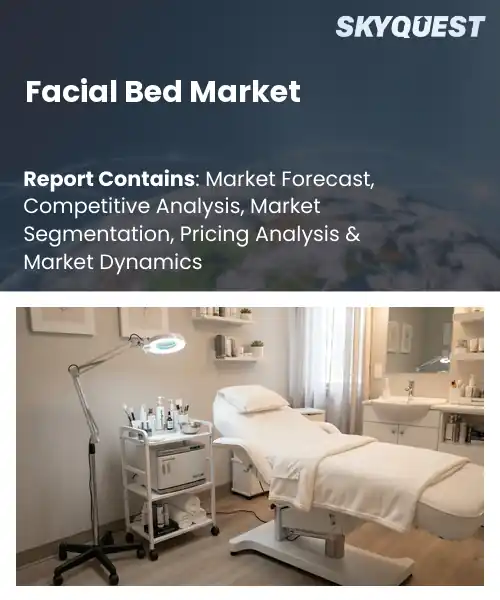
Facial Bed Market
Report ID: SQMIG25S2168
Report ID: SQMIG25S2168
[email protected]
USA +1 351-333-4748
Report ID:
SQMIG25S2168 |
Region:
Global |
Published Date: November, 2026
Pages:
157
|Tables:
119
|Figures:
77


Global Facial Bed Market size was valued at USD 920.0 Million in 2024 and is poised to grow from USD 971.52 Million in 2025 to USD 1502.33 Million by 2033, growing at a CAGR of 5.6% during the forecast period (2026-2033).
The global facial bed market comprises adjustable platforms used in facial procedures such as laser resurfacing, microdermabrasion and injectables. Its importance derives from rising demand for minimally invasive aesthetic treatments driven by aging populations and growing disposable incomes in emerging economies. Historically, the market shifted from simple examination chairs to sophisticated beds with hydraulic lift, lighting and positioning control, a change illustrated by the 2015 launch of the XYZ Pro series. This progression has improved clinical precision, shortened procedure times and created additional revenue streams for dermatology clinics worldwide and expanded service portfolios across private and hospital‑based aesthetic units significantly globally. A principal growth catalyst for the facial bed market is the integration of smart technologies that enable real‑time monitoring and automated adjustments during procedures. By linking beds to patient sensors and treatment software, clinics can maintain optimal facial positioning, temperature and pressure, which reduces complications and enhances patient comfort. This capability has spurred adoption in high‑volume aesthetic centers such as the LA‑based SkinScience Group, where data‑driven protocols lowered average session time by 15 % and increased throughput. Consequently, manufacturers are investing in IoT‑enabled models, creating a feedback loop that drives further clinical innovation and expands market reach into tele‑dermatology platforms today.
How is AI-driven automation influencing growth and product innovation in the facial bed market?
AI-driven automation is reshaping the facial bed market by streamlining product design, manufacturing, and personalized treatment planning. Machine‑learning algorithms analyze skin data to suggest optimal pressure, temperature, and light settings, enabling devices to adapt in real time. Integrated sensors feed continuous feedback to cloud platforms, allowing manufacturers to iterate designs faster and reduce prototyping cycles. Clinics benefit from automated scheduling and remote monitoring, which frees staff to focus on client care while maintaining consistent treatment quality. This convergence of AI and hardware accelerates innovation, shortens time‑to‑market, and expands the range of therapeutic options available to consumers.In March 2023, Silk’n introduced an AI‑enhanced facial bed that automatically calibrates treatment protocols based on individual skin assessments, demonstrating how intelligent automation can boost product performance and market adoption.
Market snapshot - (2026-2033)
Global Market Size
USD 920.0 Million
Largest Segment
Manual Facial Beds
Fastest Growth
Hydraulic Facial Beds
Growth Rate
5.6% CAGR
To get more insights on this market click here to Request a Free Sample Report
Global facial bed market is segmented by product type, configuration, application, end user and region. Based on product type, the market is segmented into Manual Facial Beds, Electric Facial Beds and Hydraulic Facial Beds. Based on configuration, the market is segmented into Fixed Facial Beds, Adjustable Facial Beds and Portable Facial Beds. Based on application, the market is segmented into Facial Treatments, Skincare & Beauty Treatments, Cosmetic Procedures and Other Applications. Based on end user, the market is segmented into Beauty Salons & Spas, Dermatology Clinics, Aesthetic Clinics and Home Users. Based on region, the market is segmented into North America, Europe, Asia Pacific, Latin America and Middle East & Africa.
Electric facial beds segment dominates because they combine automated adjustments with integrated therapeutic functions, meeting the demand for precision and efficiency in professional settings. Their ability to synchronize multiple treatment modalities reduces practitioner fatigue and enhances client experience, prompting widespread adoption among high‑volume establishments. The reliability and ease of use position them as the preferred choice for modern skin‑care operations. Additionally, manufacturers embed smart controls that allow customized protocols, aligning with evolving clinical guidelines and client personalization trends. This technological edge reinforces the segment's leadership across diverse treatment categories.
However, hydraulic facial beds are witnessing the strongest growth momentum because they deliver smooth, multi‑axis positioning that enhances treatment precision for advanced cosmetic procedures. Their ability to support heavier equipment and provide ergonomic support attracts clinics expanding into more complex interventions. This flexibility drives new adoption, opening avenues for broader market penetration and innovation‑driven expansion.
Fixed facial beds segment leads because they provide a stable, robust platform essential for consistent treatment outcomes, especially in high‑throughput environments. Their solid construction minimizes vibration and ensures precise alignment, which is critical for procedures requiring exact positioning. This reliability builds trust among practitioners, reinforcing their status as the foundational equipment across professional settings. It also supports seamless integration with lighting and suction systems, creating a fully optimized treatment environment.
Meanwhile, portable facial beds are emerging as the key high‑growth area because they cater to the rising demand for mobile aesthetic services and in‑home treatments. Their lightweight construction and easy assembly enable practitioners to extend services beyond fixed locations, attracting a new client base seeking convenience. This mobility fuels market expansion and creates fresh revenue streams for providers.
To get detailed segments analysis, Request a Free Sample Report
North America leads the global facial bed market thanks to a convergence of sophisticated healthcare ecosystems, high consumer demand for premium aesthetic services, and a cluster of innovative manufacturers that prioritize product quality and technology integration. The region benefits from well‑established regulatory frameworks that streamline product approvals while ensuring safety, encouraging both domestic and multinational players to invest heavily. Strong purchasing power and a cultural preference for advanced spa and clinical treatments drive consistent adoption across clinics, dermatology centers and luxury wellness facilities. In addition, extensive distribution channels and close collaboration between equipment suppliers and service providers accelerate product rollout and after‑sales support, reinforcing the region’s preeminence in shaping market trends.
Facial Bed Market in United States thrives on a dense network of high‑end aesthetic clinics and a strong culture of cutting‑edge skincare. Leading manufacturers locate research hubs near major medical universities, fostering rapid product iteration. Consumer preference for personalized treatment experiences fuels demand for advanced ergonomic designs, while reimbursement pathways stimulate institutional adoption. Collaborative ecosystems among distributors, service technicians and training institutes ensure swift market penetration and sustained product reliability.
Facial Bed Market in Canada benefits from a funded health system that encourages adoption of clinically validated equipment in dermatology and cosmetic surgery settings. Close proximity to leading research institutions drives product development, emphasizing safety and patient comfort. Consumer awareness of non‑invasive facial rejuvenation fuels boutique spa demand, while strong provincial procurement guidelines streamline acquisition processes. Integrated training programs and after‑sales service reinforce confidence among practitioners and sustain market growth.
Europe experiences rapid expansion of the facial bed market through a blend of sophisticated consumer expectations, harmonized regulatory frameworks, and a deep pool of engineering expertise. Nations prioritize sustainable manufacturing, prompting suppliers to embed eco‑friendly materials and energy‑efficient designs, which resonates with environmentally conscious clinics and spas. A well‑established tradition of facial aesthetics fuels continuous demand for products that combine precision, comfort and digital integration. Collaborative networks linking universities, research institutes and leading manufacturers accelerate innovation cycles, delivering ergonomic solutions tailored to varied treatment modalities. Moreover, strong cross‑border trade agreements simplify distribution, allowing niche brands to reach a broad professional audience and reinforcing Europe’s reputation as a hub for premium facial care equipment. The collective focus on patient safety and outcome quality further amplifies market acceptance.
Facial Bed Market in Germany is anchored by a strong engineering base and a tradition of high‑precision medical device production. Partnerships between leading manufacturers and cosmetic research centers drive refinement of ergonomic features and integrated sensor technologies. Domestic clinics value the reliability and compliance offered by locally sourced equipment, while export‑oriented firms benefit from the country’s reputation for quality. Comprehensive training schemes and responsive service networks further consolidate market position.
Facial Bed Market in United Kingdom is propelled by an aesthetic clinic scene and a regulatory environment that encourages swift product adoption. Innovation hubs within cities collaborate with universities to embed smart connectivity and patient‑feedback loops into facial beds, appealing to practitioners. High consumer willingness to invest in non‑invasive treatments drives demand for devices that combine comfort with clinical efficacy. A after‑sales infrastructure ensures maintenance and upgrades, reinforcing market momentum.
Facial Bed Market in France is as boutique spas and dermatology clinics increasingly prioritize facial rejuvenation experiences. Emphasis on design aesthetics aligns with French consumer appreciation for elegance, prompting manufacturers to integrate sleek forms with therapeutic functions. Collaborative projects with technology institutes foster innovative surface materials and intuitive controls. Supportive local incentives for medical equipment encourage adoption of saving models, while training programs enhance practitioner confidence and accelerate market penetration.
Asia Pacific is strengthening its position in the facial bed market by leveraging a blend of advanced technology adoption, rising consumer interest in aesthetic wellness, and supportive government initiatives. In Japan, a cultural emphasis on meticulous skincare drives demand for precision‑engineered equipment that integrates subtle therapeutic modalities. South Korea’s reputation as a beauty innovation hub fuels rapid incorporation of smart sensors and AI‑guided treatment interfaces, appealing to tech‑savvy clientele. Regional manufacturers focus on compact, space‑efficient designs suited to densely populated urban clinics, while also prioritizing energy efficiency to meet sustainability goals. Collaborative research programs between universities and device makers accelerate product differentiation, and expanding distribution networks across emerging economies broaden market reach, positioning Asia Pacific as a dynamic growth frontier.
Facial Bed Market in Japan is characterized by a focus on precision engineering and integration of therapeutic principles. Leading firms collaborate with dermatology research institutes to embed subtle vibration and temperature controls that align with the Japanese preference for gentle facial treatments. Compact form factors address space constraints in urban clinics, while reliability and low maintenance requirements foster adoption. Dedicated training academies ensure practitioners master advanced functionalities, reinforcing market stability.
Facial Bed Market in South Korea thrives on a culture that blends technology with high aesthetic standards. Manufacturers embed AI‑driven assessment tools and real‑time skin analysis sensors, enabling personalized treatment protocols that resonate with tech‑forward consumers. Sleek, minimalist designs complement modern clinic interiors, while rapid product rollout cycles meet the demand for innovations. Government support for smart medical device development and strong export networks further amplify market dynamism and influence.
To know more about the market opportunities by region and country, click here to
Buy The Complete Report
Increasing Demand For At‑Home Care
Advancements In Skincare Technology
High Cost Of Advanced Devices
Regulatory Hurdles In Certain Regions
Request Free Customization of this report to help us to meet your business objectives.
The global facial bed market is shaped by intense competition among technology‑driven manufacturers, with recent M&A activity consolidating key players and strategic partnerships accelerating product integration. Companies are leveraging advanced LED, microcurrent, and AI‑controlled platforms to differentiate offerings, while joint ventures with skincare brands enable bundled solutions that enhance patient experience and clinic efficiency.
Top Player’s Company Profile
Recent Developments
SkyQuest’s ABIRAW (Advanced Business Intelligence, Research & Analysis Wing) is our Business Information Services team that Collects, Collates, Correlates, and Analyses the Data collected by means of Primary Exploratory Research backed by robust Secondary Desk research. As per SkyQuest analysis, the global facial bed market is propelled primarily by the rising demand for at‑home care, which fuels the rapid growth of portable and smart beds, while advancements in skincare technology such as LED and AI‑driven sensors serve as a second catalyst that enhances treatment precision and client appeal. The market’s leading segment remains electric facial beds, valued for their automated adjustments and integrated therapeutic functions. North America dominates the landscape, benefiting from strong purchasing power, sophisticated clinics and a supportive regulatory environment. However, the high cost of advanced devices restrains broader adoption, especially in price‑sensitive regions, tempering overall expansion.
| Report Metric | Details |
|---|---|
| Market size value in 2024 | USD 920.0 Million |
| Market size value in 2033 | USD 1502.33 Million |
| Growth Rate | 5.6% |
| Base year | 2024 |
| Forecast period | (2026-2033) |
| Forecast Unit (Value) | USD Million |
| Segments covered |
|
| Regions covered | North America (US, Canada), Europe (Germany, France, United Kingdom, Italy, Spain, Rest of Europe), Asia Pacific (China, India, Japan, Rest of Asia-Pacific), Latin America (Brazil, Rest of Latin America), Middle East & Africa (South Africa, GCC Countries, Rest of MEA) |
| Companies covered |
|
| Customization scope | Free report customization with purchase. Customization includes:-
|
To get a free trial access to our platform which is a one stop solution for all your data requirements for quicker decision making. This platform allows you to compare markets, competitors who are prominent in the market, and mega trends that are influencing the dynamics in the market. Also, get access to detailed SkyQuest exclusive matrix.
Table Of Content
Executive Summary
Market overview
Parent Market Analysis
Market overview
Market size
KEY MARKET INSIGHTS
COVID IMPACT
MARKET DYNAMICS & OUTLOOK
Market Size by Region
KEY COMPANY PROFILES
Methodology
For the Facial Bed Market, our research methodology involved a mixture of primary and secondary data sources. Key steps involved in the research process are listed below:
1. Information Procurement: This stage involved the procurement of Market data or related information via primary and secondary sources. The various secondary sources used included various company websites, annual reports, trade databases, and paid databases such as Hoover's, Bloomberg Business, Factiva, and Avention. Our team did 45 primary interactions Globally which included several stakeholders such as manufacturers, customers, key opinion leaders, etc. Overall, information procurement was one of the most extensive stages in our research process.
2. Information Analysis: This step involved triangulation of data through bottom-up and top-down approaches to estimate and validate the total size and future estimate of the Facial Bed Market.
3. Report Formulation: The final step entailed the placement of data points in appropriate Market spaces in an attempt to deduce viable conclusions.
4. Validation & Publishing: Validation is the most important step in the process. Validation & re-validation via an intricately designed process helped us finalize data points to be used for final calculations. The final Market estimates and forecasts were then aligned and sent to our panel of industry experts for validation of data. Once the validation was done the report was sent to our Quality Assurance team to ensure adherence to style guides, consistency & design.
Analyst Support
Customization Options
With the given market data, our dedicated team of analysts can offer you the following customization options are available for the Facial Bed Market:
Product Analysis: Product matrix, which offers a detailed comparison of the product portfolio of companies.
Regional Analysis: Further analysis of the Facial Bed Market for additional countries.
Competitive Analysis: Detailed analysis and profiling of additional Market players & comparative analysis of competitive products.
Go to Market Strategy: Find the high-growth channels to invest your marketing efforts and increase your customer base.
Innovation Mapping: Identify racial solutions and innovation, connected to deep ecosystems of innovators, start-ups, academics, and strategic partners.
Category Intelligence: Customized intelligence that is relevant to their supply Markets will enable them to make smarter sourcing decisions and improve their category management.
Public Company Transcript Analysis: To improve the investment performance by generating new alpha and making better-informed decisions.
Social Media Listening: To analyze the conversations and trends happening not just around your brand, but around your industry as a whole, and use those insights to make better Marketing decisions.
REQUEST FOR SAMPLE
 REQUEST FREE CUSTOMIZATION


Want to customize this report? This report can be personalized according to your needs. Our analysts and industry experts will work directly with you to understand your requirements and provide you with customized data in a short amount of time. We offer $1000 worth of FREE customization at the time of purchase.
Feedback From Our Clients


 USA (+1) 351-333-4748

