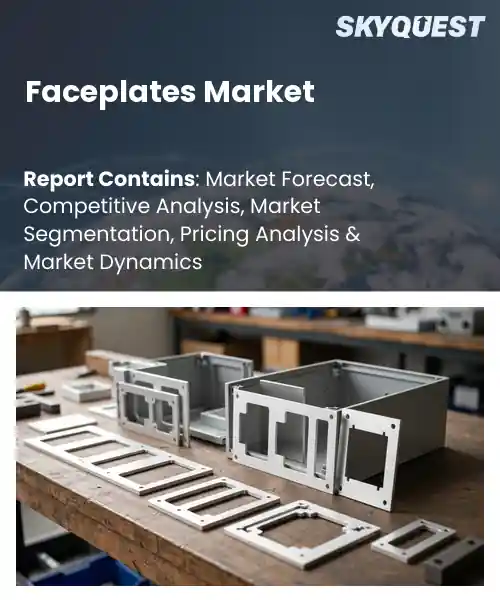
Faceplates Market
Report ID: SQMIG20I2888
Report ID: SQMIG20I2888
[email protected]
USA +1 351-333-4748
Report ID:
SQMIG20I2888 |
Region:
Global |
Published Date: April, 2026
Pages:
157
|Tables:
95
|Figures:
76


Global Faceplates Market size was valued at USD 842.6 Million in 2024 and is poised to grow from USD 877.15 Million in 2025 to USD 845.7 Million by 2033, growing at a CAGR of 4.1% during the forecast period (2026-2033).
The primary driver of the faceplates market is the rapid proliferation of connected devices and the parallel demand for aesthetic and functional integration in commercial and industrial environments. Faceplates, comprising wall plates, outlet and switch covers, port panels and device bezels, matter because they combine safety and durability while enabling neat installation of electrical and data infrastructure. Historically the market shifted from simple stamped metals and bakelite to modular plastics, metal and antimicrobial coatings as building codes, interior design trends and smart home technology evolved. For example, the rise of smart switches and structured cabling systems has driven demand for modular faceplates.A factor shaping global faceplates growth is the shift toward modularity and smart integration, which creates opportunities because systems that require flexible port configurations and embedded electronics need adaptable face solutions. As enterprises deploy denser networking and homeowners adopt smart switches, manufacturers respond by offering snap in modules, sensor enabled bezels and antimicrobial finishes, which accelerates adoption since installers prefer reduced downtime and simpler upgrades. In hospitals antimicrobial faceplates reduce infection risk, while data centers use blankable port panels to manage cable density, demonstrating how product innovation causes expanded specification in procurement and opens niches for customized on demand production.
How is IoT enhancing functionality in the global faceplates market?
IoT is transforming faceplates by turning simple covers into networked hubs that host sensors switches and local intelligence. This allows remote control customization and on device automation while keeping design and finish options intact. Manufacturers and integrators are moving toward modular smart faceplates to simplify retrofits and add cloud connected capabilities for energy awareness and predictive maintenance. Practical examples include scene controllers and smart switches that embed gateways and sensors into the faceplate and outlet plates that combine power data and USB charging in a single unit. These advances make installations neater reduce wiring complexity and improve user experience.Legrand March 2026, the company introduced a radiant Wireless Smart Scene Controller that embeds IoT faceplate controls for scene based automation and remote management. This product reduces setup complexity and leverages cloud connectivity to improve monitoring and interoperability which supports faster adoption and more efficient building operation.
Market snapshot - (2026-2033)
Global Market Size
USD 842.6 Million
Largest Segment
Fastest Growth
Growth Rate
4.1% CAGR
To get more insights on this market click here to Request a Free Sample Report
Global faceplates market is segmented by animal category (major volume drivers), application/end-use, sales channel and region. Based on animal category (major volume drivers), the market is segmented into Livestock (Cattle, Sheep, Pigs, Poultry), Companion Animals (Dogs, Cats, Fish) and Others (Equine & Exotic/Laboratory Animals). Based on application/end-use, the market is segmented into Meat & Dairy Production, Breeding & Genetic Stock and Others (Recreation, Security & Research). Based on sales channel, the market is segmented into Direct Farm-to-Buyer Contracts and Livestock Auctions & Marketplaces. Based on region, the market is segmented into North America, Europe, Asia Pacific, Latin America and Middle East & Africa.
[Livestock] segment dominates because it drives the largest and most consistent demand for robust, standardized faceplates tailored to heavy throughput environments in meat and dairy operations. High operational intensity and strict hygiene requirements create pressure for durable materials, easy sanitation and seamless integration with identification and handling systems, prompting manufacturers to prioritize livestock-grade designs and forge long-term supplier relationships that reinforce market leadership.
However, [Companion Animals] is the fastest growing area due to rising pet ownership and demand for personalized, aesthetic faceplates that integrate with pet wearables and smart home systems. Premiumization and direct to consumer channels accelerate product innovation and allow niche suppliers to scale, creating new accessory and service revenue that broadens market opportunities.
[Direct Farm-to-Buyer Contracts] segment leads because direct procurement fosters predictable purchasing patterns and closer supplier-buyer collaboration that favor customized bulk faceplate solutions aligned with farm workflows. Eliminating intermediaries shortens feedback loops and accelerates specification updates, enabling integrated maintenance and traceability services. These enduring contractual relationships encourage manufacturers to optimize production planning and invest in scalable, farm-specific designs, strengthening this channel's role in the Faceplates Market.
However, [Livestock Auctions & Marketplaces] is the fastest growing channel as digital marketplaces broaden buyer participation and spur demand for modular, portable faceplates engineered for transient handling. Auction driven turnover and reseller activity stimulate lightweight, universal designs and aftermarket services, accelerating product innovation and opening new distribution and revenue pathways in the Faceplates Market.
To get detailed segments analysis, Request a Free Sample Report
Asia Pacific dominates the global faceplates market due to a combination of manufacturing scale, integrated supply chains, and concentrated demand from consumer electronics and industrial automation sectors. Strong regional manufacturing ecosystems enable rapid iteration of design, material sourcing, and cost competitive production, while close collaboration between component suppliers and OEMs accelerates product development cycles. High adoption of smart home and commercial building upgrades, together with growing standards for aesthetic and functional finishes, supports a diverse product mix. Government policies that foster advanced manufacturing and export orientation further reinforce regional competitiveness. Innovation hubs in multiple countries promote materials research and surface treatment technologies, positioning the region as both a production powerhouse and a lead market for design driven faceplate solutions. Service providers and aftermarket networks in the region also support customization and rapid distribution.
Faceplates Market Japan draws on precision manufacturing expertise and advanced materials research, serving design focused electronics OEMs and industrial control producers. Manufacturers emphasize surface finish quality, compact form factors and compatibility with consumer devices. Close collaboration between component suppliers and system integrators enables rapid prototyping and timely introductions. Domestic preference for refined aesthetics and durable finishes, alongside strong export production, sustains a balanced portfolio of specialty and mainstream faceplate offerings.
Faceplates Market South Korea benefits from integration with consumer electronics clusters, strong surface treatment capabilities and focus on compact high performance designs. Local manufacturers emphasize material innovation, thin form factors and precision finishing to meet demand from mobile and appliance producers. Collaborative R and D between suppliers and system makers accelerates product refinement. A well developed supply chain and reputation for rapid customization support a balanced range of faceplate solutions.
North America is experiencing rapid expansion in the faceplates market driven by a convergence of factors including high adoption of smart infrastructure, demand for aesthetic and ergonomic components in consumer electronics, and growth in retrofit and commercial construction activity. A mature distribution network and strong aftermarket services support quick market penetration of new materials and finishes. OEMs and system integrators prioritize regulatory compliance, safety standards and interoperability, which elevates demand for specialized faceplate solutions. Investment by design led manufacturers and partnerships with materials innovators accelerate development of customizable, durable offerings tailored to both residential and industrial applications. The region also benefits from strong warranty and service ecosystems that facilitate adoption of premium and configurable faceplate products. Local prototyping hubs and close collaboration with technology integrators enable faster time to market and targeted customization.
Faceplates Market United States reflects a demand for customizable, standards compliant solutions across residential, commercial and industrial sectors. Emphasis on seamless integration with smart systems and durable finishes drives procurement from design conscious OEMs. Robust aftermarket channels and prototyping services enable localized customization and quick iterations. Collaboration between materials suppliers and integrators accelerates development of premium, performance oriented faceplates that cater to aesthetic preferences and stringent safety and interoperability requirements.
Faceplates Market Canada is characterized by demand for durable, climate resilient finishes and emphasis on compliance with regional safety and performance guidelines. Manufacturers focus on versatile design options that suit residential retrofit projects and commercial installations. Collaboration between domestic suppliers and OEMs supports tailored offerings and supply chain reliability. Service networks and procurement practices encourage adoption of modular, maintainable faceplates that balance aesthetic appeal with functional robustness across diverse environments.
Europe is strengthening its position in the faceplates market through a combination of design leadership, stringent regulatory frameworks, and focused investments in sustainable materials and manufacturing processes. A concentration of premium appliance and building systems manufacturers drives demand for high quality finishes, innovative textures and recyclable substrates. Strong cross border collaboration between design studios, material scientists and specialized fabricators enables customization for niche architectural and industrial applications. Emphasis on lifecycle considerations and circularity compels suppliers to develop durable, repairable faceplate solutions. Robust standards for safety and interoperability, together with well established specification channels in commercial projects, enhance preference for certified, high performance products. Regional clusters also support rapid prototype to production transitions, elevating Europe as a market for differentiated, design driven and environmentally conscious faceplate innovations.
Faceplates Market Germany centers on precision engineering, functional durability and seamless integration with industrial control systems. Manufacturers prioritize material performance, robust surface treatments and adherence to stringent safety and interoperability standards. Close collaboration between machinery producers and fabricators produces bespoke faceplate solutions for automation and commercial equipment. Advanced finishing techniques and modular design approaches meet demanding application requirements. Engineering quality drives preference for technically robust faceplate offerings in specialized sectors.
Faceplates Market United Kingdom combines strong design orientation with refined aesthetics and smart building integration. Manufacturers and studios collaborate to deliver customizable faceplates that marry visual appeal with functional performance. Emphasis on sustainable, recyclable materials aligns with procurement priorities for commercial and residential projects. Rigorous specification practices and close engagement with architects and integrators facilitate introduction of premium, tailored faceplate solutions suited to both heritage refurbishment and modern construction contexts.
Faceplates Market France is driven by industrial design influence and architectural integration, emphasizing refined finishes and material innovation. Manufacturers partner with design houses to deliver faceplates that combine aesthetics and tactile quality for luxury consumer products and tailored commercial installations. Emphasis on sustainable, recyclable substrates and advanced coating techniques matches procurement preferences of architects and specifiers. Strong coordination between fabricators and installers facilitates practical, design focused solutions for projects.
To know more about the market opportunities by region and country, click here to
Buy The Complete Report
Increasing Demand For Aesthetic Finishes
Integration With Smart Home Systems
High Material And Production Costs
Fragmented Regulatory and Compatibility Standards
Request Free Customization of this report to help us to meet your business objectives.
Do you mean wall and switch faceplates used in electrical and smart-home installations, or faceplates for consumer devices? I need to confirm the category before I search and produce the Competitive Landscape with two verified startups founded in 2019 or later.
Top Player’s Company Profile
Recent Developments
SkyQuest’s ABIRAW (Advanced Business Intelligence, Research & Analysis Wing) is our Business Information Services team that Collects, Collates, Correlates, and Analyses the Data collected by means of Primary Exploratory Research backed by robust Secondary Desk research. As per SkyQuest analysis, the global faceplates market is being propelled primarily by the rapid proliferation of connected devices and growing demand for aesthetic and functional integration in commercial and residential spaces, while IoT-enabled faceplates that host sensors and embedded intelligence form a secondary driver by enabling remote control, automation and neater installations. Asia Pacific dominates the market thanks to manufacturing scale, integrated supply chains and strong adoption of smart infrastructure, and the livestock segment leads volumes driven by robust, hygienic specifications for high-throughput operations. High material and production costs remain a key restraint, limiting adoption of premium and technologically enhanced offerings in price-sensitive segments.
| Report Metric | Details |
|---|---|
| Market size value in 2024 | USD 842.6 Million |
| Market size value in 2033 | USD 845.7 Million |
| Growth Rate | 4.1% |
| Base year | 2024 |
| Forecast period | (2026-2033) |
| Forecast Unit (Value) | USD Million |
| Segments covered |
|
| Regions covered | North America (US, Canada), Europe (Germany, France, United Kingdom, Italy, Spain, Rest of Europe), Asia Pacific (China, India, Japan, Rest of Asia-Pacific), Latin America (Brazil, Rest of Latin America), Middle East & Africa (South Africa, GCC Countries, Rest of MEA) |
| Companies covered |
|
| Customization scope | Free report customization with purchase. Customization includes:-
|
To get a free trial access to our platform which is a one stop solution for all your data requirements for quicker decision making. This platform allows you to compare markets, competitors who are prominent in the market, and mega trends that are influencing the dynamics in the market. Also, get access to detailed SkyQuest exclusive matrix.
Table Of Content
Executive Summary
Market overview
Parent Market Analysis
Market overview
Market size
KEY MARKET INSIGHTS
COVID IMPACT
MARKET DYNAMICS & OUTLOOK
Market Size by Region
KEY COMPANY PROFILES
Methodology
For the Faceplates Market, our research methodology involved a mixture of primary and secondary data sources. Key steps involved in the research process are listed below:
1. Information Procurement: This stage involved the procurement of Market data or related information via primary and secondary sources. The various secondary sources used included various company websites, annual reports, trade databases, and paid databases such as Hoover's, Bloomberg Business, Factiva, and Avention. Our team did 45 primary interactions Globally which included several stakeholders such as manufacturers, customers, key opinion leaders, etc. Overall, information procurement was one of the most extensive stages in our research process.
2. Information Analysis: This step involved triangulation of data through bottom-up and top-down approaches to estimate and validate the total size and future estimate of the Faceplates Market.
3. Report Formulation: The final step entailed the placement of data points in appropriate Market spaces in an attempt to deduce viable conclusions.
4. Validation & Publishing: Validation is the most important step in the process. Validation & re-validation via an intricately designed process helped us finalize data points to be used for final calculations. The final Market estimates and forecasts were then aligned and sent to our panel of industry experts for validation of data. Once the validation was done the report was sent to our Quality Assurance team to ensure adherence to style guides, consistency & design.
Analyst Support
Customization Options
With the given market data, our dedicated team of analysts can offer you the following customization options are available for the Faceplates Market:
Product Analysis: Product matrix, which offers a detailed comparison of the product portfolio of companies.
Regional Analysis: Further analysis of the Faceplates Market for additional countries.
Competitive Analysis: Detailed analysis and profiling of additional Market players & comparative analysis of competitive products.
Go to Market Strategy: Find the high-growth channels to invest your marketing efforts and increase your customer base.
Innovation Mapping: Identify racial solutions and innovation, connected to deep ecosystems of innovators, start-ups, academics, and strategic partners.
Category Intelligence: Customized intelligence that is relevant to their supply Markets will enable them to make smarter sourcing decisions and improve their category management.
Public Company Transcript Analysis: To improve the investment performance by generating new alpha and making better-informed decisions.
Social Media Listening: To analyze the conversations and trends happening not just around your brand, but around your industry as a whole, and use those insights to make better Marketing decisions.
REQUEST FOR SAMPLE
 REQUEST FREE CUSTOMIZATION


Want to customize this report? This report can be personalized according to your needs. Our analysts and industry experts will work directly with you to understand your requirements and provide you with customized data in a short amount of time. We offer $1000 worth of FREE customization at the time of purchase.
Feedback From Our Clients


 USA (+1) 351-333-4748

