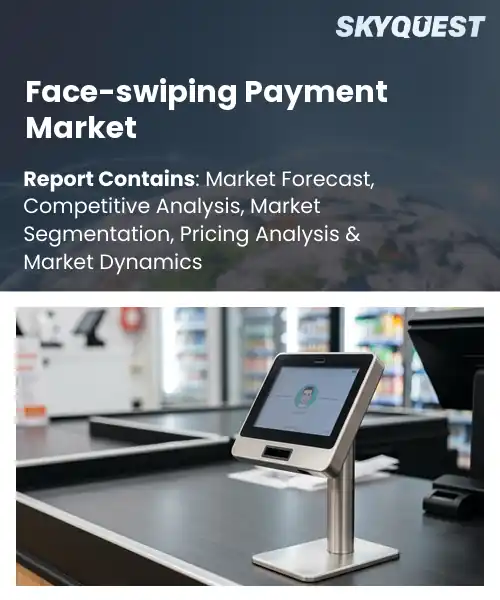
Face-swiping Payment Market
Report ID: SQMIG40D2050
Report ID: SQMIG40D2050
[email protected]
USA +1 351-333-4748
Report ID:
SQMIG40D2050 |
Region:
Global |
Published Date: April, 2026
Pages:
157
|Tables:
117
|Figures:
77


Global Face-Swiping Payment Market size was valued at USD 6.82 Billion in 2024 and is poised to grow from USD 8.14 Billion in 2025 to USD 6.9 Billion by 2033, growing at a CAGR of 19.4% during the forecast period (2026-2033).
Face-swiping payment systems use facial biometrics to authenticate transactions by matching a live image to a stored identity profile, effectively replacing cards and PINs in contexts. The market matters because removing transactional friction increases throughput and conversion for merchants while giving consumers a faster, contactless alternative to cash. Its primary driver has been concurrent advances in computer vision, mobile cameras, and cloud-based machine learning that made accurate, low-latency recognition commercially viable. Early pilots in China led by major digital wallet providers and camera-driven checkout experiments in retail and travel sectors demonstrated feasibility and accelerated investment despite privacy and regulatory debates.Building on those technical and market foundations, a dominant growth factor is the alignment of consumer demand for frictionless contactless experiences with merchant incentives to increase throughput and reduce labor costs. Because real-time face authentication now reaches accuracy and can be tokenized into payment credentials, retailers can deploy camera-based checkouts that speed service, raise basket sizes through quicker impulse purchases, and lower checkout staffing. That cause-and-effect dynamic opens opportunities in high-volume environments such as transit fares, stadium concessions, and unmanned micro-retail kiosks, while analytics and loyalty integration enable personalized offers, which further justify investment despite lingering privacy and regulatory caveats.
How is AI transforming the face-swiping payment market?
AI is reshaping face swiping payments by pairing facial biometrics with machine learning to deliver instant identity verification fraud detection and contextual authentication. Key aspects include on device or edge matching that speeds checkout adaptive risk scoring that flags unusual transactions and AI driven personalization that ties identity to loyalty and payment credentials. The market is in an early growth phase where pilots and merchant rollouts coexist with regulatory and privacy debates. Real world examples show biometric kiosks in food service and card network partnerships with face payment providers as stakeholders standardize acceptance and improve user convenience.PopID January 2026, the UAE Central Bank ran a biometric payment pilot using PopID and Network International which illustrates how AI powered face matching and multimodal biometrics can streamline checkout reduce manual review and support broader market adoption through greater efficiency and trust.
Market snapshot - (2026-2033)
Global Market Size
USD 6.82 Billion
Largest Segment
2D Facial Recognition & Thermal Imaging
Fastest Growth
Multi-modal Biometrics (Face + Palm/Iris Integration)
Growth Rate
19.4% CAGR
To get more insights on this market click here to Request a Free Sample Report
Global face-swiping payment market is segmented by technology framework, component/infrastructure, application vertical, deployment model and region. Based on technology framework, the market is segmented into 3D Facial Recognition (Structured Light/ToF), 2D Facial Recognition & Thermal Imaging and Multi-modal Biometrics (Face + Palm/Iris Integration). Based on component/infrastructure, the market is segmented into Face-swiping Payment Terminals (POS Hardware), Biometric Authentication Software & Algorithms and Cloud-based Security & Identity Management. Based on application vertical, the market is segmented into Retail & Supermarkets (Self-checkout), Transportation & Smart Transit Gates, Hospitality & Entertainment Venues and Banking & Financial Kiosks. Based on deployment model, the market is segmented into Merchant-owned Hardware and Third-party Payment Provider Solutions (Alipay/WeChat Pay model). Based on region, the market is segmented into North America, Europe, Asia Pacific, Latin America and Middle East & Africa.
3D Facial Recognition (Structured Light/ToF) segment dominates because its depth-sensing capability delivers robust liveness detection and strong resistance to spoofing, leading providers to prefer it for high-value transactions. The inherent accuracy across variable lighting and viewing angles reduces false matches, simplifying compliance and risk management, which in turn accelerates integration into payment platforms and merchant acceptance as a reliable authentication backbone. This capability also lowers operational friction for end users.
However, 2D Facial Recognition & Thermal Imaging is emerging as the most rapidly expanding technology, propelled by lower implementation barriers and integration into existing camera infrastructures. Advances in image processing and thermal based liveness checks are widening use cases in retail and transit, unlocking deployment at scale and creating new commercial opportunities for solution providers.
Biometric Authentication Software & Algorithms segment leads because software orchestrates sensor inputs, fuses biometric modalities, and continuously improves recognition performance through model refinement, making authentication both reliable and adaptive. Robust algorithms enable liveness detection and anti-spoofing, reduce hardware burdens on merchants, and provide scalable SDKs and compliance controls that payment platforms embed to manage fraud risk and uphold user experience across diverse endpoints. This software led control encourages partner ecosystems and rapid deployment cycles.
However, Cloud based Security & Identity Management is the fastest growing infrastructure area, driven by demand for centralized credential control, real-time risk analytics, and simpler compliance workflows. Cloud identity services enable rapid merchant onboarding, seamless federation with payment networks, and continuous security updates, unlocking recurring service revenue and scalable deployment opportunities for solution providers.
To get detailed segments analysis, Request a Free Sample Report
Asia Pacific leads due to a convergence of consumer openness to biometric convenience, high mobile payment adoption, and close collaboration between technology providers and financial institutions. Strong emphasis on seamless retail and transit experiences has encouraged rapid integration of face-swiping solutions into everyday commerce. Local vendors and global suppliers engage in codevelopment and pilot deployments, while ecosystems of device makers, payment processors, and regulators work toward interoperability. Urban density and a culture of digital-first services support broad use cases across retail, hospitality, and public transport. Governments and private actors prioritize security frameworks and identity verification norms that favor biometric modalities, enabling trust in transaction flows and promoting scale across diverse markets within the region. Investments in user experience design and multilingual support further accelerate acceptance among consumers and merchants.
Face-swiping Payment Market in Japan benefits from sophisticated consumer tech expectations, widespread smartphone penetration, and strong partnerships between retailers and electronics manufacturers. Emphasis on convenience in urban commerce and an appetite for contactless experiences catalyze trials and gradual mainstreaming. Regulatory engagement and attention to privacy create a framework that supports merchant confidence, while integrated transport and retail pilots demonstrate pathways for scaling biometric payments across diverse consumer segments and environments.
Face-swiping Payment Market in South Korea is shaped by tech savvy consumers, dense urban centers, and a competitive fintech landscape that encourages rapid experimentation. Domestic device manufacturers and payment platforms collaborate closely with retailers to deliver seamless biometric checkout. Strong focus on user experience and integration with lifestyle services supports broader acceptance. Privacy safeguards and vendor engagement help build merchant trust, enabling pilots to evolve into mainstream offerings across channels.
North America is experiencing rapid expansion driven by strong investment in biometric research, major retail adoption initiatives, and consumer interest in contactless, convenient payment journeys. Collaboration among technology vendors, payment networks, and merchant groups has produced integrated solutions tailored to both large-scale retailers and niche service providers. Focus on interoperability with existing point of sale systems and mobile wallets reduces deployment friction. Privacy and security dialogues shape solution design and vendor selection, encouraging established brands to adopt mature offerings. Market momentum is also influenced by experiential retail concepts and airport and transit pilots that highlight operational efficiencies, helping to normalize face-swiping as a practical payment modality across channels. Enterprise adoption is supported by vendor ecosystems that provide managed services and analytics to demonstrate value to merchants. Coordinated public private engagements and industry working groups further accelerate standardization and best practice dissemination.
Face-swiping Payment Market in United States reflects strong enterprise pilots across retail, hospitality, and transit, supported by established payment infrastructures and solution providers. Merchant interest in streamlined checkout and loyalty integration motivates trials that emphasize seamless user journeys. Privacy and compliance conversations influence vendor selection and system architecture. Partnerships between banks, networks, and technology firms enable interoperable deployments. Focus on scalability and retailer economics helps translate pilots into broader adoption.
Face-swiping Payment Market in Canada is influenced by collaborative initiatives among banks, payment networks, and retail groups that prioritize secure, friendly experiences. Emphasis on compatibility with existing contactless systems and multilingual interfaces supports broader consumer engagement. Pilot programs in urban centers explore integration with loyalty and mobile wallets. Strong vendor engagement and regulatory clarity around biometric use foster adoption, enabling merchants to assess operational benefits and consumer reception across channels.
Europe is strengthening its position through coordinated emphasis on privacy compliant implementations, cross industry standardization efforts, and targeted pilots that demonstrate practical utility across retail and transit contexts. Collaboration among technology providers, financial institutions, and industry bodies promotes interoperability while addressing consumer trust concerns. National market actors focus on secure enrollment processes and transparent data handling, aligning with broader regulatory expectations. Investment in user centric interfaces and multilingual deployments further enhances accessibility. European vendors and integrators emphasize modular solutions that can be integrated with established payment rails, enabling merchants to trial biometric experiences within familiar operational and compliance frameworks. Regional hubs of innovation and partnerships with academic and research institutions support rigorous testing and user studies, informing responsible deployment practices. Focus on ethical design and accessibility ensures solutions cater to diverse populations, while consortium led initiatives create pathways for wider adoption across national boundaries.
Face-swiping Payment Market in Germany reflects structured advancement driven by a focus on privacy, interoperability, and industrial partnerships. Financial institutions and technology vendors collaborate to create solutions that align with stringent data handling expectations and enterprise security. Retailers evaluate integration paths that respect consumer consent frameworks while exploring use cases in large retail and public transport. Emphasis on transparent enrollment and vendor certification supports merchant confidence and scaling across channels.
Face-swiping Payment Market in United Kingdom benefits from a dynamic fintech ecosystem and retailer interest in experiential checkout models that integrate loyalty. Cross sector collaborations between payment providers, technology firms, and retail chains facilitate pilots. Attention to strong consumer consent mechanisms and robust data governance underpins trust. Solutions emphasize seamless integration with mobile wallets and point of sale systems, enabling merchants to explore biometric options with operational and compliance pathways.
Face-swiping Payment Market in France is characterized by pilots among retailers, transport operators, and technology providers that emphasize privacy and design for accessibility. National dialogues on biometric use guide transparent enrollment and consent practices, helping to build consumer trust. Vendors tailor solutions for local contexts and integrate with payment acceptance infrastructure. Emphasis on real world retail testing allows stakeholders to evaluate usability, operational implications, and regulatory alignment before wider rollouts.
To know more about the market opportunities by region and country, click here to
Buy The Complete Report
Advancements In Biometric Algorithms
Expanded Merchant Acceptance Networks
Privacy and Data Protection Concerns
Implementation and Integration Challenges
Request Free Customization of this report to help us to meet your business objectives.
Competition in the global face-swiping payment market is intensifying as payments firms, retailers and specialist biometric vendors use partnerships, product launches and platform rollouts to capture merchant acceptance and consumer opt in. Key competitive drivers include rapid regional rollouts and integration deals. Examples include Alipay and WeChat Pay facial payment rollouts in 2019, Amazon One palm biometric launch in 2020, and Zippin’s channel partnership with Fujitsu for checkout free retail.
Top Player’s Company Profile
Recent Developments
SkyQuest’s ABIRAW (Advanced Business Intelligence, Research & Analysis Wing) is our Business Information Services team that Collects, Collates, Correlates, and Analyses the Data collected by means of Primary Exploratory Research backed by robust Secondary Desk research. As per SkyQuest analysis, the global face-swiping payment market is propelled by a key driver that consumer demand for frictionless contactless experiences aligns with merchant incentives to increase throughput and reduce costs. A second driver is rapid advances in AI, computer vision and cloud identity services that improve recognition accuracy and enable tokenized, low latency authentication. A restraint is privacy and data protection concerns which slow adoption and force costly consent and compliance processes. The dominating region is Asia Pacific due to high mobile payment adoption and strong public private collaboration. The dominating segment is 3D facial recognition given its depth sensing, liveness detection and resistance to spoofing.
| Report Metric | Details |
|---|---|
| Market size value in 2024 | USD 6.82 Billion |
| Market size value in 2033 | USD 6.9 Billion |
| Growth Rate | 19.4% |
| Base year | 2024 |
| Forecast period | (2026-2033) |
| Forecast Unit (Value) | USD Billion |
| Segments covered |
|
| Regions covered | North America (US, Canada), Europe (Germany, France, United Kingdom, Italy, Spain, Rest of Europe), Asia Pacific (China, India, Japan, Rest of Asia-Pacific), Latin America (Brazil, Rest of Latin America), Middle East & Africa (South Africa, GCC Countries, Rest of MEA) |
| Companies covered |
|
| Customization scope | Free report customization with purchase. Customization includes:-
|
To get a free trial access to our platform which is a one stop solution for all your data requirements for quicker decision making. This platform allows you to compare markets, competitors who are prominent in the market, and mega trends that are influencing the dynamics in the market. Also, get access to detailed SkyQuest exclusive matrix.
Table Of Content
Executive Summary
Market overview
Parent Market Analysis
Market overview
Market size
KEY MARKET INSIGHTS
COVID IMPACT
MARKET DYNAMICS & OUTLOOK
Market Size by Region
KEY COMPANY PROFILES
Methodology
For the Face-swiping Payment Market, our research methodology involved a mixture of primary and secondary data sources. Key steps involved in the research process are listed below:
1. Information Procurement: This stage involved the procurement of Market data or related information via primary and secondary sources. The various secondary sources used included various company websites, annual reports, trade databases, and paid databases such as Hoover's, Bloomberg Business, Factiva, and Avention. Our team did 45 primary interactions Globally which included several stakeholders such as manufacturers, customers, key opinion leaders, etc. Overall, information procurement was one of the most extensive stages in our research process.
2. Information Analysis: This step involved triangulation of data through bottom-up and top-down approaches to estimate and validate the total size and future estimate of the Face-swiping Payment Market.
3. Report Formulation: The final step entailed the placement of data points in appropriate Market spaces in an attempt to deduce viable conclusions.
4. Validation & Publishing: Validation is the most important step in the process. Validation & re-validation via an intricately designed process helped us finalize data points to be used for final calculations. The final Market estimates and forecasts were then aligned and sent to our panel of industry experts for validation of data. Once the validation was done the report was sent to our Quality Assurance team to ensure adherence to style guides, consistency & design.
Analyst Support
Customization Options
With the given market data, our dedicated team of analysts can offer you the following customization options are available for the Face-swiping Payment Market:
Product Analysis: Product matrix, which offers a detailed comparison of the product portfolio of companies.
Regional Analysis: Further analysis of the Face-swiping Payment Market for additional countries.
Competitive Analysis: Detailed analysis and profiling of additional Market players & comparative analysis of competitive products.
Go to Market Strategy: Find the high-growth channels to invest your marketing efforts and increase your customer base.
Innovation Mapping: Identify racial solutions and innovation, connected to deep ecosystems of innovators, start-ups, academics, and strategic partners.
Category Intelligence: Customized intelligence that is relevant to their supply Markets will enable them to make smarter sourcing decisions and improve their category management.
Public Company Transcript Analysis: To improve the investment performance by generating new alpha and making better-informed decisions.
Social Media Listening: To analyze the conversations and trends happening not just around your brand, but around your industry as a whole, and use those insights to make better Marketing decisions.
REQUEST FOR SAMPLE
 REQUEST FREE CUSTOMIZATION


Want to customize this report? This report can be personalized according to your needs. Our analysts and industry experts will work directly with you to understand your requirements and provide you with customized data in a short amount of time. We offer $1000 worth of FREE customization at the time of purchase.
Feedback From Our Clients


 USA (+1) 351-333-4748

