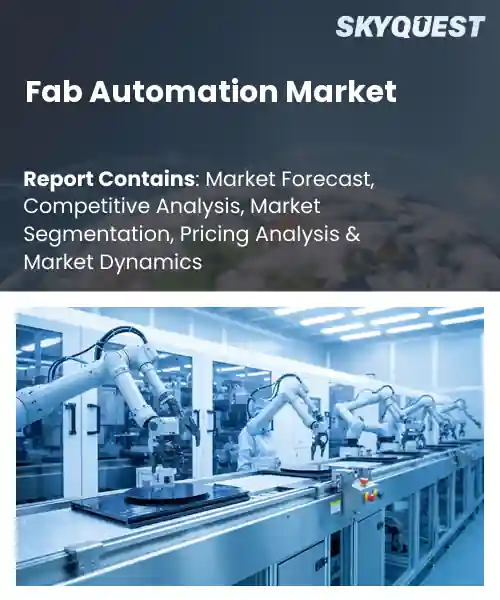
Fab Automation Market
Report ID: SQMIG45N2237
Report ID: SQMIG45N2237
[email protected]
USA +1 351-333-4748
Report ID:
SQMIG45N2237 |
Region:
Global |
Published Date: June, 2026
Pages:
157
|Tables:
145
|Figures:
78


Global Fab Automation Market size was valued at USD 25.2 Billion in 2024 and is poised to grow from USD 27.04 Billion in 2025 to USD 47.51 Billion by 2033, growing at a CAGR of 7.3% during the forecast period (2026-2033).
To improve transistor sizes while at the same time improving functionality, increasing demands for improvements will force the manufacturers to replace human variability with automatic systems due to the demands being placed on them to achieve precision and repeatability at microscopic levels. Fab automation consists of the manufacturing equipment, factory control software, and integration services used to coordinate processing and quality, and are an important element because small yield improvements will result in large increase in revenues at advanced nodes. Historically, this industry has transitioned from manually transferring wafers and traditional SPC via majorly enhanced MES, autonomous materials handling and AI inspection; major foundries implement these systems to meet increasingly demanding specifications while lowering their operational expenses.
An accelerating factor behind the global fab automation market growth is the rise of data-centric production techniques; due to the proliferation of sensors and data collection devices coupled to high frequency telemetry, AI models are able to predict possible defects and create optimal tool recipes when used with automation stacks which allows "closed loop" systems to be established between sensing and control. A specific example of such an application would be utilizing predictive maintenance algorithms based on deviations in temperature and vibrations, which can lead to significant decreases in unplanned downtime by increasing throughput by decreasing cost per good die and also driving more investment into automation. Automated material handling with MES traceability meets automotive and medical quality requirements, creating opportunities for retrofits, SaaS platforms and integrators to capture growing service revenues globally.
How is AI Improving Yield Optimization In Semiconductor Fab Automation?
Yield optimization for automation of semiconductor fabrication (Fab) is enhanced through the integration of data derived from sensors, virtual metrology and ML technologies to detect early defect signatures and to recommend corrective actions. Predictive process control (PPC), automated root-cause-analysis (RCA), and equipment health monitoring (EHM) are all key components of maintaining tighter tolerances across the manufacturing runs. Presently, pilots and/or emerging production deployments exist in various stages of completion whereby tool vendors are adding analytics into their factory software and service offerings.
Due to the high degree of market competitive pressure caused by the increasing complexity associated with advanced packaging and the increasing number of manufacturers utilizing these technologies, faster identification of problems and thus shorter ramp-cycle times greatly increase fab productivity. For example, detecting anomalies on etch and deposition tools as well as performing run-to-run adjustments of machine models in real time both improve yield and reduce scrap to qualify a run faster. In a joint announcement on May 1, 2026, Applied Materials announced a cooperative development agreement with ETG Corp. to develop advanced wafer-cleaning capabilities in Applied Material's EPIC Centre that can be leveraged by any semiconductor manufacturer. This process cleaning data is fed through AI systems to decrease defect density as well as to shorten ramp times which increases fab efficiency and the likelihood of achieving wide-spread use of AI enabled automation by semiconductor manufacturers.
Market snapshot - (2026-2033)
Global Market Size
USD 25.2 Billion
Largest Segment
Automated Material Handling Systems (AMHS)
Fastest Growth
Robotics & Handling Equipment
Growth Rate
7.3% CAGR
To get more insights on this market click here to Request a Free Sample Report
Global fab automation market is segmented by automation type, component, wafer size, application, fab type and region. Based on automation type, the market is segmented into Automated Material Handling Systems (AMHS), Robotics & Handling Equipment, Process Automation Systems and Factory Control Systems. Based on component, the market is segmented into Hardware, Software and Services. Based on wafer size, the market is segmented into 200 mm and 300 mm. Based on application, the market is segmented into Wafer Processing, Wafer Transport & Storage, Inspection & Metrology and Assembly & Packaging. Based on fab type, the market is segmented into Foundries, Integrated Device Manufacturers (IDMs) and OSAT (Outsourced Semiconductor Assembly & Test). Based on region, the market is segmented into North America, Europe, Asia Pacific, Latin America and Middle East & Africa.
The Automated Material Handling Systems segment leads the way as it is the key component to enable wafer transport and internal logistics which provides the continuous equipment and contamination control that are key to the fab environment. The integration of the mature technology associated with AMHS into tools and factory control systems provides lower risk for integration and operational variance, while predictable reliability and customization options support multiple process flows. Buyers value AMHS as they provide continually stable production rates, reduced reliance on manual labor and allow for greater utilization of tools throughout the various stages of complex manufacturing processes.
As per fab automation market analysis, the Robotics and Handling Equipment segment is expected to be the fastest growing area due to advances in flexible end-of-arm tooling (grippers), vision guided handling, and collaborative robots (CAST) allowing for more precise and adaptable methods of interacting with tools and payloads. There are more needs than ever to enable more rapid changeovers, careful handling of advanced nodes, and retrofitting of capabilities will also allow for new automation applications and create opportunities for integrators and technology innovators to further accelerate future market growth.
Software is the leading section of the market due to the way manufacturer orchestration, manufacturing execution systems and analytical software convert the capability of machines into means of measuring production efficiency and yield improvements across the manufacturing facility. Centralised scheduling, the integration of equipment, and workflows associated with predictive maintenance integrate multi-vendor tooling, reduce the amount of time machines are down, and speed up the development of processes. By investing in software, companies can increase the number of machines they have, improve the quality of their operation, and ensure that the operation will be performed consistently over time. Software is also a lever for driving efficiencies over the long-term by providing companies with greater value through the use of their existing automation equipment.
As per fab automation market forecast, the Services segment is growing the fastest due to companies increasingly outsourcing the integration, commissioning and lifecycle support of the complex automation that they have installed in their manufacturing facilities. Increased demand for specialised consulting, configuration, remote monitoring or management of services is addressing shortages of in-house resources that provide these same services and, therefore, reducing the time it takes to realise value from the automation that has been implemented. By moving to outcome-focused Service Models, companies are creating recurring revenue, supporting faster implementation of automation projects, and creating more opportunities for Service Providers across the entire automation ecosystem.
To get detailed segments analysis, Request a Free Sample Report
Semiconductor manufacturing has a significant influence on Asia Pacific fab automation market outlook. The combination of tightly clustered semiconductor manufacturers, numerous supplier networks, and an abundance of expert engineers creates a conducive environment for innovative manufacturing processes. In addition to this, the establishment of regional fabrication clusters will foster partnerships between vendors (equipment suppliers) and fabrication plants, which will lead to shorter time frames for the development of new automation technologies (innovation cycle) and ultimately, create custom automation systems for manufacturing processes. The supportive political climate combined with agglomeration of the supply chain will result in additional investments in the development of automation systems while providing a competitive marketplace for vendors to produce customized robots, material handling equipment, and process control systems. The strong relationship between academic/research facilities and industry will further enhance the capability of automation systems with respect to process control, data analytics, and smart factory orchestration while also further enhancing the Asia Pacific region's role as a preeminent global center for high volume, complex fabrication.
The Fab Automation market is seeing an increase in activity in Japan due to the large number of established manufacturers of sophisticated equipment, experienced operators of fabs, and high levels of engineering talent available there. Suppliers and fabs in Japan are working closely together so that the developments and implementations of precision automation and robotics designed specifically for difficult to manage process flows is achieved quickly. Suppliers are being rewarded with durable relationships with their customers due to the emphasis that both parties place on reliability, process control, and incremental innovation. Vendors that can deliver field proven installations will be able to continue to optimize their customers' processes and yield millions of parts from multiple devices while continually meeting quality assurances.
The South Korean Fab Automation market is growing rapidly as a result of the close collaboration between the top semiconductor manufacturers and the suppliers of automation solutions. This close collaboration allows the semiconductor manufacturers to quickly and effectively replace their shipping, measuring and delivering systems with new advanced, automated handling of materials. The interest in high-throughput manufacturing and very small factory footprints encourages the development of customized automation systems. Working collaboratively on research and development, the semiconductor manufacturing companies have pooled their resources and created systems that improve process stability and yield management. These advancements will enable semiconductor fabs to continue to provide sustainable production capacity and agility which have created a high degree of competitiveness in the South Korean semiconductor manufacturing and advanced industries.
North America is experiencing rapid expansion in fab automation due to technology leadership, a mature ecosystem of software and robotics providers, and extensive systems integration capabilities. Demand from advanced logic development and heterogeneous integration has elevated requirements for sophisticated automation platforms, in-line monitoring, and analytics driven process control. A pervasive digital transformation mindset encourages adoption of IoT enabled orchestration, predictive maintenance, and factory analytics. Strong partnerships among vendors, fabs, and research institutions facilitate rapid pilots and tailored deployments. Comprehensive aftermarket support and integrator networks enable lifecycle optimization, while focus on flexible, modular automation architectures addresses labor constraints and high-mix production needs, positioning the region as a key environment for piloting next generation fab automation solutions.
Fab Automation Market in United States is characterized by strong innovation in software driven factory automation, systems integration expertise, and a vibrant supplier base for robotics and sensing. Demand from advanced logic and packaging facilities incentivizes adoption of end-to-end automation and smart material handling. Emphasis on modular, scalable solutions and service oriented support enables rapid customization, while close collaboration between industry and research entities accelerates implementation and continuous operational refinement.
Fab Automation Market in Canada reflects strengths in systems integration, precision engineering, and a collaborative supplier network supporting both pilot fabs and specialized production. Demand for turnkey automation, metrology integration, and automated material handling is supported by a skilled workforce and strong engineering education pipelines. Emphasis on flexible, scalable automation enables smaller volume, high value production to compete effectively while providing reliable service and lifecycle support to maintain operational continuity.
Europe is strengthening its position in fab automation through advanced industrial automation expertise, precision engineering, and coordinated innovation across national research and industry networks. The region emphasis on Industry transformation promotes integration of robotics, digitized process control, and energy efficient automation aligned with stringent quality standards. Country level strengths in systems integration, software orchestration, and specialized equipment suppliers support modular automation and retrofit strategies for legacy fabs. Cross border partnerships, standardized interfaces, and a strong base of integrators enable lifecycle services and modernization efforts, while regulatory focus on safety and energy efficiency further encourages automated process control deployments that align with sustainability objectives.
Fab Automation Market in Germany benefits from world class precision engineering, established industrial automation suppliers, and deep systems integration capabilities. Demand for robust, energy efficient factory equipment encourages development of modular automation platforms and reliable robotics solutions. Collaboration between engineering firms and fab operators enables tailored automation for complex process steps, while a strong service network supports lifecycle management and continuous performance improvement across diverse semiconductor and microtechnology production environments.
Fab Automation Market in United Kingdom emphasizes software driven manufacturing orchestration, data analytics, and research led innovation. Strengths in factory control systems and digital twin technologies support complex production sequencing and predictive maintenance strategies. Active collaboration between universities, automation vendors, and fab operators accelerates integration of novel robotics and sensing solutions, while specialized service providers enable deployment and optimization across high value, small batch and advanced packaging facilities and scalability.
Fab Automation Market in France is shaped by a strong engineering base, specialized equipment manufacturers, and a focus on hybrid production models combining microfabrication. Investment in customized automation for niche applications supports high precision process control and integrated metrology. Collaboration between industrial players and research centers advances robotics integration and systems engineering, while local service networks provide retrofit and lifecycle services support continuous improvement and resilience for diverse fabrication operations.
To know more about the market opportunities by region and country, click here to
Buy The Complete Report
Increasing Demand For Precision Equipment
Rising Adoption Of Smart Manufacturing
Complex System Integration Challenges
High Capital Expenditure Requirements
Request Free Customization of this report to help us to meet your business objectives.
Competitive landscape in global fab automation is tightening as incumbents and new entrants compete on MES, AMHS and AI analytics, with strategic moves that include partnerships and platform acquisitions; for example Black Semiconductor selected Critical Manufacturing to deliver a fully automated 300mm pilot fab MES while Critical Manufacturing operates as an ASMPT subsidiary, illustrating consolidation, vertical integration and product platform plays driving differentiation.
SkyQuest’s ABIRAW (Advanced Business Intelligence, Research & Analysis Wing) is our Business Information Services team that Collects, Collates, Correlates, and Analyses the Data collected by means of Primary Exploratory Research backed by robust Secondary Desk research.
As per SkyQuest analysis, the fab automation market is driven primarily by the need for microscopic precision as fabs scale down node sizes, and one key driver is the pressure to reduce human variability to improve yields. One restraint is complex system integration challenges that slow deployment across legacy tools and diverse vendor protocols. Dominating region is Asia Pacific, where dense manufacturing clusters and supplier networks accelerate adoption. Dominating segment is Automated Material Handling Systems (AMHS), which underpins continuous throughput and contamination control. A second driver is the rise of data-centric manufacturing and AI enabled predictive maintenance that shortens ramp cycles and raises overall equipment effectiveness.
| Report Metric | Details |
|---|---|
| Market size value in 2024 | USD 25.2 Billion |
| Market size value in 2033 | USD 47.51 Billion |
| Growth Rate | 7.3% |
| Base year | 2024 |
| Forecast period | (2026-2033) |
| Forecast Unit (Value) | USD Billion |
| Segments covered |
|
| Regions covered | North America (US, Canada), Europe (Germany, France, United Kingdom, Italy, Spain, Rest of Europe), Asia Pacific (China, India, Japan, Rest of Asia-Pacific), Latin America (Brazil, Rest of Latin America), Middle East & Africa (South Africa, GCC Countries, Rest of MEA) |
| Companies covered |
|
| Customization scope | Free report customization with purchase. Customization includes:-
|
To get a free trial access to our platform which is a one stop solution for all your data requirements for quicker decision making. This platform allows you to compare markets, competitors who are prominent in the market, and mega trends that are influencing the dynamics in the market. Also, get access to detailed SkyQuest exclusive matrix.
Table Of Content
Executive Summary
Market overview
Parent Market Analysis
Market overview
Market size
KEY MARKET INSIGHTS
COVID IMPACT
MARKET DYNAMICS & OUTLOOK
Market Size by Region
KEY COMPANY PROFILES
Methodology
For the Fab Automation Market, our research methodology involved a mixture of primary and secondary data sources. Key steps involved in the research process are listed below:
1. Information Procurement: This stage involved the procurement of Market data or related information via primary and secondary sources. The various secondary sources used included various company websites, annual reports, trade databases, and paid databases such as Hoover's, Bloomberg Business, Factiva, and Avention. Our team did 45 primary interactions Globally which included several stakeholders such as manufacturers, customers, key opinion leaders, etc. Overall, information procurement was one of the most extensive stages in our research process.
2. Information Analysis: This step involved triangulation of data through bottom-up and top-down approaches to estimate and validate the total size and future estimate of the Fab Automation Market.
3. Report Formulation: The final step entailed the placement of data points in appropriate Market spaces in an attempt to deduce viable conclusions.
4. Validation & Publishing: Validation is the most important step in the process. Validation & re-validation via an intricately designed process helped us finalize data points to be used for final calculations. The final Market estimates and forecasts were then aligned and sent to our panel of industry experts for validation of data. Once the validation was done the report was sent to our Quality Assurance team to ensure adherence to style guides, consistency & design.
Analyst Support
Customization Options
With the given market data, our dedicated team of analysts can offer you the following customization options are available for the Fab Automation Market:
Product Analysis: Product matrix, which offers a detailed comparison of the product portfolio of companies.
Regional Analysis: Further analysis of the Fab Automation Market for additional countries.
Competitive Analysis: Detailed analysis and profiling of additional Market players & comparative analysis of competitive products.
Go to Market Strategy: Find the high-growth channels to invest your marketing efforts and increase your customer base.
Innovation Mapping: Identify racial solutions and innovation, connected to deep ecosystems of innovators, start-ups, academics, and strategic partners.
Category Intelligence: Customized intelligence that is relevant to their supply Markets will enable them to make smarter sourcing decisions and improve their category management.
Public Company Transcript Analysis: To improve the investment performance by generating new alpha and making better-informed decisions.
Social Media Listening: To analyze the conversations and trends happening not just around your brand, but around your industry as a whole, and use those insights to make better Marketing decisions.
REQUEST FOR SAMPLE
 REQUEST FREE CUSTOMIZATION
Global Fab Automation Market size was valued at USD 25.2 Billion in 2024 and is poised to grow from USD 27.04 Billion in 2025 to USD 47.51 Billion by 2033, growing at a CAGR of 7.3% during the forecast period (2026-2033).
Competitive landscape in global fab automation is tightening as incumbents and new entrants compete on MES, AMHS and AI analytics, with strategic moves that include partnerships and platform acquisitions; for example Black Semiconductor selected Critical Manufacturing to deliver a fully automated 300mm pilot fab MES while Critical Manufacturing operates as an ASMPT subsidiary, illustrating consolidation, vertical integration and product platform plays driving differentiation. 'Daifuku Co., Ltd.', 'Murata Machinery Ltd.', 'FANUC Corporation', 'KUKA AG', 'Yaskawa Electric Corporation', 'Kawasaki Heavy Industries Ltd.', 'Hirata Corporation', 'Rorze Corporation', 'Ebara Corporation', 'Atlas Copco AB', 'Applied Materials Inc.', 'Lam Research Corporation', 'KLA Corporation', 'Tokyo Electron Limited', 'ASML Holding N.V.', 'Brooks Automation Inc.', 'Teradyne Inc.', 'ABB Ltd.', 'Siemens AG', 'Omron Corporation'
Automated precision equipment reduces variability in semiconductor manufacturing and enables tighter process control, which encourages fabs to invest in advanced automation solutions. By ensuring consistent handling, alignment, and inspection, such equipment helps manufacturers achieve higher yields and accelerate process stabilization. The ability to integrate precision tools with factory automation platforms simplifies complex workflows and reduces manual intervention, making operations more predictable and scalable. This alignment of precision capabilities with overarching production goals motivates adoption of fab automation across different process nodes and production environments.
Edge Ai Integration: Deployment of edge-based artificial intelligence within fabrication environments is enabling near real-time decision making, predictive maintenance, and localized process control that reduces latency and reliance on centralized compute. Integrating AI at the edge enhances process stability through immediate anomaly detection, adaptive recipe adjustments, and efficient data pre-processing before cloud transmission. Vendors and fabs are prioritizing interoperable edge platforms to accelerate yield enhancement initiatives, shorten response cycles, and support heterogeneous equipment networks while maintaining data privacy and operational continuity across shifts.
Why does Asia Pacific Dominate the Global Fab Automation Market? |@12


Want to customize this report? This report can be personalized according to your needs. Our analysts and industry experts will work directly with you to understand your requirements and provide you with customized data in a short amount of time. We offer $1000 worth of FREE customization at the time of purchase.
Feedback From Our Clients


 USA (+1) 351-333-4748

