Extremities Market
Report ID: SQMIG35A4145
Report ID: SQMIG35A4145
[email protected]
USA +1 351-333-4748
Report ID:
SQMIG35A4145 |
Region:
Global |
Published Date: July, 2026
Pages:
157
|Tables:
121
|Figures:
77


Global Extremities Market size was valued at USD 14.43 Billion in 2024 and is poised to grow from USD 15.21 Billion in 2025 to USD 23.16 Billion by 2033, growing at a CAGR of 5.4% during the forecast period (2026-2033).
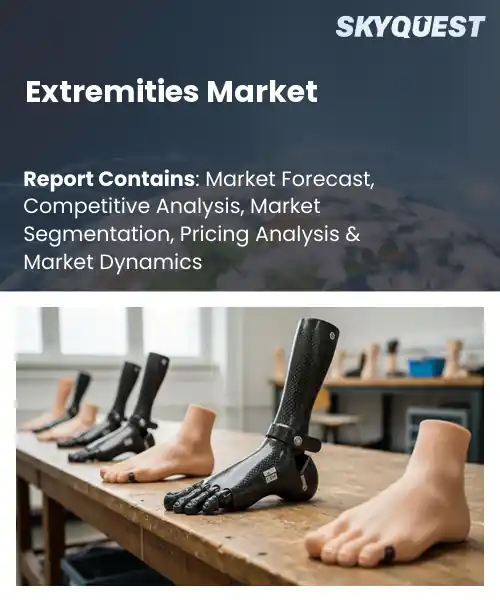
The global extremities market trends comprises prosthetic limbs, orthotic supports and surgical implants used to restore functions of hands and feet. Its importance lies in the ability to restore mobility and independence to patients with trauma, congenital defects or age-related degeneration, thus reducing the costs of care. The market expansion is mainly driven by the increasing prevalence of limb loss and musculoskeletal disorders which is further augmented by an aging population and increasing road-traffic accidents globally. Over time, the sector evolved from simple wooden prostheses in the early twentieth century to microprocessor-controlled bionic devices and 3D-printed solutions today, such as the DEKA Arm System and osseointegration implants for skeletal attachment.
The marriage of digital manufacturing and rehabilitation is the catalyst for the global extremities market growth, building on this evolution to create a cycle of faster delivery and better outcomes. Additive printing cuts lead times and material waste, so clinicians can order patient-specific sockets in days and schedule surgeries quickly, reducing hospital stays. At this point, sensor-equipped prostheses connected to tele-rehab platforms produce gait data to guide iterative tuning of the device, increasing functionality. Companies like Össur and Stryker have capitalized on these advances to develop modular limb systems, creating new revenue opportunities in emerging markets where injury rates are rising and insurance coverage is expanding.
How is AI-driven Automation Reshaping Product Development in the Extremities Market?
AI-driven automation is speeding up all stages of extremities product development. Generative algorithms are used by designers to explore a large number of implant geometries, quickly narrowing down to concepts that meet biomechanical constraints. Simulation platforms enable engineers to perform thousands of stress tests in minutes, validating durability before physical prototypes. Machine-learning models that predict patient-specific performance are trained on surgical outcome data and can inform decisions regarding material selection and sizing. The tools shorten design cycles, lessen dependence on costly trial-and-error, and allow for more personalized solutions, helping manufacturers stay agile in a fast-growing extremities market share.
Stryker unveiled a new AI-optimized fracture fixation system in June 2024, showing how predictive modelling cuts time to market and enhances surgical efficiency, driving growth in the extremities segment.
Market snapshot - (2026-2033)
Global Market Size
USD 14.43 Billion
Largest Segment
Lower Extremity Implants
Fastest Growth
Upper Extremity Implants
Growth Rate
5.4% CAGR
To get more insights on this market click here to Request a Free Sample Report
Global extremities market is segmented by product type, material, application, end user and region. Based on product type, the market is segmented into upper extremity implants, lower extremity implants, fixation devices and others. Based on material, the market is segmented into metallic biomaterials, polymeric biomaterials, bioabsorbable polymers and others. Based on application, the market is segmented into joint reconstruction, trauma fracture repair, osteoarthritis management and others. Based on end user, the market is segmented into hospitals, ambulatory surgical centers, orthopedic specialty clinics and others. Based on region, the market is segmented into North America, Europe, Asia Pacific, Latin America and Middle East & Africa.
The metallic biomaterials segment is dominating as they provide unmatched strength, fatigue resistance and longevity required for load bearing extremity implants. Clinicians rely on these materials to restore function to complex anatomical sites and they are widely used in upper and lower limb procedures. Their existing manufacturing processes and extensive clinical data lower uncertainty , making hospitals more likely to prioritize them over newer options . This reinforces their leadership in the market and supports long-term patient outcomes.
Meanwhile, bioabsorbable polymers segment is the fastest growing segment as advancements in material science allow resorbable fixation that eliminates secondary surgeries. As patient demand for minimally invasive options grows, and regulatory pressure for biodegradable technologies increases, surgeons are embracing these devices in trauma and reconstruction, creating new market opportunities.
The segment of joint reconstruction takes the lead as it directly addresses the fundamental cause of disability in extremity patients, bringing back mobility and eliminating pain. The procedure’s ability to replace degenerative joints with durable implants creates a compelling value proposition for clinicians and payers. As surgical techniques grow less invasive and postoperative protocols improve, demand increases further cementing its role in shaping the extremities market landscape and supporting long-term functional independence.
The trauma fracture repair segment is witnessing the strongest growth momentum, fueled by high incidences of acute injuries and innovative fixation devices that improve outcomes. Surgeons prefer trauma solutions that speed up the healing process, shorten hospital stays, and fit into pathways. This drives market growth and provides new opportunities for product development.
To get detailed segments analysis, Request a Free Sample Report
North America is leading the market owing to the presence of advanced healthcare infrastructure, high adoption of innovative prosthetic technologies, strong reimbursement framework, robust research institutions and presence of leading device manufacturers. The market is supported by integrated supply chains, early adopters of digital health solutions and collaborative networks between academic centers and industry. Demand is also driven by patient awareness and preference for high performance extremity solutions. Regulatory environment favors rapid product approvals providing a steady pipeline of next-generation devices that maintain the region’s leadership. Also, the large investment of venture capital supports the development of start-ups based on smart orthotics, and the use of multidisciplinary talent speeds up the personalization of therapies. The combination of patient-centric care models and strong intellectual property protection continues to stimulate creativity and reinforce North America’s leadership position in the global extremities landscape.
Extremities market outlook in the United States is propelled by a mature reimbursement landscape that encourages adoption of advanced prosthetic and orthotic solutions. A dense network of leading academic hospitals collaborates closely with manufacturers to pilot cutting‑edge devices, while a robust venture ecosystem nurtures innovative start‑ups. High patient awareness and demand for personalized outcomes further stimulate product differentiation, and a clear regulatory pathway accelerates time‑to‑market for new technologies across the nation today.
Extremities market forecast in Canada benefits from a publicly funded health system that emphasizes equitable access to rehabilitation technologies, fostering steady demand for extremity solutions. Strong collaboration between provincial health agencies and research institutes drives clinical trials of emerging devices, while multicultural patient populations create diverse needs that encourage customization. Government incentives for domestic manufacturing and a growing talent pool in biomedical engineering further reinforce Canada’s capacity to support innovative product pipelines.
Europe is experiencing the rapid growth of the extremities market, driven by a synergistic combination of strong regulatory harmonization, broad public healthcare coverage and a long-standing tradition of engineering excellence. The EU framework simplifies product approval, enabling manufacturers to roll out innovations in several markets more quickly. Top universities and specialized clinics invest in collaborative research to accelerate the clinical validation of state-of-the-art prosthetic and orthotic technologies. The health policy stresses functional rehabilitation and supports reimbursement for high quality devices. Moreover, there is a growing interest in the combination of digital health and individualized healthcare, reflecting patient demand for customized solutions, and sustainability requirements for lighter and recyclable materials. This convergence of policy support, technical expertise and patient focus is driving rapid growth for Europe’s extremities sector.
Extremities market regional outlook in Germany is anchored by engineering firms that specialize in precision manufacturing of prosthetic components and orthotic devices. Close cooperation between federal research institutions and clinical centers accelerates translation of biomechanical breakthroughs into commercial offerings. Reimbursement schemes prioritize functional outcomes, encouraging adoption of customized solutions. Supply chain ecosystem supports rapid prototyping, while emphasis on quality standards ensures reliability, reinforcing Germany’s position as a dominant hub for extremities innovation globally.
Extremities market regional forecast in United Kingdom is supported by a strong National Health Service commitment to integrating mobility solutions in rehabilitation. Collaborative research networks linking universities, orthopaedic specialists and industry accelerate validation of next‑generation prosthetic interfaces. Policy incentives encourage adoption of enabled devices, while focus on outcomes drives personalization. Presence of manufacturers and an engineering workforce sustains an ecosystem that positions the United Kingdom as the fastest‑growing market in Europe for extremities technologies.
Extremities market analysis in France is supported by health policies that prioritize mobility and restoration. Collaborative initiatives between public hospitals and research labs foster clinical trials of orthotic and prosthetic concepts. Reimbursement frameworks increasingly cover devices that demonstrate quality‑of‑life improvements, stimulating market entry. Awareness of the ageing population’s needs and a push toward sustainable material usage encourage manufacturers to develop solutions, positioning France as an important contributor to the European extremities landscape.
The Asia Pacific region is establishing its position in the extremities market with rapid technology adoption, increasing healthcare infrastructure and rising demand from large and diverse populations. Governments across the region are investing heavily in modern hospitals and rehabilitation centres paving ways for advanced prosthetic and orthotic solutions. Cost-effective manufacturing and the integration of smart sensors and AI into devices are enabling local manufacturers to produce sophisticated yet inexpensive devices. Partnerships between multinational companies and regional research centers accelerate the flow of knowledge and foster innovation based on cultural and anatomical differences. Additionally, the rise in health awareness and policy support is driving reimbursement for quality mobility aids, making Asia Pacific an emerging region for scalable extremities technologies.
Extremities market penetration in Japan is characterized by precision engineering and clinical validation, supported by a health insurance system that reimburses prosthetic devices. Research hospitals collaborate with domestic manufacturers to develop robotic‑enabled orthoses that address age‑related mobility challenges. Government initiatives promote integration of wearable sensors for real‑time monitoring, while a skilled workforce ensures prototyping and production quality. These factors drive Japan’s reputation as a leader in high‑performance extremities solutions globally recognized today.
Extremities industry in South Korea advances through integration of digital technologies and a governmental push for smart rehabilitation. Manufacturers combine manufacturing techniques with AI customization to produce lightweight prosthetic limbs that meet individual anatomical requirements. Public‑private partnerships fund clinical research in sensor‑based orthoses, while insurance coverage expands for evidence‑based devices. A connected consumer base readily adopts wearable health solutions, positioning South Korea as a contributor to the Asia Pacific extremities ecosystem.
To know more about the market opportunities by region and country, click here to
Buy The Complete Report
Growing Preference For Home Rehabilitation
Advances In 3D Scanning Technology
High Cost Of Advanced Devices
Limited Reimbursement Policies Worldwide
Request Free Customization of this report to help us to meet your business objectives.
The extremities market is characterized by intense competition as established orthopedic manufacturers strengthen their portfolios through acquisitions, strategic partnerships, and continuous product innovation, while emerging medtech companies introduce advanced fixation technologies, biologic implants, and digital surgical solutions. Industry consolidation has accelerated with acquisitions such as Zimmer Biomet's purchase of Paragon 28, expanding its foot and ankle portfolio, while companies continue investing in AI-assisted planning, robotics, and next-generation implant systems to improve surgical precision and patient outcomes. Meanwhile, venture-backed startups are accelerating commercialization of biointegrative implants and minimally invasive extremity solutions, increasing competitive pressure across trauma, upper extremity, and foot and ankle segments.
Top Player’s Company Profile
Recent Developments in the Extremities Market
SkyQuest’s ABIRAW (Advanced Business Intelligence, Research & Analysis Wing) is our Business Information Services team that Collects, Collates, Correlates, and Analyses the Data collected by means of Primary Exploratory Research backed by robust Secondary Desk research. As per SkyQuest analysis, the global extremities market is being propelled primarily by a growing preference for home rehabilitation, which encourages manufacturers to create lightweight, connected devices that patients can use independently, while advances in 3D scanning technology serve as a second driver by enabling rapid, patient‑specific design and shorter production cycles; however, the high cost of advanced devices remains a restraint that hampers adoption in cost‑sensitive settings. North America continues to dominate the market thanks to its advanced healthcare infrastructure and strong reimbursement frameworks, and the metallic biomaterials segment leads across product types because of its proven strength and durability for both upper and lower limb implants.
| Report Metric | Details |
|---|---|
| Market size value in 2024 | USD 14.43 Billion |
| Market size value in 2033 | USD 23.16 Billion |
| Growth Rate | 5.4% |
| Base year | 2024 |
| Forecast period | (2026-2033) |
| Forecast Unit (Value) | USD Billion |
| Segments covered |
|
| Regions covered | North America (US, Canada), Europe (Germany, France, United Kingdom, Italy, Spain, Rest of Europe), Asia Pacific (China, India, Japan, Rest of Asia-Pacific), Latin America (Brazil, Rest of Latin America), Middle East & Africa (South Africa, GCC Countries, Rest of MEA) |
| Companies covered |
|
| Customization scope | Free report customization with purchase. Customization includes:-
|
To get a free trial access to our platform which is a one stop solution for all your data requirements for quicker decision making. This platform allows you to compare markets, competitors who are prominent in the market, and mega trends that are influencing the dynamics in the market. Also, get access to detailed SkyQuest exclusive matrix.
Table Of Content
Executive Summary
Market overview
Parent Market Analysis
Market overview
Market size
KEY MARKET INSIGHTS
COVID IMPACT
MARKET DYNAMICS & OUTLOOK
Market Size by Region
KEY COMPANY PROFILES
Methodology
For the Extremities Market, our research methodology involved a mixture of primary and secondary data sources. Key steps involved in the research process are listed below:
1. Information Procurement: This stage involved the procurement of Market data or related information via primary and secondary sources. The various secondary sources used included various company websites, annual reports, trade databases, and paid databases such as Hoover's, Bloomberg Business, Factiva, and Avention. Our team did 45 primary interactions Globally which included several stakeholders such as manufacturers, customers, key opinion leaders, etc. Overall, information procurement was one of the most extensive stages in our research process.
2. Information Analysis: This step involved triangulation of data through bottom-up and top-down approaches to estimate and validate the total size and future estimate of the Extremities Market.
3. Report Formulation: The final step entailed the placement of data points in appropriate Market spaces in an attempt to deduce viable conclusions.
4. Validation & Publishing: Validation is the most important step in the process. Validation & re-validation via an intricately designed process helped us finalize data points to be used for final calculations. The final Market estimates and forecasts were then aligned and sent to our panel of industry experts for validation of data. Once the validation was done the report was sent to our Quality Assurance team to ensure adherence to style guides, consistency & design.
Analyst Support
Customization Options
With the given market data, our dedicated team of analysts can offer you the following customization options are available for the Extremities Market:
Product Analysis: Product matrix, which offers a detailed comparison of the product portfolio of companies.
Regional Analysis: Further analysis of the Extremities Market for additional countries.
Competitive Analysis: Detailed analysis and profiling of additional Market players & comparative analysis of competitive products.
Go to Market Strategy: Find the high-growth channels to invest your marketing efforts and increase your customer base.
Innovation Mapping: Identify racial solutions and innovation, connected to deep ecosystems of innovators, start-ups, academics, and strategic partners.
Category Intelligence: Customized intelligence that is relevant to their supply Markets will enable them to make smarter sourcing decisions and improve their category management.
Public Company Transcript Analysis: To improve the investment performance by generating new alpha and making better-informed decisions.
Social Media Listening: To analyze the conversations and trends happening not just around your brand, but around your industry as a whole, and use those insights to make better Marketing decisions.
REQUEST FOR SAMPLE
 REQUEST FREE CUSTOMIZATION
Global Extremities Market size was valued at USD 14.43 Billion in 2024 and is poised to grow from USD 15.21 Billion in 2025 to USD 23.16 Billion by 2033, growing at a CAGR of 5.4% during the forecast period (2026-2033).
The extremities market is shaped by intense competition as incumbents and emerging med‑tech firms race to capture surgeon and hospital loyalty through M&A, strategic alliances and rapid tech roll‑outs; recent examples include a leading joint‑replacement maker’s acquisition of a robotics specialist and Greenbone’s partnership with a major implant producer to embed AI planning, while Ossio secured a $12 million Series A to accelerate its modular fixation platform. 'Stryker Corporation', 'Zimmer Biomet Holdings, Inc.', 'Johnson & Johnson Services, Inc.', 'Smith & Nephew plc', 'Enovis Corporation', 'Medartis Holding AG', 'Acumed LLC', 'Arthrex, Inc.', 'Conmed Corporation', 'Össur hf.', 'Paragon 28, Inc.', 'MicroPort Scientific Corporation', 'Skeletal Dynamics, Inc.', 'Integra LifeSciences Holdings Corporation', 'Corin Group', 'TriMed, Inc.', 'Exactech, Inc.', 'Orthofix Medical Inc.', 'OsteoMed LLC', 'Grupo Industrial Saltillo'
Patients increasingly seek rehabilitation services that can be performed within the comfort of their own homes, reducing travel burdens and exposure to clinical settings. This shift encourages manufacturers to develop modular, lightweight extremities devices equipped with simple interfaces and wireless connectivity. By aligning product design with home‑based therapy preferences, companies can expand their addressable consumer base, accelerate adoption among elderly and mobility‑restricted populations, and foster long‑term usage, thereby propelling overall market expansion. This convenience also boosts patient confidence in ongoing therapy.
Personalized Prosthetic Integration: Advances in 3D printing, bio‑compatible materials and AI‑driven design are enabling clinicians to create extremity devices that closely match individual anatomy and functional needs. This shift toward patient‑specific solutions reduces adaptation time, improves comfort, and enhances long‑term outcomes. Manufacturers are partnering with medical institutions to develop modular platforms that can be rapidly reconfigured as patients recover or as their activity levels change, driving a move away from one‑size‑fits‑all offerings toward highly tailored product portfolios for clinicians and patients alike.
Why does North America Dominate the Global Extremities Market? |@12


Want to customize this report? This report can be personalized according to your needs. Our analysts and industry experts will work directly with you to understand your requirements and provide you with customized data in a short amount of time. We offer $1000 worth of FREE customization at the time of purchase.
Feedback From Our Clients


 USA (+1) 351-333-4748

