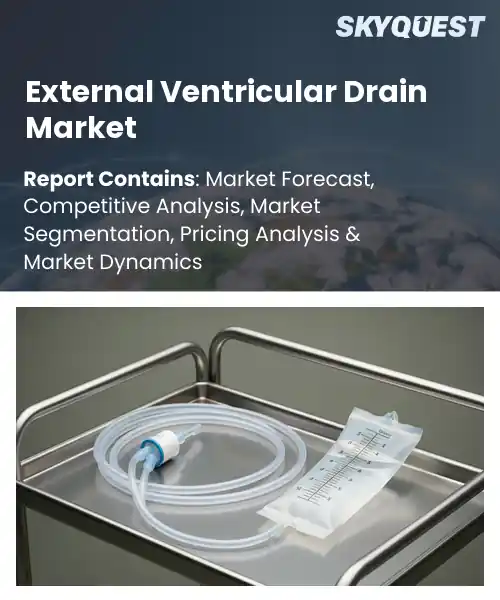
External Ventricular Drain Market
Report ID: SQMIG35A3999
Report ID: SQMIG35A3999
[email protected]
USA +1 351-333-4748
Report ID:
SQMIG35A3999 |
Region:
Global |
Published Date: June, 2026
Pages:
157
|Tables:
145
|Figures:
78


Global External Ventricular Drain Market size was valued at USD 299.7 Million in 2024 and is poised to grow from USD 326.22 Million in 2025 to USD 642.9 Million by 2033, growing at a CAGR of 8.85% during the forecast period (2026-2033).
The primary driver of the external ventricular drain market is the rising global burden of acute neurological conditions that require cerebrospinal fluid diversion and intracranial pressure management. An external ventricular drain (EVD) is a temporary catheter system used in neurosurgical and critical care settings to drain cerebrospinal fluid and monitor intracranial pressure, and it matters because timely intervention directly reduces morbidity and mortality from hydrocephalus, hemorrhagic stroke and traumatic brain injury. Over the past decades the market has evolved from simple open-drain catheters to infection-resistant, antimicrobial-coated systems and integrated ICP monitoring platforms, exemplified by product launches and acquisitions among suppliers.
The critical factor shaping market expansion is technological innovation in catheter design and monitoring systems, because improvements that reduce infection rates and enhance intracranial pressure management translate directly into clinical and economic value for hospitals. When manufacturers introduce antimicrobial-coated drains and integrated digital ICP monitoring, clinicians can shorten device dwell time, lower ventriculostomy-associated infection rates and make faster therapeutic decisions, which reduces length of stay and overall treatment costs. These outcomes incentivize hospitals to adopt premium EVD systems, creating growth opportunities for suppliers, especially as emerging markets scale neurosurgical capacity and tele-ICU programs seek interoperable monitoring solutions thereby improving outcomes.
How is IoT enhancing remote monitoring in the external ventricular drain market?
Internet of Things is transforming remote monitoring for external ventricular drains by embedding sensors and network connectivity to send continuous physiologic and fluid data to clinical teams. Key aspects are intracranial pressure sensing flow measurement and effluent quality streamed to secure dashboards and electronic health records. The market now shows sensor integrated catheters and clip on modules entering clinical pilots and hospital innovation programs. This reduces reliance on intermittent manual checks and lets remote neurocritical teams detect complications sooner and standardize drain management. Examples include catheters that confirm ventricular position and clip on monitors that report volume color and turbidity while sending clinician alerts.
Rhovica Neuroimaging AG August 2025, the company secured financing and advanced its SoNav sensor integrated EVD catheter. That development shows how IoT enabled telemetry provides continuous ventricular visualization and pressure related alerts which improve placement safety speed clinical response and support more efficient neuro ICU workflows through remote monitoring dashboards.
Market snapshot - (2026-2033)
Global Market Size
USD 299.7 Million
Largest Segment
External Ventricular Drainage Sets
Fastest Growth
Drainage Accessories
Growth Rate
8.85% CAGR
To get more insights on this market click here to Request a Free Sample Report
Global external ventricular drain market is segmented by product focus, application, component type, end-user, sales channel and region. Based on product focus, the market is segmented into External Ventricular Drainage Sets, Drainage Accessories and Others. Based on application, the market is segmented into Traumatic Brain Injury (TBI), Intracranial Hemorrhage, Hydrocephalus and Others. Based on component type, the market is segmented into Catheters and Drainage Systems, ICP Monitors and Transducers and Others. Based on end-user, the market is segmented into Hospitals, Specialty Neurology Centers and Others. Based on sales channel, the market is segmented into Direct Institutional Sales, Medical Device Wholesalers and Others. Based on region, the market is segmented into North America, Europe, Asia Pacific, Latin America and Middle East & Africa.
External Ventricular Drainage Sets segment holds the largest share as these sets are the prime therapeutic kits for acute cerebrospinal fluid management and are part of standard neurocritical care pathways. Market leadership is supported by clinical trust in time-tested configurations, ease of integration with operating room workflows, and established safety and infection-control features that influence hospital procurement and clinician preference, all of which encourage manufacturers to invest in reliability and wide availability.
However, Drainage Accessories is the fastest growing segment as innovations in modular connectors, closed-system adapters and antimicrobial dressings reduce the risk of complications and streamline bedside management. Clinicians’ interest in customizable add-ons and better compatibility with monitoring devices is driving adoption and generating new procurement opportunities for suppliers focusing on ancillary portfolios and workflow efficiency improvements.
The Catheters and Drainage Systems segment leads because these components are the direct patient interface and determine ease of placement, cerebrospinal fluid flow control, and risk of infection. Better materials and lumen design to reduce occlusion and improve fixation give clinicians confidence, which affects hospital purchasing decisions based on reliability and outcomes, pushing manufacturers to focus on durable engineering and clinical validation.
Simultaneously ICP Monitors and Transducers are witnessing the highest growth due to increasing demand for continuous intracranial pressure data for guiding individual therapy and reducing adverse events. Advances in sensor miniaturization, wireless connectivity and interoperability with drainage platforms are accelerating clinical adoption, paving the way for integrated system offerings and analytics that broaden clinical utility and commercial opportunity.
To get detailed segments analysis, Request a Free Sample Report
North America is the dominant region in the global external ventricular drain market, owing to a convergence of advanced clinical capabilities, concentrated manufacturing, and strong ecosystem support for neurosurgical innovation. Well-established hospital networks and specialized trauma and neurocritical care centers are early adopters of improved catheter designs and the monitoring technologies that go with them. The strong clinical research infrastructure and frequent collaborations between academic institutions and industry enable extensive clinical validation and iterative product improvements. Established distribution channels, experienced clinical users and favorable reimbursement frameworks further facilitate procurement. The extensive availability of specialty suppliers and comprehensive aftermarket services, including training, maintenance and technical support, ensures long term integration of external ventricular drain systems into hospital workflows.
The U.S. External Ventricular Drain Market is characterized by a high degree of clinical specialization, extensive tertiary care networks and strong research activities. The rate of procurement is driven by the adoption of advanced catheter designs and a focus on protocolized neurocritical care. Device developers collaborating with leading medical centers speed up the clinical validation process. Strong hospital purchasing power, an established distribution infrastructure and focus on reducing complications drive sustained demand and continuous product refinement across care pathways and outcomes.
Some of the factors benefitting the External Ventricular Drain Market in Canada are integrated public health systems, strong hospital coordination and emphasis on evidence based procurement. Provincial clinical networks promote standard protocols and training that promote the use of proven drainage solutions. Partnership models between clinicians and regional suppliers help to deliver localized service and device maintenance. Patient safety, infection prevention, interdisciplinary neurocritical care teams are shaping adoption patterns and creating demand for reliable maintainable systems.
Rapid growth in the external ventricular drain market in Europe is being fueled by concerted efforts to standardize neurocritical care, strong clinical networks, and active engagement between healthcare providers and industry. Investments in modernization of hospital infrastructure and adoption of evidence based protocols increase the demand for reliable drainage systems that integrate with broader monitoring platforms. Established medical device companies and targeted distribution channels are supporting market reach across the national boundaries. Patient safety, infection prevention and value based procurement incentives Policy focus on the adoption of products that demonstrate operational efficiency and clinical reliability. Regional investment in clinician training, supportive reimbursement structures and a growing emphasis on domestic manufacturing and service partnerships create favorable conditions for further market expansion.
Germany External Ventricular Drain Market have dense network of specialized academic centers and strong medical device manufacturing. High clinical expertise combined with structured hospital procurement promotes the use of advanced drainage systems. Collaboration between clinicians and manufacturers provides for clinical validation and product improvement. Quality assurance, rigorous hospital protocols and targeted training are the focus of consistent demand for reliable standardized external ventricular drain solutions across tertiary and regional care settings and outcomes.
In the United Kingdom, the external ventricular drain market is driven by the proactive adoption of technology in private and public hospitals, which are supported by a vibrant clinical research environment. Prompt clinical assessment. Multidisciplinary teams of neurocritical care. Specialized training for the accelerated adoption of improved drainage technologies. Close links between health care providers and device innovators facilitate pilot programs and the generation of evidence. Procurement is focused on devices that enhance safety, usability and efficiency across clinical workflows.
The France External Ventricular Drain Market is driven by modernization of regional neurosurgical centers and increasing collaboration between hospitals and suppliers. Increased standardization of protocols, training of surgeons and emphasis on infection control promote adoption of effective drainage technologies. There is an opportunity for solutions that blend clinical performance with simplified servicing, with a health system procurement focus on value and on maintenance relationships. Targeted pilot programmes and clinician led evaluations underpin national expansion across tertiary and community care settings.
Asia Pacific is consolidating its position in the external ventricular drain market through capacity building, technology transfer and domestic innovation. The expansion of neurosurgery services, the cost of hospital reconstruction and special training programs increase clinical readiness to implement advanced drainage technologies. Global manufacturers can form strategic partnerships with regional companies to customize devices to local clinical preferences and cost structures. Key market regulators are improving the efficiency of approvals and encouraging post market data collection which builds clinician confidence. Developing local manufacturing capabilities, focusing on exports and extending service networks improve accessibility and long-term viability, positioning the region as a key adopter and contributor to global product development. Emerging centres of excellence and clinician led research initiatives facilitate generation of local evidence and adoption of context specific best practices. The market momentum is further boosted by the emphasis on infection prevention, cost-effectiveness and integrated service offerings.
Japan External Ventricular Drain Market is driven by adoption of precision neurosurgical technologies and stringent regulatory standards for safety and efficacy. Device manufacturers can collaborate with academic medical centers for more rigorous clinical evaluation and device improvement. Protocols are standardized and monitoring is state of the art in neurocritical care units. Clinicians want high quality, reliable systems and good service networks to keep the demand going, keep the innovation going.
South Korea External Ventricular Drain Market is growing on the back of strong domestic medical devices production along with proactive adoption of innovative neurosurgical instruments by hospitals. When tech companies partner with clinical centers, they can accelerate the testing and improvement of their products. Cost-effective, user-friendly designs and full support make the procurement process more attractive. Surgeon training, infection control guidelines and integrated service offerings result in acceptance across hospitals and specialized neurocritical care units.
To know more about the market opportunities by region and country, click here to
Buy The Complete Report
Technological Innovations In Drainage Systems
Growing Prevalence Of Neurological Disorders
High Procedural And Device Costs
Risk Of Infection And Complications
Request Free Customization of this report to help us to meet your business objectives.
Global External Ventricular Competitive Landscape Consolidation is being driven by targeted acquisitions, clinical partnerships and device innovation. While startups continue to advance differentiated approaches like closed-loop cerebrospinal fluid filtration and wireless intracranial pressure monitoring, large incumbents pursue tuck-in deals such as Medtronic’s recent neurovascular acquisition, driving product relaunches and strategic collaborations across manufacturers and clinical networks.
SkyQuest’s ABIRAW (Advanced Business Intelligence, Research & Analysis Wing) is our Business Information Services team that Collects, Collates, Correlates, and Analyses the Data collected by means of Primary Exploratory Research backed by robust Secondary Desk research.
The global external ventricular drain market is expected to grow owing to the increasing burden of acute neurological disorders requiring cerebrospinal fluid diversion and intracranial pressure management, SkyQuest analysis shows. Adoption is also accelerating with advances in technology such as antimicrobial coated catheters, integrated ICP monitoring and IoT enabled remote telemetry with potential for better outcomes and workflows. But the expense of procedures and devices remains a major barrier, restricting use in poorer hospitals. North America dominates the market due to the advanced neurocritical care infrastructure and higher clinical adoption. The product type with the largest share is External Ventricular Drainage Sets (the basic therapeutic kit for managing acute cerebrospinal fluid).
| Report Metric | Details |
|---|---|
| Market size value in 2024 | USD 299.7 Million |
| Market size value in 2033 | USD 642.9 Million |
| Growth Rate | 8.85% |
| Base year | 2024 |
| Forecast period | (2026-2033) |
| Forecast Unit (Value) | USD Million |
| Segments covered |
|
| Regions covered | North America (US, Canada), Europe (Germany, France, United Kingdom, Italy, Spain, Rest of Europe), Asia Pacific (China, India, Japan, Rest of Asia-Pacific), Latin America (Brazil, Rest of Latin America), Middle East & Africa (South Africa, GCC Countries, Rest of MEA) |
| Companies covered |
|
| Customization scope | Free report customization with purchase. Customization includes:-
|
To get a free trial access to our platform which is a one stop solution for all your data requirements for quicker decision making. This platform allows you to compare markets, competitors who are prominent in the market, and mega trends that are influencing the dynamics in the market. Also, get access to detailed SkyQuest exclusive matrix.
Table Of Content
Executive Summary
Market overview
Parent Market Analysis
Market overview
Market size
KEY MARKET INSIGHTS
COVID IMPACT
MARKET DYNAMICS & OUTLOOK
Market Size by Region
KEY COMPANY PROFILES
Methodology
For the External Ventricular Drain Market, our research methodology involved a mixture of primary and secondary data sources. Key steps involved in the research process are listed below:
1. Information Procurement: This stage involved the procurement of Market data or related information via primary and secondary sources. The various secondary sources used included various company websites, annual reports, trade databases, and paid databases such as Hoover's, Bloomberg Business, Factiva, and Avention. Our team did 45 primary interactions Globally which included several stakeholders such as manufacturers, customers, key opinion leaders, etc. Overall, information procurement was one of the most extensive stages in our research process.
2. Information Analysis: This step involved triangulation of data through bottom-up and top-down approaches to estimate and validate the total size and future estimate of the External Ventricular Drain Market.
3. Report Formulation: The final step entailed the placement of data points in appropriate Market spaces in an attempt to deduce viable conclusions.
4. Validation & Publishing: Validation is the most important step in the process. Validation & re-validation via an intricately designed process helped us finalize data points to be used for final calculations. The final Market estimates and forecasts were then aligned and sent to our panel of industry experts for validation of data. Once the validation was done the report was sent to our Quality Assurance team to ensure adherence to style guides, consistency & design.
Analyst Support
Customization Options
With the given market data, our dedicated team of analysts can offer you the following customization options are available for the External Ventricular Drain Market:
Product Analysis: Product matrix, which offers a detailed comparison of the product portfolio of companies.
Regional Analysis: Further analysis of the External Ventricular Drain Market for additional countries.
Competitive Analysis: Detailed analysis and profiling of additional Market players & comparative analysis of competitive products.
Go to Market Strategy: Find the high-growth channels to invest your marketing efforts and increase your customer base.
Innovation Mapping: Identify racial solutions and innovation, connected to deep ecosystems of innovators, start-ups, academics, and strategic partners.
Category Intelligence: Customized intelligence that is relevant to their supply Markets will enable them to make smarter sourcing decisions and improve their category management.
Public Company Transcript Analysis: To improve the investment performance by generating new alpha and making better-informed decisions.
Social Media Listening: To analyze the conversations and trends happening not just around your brand, but around your industry as a whole, and use those insights to make better Marketing decisions.
REQUEST FOR SAMPLE
 REQUEST FREE CUSTOMIZATION
Global External Ventricular Drain Market size was valued at USD 299.7 Million in 2024 and is poised to grow from USD 326.22 Million in 2025 to USD 642.9 Million by 2033, growing at a CAGR of 8.85% during the forecast period (2026-2033).
Competitive landscape in the Global External Ventricular Drain market is shaped by consolidation through targeted acquisitions, clinical partnerships, and device innovation. Large incumbents pursue tuck-in deals such as Medtronic’s recent neurovascular acquisition while startups push differentiated approaches like closed-loop cerebrospinal fluid filtration and wireless intracranial pressure monitoring, driving product relaunches and strategic collaborations across manufacturers and clinical networks. 'Medtronic', 'Integra LifeSciences', 'Johnson & Johnson', 'Codman Neuro', 'B. Braun', 'Sophysa', 'Natus Medical', 'Spiegelberg', 'Spitzner', 'Raumedic', 'Hpbio', 'Silmag', 'Möller Medical', 'Neuromedex', 'G. Surgiwear', 'Dispomedica', 'Yushin Medical', 'Wellong Instruments', 'Scitech', 'Penumbra'
Improved device designs, integrated monitoring features, and novel biocompatible materials have enhanced clinical outcomes and procedural workflow, making external ventricular drains more attractive to clinicians and healthcare facilities. Easier implantation, reduced complication risk, and clearer performance benefits encourage adoption by neurosurgeons and critical care teams, while manufacturer focus on user-friendly interfaces and disposable components simplifies inventory and sterilization concerns. These cumulative technological advances strengthen clinician confidence, broaden indications for use, and support procurement decisions, thereby driving demand and stimulating investment in product development and market expansion.
Neurocritical Care Integration: Growing emphasis on multidisciplinary neurocritical care pathways is driving adoption of external ventricular drain solutions that integrate with broader intensive care workflows. Clinicians and hospitals seek devices and protocols that support standardized monitoring, easier bedside management, and coordination across neurosurgery, critical care, and nursing teams. Suppliers responding with training programs, interoperable systems, and service models position themselves as strategic partners. This trend shifts procurement toward comprehensive solutions that address clinical workflow efficiency, staff competency, and continuity of care and outcomes.
Why does North America Dominate the Global External Ventricular Drain Market? |@12


Want to customize this report? This report can be personalized according to your needs. Our analysts and industry experts will work directly with you to understand your requirements and provide you with customized data in a short amount of time. We offer $1000 worth of FREE customization at the time of purchase.
Feedback From Our Clients


 USA (+1) 351-333-4748

