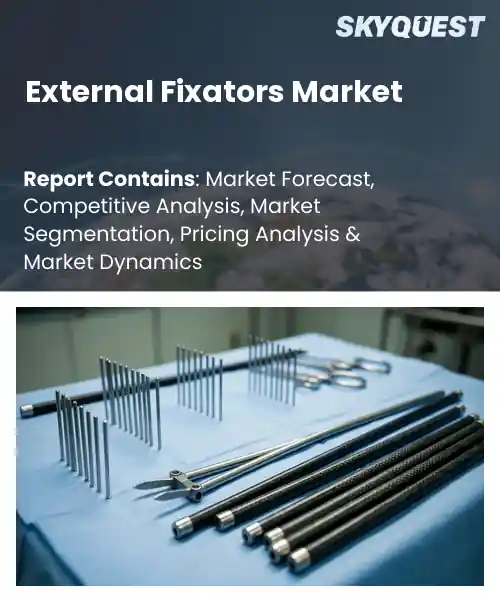
External Fixators Market
Report ID: SQMIG35A3409
Report ID: SQMIG35A3409
[email protected]
USA +1 351-333-4748
Report ID:
SQMIG35A3409 |
Region:
Global |
Published Date: May, 2026
Pages:
157
|Tables:
181
|Figures:
79


Global External Fixators Market size was valued at USD 1.1 Billion in 2024 and is poised to grow from USD 1.15 Billion in 2025 to USD 1.68 Billion by 2033, growing at a CAGR of 4.8% during the forecast period (2026-2033).
The primary factor shaping the global external fixators market growth is the high incidence and prevalence of complex fracture and limb malformations, which continue to drive the demand for versatile fixation solutions from surgeons and healthcare organizations alike. External fixators are external devices used to provide stabilization for bone and soft tissue after a traumatic event, during reconstruction, on limbs that have their length increased or for a combination of reasons; they are important because they allow for limb salvage and provide early mobility and care when traditional internal fixation methods can’t be utilized. Over the years, the external fixatorsmarket has evolved from basic unilateral frame design to circular and hexapod systems representative of both the Ilizarov and Taylor designs, with companies such as Stryker expanding their portfolios to accommodate the existing needs of the marketplace. Technological advances are also a significant factor driving the growth of the external fixators market, since newer modular designs, smaller profile pins, and hexapod adjustments have reduced complications and increased the number of patients who can utilize external fixation. As a result, more surgeons are now choosing to utilize external fixators for the accident stabilization of multi-system injury patients, for limb lengthening in both children and adults with deformities, and for oncological reconstruction when multiple stages of repair are required. The addition of 3D planning, customized components, and remote patient monitoring will speed up surgical preparation, allow for outpatient follow-up care, decrease hospital costs for the institution, and provide greater accessibility to patients in developing countries.Consequently manufacturers and investors find opportunities in robust systems tailored to field and rural care.
How is AI Enhancing Design and Performance in the External Fixators Market?
The external fixators industry is benefiting from AI, which is providing more personalized and outcome-oriented solutions to improve design and functionality. For example, by leveraging AI-based image analysis, we can ensure precise alignment, use algorithmic planning methods to simplify complex deformity correction, and create predictive models to determine healing times and adjust frames accordingly. Additionally, the trend in this market is moving away from fully mechanical devices and toward software-based systems that assist surgeons in decision-making and decrease the time spent on repetitive adjustments. For example, using computer-assisted hexapod planning and intelligent guidance tools reduces the need for guesswork, enables lighter-weight designs for greater comfort, and allows for integrating sensor data to provide dynamic stability. As of December 2024, Orthofix received regulatory approval for its OrthoNext planning platform, providing evidence that pre-operative workflow processes using AI-enabled technology can support future growth within the external fixators market by providing accurate external fixators device application results.
Market snapshot - (2026-2033)
Global Market Size
USD 1.1 Billion
Largest Segment
Unilateral External Fixators
Fastest Growth
Hexapod External Fixators
Growth Rate
4.8% CAGR
To get more insights on this market click here to Request a Free Sample Report
Global external fixators market is segmented by by product type, by material type, by application, by anatomical site, by end user, by patient type and region. Based on by product type, the market is segmented into Unilateral External Fixators, Circular External Fixators, Hybrid External Fixators, Hexapod External Fixators, Wrist External Fixators, Pediatric External Fixators and Others. Based on by material type, the market is segmented into Stainless Steel External Fixators, Titanium External Fixators, Carbon Fiber External Fixators and Others. Based on by application, the market is segmented into Fracture Fixation, Limb Lengthening, Deformity Correction, Orthopedic Reconstruction, Trauma Management and Others. Based on by anatomical site, the market is segmented into Upper Extremities, Lower Extremities, Pelvic Fixation and Spinal Fixation. Based on by end user, the market is segmented into Hospitals, Orthopedic Clinics, Ambulatory Surgical Centers, Trauma Centers and Others. Based on by patient type, the market is segmented into Adult and Pediatric. Based on region, the market is segmented into North America, Europe, Asia Pacific, Latin America and Middle East & Africa.
As per global external fixators market analysis, the Hexapod External Fixators sector leads in the marketplace due to the function of hexapod systems providing unrivaled multi axis control and programmable correction of complex deformities and lengthening of limbs. With software enabled planning and precision adjustments to minimize intraoperative guesswork and postoperative revisions, hexapod systems are the preferred choice for complex reconstructions. Due to surgeons familiar with hexapod systems, successful clinical outcomes with hexapod systems, and large manufacturer investment in hexapod platforms drive purchasing behavior for difficult orthopedic cases.
As per global external fixators market forecast, Circular External Fixators are experiencing the greatest rate of growth due to improvements in their design and lower weight of frame material enabling them to be used for limb lengthening and pediatric use. Assembling circular external fixators is becoming easier, the expanding amount of knowledge gained from training surgeons, and the lower costs of Circular External Fixators is opening up new product lines and opportunities for commercial growth.
As per global external fixators market outlook, the Titanium Ex-fix segment has the greatest market share of all ex-fix materials based on its properties and characteristics relevant to surgeons, including biocompatibility, high strength-to-weight ratio and resistance to corrosion. These features of titanium allow for a high level of durability and ease of use by the patient, which are top surgeon priorities when selecting a fixation method. In addition, the mechanical fidelity of titanium and lower perceived complication rate than other materials result in a greater acceptance for clinical use, both in trauma patients and those undergoing reconstruction. As a result of maturation of manufacturing processes, established supply chain relationships, and familiarity with the use of titanium by surgeons, titanium should be considered the standard material used for premium external fixation systems for a wide range of indications.
Conversely, carbon fiber is growing the fastest in market share as the material used for ex-fix devices, primarily due to its radiolucent properties, low weight, and therefore improved patient comfort. Additional manufacturing technology innovations, as well as increased use of image-guided techniques by surgeons, are facilitating the use of carbon fiber ex-fix devices, increasing the opportunities for new clinical applications and new suppliers to enter this market.
To get detailed segments analysis, Request a Free Sample Report
As per global external fixators market regional analysis, North America holds the leading position in the global market due to having advanced infrastructures for clinical care, high concentrations of orthopedic centers of excellence, and well-developed innovation systems. Close collaborations between academic researchers, device manufacturers, and end-users create rapid development and adoption of newer, more effective means of fixation. Established reimbursement processes, regulatory compliance, established supply chain networks and strong distribution channels provide easy access to devices and training materials necessary for using these devices. Clinicians prefer to use state-of-the art technology and participate in clinical trials and guideline development which helps support North America’s continued dominance in this market. Partnerships between industry participants and healthcare organizations as well as continued emphasis on post-market evaluations of devices further strengthen North America’s position within the global market for external fixation technologies enabling continual improvement through iterative cycles of innovation leading to maintaining continuous use of these devices clinically.
The US External Fixators Market has a variety of advantages as a result of the close collaboration amongst skilled trauma facilities, the familiarity of clinicians with current fixation methods, the large number of medical institutions that do advanced orthopedic research, and the collaboration between manufacturers and leading orthopedic research institutes. The competitive marketplace in the US promotes innovation and improvement in surgeon training, development of advanced fixation devices, and a comprehensive delivery of support services. The payer community and institutional purchasing strategies provide the environment for the adoption of advanced systems, which is further supported by post-market evaluation studies and educational programs to maintain clinician confidence and utilization.
The Canada External Fixators Market is regulated by multiple centralized healthcare systems and are greatly influenced by their purchasing and procurement systems. Value and outcome are significant criteria for the evaluation of new devices; therefore, the emphasis placed on clinical guidelines, the value and effectiveness of multidisciplinary teams, joint initiatives to train and develop skills related to care, and partnerships between Canadian distributors and international device manufacturers facilitates clinician access to fixation solutions and increased use of these solutions as part of the standard pathway for national trauma care.
As per global external fixators market regional forecast, the growth of the Europe market is driven by strong clinical expertise for Orthopaedic Trauma, Centres of Excellence that they offer, and being proactive in terms of engagement with newer technologies in fixation devices. As regulatory frameworks become more harmonized across numerous countries, the opportunity for cross-border distribution and clinical evaluation will become more commonplace. Additionally, with the importance of adopting evidence-based medicine in national health systems and cost-effective use of these devices, many local manufacturing companies and leading medical device manufacturers are working with universities to develop products that have designs based on specific clinical needs of the region. There is a growing collaborative effort between practicing physicians, professional medical societies and education/training providers to develop local expertise and familiarity among surgeons regarding advanced external fixation techniques by developing educational and surgical training programs. Some countries in Europe also continue to focus on improving patient outcomes; improving the integration of multidisciplinary pathways of care; and improving the speed of uptake through centralized procurement. As models of reimbursement continue to evolve within each of these countries, it will also support greater availability of post-market data that will help to create a continuous cycle of improvement in devices and acceptance within the Healthcare Community across Europe.
The external fixators market in Germany benefits from an established basis of orthopedic research, a high degree of clinician involvement with using complex trauma treatment options, and the increasing use of advanced device design within hospital clinical practice. University Hospitals and Trauma Networks provide support for the clinical evaluation of new technologies and to assist in developing the protocol refinements required for the use of these devices in practice, while the expertise of manufacturers allows for the design of customized, patient-specific systems. As such, when procuring external fixators, healthcare facilities often prioritize both clinical outcomes and cost and will be promoted to use multi-functional devices due to this prioritization. Ongoing education programs and professional societies that are active in providing education to clinicians will also promote continued innovative ways to use external fixators by practitioners.
The external fixators market in the UK is also growing through focused clinical programmes, centralised training initiatives and an increased interest in using external fixators for trauma fixation. Academic centres and specialist trauma units are involved in the clinical evaluation and standardisation of the procedures for using external fixators, while procurement frameworks are designed to promote the evaluation of clinical value. Cooperation between clinicians and manufacturers provides a foundation for developing external fixator systems to be compatible with clinical practice in the UK. The use of external fixators will continue to increase due to the emphasis on assisting surgeons through education, creating guidelines, and implementing integrated clinical pathways.
The External Fixators Market is expanding in France due to increased investment by hospitals and other medical facilities on trauma care as a result of collaboration between clinical research sites and device innovators, heightened dissemination of best practice guidelines, as well as evidence that hospitals will continue to improve patient outcomes through selection of devices and enhancing patient flow through care pathways, along with continued development of education/training programs for surgeons that enable them to improve surgeon competence in the use of external fixators. Manufacturers and distributors are actively working together to adapt their systems based on clinical preferences, creating strong clinical networks, and creating a supportive procurement process that is helping hospitals and other care facilities have access to external fixators more broadly than previously.
The external fixators market in Asia-Pacific is expanding through various initiatives, including investments in clinical capabilities, orthopedic training, and manufacturing capacity; more clinical research activity; increased implementation of standardized treatment protocols in all major markets to evaluate and integrate fixation technologies; and collaboration between international manufacturers and regional distribution partners to increase accessibility and clinician education about external fixation devices. Domestic companies are working on low-cost design adaptations to better fit local practices, as well as improving their hospital infrastructure and development of trauma care networks. An emphasis on improving surgical outcomes through government policy is also increasing the use of external fixation. Additionally, knowledge transfer will be improved through cross-border knowledge exchange with international participation in conferences and training programs; thus, enabling surgeons throughout Asia-Pacific to develop skills more quickly and be accepted as a viable option in the treatment of fractures. Through an ongoing effort to modernize regulations, collect post-market data, and provide technology transfer and clinical validation of new systems, Asia-Pacific's regulatory frameworks will create a more streamlined introduction of new products for practitioners.
The External Fixators Market in Japan offers a combination of advanced surgical training, strong hospital networks and innovation in the clinic which assists in the adoption of fixation systems. The partnership between academic centers and local manufacturers encourages the personalization of devices to accommodate local procedural preferences. Procurement and clinical practice are influenced by the emphasis on precision engineering and the way post-operative care is provided. Education programs and specialty societies assist in developing surgeon skill, while hospitals focus on technology that will provide a consistent outcome and integrate with the protocols used when treating trauma.
The External Fixators Market in South Korea is supported by the strong adoption of medical technology, the strong partnerships of hospitals and manufacturers of fixation systems, and focused surgeon training in trauma care. Local companies and global suppliers work together to customize systems to accommodate local procedural preferences. Clinical settings emphasize outcome-based criteria for device selection, and specialty societies support standardized procedure protocols. Investment in surgical education and post-market evaluation help build surgeon confidence and enhance integration of fixation systems into trauma care systems.
To know more about the market opportunities by region and country, click here to
Buy The Complete Report
Rising Incidence Of Orthopaedic Trauma
The increasing prevalence of external fixators in the treatment of complicated fractures and serious injuries to limbs is encouraging hospitals and trauma facilities to increase the volume of these devices they procure and their use in clinical practice. This increase in demand for external fixators by clinicians has prompted manufacturers to increase their investments in the development of new products and in the capacity of their supply chain; it has also led clinicians to prioritize devices that allow rapid stabilization and gradual reconstruction of these complex injuries. There is an obvious clinical benefit from external fixators in terms of decreasing time to definitive surgical care for the injured limb, and in terms of providing a viable option for limb salvage, which enhances purchasing decisions by clinicians and the integration of external fixators into treatment protocols, leading to sustained growth in market uptake and continued innovation in the external fixator category.
Advancements In Device Technology
High Procedure And Device Costs
Adoption of external fixation systems is hindered by high acquisition and perioperative costs, primarily in resource constrained healthcare systems that require review of capital expenditures prior to allocation. Hospitals and clinics often choose other treatment options (i.e., lower cost alternatives or less resource intensive treatment options) when reimbursement policies do not adequately acknowledge the complexity of the procedures involved with external fixation systems. Financial constraints resulting from these policies lead to delays in purchasing, limitations on the stocking of specialized systems, and reduced opportunities for surgeon training and familiarity; therefore, cost considerations slow the market penetration of external fixation systems and complicate the uniform adoption of such systems by different types of healthcare providers in various geographic locations.
Regulatory And Reimbursement Challenges
Request Free Customization of this report to help us to meet your business objectives.
The competition in the global external fixators market is characterized by both consolidation and targeted differentiation of products. Examples of this include the acquisitions of Wright Medical by Stryker and of OrthoSpin by DePuy Synthes, along with the development of new products like the Metric Medical Devices' LINK system and the Orthofix's Galaxy system. Demand for clinically available, minimally invasive, and soft tissue compatible digitally-enhanced constructs is the dominant competitive driver that will influence partnerships, regulatory approaches, and technology investments in the industry.
SkyQuest’s ABIRAW (Advanced Business Intelligence, Research & Analysis Wing) is our Business Information Services team that Collects, Collates, Correlates, and Analyses the Data collected by means of Primary Exploratory Research backed by robust Secondary Desk research.
As per SkyQuest analysis, the global external fixators market is driven primarily by a rising burden of complex fractures and limb deformities that increase demand for versatile stabilization and limb salvage solutions, while rapid technological innovation including AI enabled planning and modular, low profile designs further expands clinical applications and adoption. Cost remains a key restraint, with high device prices and perioperative expenses limiting uptake in budget sensitive settings. North America continues to dominate due to advanced clinical infrastructure and strong innovation ecosystems. Hexapod external fixators lead the market because of superior multi axis control and software guided deformity correction, creating opportunities for manufacturers focused on integrated digital systems.
| Report Metric | Details |
|---|---|
| Market size value in 2024 | USD 1.1 Billion |
| Market size value in 2033 | USD 1.68 Billion |
| Growth Rate | 4.8% |
| Base year | 2024 |
| Forecast period | (2026-2033) |
| Forecast Unit (Value) | USD Billion |
| Segments covered |
|
| Regions covered | North America (US, Canada), Europe (Germany, France, United Kingdom, Italy, Spain, Rest of Europe), Asia Pacific (China, India, Japan, Rest of Asia-Pacific), Latin America (Brazil, Rest of Latin America), Middle East & Africa (South Africa, GCC Countries, Rest of MEA) |
| Companies covered |
|
| Customization scope | Free report customization with purchase. Customization includes:-
|
To get a free trial access to our platform which is a one stop solution for all your data requirements for quicker decision making. This platform allows you to compare markets, competitors who are prominent in the market, and mega trends that are influencing the dynamics in the market. Also, get access to detailed SkyQuest exclusive matrix.
Table Of Content
Executive Summary
Market overview
Parent Market Analysis
Market overview
Market size
KEY MARKET INSIGHTS
COVID IMPACT
MARKET DYNAMICS & OUTLOOK
Market Size by Region
KEY COMPANY PROFILES
Methodology
For the External Fixators Market, our research methodology involved a mixture of primary and secondary data sources. Key steps involved in the research process are listed below:
1. Information Procurement: This stage involved the procurement of Market data or related information via primary and secondary sources. The various secondary sources used included various company websites, annual reports, trade databases, and paid databases such as Hoover's, Bloomberg Business, Factiva, and Avention. Our team did 45 primary interactions Globally which included several stakeholders such as manufacturers, customers, key opinion leaders, etc. Overall, information procurement was one of the most extensive stages in our research process.
2. Information Analysis: This step involved triangulation of data through bottom-up and top-down approaches to estimate and validate the total size and future estimate of the External Fixators Market.
3. Report Formulation: The final step entailed the placement of data points in appropriate Market spaces in an attempt to deduce viable conclusions.
4. Validation & Publishing: Validation is the most important step in the process. Validation & re-validation via an intricately designed process helped us finalize data points to be used for final calculations. The final Market estimates and forecasts were then aligned and sent to our panel of industry experts for validation of data. Once the validation was done the report was sent to our Quality Assurance team to ensure adherence to style guides, consistency & design.
Analyst Support
Customization Options
With the given market data, our dedicated team of analysts can offer you the following customization options are available for the External Fixators Market:
Product Analysis: Product matrix, which offers a detailed comparison of the product portfolio of companies.
Regional Analysis: Further analysis of the External Fixators Market for additional countries.
Competitive Analysis: Detailed analysis and profiling of additional Market players & comparative analysis of competitive products.
Go to Market Strategy: Find the high-growth channels to invest your marketing efforts and increase your customer base.
Innovation Mapping: Identify racial solutions and innovation, connected to deep ecosystems of innovators, start-ups, academics, and strategic partners.
Category Intelligence: Customized intelligence that is relevant to their supply Markets will enable them to make smarter sourcing decisions and improve their category management.
Public Company Transcript Analysis: To improve the investment performance by generating new alpha and making better-informed decisions.
Social Media Listening: To analyze the conversations and trends happening not just around your brand, but around your industry as a whole, and use those insights to make better Marketing decisions.
REQUEST FOR SAMPLE
 REQUEST FREE CUSTOMIZATION
Global External Fixators Market size was valued at USD 1.1 Billion in 2024 and is poised to grow from USD 1.15 Billion in 2025 to USD 1.68 Billion by 2033, growing at a CAGR of 4.8% during the forecast period (2026-2033).
Competition in the global external fixators market combines consolidation and focused product differentiation. Strategic M&A and corporate buys, notably Stryker acquiring Wright Medical and DePuy Synthes acquiring OrthoSpin, sit alongside targeted launches such as Metric Medical Devices LINK and Orthofix Galaxy systems. Clinical demand for digitally enabled, minimally invasive and soft tissue friendly constructs is the primary competitive driver shaping partnerships, regulatory strategies and tech investment. 'Stryker', 'Johnson & Johnson', 'Zimmer Biomet', 'Smith & Nephew', 'Orthofix Medical', 'B. Braun', 'Globus Medical', 'Medtronic', 'NuVasive', 'Auxein Medical', 'DePuy Synthes', 'LimaCorporate', 'Response Ortho', 'Wright Medical Group', 'Acumed', 'Merete Medical', 'Citieffe', 'OrthoPediatrics', 'Hunan Sunstone Medical', 'Double Medical Technology'
External fixators are increasingly required to manage complex fractures and severe limb injuries, prompting hospitals and trauma centers to expand procurement and clinical adoption. This clinical demand encourages manufacturers to invest in product development and supply chain capacity, while clinicians prioritize devices that enable rapid stabilization and staged reconstruction. The visible clinical utility in reducing time to definitive care and supporting limb salvage strengthens purchasing decisions and fosters broader integration into treatment protocols, thereby creating sustained market uptake and motivating continued innovation across the sector.
Minimally Invasive Surgery Adoption: Surgeons increasingly prefer external fixation systems compatible with less invasive implantation approaches, emphasizing reduced tissue disruption, smaller incisions and faster patient mobilization. Device developers respond with low profile frames, percutaneous pin systems and streamlined instrumentation to support shorter operating times and outpatient management. This shift drives closer collaboration between clinical teams and manufacturers on ergonomic design, training, and procedure protocols, while encouraging product portfolios that prioritize patient comfort, wound care and simplified postoperative rehabilitation pathways and improved long term function.
North America Dominate the Global External Fixators Market


Want to customize this report? This report can be personalized according to your needs. Our analysts and industry experts will work directly with you to understand your requirements and provide you with customized data in a short amount of time. We offer $1000 worth of FREE customization at the time of purchase.
Feedback From Our Clients


 USA (+1) 351-333-4748

