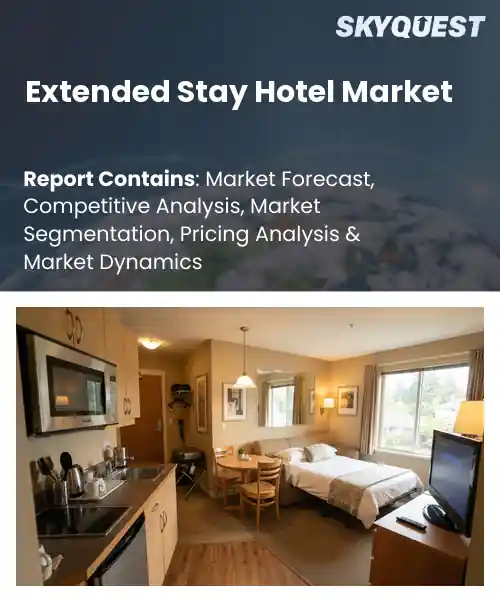
Extended Stay Hotel Market
Report ID: SQMIG25O2076
Report ID: SQMIG25O2076
[email protected]
USA +1 351-333-4748
Report ID:
SQMIG25O2076 |
Region:
Global |
Published Date: September, 2026
Pages:
157
|Tables:
116
|Figures:
77


Global Extended Stay Hotel Market size was valued at USD 57.7 Billion in 2024 and is poised to grow from USD 63.18 Billion in 2025 to USD 130.59 Billion by 2033, growing at a CAGR of 9.5% during the forecast period (2026-2033).
The global extended‑stay hotel market serves guests needing accommodation for weeks or months, bridging traditional hotels and residential rentals. Its relevance stems from growing mobility of professionals, relocating families, and long‑term tourists who demand hotel‑level services without a lease commitment. The segment originated in the United States in the 1990s when chains introduced suite‑style properties for corporate assignments; the concept later spread to Europe and Asia as business travel intensified. Over the past decade rising remote‑work arrangements and expat influxes have amplified demand, prompting developers to convert apartment blocks into serviced residences, turning extended‑stay lodging into an asset for investors. Dominant growth catalyst is the convergence of corporate mobility and digital nomadism, driving occupancy and rates. Companies outsource housing for teams, and remote‑work platforms let freelancers move to cheaper cities while retaining hotel services; landlords expand inventory and adopt technology such as contactless check‑in and dashboards. Operators that blend leases with data analytics capture higher revenue per available room and attract long‑term guests seeking predictable costs. An Asian chain partnered with a multinational firm to reserve floors for deployments, lifting RevPAR by 15 %, and a European brand launched an app‑based leasing tool that halved onboarding, opening a niche for expatriates.
How is AI-driven automation reshaping pricing strategies in the extended stay hotel market?
AI-driven automation is reshaping pricing in the extended‑stay hotel market by turning static rate structures into dynamic, data‑rich decision engines. Machine‑learning models ingest booking patterns, local events, competitor moves, and guest stay length to forecast demand at the segment level. These insights enable hotels to adjust nightly and weekly rates in real time, delivering higher occupancy while protecting average daily rate. Automation also streamlines the traditionally labor‑intensive revenue‑management process, freeing analysts to focus on strategy rather than spreadsheet updates. As travelers seek longer bookings for work‑from‑home stays, the ability to price flexibly across weeks and months becomes a competitive advantage that aligns revenue with the evolving usage patterns of the market.Extended Stay America announced an AI‑powered revenue‑management partnership with Duetto in June 2023, accelerating price optimization across its portfolio and supporting stronger occupancy growth through faster, data‑driven rate adjustments.
Market snapshot - (2026-2033)
Global Market Size
USD 57.7 Billion
Largest Segment
Monthly Stay
Fastest Growth
Extended Stay Above Three Months
Growth Rate
9.5% CAGR
To get more insights on this market click here to Request a Free Sample Report
Global extended stay hotel market is segmented by stay duration, property type, guest type, booking channel and region. Based on stay duration, the market is segmented into Weekly Stay, Monthly Stay and Extended Stay Above Three Months. Based on property type, the market is segmented into Hotel and Serviced Apartment. Based on guest type, the market is segmented into Business Travelers, Leisure Travelers and Relocation Guests. Based on booking channel, the market is segmented into Direct Booking, Online Travel Agencies and Corporate Travel Agencies. Based on region, the market is segmented into North America, Europe, Asia Pacific, Latin America and Middle East & Africa.
Monthly Stay segment dominates because travelers seeking cost-effective, semi‑permanent accommodations prioritize predictability and bundled services, which align with the core value proposition of extended stay providers. This staying pattern encourages operators to tailor amenities such as kitchenettes and laundry, fostering higher occupancy and longer guest relationships. The stability of month‑long bookings reduces turnover costs, reinforcing its leading position in the market while also enhancing brand perception among corporate clients and fostering loyalty.
However, Weekly Stay segment is witnessing the strongest growth momentum as remote workers and short‑term project teams increasingly favor flexible, week‑long bookings that blend hotel convenience with residential comfort. This emerging demand fuels investment in modular room designs and digital check‑in solutions, accelerating market expansion and opening new revenue streams.
Serviced Apartment segment dominates because it delivers a home‑like environment combined with hotel‑level services, meeting the expectations of business travelers and relocation guests who require both comfort and productivity. Operators leverage spacious layouts, personalized concierge support, and flexible lease terms to create an ecosystem that encourages prolonged stays and repeat bookings. This integrated offering differentiates the product and anchors its leadership within the extended stay sector in today’s competitive landscape.
Meanwhile, Hotel segment emerges as the fastest growing area as property owners retrofit traditional hotels with extended‑stay amenities, attracting travelers who value brand familiarity alongside longer‑term convenience. This shift drives capital infusion into technology‑enabled room customization and loyalty program extensions, propelling market dynamism and creating fresh avenues for growth overall.
To get detailed segments analysis, Request a Free Sample Report
North America leads the extended stay hotel market through a combination of mature travel infrastructure, high corporate mobility, and a culture that embraces longer‑term lodging solutions. The prevalence of large multinational headquarters creates constant demand for flexible accommodation that can serve relocating employees, project teams, and extended business trips. Robust real‑estate investment frameworks support the development of purpose‑built properties, while hospitality operators benefit from advanced technology platforms that enhance guest experience and operational efficiency. Consumer expectations for quality, safety, and convenience are consistently met through well‑established brand standards. These factors together generate a resilient ecosystem that sustains a dominant market position and attracts continued interest from investors and developers alike.
Extended Stay Hotel Market in the United States thrives on a deep pool of corporate travelers and a widespread network of major highways that facilitate easy access to suburban locations. Operators leverage sophisticated loyalty programs and technology‑driven service models to cater to guests seeking home‑like amenities. The strong financial environment encourages both domestic and foreign investors to fund new projects and refurbishments, reinforcing the market’s leading status.
Extended Stay Hotel Market in Canada benefits from a balanced mix of business travel and seasonal tourism that fuels occupancy across diverse provinces. Hospitality providers focus on delivering spacious suites, in‑room kitchens, and flexible booking terms that appeal to extended guests. Collaboration between developers and local municipalities ensures that new properties align with community planning goals, while a reputation for safety and hospitality enhances guest loyalty and market growth.
Europe’s rapid expansion is propelled by evolving work patterns, increasing cross‑border assignments, and a growing preference for residential‑style accommodations among leisure travelers. Urban centers and secondary cities alike are seeing heightened demand for flexible stay options that blend hotel services with domestic comforts. Regulatory environments that support mixed‑use developments encourage the integration of extended stay concepts within broader urban regeneration projects. Additionally, heightened focus on sustainability drives operators to adopt eco‑friendly practices, resonating with environmentally conscious guests. These dynamics collectively create a fertile landscape for brands to scale operations and for new entrants to capture niche segments across the continent.
Extended Stay Hotel Market in Germany leverages a strong industrial base and a network of multinational firms that generate steady demand for long‑term lodging. Operators emphasize premium amenities, reliable connectivity, and proximity to major business districts to attract corporate guests. Close collaboration with local real‑estate partners ensures that properties are situated near transportation hubs, facilitating easy commutes. The emphasis on high service standards and brand consistency reinforces Germany’s position as a dominant market within Europe.
Extended Stay Hotel Market in the United Kingdom experiences swift growth driven by dynamic professional mobility and a vibrant startup ecosystem. Hospitality brands focus on delivering adaptable spaces that accommodate both business travelers and extended leisure stays, often incorporating co‑working areas within the property. Strong transport links and a culture of short‑term rentals support the seamless transition between temporary and longer stays. This flexible approach fuels the rapid expansion observed across major cities and emerging regional centers.
Extended Stay Hotel Market in France emerges as a promising segment, capitalizing on a blend of cultural tourism and increasing corporate assignments. Operators tailor offerings to include spacious suites, communal kitchen facilities, and localized experiences that resonate with guests seeking authentic stays. Partnerships with regional tourism boards and business clusters help integrate extended stay properties into broader destination strategies. This emerging focus positions France as a growing contributor to the European landscape.
Asia Pacific is strengthening its position by embracing rapid urbanization, rising middle‑class mobility, and a cultural shift toward flexible living arrangements. The region’s dynamic economies encourage businesses to station staff for extended periods, creating a consistent flow of guests requiring equipped, long‑term accommodations. Hospitality providers are innovating with tech‑enabled check‑in processes, smart room features, and localized service models that align with regional preferences. Investment in mixed‑use developments integrates extended stay hotels with retail, office, and residential components, enhancing convenience for guests. A growing emphasis on sustainability and wellness further differentiates offerings, attracting both corporate and leisure travelers seeking comprehensive, adaptable experiences.
Extended Stay Hotel Market in Japan benefits from a high concentration of multinational subsidiaries and a culture that values convenience and quality. Operators emphasize spacious layouts, in‑suite kitchens, and easy access to public transportation networks, catering to business travelers and relocating families alike. Integration of traditional hospitality principles with modern technology creates a seamless guest experience, while collaboration with local developers ensures properties align with urban planning initiatives.
Extended Stay Hotel Market in South Korea is driven by a vibrant corporate sector and an emerging trend of long‑term leisure travel. Hotels focus on providing connected living spaces, flexible stay durations, and amenities that support both work and relaxation. Proximity to technology corridors and business districts enhances appeal for itinerant professionals, while strategic partnerships with local service providers enrich the guest offering and reinforce market growth.
To know more about the market opportunities by region and country, click here to
Buy The Complete Report
Rise Of Corporate Relocation Programs
Adopting Flexible Lease Models
Regulatory Zoning Restrictions
High Operating Cost Pressures
Request Free Customization of this report to help us to meet your business objectives.
The extended‑stay hotel sector is shaped by intense competition as global operators pursue M&A, strategic partnerships and technology rollouts to capture long‑term travelers; Accor’s 2020 acquisition of Onefinestay, Marriott’s 2020 launch of Homes & Villas, and Hilton’s integration of digital‑key and AI‑driven pricing illustrate how firms differentiate services, expand footprints and enhance guest experiences.
Top Player’s Company Profile
Recent Developments
SkyQuest’s ABIRAW (Advanced Business Intelligence, Research & Analysis Wing) is our Business Information Services team that Collects, Collates, Correlates, and Analyses the Data collected by means of Primary Exploratory Research backed by robust Secondary Desk research. As per SkyQuest analysis the extended‑stay hotel market is being propelled primarily by the rise of corporate relocation programs which feed a steady stream of professionals needing furnished, hotel‑level accommodations, while a second driver is the adoption of flexible lease models that let guests customize stay lengths and help operators smooth occupancy and cash flow; the monthly‑stay segment remains the dominant revenue generator because guests value predictable costs and bundled services, and North America continues to dominate the market thanks to its mature travel infrastructure and strong corporate mobility; however, regulatory zoning restrictions pose a significant restraint by limiting new conversions and slowing expansion.
| Report Metric | Details |
|---|---|
| Market size value in 2024 | USD 57.7 Billion |
| Market size value in 2033 | USD 130.59 Billion |
| Growth Rate | 9.5% |
| Base year | 2024 |
| Forecast period | (2026-2033) |
| Forecast Unit (Value) | USD Billion |
| Segments covered |
|
| Regions covered | North America (US, Canada), Europe (Germany, France, United Kingdom, Italy, Spain, Rest of Europe), Asia Pacific (China, India, Japan, Rest of Asia-Pacific), Latin America (Brazil, Rest of Latin America), Middle East & Africa (South Africa, GCC Countries, Rest of MEA) |
| Companies covered |
|
| Customization scope | Free report customization with purchase. Customization includes:-
|
To get a free trial access to our platform which is a one stop solution for all your data requirements for quicker decision making. This platform allows you to compare markets, competitors who are prominent in the market, and mega trends that are influencing the dynamics in the market. Also, get access to detailed SkyQuest exclusive matrix.
Table Of Content
Executive Summary
Market overview
Parent Market Analysis
Market overview
Market size
KEY MARKET INSIGHTS
COVID IMPACT
MARKET DYNAMICS & OUTLOOK
Market Size by Region
KEY COMPANY PROFILES
Methodology
For the Extended Stay Hotel Market, our research methodology involved a mixture of primary and secondary data sources. Key steps involved in the research process are listed below:
1. Information Procurement: This stage involved the procurement of Market data or related information via primary and secondary sources. The various secondary sources used included various company websites, annual reports, trade databases, and paid databases such as Hoover's, Bloomberg Business, Factiva, and Avention. Our team did 45 primary interactions Globally which included several stakeholders such as manufacturers, customers, key opinion leaders, etc. Overall, information procurement was one of the most extensive stages in our research process.
2. Information Analysis: This step involved triangulation of data through bottom-up and top-down approaches to estimate and validate the total size and future estimate of the Extended Stay Hotel Market.
3. Report Formulation: The final step entailed the placement of data points in appropriate Market spaces in an attempt to deduce viable conclusions.
4. Validation & Publishing: Validation is the most important step in the process. Validation & re-validation via an intricately designed process helped us finalize data points to be used for final calculations. The final Market estimates and forecasts were then aligned and sent to our panel of industry experts for validation of data. Once the validation was done the report was sent to our Quality Assurance team to ensure adherence to style guides, consistency & design.
Analyst Support
Customization Options
With the given market data, our dedicated team of analysts can offer you the following customization options are available for the Extended Stay Hotel Market:
Product Analysis: Product matrix, which offers a detailed comparison of the product portfolio of companies.
Regional Analysis: Further analysis of the Extended Stay Hotel Market for additional countries.
Competitive Analysis: Detailed analysis and profiling of additional Market players & comparative analysis of competitive products.
Go to Market Strategy: Find the high-growth channels to invest your marketing efforts and increase your customer base.
Innovation Mapping: Identify racial solutions and innovation, connected to deep ecosystems of innovators, start-ups, academics, and strategic partners.
Category Intelligence: Customized intelligence that is relevant to their supply Markets will enable them to make smarter sourcing decisions and improve their category management.
Public Company Transcript Analysis: To improve the investment performance by generating new alpha and making better-informed decisions.
Social Media Listening: To analyze the conversations and trends happening not just around your brand, but around your industry as a whole, and use those insights to make better Marketing decisions.
REQUEST FOR SAMPLE
 REQUEST FREE CUSTOMIZATION


Want to customize this report? This report can be personalized according to your needs. Our analysts and industry experts will work directly with you to understand your requirements and provide you with customized data in a short amount of time. We offer $1000 worth of FREE customization at the time of purchase.
Feedback From Our Clients


 USA (+1) 351-333-4748

