
eVTOL Aircraft Market
Report ID: SQMIG20R2070
Report ID: SQMIG20R2070
[email protected]
USA +1 351-333-4748
Report ID:
SQMIG20R2070 |
Region:
Global |
Published Date: July, 2025
Pages:
197
|Tables:
208
|Figures:
80


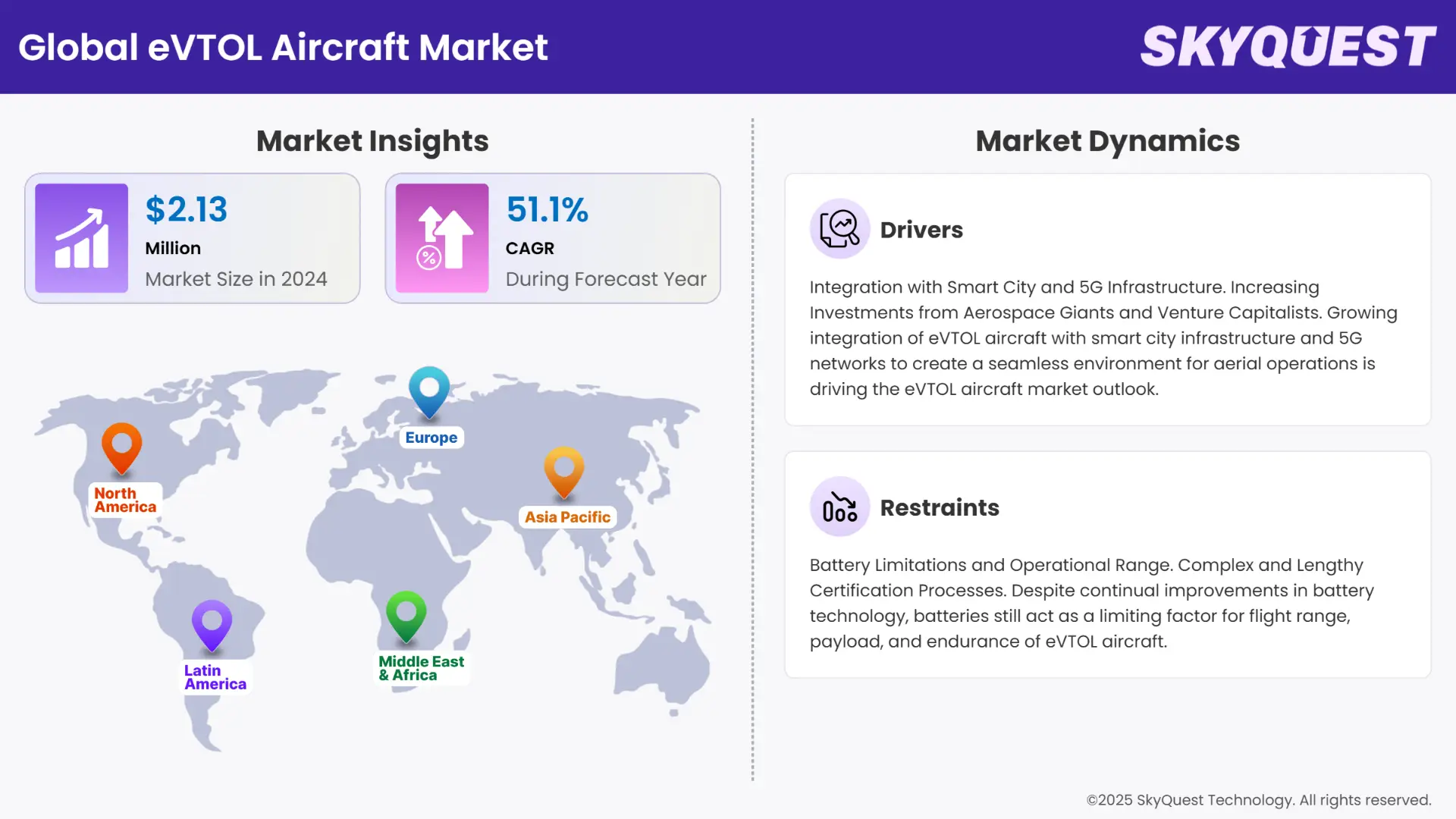
Global eVTOL Aircraft Market size was valued at USD 2.13 Billion in 2024 and is poised to grow from USD 3.22 Billion in 2025 to USD 87.47 Billion by 2033, growing at a CAGR of 51.1% during the forecast period (2026–2033).
Growing demand for urban air mobility, advancements in battery and propulsion, supportive government initiatives, high investments in R&D from aerospace giants, and high emphasis on sustainable aviation are slated to boost revenue generation in the long run.
Urban congestion in major cities is driving the need for alternative transportation. eVTOL aircraft offer vertical takeoff and landing capabilities, allowing them to operate in densely populated areas without requiring runways. Significant improvements in battery energy density, electric propulsion systems, and lightweight materials are making eVTOL aircraft viable. With global pressure to decarbonize transportation, the aviation sector is embracing electric propulsion to reduce greenhouse gas emissions. With global pressure to decarbonize transportation, the aviation sector is embracing electric propulsion to reduce greenhouse gas emissions. Governments and aviation authorities are actively supporting the development and integration of eVTOL aircraft into existing airspace, thereby promoting eVTOL aircraft market growth.
On the contrary, complex and lengthy certification processes, infrastructure and airspace management challenges, battery limitations, and high development and operational costs are forecasted to hamper the global eVTOL aircraft market penetration across the study period and beyond.
How Autonomous Technologies are Changing the Way eVTOL Aircrafts Operate?
The eVTOL market is rapidly moving toward autonomous flight to reduce pilot dependency, lower operational costs, and improve safety. Companies are developing advanced flight control systems powered by AI and sensor fusion, enabling autonomous navigation, obstacle avoidance, and real-time decision-making. Regulatory bodies are beginning to explore frameworks for unmanned operations, especially for cargo and surveillance use cases. Autonomous eVTOLs are ideal for last-mile delivery and short-hop transit in dense urban areas. While fully autonomous passenger flights remain years away, increasing autonomy in piloted models is paving the way. This trend enhances scalability, especially in regions with pilot shortages.
To get more insights on this market click here to Request a Free Sample Report
The global eVTOL aircraft market is segmented into lift technology, propulsion type, component, mode of operation, application, maximum takeoff weight, range, and region. By lift technology, the market is classified into vectored thrust, multirotor, and lift plus cruise. Depending on the propulsion type, it is categorized into fully electric, hybrid electric, and hydrogen electric. According to components, the market is divided into batteries and cells, electric motors/engines, aerostructures, avionics, software, and other solutions. Based on mode of operation, the market is segmented into piloted and autonomous. Based on application, the market is segmented into air taxis, air shuttles and air metros, private transport, cargo transport, air ambulance and medical emergency, last mile delivery, inspection and monitoring, surveying and mapping, surveillance, special mission, and other applications. Based on maximum takeoff weight, the market is segmented into <100 KG, 100–1,000 KG, 1,001–2,000 KG, and >2,000 KG. Based on range, the market is segmented into <=200 KM, >200 KM. Based on region, the market is segmented into North America, Europe, Asia Pacific, Latin America, and Middle East & and Africa.
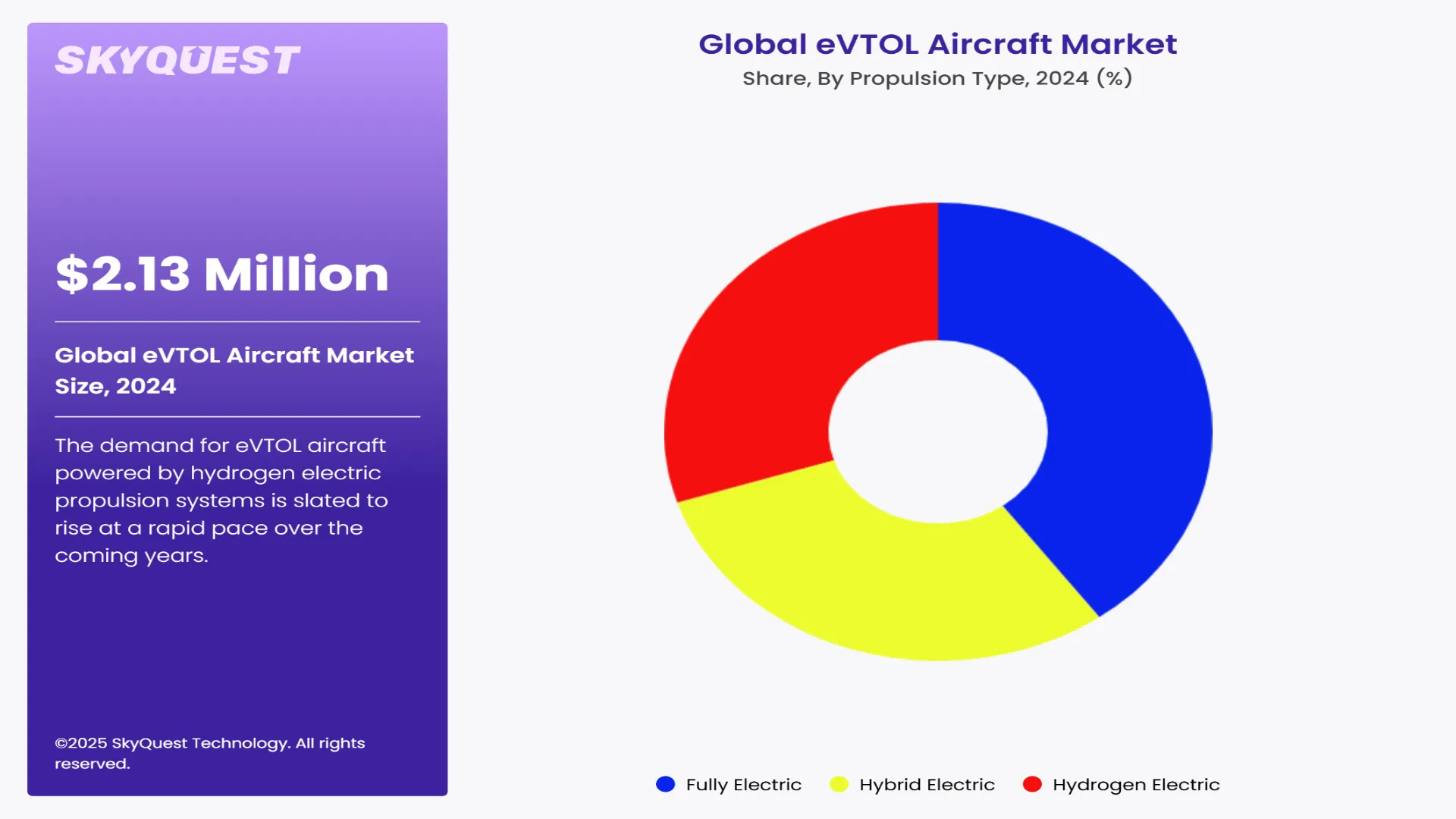
The fully electric segment is forecasted to spearhead the global eVTOL aircraft market revenue generation in the future. Advancements in battery technology and reducing costs of batteries are helping bolster the dominance of this segment going forward. Imposition of stringent emission regulations and incentives for sustainable aviation are also forecasted to help boost the demand for fully electric eVTOL aircraft over the coming years.
Meanwhile, the demand for eVTOL aircraft powered by hydrogen electric propulsion systems is slated to rise at a rapid pace over the coming years. Growing investments in R&D of advanced fuel cell technology and growing preference for alternatives to battery propulsion are slated to create new opportunities in the long run.
The piloted segment is projected to account for a substantial chunk of the global eVTOL aircraft market share in the future. Creation of new frameworks to integrate piloted eVTOLs into existing airspaces is helping this segment bolster its dominance. Advancements in avionics and control systems coupled with growing investments in piloted eVTOL aircraft development are also helping cement the high share of this segment in the long run. On the other hand, the demand for autonomous eVTOL aircraft is slated to rise at an impressive CAGR through 2032. Rapid advancements in artificial intelligence and machine learning technologies are playing a crucial role in creating new business scope for market players focused on this segment. Launch of new smart city initiatives is also creating new business scope in the future.
To get detailed segments analysis, Request a Free Sample Report
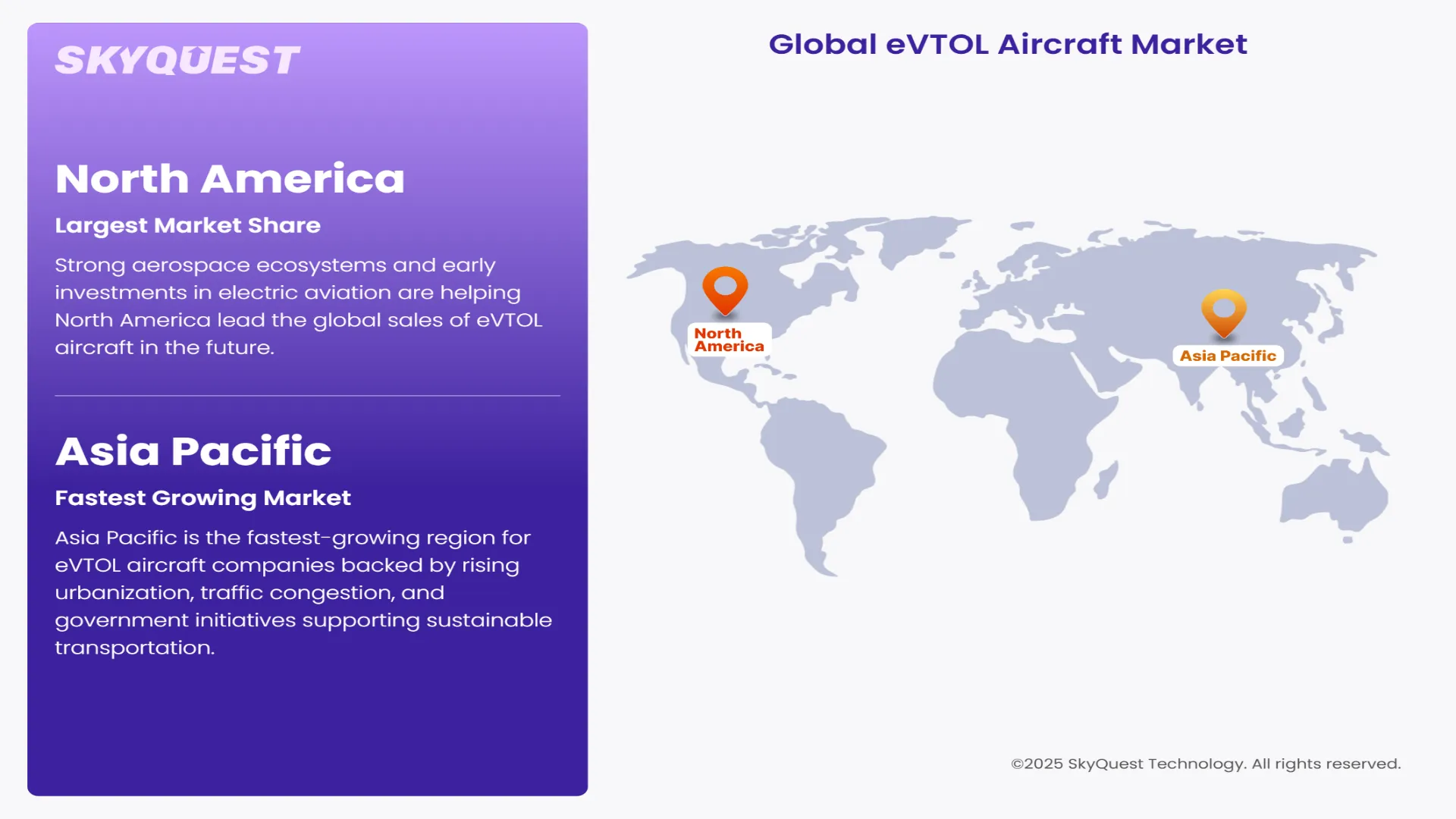
Strong aerospace ecosystems and early investments in electric aviation are helping North America lead the global sales of eVTOL aircraft in the future. Launch of Urban Air Mobility (UAM) projects supported by public-private partnerships are helping create new business scope for market players over the coming years. Venture capital inflow, advanced R&D infrastructure, and robust demand for air taxi services are also cementing the high share of this region through 2032 and beyond.
Presence of an advanced aviation infrastructure and strong government support is helping the United States lead eVTOL aircraft demand in North America. EVTOL aircraft innovation is led by companies such as Joby Aviation, Archer, and Wisk as they focus on FAA certification processes. Cities like Los Angeles and Miami are witnessing the launch of novel urban air mobility projects. With robust funding, regulatory momentum, and a mature aerospace industry, the United States remains the most advanced eVTOL market worldwide.
Strong innovation policies, clean aviation goals, and vast regional transport needs are governing the adoption of eVTOL aircraft in Canada. Surge in popularity of point-to-point air mobility, especially in remote and underserved areas, is also expected to create new business scope for market players. Transport Canada is collaborating with industry stakeholders on certification frameworks. Growing emphasis on vertiport integration into urban planning across Canadian airports is also slated to boost revenue for eVTOL aircraft companies.
Asia Pacific is the fastest-growing region for eVTOL aircraft companies backed by rising urbanization, traffic congestion, and government initiatives supporting sustainable transportation. Companies such as EHang in China and SkyDrive in Japan are pushing ahead with autonomous eVTOL demonstrations and regulatory approvals. Strategic collaboration between tech companies and urban planners is accelerating infrastructure readiness, positioning the region as a highly opportune one for eVTOL aircraft providers.
Launch of new safety and air traffic guidelines tailored for eVTOL aircraft, strong government support, and industrial involvement are forecasted to support market growth in Japan. Major corporations like Toyota and Japan Airlines are investing in electric aviation projects. The country’s emphasis on automation, compact city designs, and tech-forward urban planning makes it a fertile ground for early eVTOL adoption and innovation in this region.
Public-private partnerships and government support through aviation initiatives are helping keep eVTOL aircraft demand afloat in South Korea. The Ministry of Land, Infrastructure and Transport (MOLIT) of the country has launched the K-UAM Roadmap, which aims for commercial eVTOL services. Hyundai’s Supernal, in collaboration with KT and Incheon International Airport, is building a complete urban air mobility ecosystem including aircraft, infrastructure, and operations. South Korea’s tech-driven economy and policy alignment make it a regional leader in eVTOL aircraft innovation.
High emphasis on aerospace innovation and strong regulatory support for sustainable transportation programs are governing eVTOL aircraft adoption in Europe. The EU’s Green Deal promotes zero-emission transport, aligning with eVTOL goals. Presence of eVTOL aircraft innovators such as Volocopter and Lilium are also creating new business scope. Europe’s focus on safety, certification, and infrastructure is also predicted to play a crucial role in driving up the adoption of eVTOL aircraft over the coming years.
Strong investments in aerospace R&D and the presence of supportive policy frameworks are helping boost the demand for eVTOL aircraft in the country. The UK Civil Aviation Authority (CAA) is developing specific guidelines for eVTOL certification and integration into airspace. The Future Flight Challenge, funded by UK Research and Innovation, supports UAM trials and vertiport infrastructure planning. Cities like Coventry and London are leading urban air mobility hubs, thereby promoting sales of eVTOL aircraft.
Germany’s strong engineering expertise, clean energy focus, and robust funding ecosystem support advanced eVTOL aircraft R&D. Lilium and Volocopter are renowned firms focused on the development of electric aircraft for air taxis, intercity transport, and cargo delivery. Frankfurt, Munich, and Berlin are exploring urban vertiport infrastructure. With significant technological leadership, deep industrial partnerships, and a favorable regulatory environment, Germany is slated to emerge as a leading eVTOL aircraft innovation hub in Europe.
Sales of eVTOL aircraft in France are estimated to be influenced by aerospace giants, sustainable transport policies, and urban innovation. The French Civil Aviation Authority (DGAC) is working with EASA to define safety and airspace rules. France’s emphasis on decarbonizing aviation and its central role in the EU’s U-space initiative position it as an attractive market for eVTOL aircraft companies. Collaborations between startups and legacy establishments are also forecasted to boost revenue going forward.
To know more about the market opportunities by region and country, click here to
Buy The Complete Report
Integration with Smart City and 5G Infrastructure
Increasing Investments from Aerospace Giants and Venture Capitalists
Battery Limitations and Operational Range
Complex and Lengthy Certification Processes
Request Free Customization of this report to help us to meet your business objectives.
eVTOL aircraft providers should focus on investing more in R&D to create novel aircraft going forward. Integration of advanced autonomous systems and novel propulsion systems is slated to offer new business scope for companies as per this global eVTOL aircraft market analysis.
Sustainability is the prime focus of all startups working in the global eVTOL aircraft industry. Here are a few startups that could change the future of aviation fuel through its innovations.
SkyQuest’s ABIRAW (Advanced Business Intelligence, Research & Analysis Wing) is our Business Information Services team that Collects, Collates, Correlates, and Analyses the Data collected by means of Primary Exploratory Research backed by robust Secondary Desk research.
As per SkyQuest analysis, rising demand for sustainable aviation and integration with smart city initiatives are slated to primarily drive the demand for eVTOL aircraft going forward. However, lengthy certification processes and battery limitations are expected to slow down the demand for eVTOL aircraft in the future. North America is forecasted to emerge as the leading market for eVTOL aircraft companies owing to the presence of leading eVTOL aircraft companies and high venture capital funding in the United States and Canada. Development of vertiport infrastructure and strategic collaborations across industries are slated to be the key trends driving the eVTOL aircraft industry in the long run.
| Report Metric | Details |
|---|---|
| Market size value in 2024 | USD 2.13 Billion |
| Market size value in 2033 | USD 87.47 Billion |
| Growth Rate | 51.1% |
| Base year | 2024 |
| Forecast period | 2026–2033 |
| Forecast Unit (Value) | USD Billion |
| Segments covered |
|
| Regions covered | North America (US, Canada), Europe (Germany, France, United Kingdom, Italy, Spain, Rest of Europe), Asia Pacific (China, India, Japan, Rest of Asia-Pacific), Latin America (Brazil, Rest of Latin America), Middle East & Africa (South Africa, GCC Countries, Rest of MEA) |
| Companies covered |
|
| Customization scope | Free report customization with purchase. Customization includes:-
|
To get a free trial access to our platform which is a one stop solution for all your data requirements for quicker decision making. This platform allows you to compare markets, competitors who are prominent in the market, and mega trends that are influencing the dynamics in the market. Also, get access to detailed SkyQuest exclusive matrix.
Table Of Content
Executive Summary
Market overview
Parent Market Analysis
Market overview
Market size
KEY MARKET INSIGHTS
COVID IMPACT
MARKET DYNAMICS & OUTLOOK
Market Size by Region
KEY COMPANY PROFILES
Methodology
For the eVTOL Aircraft Market, our research methodology involved a mixture of primary and secondary data sources. Key steps involved in the research process are listed below:
1. Information Procurement: This stage involved the procurement of Market data or related information via primary and secondary sources. The various secondary sources used included various company websites, annual reports, trade databases, and paid databases such as Hoover's, Bloomberg Business, Factiva, and Avention. Our team did 45 primary interactions Globally which included several stakeholders such as manufacturers, customers, key opinion leaders, etc. Overall, information procurement was one of the most extensive stages in our research process.
2. Information Analysis: This step involved triangulation of data through bottom-up and top-down approaches to estimate and validate the total size and future estimate of the eVTOL Aircraft Market.
3. Report Formulation: The final step entailed the placement of data points in appropriate Market spaces in an attempt to deduce viable conclusions.
4. Validation & Publishing: Validation is the most important step in the process. Validation & re-validation via an intricately designed process helped us finalize data points to be used for final calculations. The final Market estimates and forecasts were then aligned and sent to our panel of industry experts for validation of data. Once the validation was done the report was sent to our Quality Assurance team to ensure adherence to style guides, consistency & design.
Analyst Support
Customization Options
With the given market data, our dedicated team of analysts can offer you the following customization options are available for the eVTOL Aircraft Market:
Product Analysis: Product matrix, which offers a detailed comparison of the product portfolio of companies.
Regional Analysis: Further analysis of the eVTOL Aircraft Market for additional countries.
Competitive Analysis: Detailed analysis and profiling of additional Market players & comparative analysis of competitive products.
Go to Market Strategy: Find the high-growth channels to invest your marketing efforts and increase your customer base.
Innovation Mapping: Identify racial solutions and innovation, connected to deep ecosystems of innovators, start-ups, academics, and strategic partners.
Category Intelligence: Customized intelligence that is relevant to their supply Markets will enable them to make smarter sourcing decisions and improve their category management.
Public Company Transcript Analysis: To improve the investment performance by generating new alpha and making better-informed decisions.
Social Media Listening: To analyze the conversations and trends happening not just around your brand, but around your industry as a whole, and use those insights to make better Marketing decisions.
REQUEST FOR SAMPLE
 REQUEST FREE CUSTOMIZATION
Global eVTOL Aircraft Market size was valued at USD 2.13 Billion in 2024 and is poised to grow from USD 3.22 Billion in 2025 to USD 87.47 Billion by 2033, growing at a CAGR of 51.1% during the forecast period (2026–2033).
eVTOL aircraft providers should focus on investing more in R&D to create novel aircraft going forward. Integration of advanced autonomous systems and novel propulsion systems is slated to offer new business scope for companies as per this global eVTOL aircraft market analysis. 'Joby Aviation (USA)', 'Lilium GmbH (Germany)', 'Vertical Aerospace (UK)', 'EHang Holdings Limited (China)', 'Archer Aviation (USA)', 'Volocopter GmbH (Germany)', 'Beta Technologies (USA)', 'Wisk Aero (USA)', 'Honda Motor Co., Ltd. (Japan)', 'Airbus SE (France)', 'EmbraerX (Eve Air Mobility) (Brazil)', 'Hyundai Motor Group (Supernal) (South Korea)', 'Pipistrel (Textron eAviation) (Slovenia)', 'Bell Textron Inc. (USA)', 'Urban Aeronautics Ltd. (Israel)', 'Kitty Hawk Corporation (USA)', 'Alauda Aeronautics (Australia)', 'Overair, Inc. (USA)', 'AutoFlight (China)', 'XTI Aircraft Company (USA)'
Growing integration of eVTOL aircraft with smart city infrastructure and 5G networks to create a seamless environment for aerial operations is driving the eVTOL aircraft market outlook. 5G enhances communication, real-time data sharing, and air traffic management, enabling safe, efficient routing. Smart cities are incorporating vertiports, charging stations, and digital monitoring into urban planning, making eVTOL operations feasible. As cities grow smarter and more connected, eVTOLs become a natural extension of urban mobility networks.
Development of Vertiport Networks and UAM Ecosystems: Emphasis on supporting urban air mobility (UAM) across cities is boosting investments in the development of vertiport infrastructure. Companies like Skyports, Urban-Air Port, and Volocopter are piloting vertiport concepts in major cities. Municipalities are revising airspace management and urban zoning to accommodate low-altitude flight paths. As cities adopt greener transport methods, emphasis on this eVTOL aircraft market trend is projected to increase at a notable pace.
Strong aerospace ecosystems and early investments in electric aviation are helping North America lead the global sales of eVTOL aircraft in the future. Launch of Urban Air Mobility (UAM) projects supported by public-private partnerships are helping create new business scope for market players over the coming years. Venture capital inflow, advanced R&D infrastructure, and robust demand for air taxi services are also cementing the high share of this region through 2032 and beyond.


Want to customize this report? This report can be personalized according to your needs. Our analysts and industry experts will work directly with you to understand your requirements and provide you with customized data in a short amount of time. We offer $1000 worth of FREE customization at the time of purchase.
Feedback From Our Clients


 USA (+1) 351-333-4748

