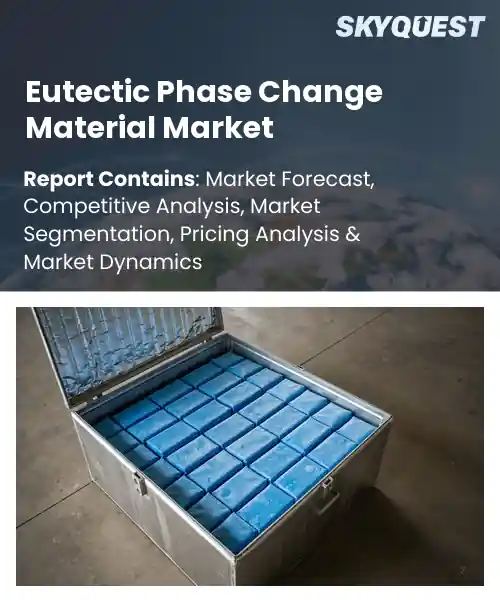
Eutectic Phase Change Material Market
Report ID: SQMIG15E3284
Report ID: SQMIG15E3284
[email protected]
USA +1 351-333-4748
Report ID:
SQMIG15E3284 |
Region:
Global |
Published Date: February, 2026
Pages:
157
|Tables:
93
|Figures:
76


Global Eutectic Phase Change Material Market size was valued at USD 2.60 Billion in 2024 and is poised to grow from USD 3.02 Billion in 2025 to USD 9.96 Billion by 2033, growing at a CAGR of 16.1% during the forecast period (2026-2033).
The eutectic phase change material market is primarily driven by their ability to store and release latent heat via melting and freezing at predetermined temperatures allowing for compact, efficient thermal management throughout a variety of industries. One of the major growth drivers of this market has been the increasing need for decarbonizing and improving energy efficiency, which is resulting in utilities, facilities owners and manufacturers shaving peak loads and integrating renewable energy sources into their operations. The market has undergone a shift over time from using basic inorganic salt hydrates for storing heat in industry to using engineered organic and eutectic mixtures to enhance thermal performance throughout building envelopes, HVAC and electronics cooling systems.
Typical deployments of PCM include thermal batteries for solar energy systems, HVAC chillers, and phase change panels used for temperature control in transportation systems. In order to support the continued growth of the market, improving thermal conductivity and cycle stability is an important driver, as enhanced functionality has the potential to reduce the size of the mechanical system and reduce overall lifecycle costs of systems using PCM products, thereby increasing the number of potential applications for PCM products. NANOEFFECT™ enhanced eutectic blends and advanced microencapsulation are examples of PCM products used to enhance heat transfer within electric vehicle battery packs and throughout rack-level modules used to cool data centre infrastructure.
How is AI Driving Innovation in the Eutectic Phase Change Material Market?
The use of AI is rapidly changing the way that innovations are developed within the eutectic phase change material (PCM) industry by increasing the speed and reliability of designing the composition and predicting the performance of these materials. Eutectic PCMs consist of blends of materials that melt and freeze (solidify) at the same temperature while providing a storage mechanism for latent heat. Currently, the industry wants bespoke melting point and stable cycling solutions to support cold chain use, building thermal energy storage, and electronics cooling. The use of machine learning and materials informatics provides the capability for rapid screening of candidate mixtures, generation of predicted phase diagrams, and execution of automated experiments to minimize trial-and-error methods for developing these materials. Companies and universities are currently combining both AI based simulations and automated laboratory equipment to facilitate laboratory work moving toward commercial scale and utilizing more sustainable bio-based solutions for their products.
Market snapshot - (2026-2033)
Global Market Size
USD 2.6 Billion
Largest Segment
Eutectic Solder
Fastest Growth
Brazing Alloys
Growth Rate
16.1% CAGR
To get more insights on this market click here to Request a Free Sample Report
Global eutectic phase change material market is segmented into product type, application, end user and region. Based on product type, the market is segmented into eutectic solder, brazing alloys and others. Based on application, the market is segmented into automotive, aerospace, electronic, and electrical, optoelectronic, medical and others. Based on end user, the market is segmented into residential, commercial and industrial. Based on region, the market is segmented into North America, Europe, Asia Pacific, Latin America and Middle East & Africa.
Eutectic solder segment dominates the market due to their straightforward phase transitions, making it easy to manage temperature while assembling and in-service cycling, leading to low risk of failure and longer product life. Established supply chains, industry experience, and compatibility with methods of automatic assembly are driving the widespread usage of eutectic solder in high-volume applications, hence providing strong demand and foundation for future market development.
On the other hand, brazing alloys are showing the most substantial growth as manufacturers look for more significant temperature stability and enhanced joint strength and integrity for thermal storage and robust fabrication. New developments in chemistry and process techniques have expanded the practical application range of brazing alloys, and facilitate new methods of integrating products, so there are many opportunities in the future across advanced electronics and high-temperature thermal management.
The optoelectronic segment leads in the market due to the strict thermal environmental requirements needed to maintain optical performance and wavelength stability of optoelectronic devices; therefore, there is a great need for materials with well-defined melting points and repeatable behavior of latent heat. Optoelectronic modules that utilize eutectic phase change materials help maintain stable temperatures during fluctuating workloads, limit thermal drift, and extend the life of the devices; consequently, eutectic phase change materials become one of the preferred materials by manufacturers in the product design and reliability process.
The automotive industry is becoming the key area with the highest growth potential because of electrical vehicles and the need to closely manage vehicle thermal management systems for battery packs and power electronics. With the growing need for scalable eutectic phase change material solutions in the automotive market, and advances in material development to improve automotive reliability and comply with regulations, the integration of these materials into thermal management systems is accelerating at a rapid pace, creating significant opportunities for product development and supply chain.
To get detailed segments analysis, Request a Free Sample Report
Asia Pacific leads due to a mix of advanced manufacturing, well-researched material sciences, and close ties to growing high demand end use markets. Both electronics and automotive established clusters will provide ongoing demand for continual thermal management solutions, while a robust amount of retrofitting activity on buildings and renewable energy projects will expand the market opportunities for eutectic phase change materials.
The Japan eutectic phase change material market share is driven by advances in electronics manufacturing, high thermal reliability requirements, and a strong focus on energy conservation. Demand comes from the integration of precision thermal management in semiconductors, battery systems, and small consumer electronics. Local research institutions and specialty material manufacturers provide custom eutectic formulations that meet the highest performance standards for these applications.
The South Korea eutectic phase change material market trends reflect a technology driven industrial base with substantial input from semiconductors, automotive electrification, and CE manufacturing. Local manufacturers utilize the best materials to develop consistent product performance to meet their specific thermal management needs. The need to integrate with battery thermal management systems and the cooling of high-density electronics encourages innovative formulation development. Working cooperatively are the manufacturers, research institutes, and system designers to develop new formulations and adapt existing ones to meet application-specific requirements; they are establishing the market as the center for specialized eutectic solutions.
Growth of e-transport and DC infrastructure coupled with research-driven ecosystems and progressive building codes and energy efficiency standards drive development in North America. Intensive collaboration between technology developers and users is resulting in pilot projects and early commercial demonstrations that provide reference applications to promote the wider adoption of technology. High amounts of venture and corporate investment in advanced thermal management materials are enabling continuous innovation in the development of new eutectic chemistry and encapsulation techniques.
The U.S. eutectic phase change material market is characterized by a high level of research activity, diverse end-use application demands, and a focus on the commercialization of advanced thermal storage solutions. The development of eutectic phase change materials has been spurred by demand from data centers, systems for buildings, and electrification of transportation. Thermal stability and reliability are critical attributes required in these markets. Partnerships between both public and private entities to participate in research are also assisting in the qualification of materials and testing for use in applications.
The Canada eutectic phase change material market focuses on sustainability driven applications and cold chain optimizations considering both climatic and logistical conditions. Research capabilities in both material and energy systems can provide cost effective/custom solutions for building envelopes as well as buildings with thermal/sustainable objectives. Collaborations between academic institutions, technology incubators, and local manufacturers will increase the successful commercialization of new eutectic blends.
Europe is boosting its capacity to utilize dedicated energy efficiency, including enhanced circular economy principles, and greater investment into advanced material research, through coordinated policy support. By creating a network of research centers and pilot facilities, along with the harmonization of technical standards and certification pathways, barriers to the cross-border adoption of eutectic solutions have been eliminated. Research consortia and public-private partnerships are also accelerating the development of scalable manufacturing methods while promoting the use of recyclable and environmentally compatible material formulations. The combined focus on regulatory alignment, performance validation, and value chain integration makes Europe a competitive region for mature sustainable applications for eutectic phase change materials.
Eutectic phase change material market in Germany is driven by strong industrial demand for energy-efficient solutions, as well as extensive expertise in the field of materials engineering. Industrial process heat, building retrofit applications and mobility systems require formulations that have undergone rigorous testing to provide reliable long-term use. Collaborative efforts between specialized manufacturers and research institutions can support the industrial-scale manufacture and integration of engineered systems that utilize these materials. Procurement decisions are influenced by emphasis on quality, adherence to standards of compliance, and life-cycle assessment and the development of circular materials that align with sustainability goals within industry sectors.
The United Kingdom's eutectic phase change material industry is supported by a strong innovation ecosystem that is closely related to the decarbonization of buildings and transportation. Several pilot projects and demonstrations have been carried out in conjunction with public sector partners to validate specific performance factors and bolster market confidence. There is also high-quality academic work being conducted on advancing encapsulation and composite methods in conjunction with industry partners, allowing for installation of these materials in both existing and new construction. A robust service industry for systems design and integration will help convert the performance attributes of these materials into operational energy savings and resiliency benefits for institutional buyers and developers alike.
The eutectic phase change material industry in France is developing along similar lines as the industry in the UK with emphasis on thermal comfort and energy efficiency as well as optimization of industrial processes. Uses for eutectic phase change materials are starting to appear across a variety of building systems, thermal storage applications and industrial processes that require precise temperature control. The adoption of eutectic phase change material has been also facilitated by the cooperation of eutectic material suppliers, engineering companies and end-users in demonstrating operational efficiencies and integrating Eutectic solutions into holistic energy management strategies.
To know more about the market opportunities by region and country, click here to
Buy The Complete Report
Expansion of Thermal Storage Applications
Advancements in Formulation Techniques
High Manufacturing Complexity and Costs
Regulatory and Standardization Uncertainties
Request Free Customization of this report to help us to meet your business objectives.
The global competitive landscape of eutectic phase change materials (PCM) is driven by differentiating technologies, strategic partnerships and targeted financing aimed to accelerate the commercialization and subsequent regional expansion of PCM applied in heating, ventilation and air conditioning (HVAC), data center cooling and cold chain markets. Incumbent companies are licensing to regional partners for growth and commercialization while larger chemical companies are establishing commercialization alliances to achieve large-scale production/bio-PCM solutions/deployments; a few noteworthy alliances include DIC’s strategic partnership with Phase Change Solutions and Rubitherm’s regional expansion efforts.
SkyQuest’s ABIRAW (Advanced Business Intelligence, Research & Analysis Wing) is our Business Information Services team that Collects, Collates, Correlates, and Analyses the Data collected by means of Primary Exploratory Research backed by robust Secondary Desk research.
As per SkyQuest analysis, the global eutectic phase change material market share is expected to show robust growth, driven primarily by the desire for decarbonization and improved energy efficiency, as well as enhanced materials engineering driven advances in thermal conductivity and cycle stability. The majority of growth will occur in the eutectic solder segment, which can be used with predictable melting behavior and familiarity in the electronics sector; the Asia-Pacific region will continue to be a significant contributor to growth due to high capability in manufacturing, R&D, and close proximity to fast-growing end-use markets. The greatest challenge to the expansion of EPCMs will continue to be manufacturing complexity and the high costs of manufacturing related to purity control and encapsulation, which restrict scalability and impede adoption despite strong technical advancements and favorable government policies.
| Report Metric | Details |
|---|---|
| Market size value in 2024 | USD 2.6 Billion |
| Market size value in 2033 | USD 9.96 Billion |
| Growth Rate | 16.1% |
| Base year | 2024 |
| Forecast period | (2026-2033) |
| Forecast Unit (Value) | USD Billion |
| Segments covered |
|
| Regions covered | North America (US, Canada), Europe (Germany, France, United Kingdom, Italy, Spain, Rest of Europe), Asia Pacific (China, India, Japan, Rest of Asia-Pacific), Latin America (Brazil, Rest of Latin America), Middle East & Africa (South Africa, GCC Countries, Rest of MEA) |
| Companies covered |
|
| Customization scope | Free report customization with purchase. Customization includes:-
|
To get a free trial access to our platform which is a one stop solution for all your data requirements for quicker decision making. This platform allows you to compare markets, competitors who are prominent in the market, and mega trends that are influencing the dynamics in the market. Also, get access to detailed SkyQuest exclusive matrix.
Table Of Content
Executive Summary
Market overview
Parent Market Analysis
Market overview
Market size
KEY MARKET INSIGHTS
COVID IMPACT
MARKET DYNAMICS & OUTLOOK
Market Size by Region
KEY COMPANY PROFILES
Methodology
For the Eutectic Phase Change Material Market, our research methodology involved a mixture of primary and secondary data sources. Key steps involved in the research process are listed below:
1. Information Procurement: This stage involved the procurement of Market data or related information via primary and secondary sources. The various secondary sources used included various company websites, annual reports, trade databases, and paid databases such as Hoover's, Bloomberg Business, Factiva, and Avention. Our team did 45 primary interactions Globally which included several stakeholders such as manufacturers, customers, key opinion leaders, etc. Overall, information procurement was one of the most extensive stages in our research process.
2. Information Analysis: This step involved triangulation of data through bottom-up and top-down approaches to estimate and validate the total size and future estimate of the Eutectic Phase Change Material Market.
3. Report Formulation: The final step entailed the placement of data points in appropriate Market spaces in an attempt to deduce viable conclusions.
4. Validation & Publishing: Validation is the most important step in the process. Validation & re-validation via an intricately designed process helped us finalize data points to be used for final calculations. The final Market estimates and forecasts were then aligned and sent to our panel of industry experts for validation of data. Once the validation was done the report was sent to our Quality Assurance team to ensure adherence to style guides, consistency & design.
Analyst Support
Customization Options
With the given market data, our dedicated team of analysts can offer you the following customization options are available for the Eutectic Phase Change Material Market:
Product Analysis: Product matrix, which offers a detailed comparison of the product portfolio of companies.
Regional Analysis: Further analysis of the Eutectic Phase Change Material Market for additional countries.
Competitive Analysis: Detailed analysis and profiling of additional Market players & comparative analysis of competitive products.
Go to Market Strategy: Find the high-growth channels to invest your marketing efforts and increase your customer base.
Innovation Mapping: Identify racial solutions and innovation, connected to deep ecosystems of innovators, start-ups, academics, and strategic partners.
Category Intelligence: Customized intelligence that is relevant to their supply Markets will enable them to make smarter sourcing decisions and improve their category management.
Public Company Transcript Analysis: To improve the investment performance by generating new alpha and making better-informed decisions.
Social Media Listening: To analyze the conversations and trends happening not just around your brand, but around your industry as a whole, and use those insights to make better Marketing decisions.
REQUEST FOR SAMPLE
 REQUEST FREE CUSTOMIZATION
Global Eutectic Phase Change Material Market size was valued at USD 2.6 Billion in 2024 and is poised to grow from USD 3.02 Billion in 2025 to USD 9.96 Billion by 2033, growing at a CAGR of 16.1% during the forecast period (2026-2033).
Competitive landscape for global eutectic phase change materials is driven by technology differentiation, strategic partnerships and targeted funding that accelerate commercialization and regional expansion across HVAC, data center cooling and cold chain. Incumbents pursue licensing and regional rollouts while chemical groups form commercialization alliances to scale BioPCM solutions; notable examples include DIC’s strategic partnership with Phase Change Solutions and Rubitherm’s regional expansion. 'BASF', 'eutectic', 'phase change materials', 'Climator', 'BioPCM', 'Phase Change Energy Solutions', 'Advanced Phase Change Materials', 'Outlast Technologies', 'PCM Products', 'ThermoSafe', 'Phase Change Technologies', 'Rubitherm Technologies', 'MENERGY', 'PCM Energy', 'Cryopak', 'Cool Polymers', 'Thermal Energy Storage Solutions', 'EikoLogic', 'Henkel', 'Solvay'
Improved availability of eutectic phase change formulations has enabled broader integration into building envelopes, HVAC systems, and industrial process heat management, supporting longer duration thermal regulation and peak load shifting. Manufacturers and designers appreciate consistent melting and solidification behavior that simplifies system design and reduces reliance on conventional materials. This practical compatibility with existing infrastructure accelerates adoption because stakeholders can retrofit or specify eutectic PCMs without extensive redesign, thereby lowering perceived implementation barriers and fostering demand from end users seeking reliable, passive temperature control solutions.
Decarbonization Driven Adoption: Organizations pursuing low carbon solutions increasingly favor eutectic phase change materials for passive thermal buffering and load shifting in buildings and industrial systems. Integration with renewable generation enhances operational flexibility and supports decarbonization goals by smoothing intermittency and reducing reliance on active heating. Demand from retrofit and construction segments is rising as stakeholders prioritize lifecycle energy performance. Procurement preferences emphasize materials that enable peak load reduction and improved renewables utilization, stimulating collaboration across supply chains, formulation development for thermal profiles.
Asia Pacific Dominate the Global Eutectic Phase Change Material Market.


Want to customize this report? This report can be personalized according to your needs. Our analysts and industry experts will work directly with you to understand your requirements and provide you with customized data in a short amount of time. We offer $1000 worth of FREE customization at the time of purchase.
Feedback From Our Clients


 USA (+1) 351-333-4748

