Equipment Monitoring Market
Report ID: SQMIG20I2643
Report ID: SQMIG20I2643
[email protected]
USA +1 351-333-4748
Report ID:
SQMIG20I2643 |
Region:
Global |
Published Date: February, 2026
Pages:
157
|Tables:
100
|Figures:
76


Global Equipment Monitoring Market size was valued at USD 5.3 Billion in 2024 and is poised to grow from USD 5.62 Billion in 2025 to USD 8.95 Billion by 2033, growing at a CAGR of 6.0% during the forecast period (2026-2033).
The primary driver of the equipment monitoring market is the growing use of Industrial Internet of Things platforms that turn various types of sensor data into usable information which allows for predictive maintenance and optimization. Equipment monitoring includes hardware sensors, communications networks, analytics either on-premises or in the cloud, plus interfaces to continuously view an asset’s condition and performance. This market is important because reducing unplanned downtime, lowering maintenance costs, and meeting regulatory compliance, will provide manufacturers, utilities, and logistics companies a competitive edge. Historically, monitoring has evolved from manual inspections performed periodically or by PLC alarm systems to wireless sensors, edge computing, and machine learning; examples of this evolution include smart factories and turbine farms.
Building on improvements in sensor fidelity and analytics, the critical growth factor is return on investment from predictive maintenance, because anomaly detection reduces unplanned outages and maintenance spend and extends asset life. As cloud and edge computing mature and sensor costs decline, more operators deploy condition-based monitoring across fleets, prompting vendors to offer subscription platforms that scale and lower upfront capital requirements. For example, wind-farm operators use blade vibration and SCADA integration to schedule repairs before blade failure, and chemical plants apply corrosion monitoring to avoid leaks, which in turn opens opportunities for retrofit services, data monetization and cross-industry benchmarking.
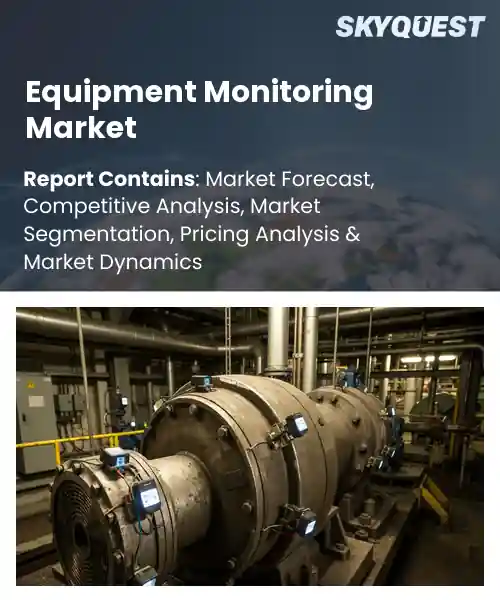
How is IoT Improving Real-time Asset Performance in the Equipment Monitoring Market?IoT improves real time asset performance in equipment monitoring by combining continuous sensors edge computing and cloud analytics to turn raw signals into actionable insights. Key aspects include persistent telemetry from vibration temperature and load sensors local preprocessing to filter noise and predictive analytics that flag deviations before failure. The current market has moved from periodic inspections to continuous condition-based management where manufacturers fleet operators and facility teams gain visibility across distributed assets. Practical instances span industrial motors HVAC and heavy construction equipment where early alerts enable faster interventions reduce unplanned stoppages and extend useful life.
Market snapshot - 2026-2033
Global Market Size
USD 5.3 Billion
Largest Segment
Vibration Monitoring
Fastest Growth
GPS Tracking
Growth Rate
6.0% CAGR
To get more insights on this market click here to Request a Free Sample Report
The equipment monitoring market is segmented by monitoring type, deployment type, industry and region. Based on monitoring type, the market is segmented into Vibration Monitoring, Thermal Monitoring, Lubrication Monitoring, Corrosion Monitoring, Noise Monitoring, Motor Current Monitoring, GPS Tracking and Alarm Monitoring. Based on deployment type, the market is segmented into On-Premise and Cloud. Based on industry, the market is segmented into Oil & Gas, Power Generation, Metals & Mining, Chemicals, Automotive, Aerospace & Defense, Food & Beverages, Marine and Others. Based on region, the market is segmented into North America, Europe, Asia Pacific, Latin America and Middle East & Africa.
Vibration Monitoring segment dominates because its ability to detect early mechanical anomalies directly reduces unplanned downtime and extends asset life through predictive maintenance. Continuous frequency and amplitude analysis enables precise fault localization, which prompts targeted interventions and reduces inspection overhead. The maturity of sensor technology and integration with analytics creates reliable condition-based workflows, causing maintenance teams to prioritize vibration solutions for critical rotating equipment where mechanical failure risk is highest.
GPS tracking monitoring is poised to be the fastest-growing segment in the global equipment monitoring market due to rising demand for real-time asset visibility, fleet optimization, theft prevention, and supply chain transparency. Rapid expansion of logistics, construction, and rental equipment industries, combined with IoT integration and falling sensor costs, accelerates large-scale adoption.
Cloud segment leads because centralized data aggregation and elastic compute resources allow real-time analysis across dispersed assets, enabling monitoring operations that were previously constrained by local infrastructure. Improved analytics accuracy because of regular software updates enhance anytime availability for smaller businesses (rapid turnaround time combined with lower upfront investment). Together, these factors will be the key driver behind preference among operators of complex asset estates to utilizecloud-based technologies in equipment monitoring installations.
On-premises deployment is expected to be the fastest-growing segment in the global equipment monitoring market due to rising concerns over data security, regulatory compliance, and operational control. Industries that depend on assets favourhaving localized assets to ensure that they have real-time processing times, the least amount of latency, ability to customize their systems, and most importantly, provide a level of protection for their sensitive operational data against cyber threats.
To get detailed segments analysis, Request a Free Sample Report
North America leads the global equipment monitoring market due to a convergence of technological maturity, strong vendor ecosystems, and high enterprise readiness. Large industrial and utility companies are working with service providers, researchers and others to test advanced sensing and ML solutions in pilot projects, while drives toward improved uptime and operational resilience fuel investment. Established regulatory environments and cybersecurity best practices support large-scale deployments. Additionally, the presence of established professional services, availability of funding and an active startup community will help to speed up the commercialization of new offering and provide full support and customization for complex asset environments. Established service networks and consultative selling methods allow for broad "aftermarket" adoption; pairing established vendors with niche innovators helps to eliminate the time it takes for users to realize the benefits of these technology advancements.
United States Equipment Monitoring Market
Equipment monitoring market in the United States is driven by integrated industrial ecosystems, widespread deployment of IoT sensors, advanced analytics adoption, and a mature vendor landscape. Providers of service and the final users will work together to develop custom made prediction maintenance strategies (such as research projects) with help from strong research institutions and an experienced workforce. By focusing on these three areas i.e., Interoperability; Cyber Security; and Outcomes-Based Service Contracts, the adoption rate of these initiatives across the manufacturing, energy, and transportation sectors.
Canada Equipment Monitoring Market
Equipment monitoring market in Canada reflects a strategic emphasis on reliability, remote monitoring for dispersed assets, and tailored solutions for resource-intensive industries. Collaboration between technology firms and operators emphasizes low-power sensing, edge analytics, and modular deployment models. Targeted incentives for trial-and-scaling by promote regulatory alignment and local integrators align using service quality and lifecycle support provided by local businesses to provide solutions that meet the community's needs throughout mining, utility, and manufacturing industries.
Asia Pacific is experiencing rapid expansion in equipment monitoring driven by accelerated industrial modernization, widespread adoption of connectivity technologies, and robust electronics and semiconductor manufacturing hubs. Collaboration between government and industry for Digitization goals is on Automation, Remote Diagnostics, Predictive Maintenance of Distributed Assets. They have achieved new capabilities in high-speed communication and Edge Analytics, which allow them to monitor low-latency environments. Local vendors and integrators are able to develop solutions that fit within compact physical spaces and can withstand extreme conditions due to advances in technology. Export-oriented production, a competitive supplier base, strong OEM partnerships, and emphasis on operational resilience consolidate the region's place as a rapidly growing market for complete monitoring services platforms. Investment in the workforce skillset, local manufacturing of sensor/funding components, and developing partnerships for localizing solutions all help to remove barriers to adoption. Managed Services/Outcome-based service models will drive more penetration into SME's.
Japan Equipment Monitoring Market
Equipment monitoring market in Japan benefits from advanced manufacturing ecosystems, strong robotics integration, and a cultural emphasis on quality and continuous improvement. Local firms prioritize highly reliable sensing, precision analytics, and integration with factory automation platforms. Collaboration among OEMs, system integrators, and research institutions accelerates refinement of tailored solutions for electronics, automotive, and semiconductor production lines, with focus on long-term operational efficiency and minimal disruption and enhanced lifecycle support capabilities.
South Korea Equipment Monitoring Market
Equipment monitoring market in South Korea is propelled by a dense electronics and semiconductor manufacturing base, advanced telecommunications infrastructure, and a strong focus on real-time monitoring. In general, the integration of high-speed networks and AI-based analysis is leading to the introduction of compact sensor technology by industry leaders. In addition, companies specializing in systems integration are creating customized solutions through system integration to maximize throughput and yield. Numerous collaborative partnerships among large corporations, new companies, and academic institutions are increasing the speed of developing product prototypes.
Europe is strengthening its position in equipment monitoring through coordinated policy support, emphasis on standards, and a strong industrial base that values precision and sustainability. Interoperability, data privacy and secure architecture have all been defined by regional efforts as a priority for cross border deployments and vendor collaboration. National clusters are leveraging existing manufacturing capability and service ecosystems to adapt retrofit strategies for existing assets as well as advance digital twins, edge analytics and modular sensing platforms. Public funding and industry consortia are accelerating validation efforts through use of standards-based approaches; mature field service networks and consultative sales models are increasing adoption rates for complex industrial users, utilities and transportation operators that are looking to improve reliability and optimise asset lifecycles. An emphasis on workforce upskilling, local component manufacturing, and sustainability objectives is driving demand for monitoring solutions that enable energy efficient operations and reduced downtime.
Germany Equipment Monitoring Market
Equipment monitoring market in Germany centers on integration with advanced manufacturing practices, strong automation vendor presence, and a focus on digital industry initiatives. Companies that are primarily focused on engineering will be establishing their priorities around having reliable sensor technologies: deterministic data architectures, and that they will need to have lifecycle engineering integrated into their systems. Integrators within the local market / OEM's that have developed customized predictive maintenance programmes, retrofit services that conform to strict quality control measures.
United Kingdom Equipment Monitoring Market
Equipment monitoring market in United Kingdom emphasizes service-led models, cloud platform adoption, and strong capabilities in systems integration and consultancy. Managed services, digital twin development, and remote diagnostics have become the primary focus of providers that serve both the offshore energy and infrastructure industries. A collaborative cluster of academic centers, consultants, and startups is jointly developing, designing, and implementing solutions that emphasize data governance, interoperability, and cyber resilience.
France Equipment Monitoring Market
Equipment monitoring market in France is shaped by strong ties between industrial OEMs, energy operators, and research institutions, fostering applied innovation in sensing and analytics. Utilities, rail, and process industries service all vendors and integrators who create modular and interoperable products, with a strong focus on retrofit and energy efficiency. The key drivers of these solutions are public and private partnerships and local champions who encourage field testing and standards alignment between systems or devices.
To know more about the market opportunities by region and country, click here to
Buy The Complete Report
Rising Demand for Predictive Maintenance
Integration with Industrial IoT Platforms
Concerns Over Data Security
High Implementation and Integration Costs
Request Free Customization of this report to help us to meet your business objectives.
Competitive landscape in the global equipment monitoring market centers on incumbents consolidating analytics and sensor portfolios while cloud providers and industrial groups form strategic alliances. Examples of recent acquisitions/mergers and partnerships (including acquisitions) include: the acquisition of Azima DLI, a vibration analytics provider, by Fluke Reliability; the integration of ABB's Genix condition monitoring solution with Microsoft Azure; and SKF's introduction of new wireless systems. Collectively, these events signify M&A (mergers/acquisitions), alliances/partnerships, and new types of sensors as direct competitive advantages in the market.
Edge AI Analytics
Outcome-based Services
SkyQuest’s ABIRAW (Advanced Business Intelligence, Research & Analysis Wing) is our Business Information Services team that Collects, Collates, Correlates, and Analyses the Data collected by means of Primary Exploratory Research backed by robust Secondary Desk research.
As per SkyQuest analysis, the global equipment monitoring market is growing steadily driven primarily by widespread adoption of Industrial Internet of Things platforms that turn diverse sensor signals into actionable intelligence for predictive maintenance and reduced downtime, and further accelerated by cloud deployments that enable scalable, lower-cost analytics across dispersed assets. Data privacy and security are a concern that holds back the accelerated adoption. North America leads in terms of technological maturity; however, North America has strong vendor ecosystems and enterprises were early adopters. As such, in addition to being ahead in terms of technological maturity, vibration monitoring leads the market as the largest segment within the industry since its historical return on investment is strong for detecting faults on rotating equipment.
| Report Metric | Details |
|---|---|
| Market size value in 2024 | USD 5.3 Billion |
| Market size value in 2033 | USD 8.95 Billion |
| Growth Rate | 6.0% |
| Base year | 2024 |
| Forecast period | 2026-2033 |
| Forecast Unit (Value) | USD Billion |
| Segments covered |
|
| Regions covered | North America (US, Canada), Europe (Germany, France, United Kingdom, Italy, Spain, Rest of Europe), Asia Pacific (China, India, Japan, Rest of Asia-Pacific), Latin America (Brazil, Rest of Latin America), Middle East & Africa (South Africa, GCC Countries, Rest of MEA) |
| Companies covered |
|
| Customization scope | Free report customization with purchase. Customization includes:-
|
To get a free trial access to our platform which is a one stop solution for all your data requirements for quicker decision making. This platform allows you to compare markets, competitors who are prominent in the market, and mega trends that are influencing the dynamics in the market. Also, get access to detailed SkyQuest exclusive matrix.
Table Of Content
Executive Summary
Market overview
Parent Market Analysis
Market overview
Market size
KEY MARKET INSIGHTS
COVID IMPACT
MARKET DYNAMICS & OUTLOOK
Market Size by Region
KEY COMPANY PROFILES
Methodology
For the Equipment Monitoring Market, our research methodology involved a mixture of primary and secondary data sources. Key steps involved in the research process are listed below:
1. Information Procurement: This stage involved the procurement of Market data or related information via primary and secondary sources. The various secondary sources used included various company websites, annual reports, trade databases, and paid databases such as Hoover's, Bloomberg Business, Factiva, and Avention. Our team did 45 primary interactions Globally which included several stakeholders such as manufacturers, customers, key opinion leaders, etc. Overall, information procurement was one of the most extensive stages in our research process.
2. Information Analysis: This step involved triangulation of data through bottom-up and top-down approaches to estimate and validate the total size and future estimate of the Equipment Monitoring Market.
3. Report Formulation: The final step entailed the placement of data points in appropriate Market spaces in an attempt to deduce viable conclusions.
4. Validation & Publishing: Validation is the most important step in the process. Validation & re-validation via an intricately designed process helped us finalize data points to be used for final calculations. The final Market estimates and forecasts were then aligned and sent to our panel of industry experts for validation of data. Once the validation was done the report was sent to our Quality Assurance team to ensure adherence to style guides, consistency & design.
Analyst Support
Customization Options
With the given market data, our dedicated team of analysts can offer you the following customization options are available for the Equipment Monitoring Market:
Product Analysis: Product matrix, which offers a detailed comparison of the product portfolio of companies.
Regional Analysis: Further analysis of the Equipment Monitoring Market for additional countries.
Competitive Analysis: Detailed analysis and profiling of additional Market players & comparative analysis of competitive products.
Go to Market Strategy: Find the high-growth channels to invest your marketing efforts and increase your customer base.
Innovation Mapping: Identify racial solutions and innovation, connected to deep ecosystems of innovators, start-ups, academics, and strategic partners.
Category Intelligence: Customized intelligence that is relevant to their supply Markets will enable them to make smarter sourcing decisions and improve their category management.
Public Company Transcript Analysis: To improve the investment performance by generating new alpha and making better-informed decisions.
Social Media Listening: To analyze the conversations and trends happening not just around your brand, but around your industry as a whole, and use those insights to make better Marketing decisions.
REQUEST FOR SAMPLE
 REQUEST FREE CUSTOMIZATION
Global Equipment Monitoring Market size was valued at USD 5.3 Billion in 2024 and is poised to grow from USD 5.62 Billion in 2025 to USD 8.95 Billion by 2033, growing at a CAGR of 6.0% during the forecast period (2026-2033).
Emerson Electric, General Electric, Honeywell, National Instruments, SKF, Parker Hannifin, Rockwell Automation, Siemens, Yokogawa, Flir Systems, Analog Devices, Fluke Corporation, PCB Piezotronics, Petasense, ABB, Cisco Systems, IBM, Trimble, Panasonic, Mitsubishi Electric
The key driver of the Equipment Monitoring Market is the increasing adoption of predictive maintenance and industrial automation technologies. Industries are focusing on minimizing downtime, improving operational efficiency, and reducing maintenance costs through real-time equipment monitoring and IoT-enabled condition tracking systems.
Key trends in the Equipment Monitoring Market include the rise of IoT‑enabled and wireless monitoring solutions, increasing use of predictive analytics and AI for maintenance, growing demand for real‑time condition monitoring, adoption of cloud‑based asset management platforms, and integration with Industry 4.0 smart factory systems.
North America accounted for the largest share in the Equipment Monitoring Market, driven by advanced industrial automation adoption, early implementation of IoT-enabled monitoring solutions, strong focus on predictive maintenance, and high investments in smart factory and asset performance management technologies.


Want to customize this report? This report can be personalized according to your needs. Our analysts and industry experts will work directly with you to understand your requirements and provide you with customized data in a short amount of time. We offer $1000 worth of FREE customization at the time of purchase.
Feedback From Our Clients


 USA (+1) 351-333-4748

