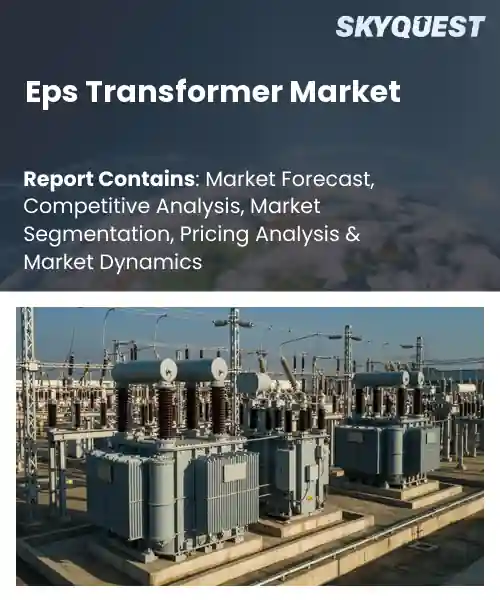
Eps Transformer Market
Report ID: SQMIG20I2772
Report ID: SQMIG20I2772
[email protected]
USA +1 351-333-4748
Report ID:
SQMIG20I2772 |
Region:
Global |
Published Date: February, 2026
Pages:
157
|Tables:
176
|Figures:
79


Global EPS Transformer Market size was valued at USD 1.2 Billion in 2024 and is poised to grow from USD 1.26 Billion in 2025 to USD 1.83 Billion by 2033, growing at a CAGR of 4.8% during the forecast period (2026-2033).
At the heart of demand for EPS transformers lies the accelerating need for resilient, uninterrupted power in critical infrastructure and commercial facilities, which has reshaped a traditionally static transformer market. The EPS transformer market supplies units that interface with emergency power systems, backup generators and uninterruptible power supplies; this sector matters because outages incur higher economic and safety costs. Over the past decade the market moved from passive distribution transformers toward compact, efficient and digitally monitored designs as hospitals, data centers and telecom operators sought tighter power quality control. For example, hospital emergency wings and island microgrids demonstrate evolving requirements.
The key trend driving the global EPS transformer sector growth is the convergence of distributed generation, tighter efficiency standards and commercial demand for resilience, which together create measurable demand for advanced transformer solutions. Conventional transformers cannot accommodate additional bidirectional energy flows as there is an increase in the number of solar and battery storage systems supplying electricity to the grid via distributed generation. Consequently manufacturers investing in amorphous cores and power electronics gain opportunities in microgrid projects, data center UPS upgrades and telecom backup systems. Real-world deployments in Puerto Rico after storms and urban EV charging hubs demonstrate clear commercial pathways for these technologies now.
How is AI Improving Performance and Reliability in the EPS Transformer Market?
AI is increasing efficiency and dependability across the Eps transformer market through methods such as smart maintenance through condition based monitoring (CBM). Major components for achieving this are sensor fusion for gas & thermal sensors; edge AI for near real-time anomaly identification; and digital twin technologies that model degradation stress and aging. Many utilities and OEMs are now implementing retrofittable monitors and utilizing cloud-based analytics to transition from normal scheduled repairs to doing risk based repairs. The result will be reduced chance of unplanned outages from the asset and longer asset life while supporting more efficient planning of assets for maintenance.
In January 2026, Hitachi Energy rolled out AI enabled asset management enhancements that integrate AI diagnostics and digital twins into transformer workflows. That innovation helps the Eps transformer market by improving fault prediction and optimizing maintenance decisions which supports greater operational efficiency and steadier service delivery.
Market snapshot - (2026-2033)
Global Market Size
USD 1.2 Billion
Largest Segment
Distribution Transformers
Fastest Growth
Distribution Transformers
Growth Rate
4.8% CAGR
To get more insights on this market click here to Request a Free Sample Report
Global eps transformer market is segmented by product type, phase, cooling type, power rating, application, end-use industry and region. Based on product type, the market is segmented into power transformers, distribution transformers, instrument transformers, isolation transformers and other transformer types. Based on phase, the market is segmented into single-phase transformers and three-phase transformers. Based on cooling type, the market is segmented into oil-cooled transformers, air-cooled/dry-type transformers and gas-insulated transformers. Based on power rating, the market is segmented into low voltage transformers, medium voltage transformers and high voltage transformers. Based on application, the market is segmented into utilities (power generation & distribution), industrial & manufacturing facilities, commercial buildings & infrastructure, residential use and other applications. Based on end-use industry, the market is segmented into energy & power sector, manufacturing sector, transportation & railways, renewable energy projects and others. Based on region, the market is segmented into North America, Europe, Asia Pacific, Latin America and Middle East & Africa.
Based on the global Eps transformer market growth, distribution transformers segment dominates because they sit at the final voltage conversion point delivering stable, regulated power to end users, which makes them indispensable to grid resilience and service continuity. The expansion of distributed energy sources (DE) in high-capacity generating facilities and power plants is related, but does not directly correlate, to a decrease in cost. This may be because of economies of scale in production matched with large quantities of DE being produced and/or sold for end-user consumption and/or use by transmission system operators (TSOs).
However, power transformers are emerging as the fastest growing area as utilities and large industrial operators invest in higher capacity, long-distance transmission infrastructure and grid modernization. New opportunities and supplier innovations are being created by developments in core materials, insulation technology and processes as well as an increasing demand for high voltage applications and integration with generation assets.
Air-cooled/dry-type transformers segment leads because their non-oil construction eliminates fire and contamination hazards, aligning with stringent safety standards and environmentally conscious procurement. The simpler cooling architecture of these systems leads to a reduction in maintenance complexity and operational risks; therefore, they appeal to those interested in installing cooling systems within environments that have very strict indoor or populated area limitations. As insulation technology improves and manufacturers begin optimizing thermal performance, this type of cooling system will be adopted at an accelerated rate across commercial application, infrastructure application, or distributed generation applications.
However, gas-insulated transformers are witnessing the strongest growth momentum as system operators prioritize compact, high-reliability solutions for constrained installations and upgraded substations. The design of the sealed units reduces the maintenance interval and permits higher voltage densities to be employed. In addition, with improved insulating gases and modular technology, new expectations for deployment (i.e., installation) will be made available to manufacturers.
To get detailed segments analysis, Request a Free Sample Report
As per the global Eps transformer market share, Asia Pacific dominates the global Eps transformer market due to a confluence of industrial and policy strengths that reinforce supply chain depth and innovation. Transformers manufactured at concentrated electronics and automotive production centers have consistent orders for the specialized transformer. Large domestic supply chains enable the rapid iteration of transformers and the custom design of those transformers on a local basis. Industrial policies foster favorable conditions for investment in advanced transformer technologies by providing government incentives and resources targeted at developing the necessary power infrastructure that supports integration of renewable energy sources. The availability of a skilled technical workforce combined with active research partnerships between industry and universities accelerate the development of transformer models. The close proximity of manufacturers of critical transformer components to automobile and electronic manufacturers minimizes lead time to integrate transformers into products.
Eps transformer market in Japan emphasizes reliability and miniaturized design for precision electronics and critical power systems. Established firms prioritize strict quality regimes, advanced materials research, and exacting certification pathways. Working closely together, suppliers and integrators will allow customized solutions for industrial automation in terms of electrifying mobility. The combination of location with high concentrations of engineering talent and a culture of ongoing improvement will allow for a demand for premium, long-lasting transformers that meet strict performance and safety requirements.
Eps transformer market in South Korea benefits from close alignment between electronics manufacturers and power equipment producers. Companies focus on compact, energy efficient transformer designs for consumer and industrial applications. Collaborative research between corporate centers and technical institutes promotes innovative materials and manufacturing techniques. Strong quality systems, agile supply chain practices, and robust aftermarket service capabilities enable suppliers to support high reliability use cases across domestic and international channels worldwide.
Based on the global Eps transformer market regional forecast, North America is experiencing rapid expansion in the Eps transformer market as a result of converging infrastructure modernization and technology adoption trends. Modernizing the utility sector and increasing demand from electric mobility and data centers, as well as an increase in the needs of the power industry, have raised the need for very reliable, thermal-performance-specific transformers. A diverse supply chain of established manufacturers and creative new entrants helps spur faster product development and customisation. A focus on regulatory compliance, grid resilience and lifecycle service models has stimulated investment in durable and maintainable designs for transformers. There is strong connectivity between system integrators, technology providers and end users to support fast pilot project deployment and scaling up of more advanced technology deployments. Prioritising supply chain transparency and developing strategic partnerships helps to create a marketplace that is responsive to regional application requirements, especially given the increasing focus on aggregated supply chain projects.
Eps transformer market in the United States is shaped by strong demand from utility modernization projects, data center expansion, and automotive electrification initiatives. To meet their expected reliability and availability from their infrastructure, Suppliers are focusing on developing strong, scalable transformer architectures and advanced thermal management for transformers. Collaborating with other manufacturers (e.g., electrical equipment manufacturers), utilities, and research organisations to develop custom solutions to improve grid resilience and interoperability has accelerated the ability to provide customised solutions.
Eps transformer market in Canada is influenced by priorities around grid resilience, remote power solutions, and integration of renewable generation. Suppliers are concentrating on ruggedized transformer platforms which work well for distributed installations as well as for use in tough operating conditions. Collaboration between different types of industries, such as utilities and manufacturing, will assist with determining the various design methods and strategies for monitoring condition. All of these areas will ultimately result in a stronger emphasis on local manufacturing and a skilled field service network to support the need for long-lasting and maintainable transformer equipment.
As per global Eps transformer market regional outlook, Europe is strengthening its position in the Eps transformer market through a combination of regulatory focus, technological innovation, and collaborative industrial strategy. The emphasis placed on energy efficiency, along with the integration of distributed generation and the high level of regulatory requirements, is stimulating the development of compact and low-loss transformer designs and rigorous testing methods. The existing manufacturing clusters provide a broad range of engineering skills and expertise, while suppliers focused on specific types of materials and digital monitoring technologies are contributing to innovation in these areas. Cross-border cooperation and collaboration between utilities, research organizations, and manufacturers of building components can stimulate the establishment of scalable pilot projects with harmonized certification processes. Increased focus on sustainability over the lifecycle of products, repairability of products at the end of their life cycle, and promotion of principles of a circular economy are also influencing the design and development of products that provide durable and serviceable solutions.
Eps transformer market in Germany centers on engineering rigor, efficiency, and integration with industrial automation. Low-loss materials, precision production technology and extensive validation are all used in order to produce components that meet demanding requirements for utility grids or other industrial applications. There will be significant co-operation between the manufacturers of the equipment, researchers from academic institutions and product end-users to create biclustered solutions to the various complex applications.
Eps transformer market in the United Kingdom focuses on grid flexibility, digital monitoring, and integration with offshore energy assets. Suppliers provide adaptable transformer platforms with remote monitoring and predictive maintenance capabilities. By collaborating, technology providers, utilities, and engineering consultants can develop customized solutions for each unique network architecture. Providers can ensure they adhere to safety standards, provide fast response times, and are able to modify their solution as the requirements of their customer change by focusing on these three areas.
Eps transformer market in France reflects integration with renewable generation, urban infrastructure initiatives, and industrial modernization. The focus of suppliers continues to be on designing transformers that have a small footprint and generate minimal noise while also complying with environmental, safety and other regulatory guidelines. Manufacturers, power companies and research organizations working together will help create both digital monitoring and retrofit solutions to fit the needs of industrial power grids. In addition, concentrating on creating service networks, developing repairable products, and working toward lifecycle management.
To know more about the market opportunities by region and country, click here to
Buy The Complete Report
Advancements In Transformer Efficiency
Transformer performance has been positively impacted by advancements in core materials, insulation materials, methodology and manufacturing processes. Due to these developments, utilities are able to provide electric power and industrial production equipment that has a lower energy loss and longer operating time as well as being more convenient to install because of improved thermal qualities and smaller sizes. The combination of the perceived benefits of lower operating costs and less frequent maintenance have made these transformers even more attractive for use in the utility and industry sectors, therefore increasing the demand for replacement and new transformer units in the overall market.
Rising Renewable Energy Integration
The accelerating deployment of renewable generation assets increases requirement for transformers that can handle variable loads, power quality management, and bi-directional flow, prompting utilities and developers to specify EPS transformers with advanced features. With the ever-increasing number of distributed energy resources such as solar panels and microgrids being built, designers of these systems are turning to smaller, more Compact and Efficient transformer solutions for secure interconnections and reliable operation. The continuing harmony between renewable growth and transformer capability will lead to the procurement of new modern devices, assist in developing vendor innovation, and create additional commercial prospects for EPS transformer makers engaged in both large and small-scale energy initiatives.
High Initial Investment Costs
The large initial financial investment for premium EPS transformers might discourage utility and industrial manufacturers from buying them since they will tend to focus primarily on short -term budget restrictions (rather than on long-term operational savings) thus resulting in delays to replace and upgrade transformer production. In the same way, smaller producers and projects with limited funds may choose to pursue lower cost or delay buying lower cost transformers leading to less immediate purchases. Long decision-making timelines as a result of the perception of high acquisition costs and long procurement/approval processes can also extend the life of the current equipment rather than investing in new transformer technology.
Regulatory and Compliance Challenges
Compliance complexity is created across regions with differing and changing regulatory frameworks for EPS transformer producers and buyers. To allow for design changes or other adaptations in regard to testing, manufacturers will need more time to get their products onto the marketplace and will have higher costs through longer entry barriers. To navigate the various levels of safety and environmental requirements imposed by different countries, the number of different designs most likely will be increased or provided approval time to get into the marketplace will be extended. For buyers, there is uncertainty about the compliance status of the product and its ability to reach their final customers, which create challenges in obtaining products, and reducing the speed involved with obtaining products.
Request Free Customization of this report to help us to meet your business objectives.
Competitive landscape in global Eps transformer market outlook, is shaped by incumbent transformer suppliers, utilities, and deep tech startups competing to commercialize power-electronic and solid-state transformer solutions driven by AI data center power needs and EV fast-charging infrastructure demand. Companies pursue commercialization partnerships and industrial scaling, exemplified by DG Matrix’s supply deal with a modular power provider and Amperesand’s move from university validation to venture-backed industrialization. Mergers, strategic supply agreements, and factory-scale manufacturing are becoming common competitive tactics.
SkyQuest’s ABIRAW (Advanced Business Intelligence, Research & Analysis Wing) is our Business Information Services team that Collects, Collates, Correlates, and Analyses the Data collected by means of Primary Exploratory Research backed by robust Secondary Desk research.
As per SkyQuest analysis, the global EPS transformer industry is propelled primarily by the convergence of distributed generation, tighter efficiency standards and commercial demand for resilience, which drive adoption of advanced, monitored transformer solutions. The increasing integration of renewable energy sources is driving more market expansion as there is now a growing demand for bidirectional, power quality capable units. High capital costs of premium EPS transformers are still a significant barrier, which causes delays in procurement and upgrades that have to be completed to facilitate the high volume of new renewable energy sources being used. The APAC region continues to be the leader in this market due to its strong manufacturing base, as well as the government policies in place that support this industry.
| Report Metric | Details |
|---|---|
| Market size value in 2024 | USD 1.2 Billion |
| Market size value in 2033 | USD 1.83 Billion |
| Growth Rate | 4.8% |
| Base year | 2024 |
| Forecast period | (2026-2033) |
| Forecast Unit (Value) | USD Billion |
| Segments covered |
|
| Regions covered | North America (US, Canada), Europe (Germany, France, United Kingdom, Italy, Spain, Rest of Europe), Asia Pacific (China, India, Japan, Rest of Asia-Pacific), Latin America (Brazil, Rest of Latin America), Middle East & Africa (South Africa, GCC Countries, Rest of MEA) |
| Companies covered |
|
| Customization scope | Free report customization with purchase. Customization includes:-
|
To get a free trial access to our platform which is a one stop solution for all your data requirements for quicker decision making. This platform allows you to compare markets, competitors who are prominent in the market, and mega trends that are influencing the dynamics in the market. Also, get access to detailed SkyQuest exclusive matrix.
Table Of Content
Executive Summary
Market overview
Parent Market Analysis
Market overview
Market size
KEY MARKET INSIGHTS
COVID IMPACT
MARKET DYNAMICS & OUTLOOK
Market Size by Region
KEY COMPANY PROFILES
Methodology
For the Eps Transformer Market, our research methodology involved a mixture of primary and secondary data sources. Key steps involved in the research process are listed below:
1. Information Procurement: This stage involved the procurement of Market data or related information via primary and secondary sources. The various secondary sources used included various company websites, annual reports, trade databases, and paid databases such as Hoover's, Bloomberg Business, Factiva, and Avention. Our team did 45 primary interactions Globally which included several stakeholders such as manufacturers, customers, key opinion leaders, etc. Overall, information procurement was one of the most extensive stages in our research process.
2. Information Analysis: This step involved triangulation of data through bottom-up and top-down approaches to estimate and validate the total size and future estimate of the Eps Transformer Market.
3. Report Formulation: The final step entailed the placement of data points in appropriate Market spaces in an attempt to deduce viable conclusions.
4. Validation & Publishing: Validation is the most important step in the process. Validation & re-validation via an intricately designed process helped us finalize data points to be used for final calculations. The final Market estimates and forecasts were then aligned and sent to our panel of industry experts for validation of data. Once the validation was done the report was sent to our Quality Assurance team to ensure adherence to style guides, consistency & design.
Analyst Support
Customization Options
With the given market data, our dedicated team of analysts can offer you the following customization options are available for the Eps Transformer Market:
Product Analysis: Product matrix, which offers a detailed comparison of the product portfolio of companies.
Regional Analysis: Further analysis of the Eps Transformer Market for additional countries.
Competitive Analysis: Detailed analysis and profiling of additional Market players & comparative analysis of competitive products.
Go to Market Strategy: Find the high-growth channels to invest your marketing efforts and increase your customer base.
Innovation Mapping: Identify racial solutions and innovation, connected to deep ecosystems of innovators, start-ups, academics, and strategic partners.
Category Intelligence: Customized intelligence that is relevant to their supply Markets will enable them to make smarter sourcing decisions and improve their category management.
Public Company Transcript Analysis: To improve the investment performance by generating new alpha and making better-informed decisions.
Social Media Listening: To analyze the conversations and trends happening not just around your brand, but around your industry as a whole, and use those insights to make better Marketing decisions.
REQUEST FOR SAMPLE
 REQUEST FREE CUSTOMIZATION
Global Eps Transformer Market size was valued at USD 1.2 Billion in 2024 and is poised to grow from USD 1.26 Billion in 2025 to USD 1.83 Billion by 2033, growing at a CAGR of 4.8% during the forecast period (2026-2033).
Competitive landscape is shaped by incumbent transformer suppliers, utilities, and deep tech startups competing to commercialize power-electronic and solid-state transformer solutions driven by AI data center power needs and EV fast-charging infrastructure demand. Companies pursue commercialization partnerships and industrial scaling, exemplified by DG Matrix’s supply deal with a modular power provider and Amperesand’s move from university validation to venture-backed industrialization. Mergers, strategic supply agreements, and factory-scale manufacturing are becoming common competitive tactics. 'Siemens Energy', 'Schneider Electric', 'ABB Ltd.', 'General Electric', 'Mitsubishi Electric', 'Eaton Corporation', 'Hitachi Energy', 'Delta Electronics', 'TBEA Co., Ltd.', 'Siemens AG', 'Nissin Electric Co., Ltd.', 'PES (Power Electronics Solutions)', 'Crompton Greaves Consumer Electricals', 'Rexel', 'KEB Automation', 'WEG Electric Corp.', 'Toshiba Energy Systems & Solutions Corporation', 'Unipower, LLC', 'SGB-SMIT Group', 'S&C Electric Company'
Technological improvements in core materials, insulation, design methodologies, and manufacturing processes have enhanced transformer efficiency and reliability, enabling EPS transformer vendors to offer solutions with lower energy losses and longer service life. Improved thermal management and compact configurations make these transformers more attractive for integration in power distribution and renewable energy applications, encouraging adoption by utilities and industrial users. The perceived value from reduced operational costs and maintenance needs stimulates demand for upgraded equipment, thereby contributing to broader market growth through sustained replacement and new installation cycles.
Autonomous Systems Integration: Demand for advanced EPS systems tailored to autonomous driving and advanced driver assistance is rising, prompting suppliers to prioritize precision, redundancy, and software-defined control strategies. Close collaboration between steering suppliers, vehicle OEMs, and autonomy software developers is fostering architectures that support lane-keeping, emergency maneuvers, and seamless handover between human and machine control. This trend accelerates modular, scalable EPS designs that can be updated over-the-air, enabling continuous performance improvements and supporting mobility transition toward shared, autonomous vehicles and resilient ecosystems globally.
Why does Asia Pacific Dominate the Global Eps Transformer Market? |@12


Want to customize this report? This report can be personalized according to your needs. Our analysts and industry experts will work directly with you to understand your requirements and provide you with customized data in a short amount of time. We offer $1000 worth of FREE customization at the time of purchase.
Feedback From Our Clients


 USA (+1) 351-333-4748

