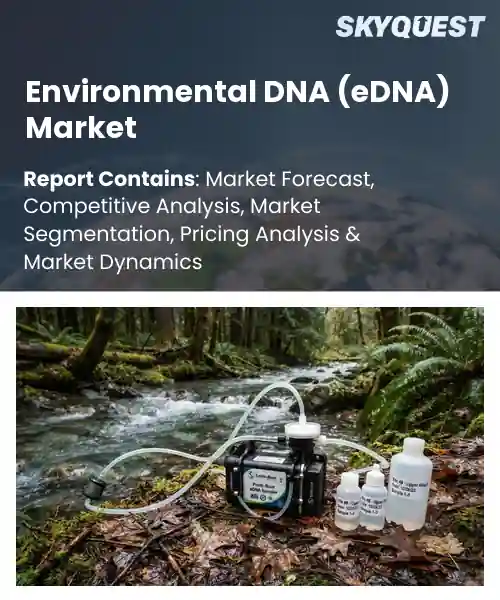
Environmental DNA (eDNA) Market
Report ID: SQMIG35J2866
Report ID: SQMIG35J2866
[email protected]
USA +1 351-333-4748
Report ID:
SQMIG35J2866 |
Region:
Global |
Published Date: November, 2026
Pages:
157
|Tables:
122
|Figures:
77


Global Environmental Dna (Edna) Market size was valued at USD 450.0 Million in 2024 and is poised to grow from USD 513.9 Million in 2025 to USD 1486.65 Million by 2033, growing at a CAGR of 14.2% during the forecast period (2026-2033).
Another pivotal factor propelling the eDNA market is the convergence of digital platforms with monitoring, creating analytics for decisions. As governments enact biodiversity targets, agencies need species inventories that can be generated quickly; eDNA fulfills this need by delivering insights that reduce field labor and sampling time. Consequently, companies invest in integrated software that aggregates sequence reads, geospatial metadata, and models, opening revenue streams from subscription analytics services. A notable case is a European consortium that paired eDNA sampling with a cloud dashboard to issue alerts for harmful algal blooms, preventing fishery closures and showing commercial viability of hardware‑software offerings.
How is AI enhancing detection accuracy in the environmental DNA (eDNA) market?
AI is reshaping eDNA analysis by automating sequence classification, reducing false positives, and accelerating turnaround. Machine learning models trained on large reference databases can distinguish target species from background noise more reliably than manual pipelines. Cloud based platforms now integrate AI to standardize sample processing, enabling labs to scale without sacrificing precision. Real time anomaly detection flags contamination early, improving data integrity. As biodiversity monitoring expands, stakeholders value the speed and reproducibility AI offers, driving broader adoption across research, conservation, and regulatory testing. The market therefore sees a shift toward AI enabled kits and services that promise higher detection confidence.Illumina announced in March 2024 an AI enhanced eDNA sequencing workflow that streamlines library preparation and improves taxonomic resolution, supporting faster biodiversity assessments and reinforcing market growth through increased efficiency. The solution integrates deep learning classifiers that reduce manual curation, allowing agencies and researchers to process larger sample volumes with confidence.
Market snapshot - (2026-2033)
Global Market Size
USD 450.0 Million
Largest Segment
eDNA Testing Services
Fastest Growth
eDNA Analysis Software
Growth Rate
14.2% CAGR
To get more insights on this market click here to Request a Free Sample Report
Global environmental dna (edna) market is segmented by product type, technology, application, end user and region. Based on product type, the market is segmented into eDNA Kits & Reagents, eDNA Sampling Equipment, eDNA Analysis Software and eDNA Testing Services. Based on technology, the market is segmented into Polymerase Chain Reaction, Quantitative PCR, Digital PCR and Next-Generation Sequencing. Based on application, the market is segmented into Biodiversity Monitoring, Aquatic Ecosystem Monitoring, Invasive Species Detection, Environmental Impact Assessment and Conservation & Wildlife Research. Based on end user, the market is segmented into Government & Environmental Agencies, Research Institutions, Environmental Consulting Firms and Water Utilities. Based on region, the market is segmented into North America, Europe, Asia Pacific, Latin America and Middle East & Africa.
EDNA kits & reagents segment dominates because it provides the foundational consumables that enable reliable field collection and laboratory processing across diverse monitoring programs. The simplicity of ready‑to‑use kits reduces technical barriers, encouraging adoption by agencies and researchers alike. Integrated reagent formulations improve assay sensitivity and consistency, fostering trust in eDNA outcomes. Consequently, this segment underpins every downstream workflow, anchoring market demand. Its broad compatibility with emerging detection platforms also fuels continuous procurement cycles.
Meanwhile, eDNA testing services segment emerges as the most rapidly expanding because organizations increasingly outsource complex bioinformatic interpretation and validation to specialized providers. Outsourcing mitigates skill gaps and accelerates result delivery, prompting broader uptake of eDNA across sectors. This service growth fuels market depth by unlocking new revenue streams and encouraging integration of advanced analytical capabilities.
Quantitative PCR segment leads because it offers a well‑established, cost‑effective method for quantifying eDNA concentrations in routine monitoring. Laboratories value its proven reliability, ease of protocol standardization, and compatibility with existing instrumentation, which accelerates project timelines. The technology’s straightforward data interpretation supports regulatory acceptance, reinforcing its central role in biodiversity assessments and compliance programs. Its entrenched position thus sustains steady market traction. Across diverse habitats, its scalability fosters widespread deployment by both academic and operational teams.
Conversely, digital PCR segment is witnessing the strongest growth momentum because it delivers absolute quantification without reference standards, appealing to precision monitoring initiatives. Its heightened sensitivity uncovers low‑abundance targets, driving adoption in early‑detection and invasive species programs. This technological edge expands market opportunities, encouraging investment in specialized instruments and consumables that propel eDNA market expansion.
To get detailed segments analysis, Request a Free Sample Report
North America maintains dominance through a combination of advanced research infrastructure, robust funding mechanisms, and a mature regulatory environment that encourages innovation in molecular diagnostics and biodiversity monitoring. Leading academic institutions and biotech hubs foster strong collaborations between government agencies, private enterprises, and non‑governmental organizations, accelerating product development and market adoption. The region benefits from early adoption of eDNA methodologies across sectors such as environmental management, forensic science, and public health, creating a broad base of expertise and a pipeline of skilled professionals. A culture of open data sharing and standardized protocols further reinforces the United States and Canada as reference points for best practices, attracting multinational investments and reinforcing market leadership.
United States Environmental DNA (eDNA) Market
Environmental DNA (eDNA) Market activity in the United States is characterized by extensive federal and state research programs that prioritize ecosystem monitoring and invasive species control. Strong partnerships between universities, federal agencies, and commercial laboratories drive rapid translation of scientific breakthroughs into commercial services. The presence of leading technology providers and a vibrant venture capital ecosystem supports continuous innovation, while expansive coastal and freshwater networks provide diverse testing environments that reinforce market depth.
Canada Environmental DNA (eDNA) Market
Environmental DNA (eDNA) Market development in Canada is propelled by a national emphasis on sustainable natural resource management and indigenous stewardship collaborations. Government research initiatives focus on Arctic and boreal ecosystems, creating niche expertise that complements broader environmental monitoring efforts. Strong ties between academic institutions and provincial agencies enable the integration of eDNA tools into policy frameworks, while a growing ecosystem of startups and service providers expands market reach across terrestrial and marine applications.
Europe’s rapid expansion is fueled by a cohesive strategy that blends stringent environmental policies, substantial public research funding, and a collaborative cross‑border approach to biodiversity conservation. The region’s emphasis on precautionary regulation and ecosystem protection creates a receptive market for eDNA solutions across water quality, habitat assessment, and invasive species management. Strong academic networks and specialized research consortia promote shared methodologies, while a vibrant ecosystem of biotech firms translates scientific advances into market‑ready products. The integration of eDNA into EU‑wide monitoring programs and the growing demand for transparent, non‑invasive testing reinforce the continent’s position as a growth engine for the industry.
Germany Environmental DNA (eDNA) Market
Environmental DNA (eDNA) Market leadership in Germany is underpinned by a dense concentration of research universities and a well‑established biotech sector that prioritize precision monitoring of waterways and forest ecosystems. Collaborative frameworks between federal environmental agencies and industrial partners accelerate the commercialization of eDNA platforms. Strong regulatory support for innovative environmental technologies encourages adoption across both public and private sectors, reinforcing Germany’s status as a dominant market hub.
United Kingdom Environmental DNA (eDNA) Market
Environmental DNA (eDNA) Market momentum in the United Kingdom is driven by aggressive investment in marine research and a proactive approach to protecting coastal biodiversity. Government funding streams and dedicated research councils support the integration of eDNA into national monitoring schemes. Partnerships between leading universities, governmental bodies, and emerging service providers foster rapid uptake of cutting‑edge analytical tools, positioning the United Kingdom as a fast‑growing market leader.
France Environmental DNA (eDNA) Market
Environmental DNA (eDNA) Market activity in France is emerging through focused governmental initiatives aimed at river restoration and agricultural runoff mitigation. Academic institutions and regional environmental agencies collaborate to pilot eDNA applications, creating early‑stage demand for analytical services. Growing awareness of eDNA’s non‑invasive advantages among policymakers and conservation groups fuels a nascent market that is gaining traction across both terrestrial and aquatic monitoring projects.
Asia Pacific is strengthening its position by leveraging rapid technological adoption, expanding research capacities, and aligning eDNA applications with pressing environmental challenges such as water scarcity and marine ecosystem health. Governmental strategies that prioritize digital transformation and sustainable resource management encourage the integration of eDNA into national monitoring frameworks. The region’s growing network of biotech startups, coupled with increasing collaboration between academic institutions and industry, accelerates the development of cost‑effective, high‑throughput eDNA solutions. This convergence of policy support, innovation, and market demand positions Asia Pacific as a dynamic and increasingly influential participant in the global eDNA landscape.
Japan Environmental DNA (eDNA) Market
Environmental DNA (eDNA) Market progress in Japan is anchored by strong governmental commitment to marine biodiversity assessment and disaster‑resilient water management. Advanced research institutes and a mature electronics manufacturing base facilitate the development of sophisticated eDNA detection platforms. Collaborative projects between ministries, universities, and private firms promote the widespread adoption of eDNA techniques for coastal monitoring, fisheries management, and environmental impact assessments.
South Korea Environmental DNA (eDNA) Market
Environmental DNA (eDNA) Market growth in South Korea is driven by a national emphasis on high‑tech environmental solutions and a proactive stance on river and coastal ecosystem protection. Significant public funding supports interdisciplinary research that bridges biotechnology and environmental engineering. Partnerships between leading universities, government agencies, and innovative startups enable rapid commercialization of eDNA services, reinforcing South Korea’s emerging role in the regional market.
To know more about the market opportunities by region and country, click here to
Buy The Complete Report
Rising Environmental DNA Adoption
Advancements In Sequencing Technologies
High Initial Equipment Costs
Regulatory Uncertainty Across Regions
Request Free Customization of this report to help us to meet your business objectives.
The global eDNA market is shaped by intense competition among established genomics leaders and agile newcomers, driving rapid innovation in sample‑to‑data workflows; Illumina’s partnership with Oxford Nanopore accelerates long‑read eDNA sequencing, Thermo Fisher’s acquisition of a niche eDNA extraction firm expands its portfolio, and QIAGEN’s launch of a streamlined eDNA kit targets biodiversity monitoring, all reinforcing market momentum.
Top Player’s Company Profile
Recent Developments
SkyQuest’s ABIRAW (Advanced Business Intelligence, Research & Analysis Wing) is our Business Information Services team that Collects, Collates, Correlates, and Analyses the Data collected by means of Primary Exploratory Research backed by robust Secondary Desk research. As per SkyQuest analysis, the global eDNA market is being propelled by rising adoption of eDNA methods, which offer non‑invasive, rapid multi‑species detection and lower field labor, while recent advancements in sequencing technologies that cut run times and costs further accelerate growth. The eDNA kits and reagents segment dominates because it supplies the essential consumables that enable these workflows, and North America remains the leading region thanks to its strong research infrastructure, funding and regulatory support. However, high initial equipment costs pose a restraint, limiting uptake among smaller labs and NGOs until more affordable solutions emerge in the near term, encouraging collaborative financing models.
| Report Metric | Details |
|---|---|
| Market size value in 2024 | USD 450.0 Million |
| Market size value in 2033 | USD 1486.65 Million |
| Growth Rate | 14.2% |
| Base year | 2024 |
| Forecast period | (2026-2033) |
| Forecast Unit (Value) | USD Million |
| Segments covered |
|
| Regions covered | North America (US, Canada), Europe (Germany, France, United Kingdom, Italy, Spain, Rest of Europe), Asia Pacific (China, India, Japan, Rest of Asia-Pacific), Latin America (Brazil, Rest of Latin America), Middle East & Africa (South Africa, GCC Countries, Rest of MEA) |
| Companies covered |
|
| Customization scope | Free report customization with purchase. Customization includes:-
|
To get a free trial access to our platform which is a one stop solution for all your data requirements for quicker decision making. This platform allows you to compare markets, competitors who are prominent in the market, and mega trends that are influencing the dynamics in the market. Also, get access to detailed SkyQuest exclusive matrix.
Table Of Content
Executive Summary
Market overview
Parent Market Analysis
Market overview
Market size
KEY MARKET INSIGHTS
COVID IMPACT
MARKET DYNAMICS & OUTLOOK
Market Size by Region
KEY COMPANY PROFILES
Methodology
For the Environmental DNA (eDNA) Market, our research methodology involved a mixture of primary and secondary data sources. Key steps involved in the research process are listed below:
1. Information Procurement: This stage involved the procurement of Market data or related information via primary and secondary sources. The various secondary sources used included various company websites, annual reports, trade databases, and paid databases such as Hoover's, Bloomberg Business, Factiva, and Avention. Our team did 45 primary interactions Globally which included several stakeholders such as manufacturers, customers, key opinion leaders, etc. Overall, information procurement was one of the most extensive stages in our research process.
2. Information Analysis: This step involved triangulation of data through bottom-up and top-down approaches to estimate and validate the total size and future estimate of the Environmental DNA (eDNA) Market.
3. Report Formulation: The final step entailed the placement of data points in appropriate Market spaces in an attempt to deduce viable conclusions.
4. Validation & Publishing: Validation is the most important step in the process. Validation & re-validation via an intricately designed process helped us finalize data points to be used for final calculations. The final Market estimates and forecasts were then aligned and sent to our panel of industry experts for validation of data. Once the validation was done the report was sent to our Quality Assurance team to ensure adherence to style guides, consistency & design.
Analyst Support
Customization Options
With the given market data, our dedicated team of analysts can offer you the following customization options are available for the Environmental DNA (eDNA) Market:
Product Analysis: Product matrix, which offers a detailed comparison of the product portfolio of companies.
Regional Analysis: Further analysis of the Environmental DNA (eDNA) Market for additional countries.
Competitive Analysis: Detailed analysis and profiling of additional Market players & comparative analysis of competitive products.
Go to Market Strategy: Find the high-growth channels to invest your marketing efforts and increase your customer base.
Innovation Mapping: Identify racial solutions and innovation, connected to deep ecosystems of innovators, start-ups, academics, and strategic partners.
Category Intelligence: Customized intelligence that is relevant to their supply Markets will enable them to make smarter sourcing decisions and improve their category management.
Public Company Transcript Analysis: To improve the investment performance by generating new alpha and making better-informed decisions.
Social Media Listening: To analyze the conversations and trends happening not just around your brand, but around your industry as a whole, and use those insights to make better Marketing decisions.
REQUEST FOR SAMPLE
 REQUEST FREE CUSTOMIZATION


Want to customize this report? This report can be personalized according to your needs. Our analysts and industry experts will work directly with you to understand your requirements and provide you with customized data in a short amount of time. We offer $1000 worth of FREE customization at the time of purchase.
Feedback From Our Clients


 USA (+1) 351-333-4748

