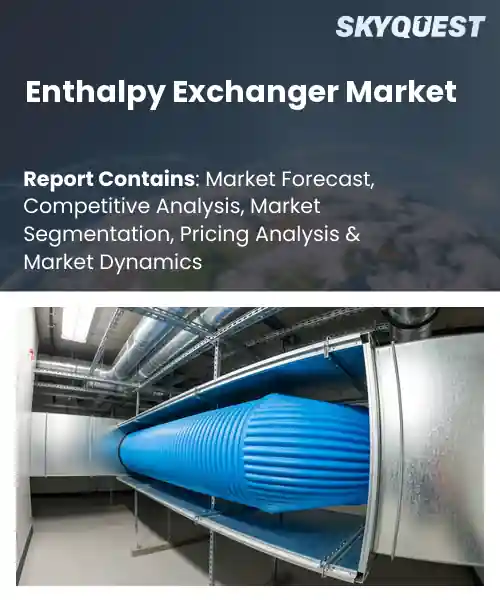
Enthalpy Exchanger Market
Report ID: SQMIG20I2663
Report ID: SQMIG20I2663
[email protected]
USA +1 351-333-4748
Report ID:
SQMIG20I2663 |
Region:
Global |
Published Date: February, 2026
Pages:
157
|Tables:
121
|Figures:
77


Global Enthalpy Exchanger Market size was valued at USD 2.8 Billion in 2024 and is poised to grow from USD 3.01 Billion in 2025 to USD 5.41 Billion by 2033, growing at a CAGR of 7.6% during the forecast period (2026-2033).
Enthalpy exchanger market is driven by the imperative to reduce energy consumption in heating, ventilation and air conditioning systems while maintaining indoor air quality. These devices transfer sensible and latent heat between incoming and outgoing air streams, enabling buildings to retain humidity and temperature without additional energy, reducing costs and carbon emissions. The market evolved from basic plate heat recovery units into sophisticated enthalpy wheels, membrane and desiccant systems integrated with smart controls as building codes and green standards such as ASHRAE and EU Ecodesign tightened. For example, hospitals and schools increasingly specify enthalpy recovery to balance ventilation and efficiency.Building on tighter codes and cost pressures, the most influential factor is regulatory and economic alignment making heat recovery mandatory and financially compelling. Stricter ventilation standards and higher energy prices force facility managers to adopt enthalpy recovery, justifying capital for advanced wheels, membranes and controls. As deployment scales, unit costs decline and manufacturers invest in more efficient materials, creating a feedback loop that expands retrofit opportunities across hospitals, data centers and multifamily housing. In practice, a hospital deploying enthalpy exchangers lowers HVAC energy bills while preserving humidity for patient care, showing a clear cause-and-effect between policy, adoption and measurable savings.
How is IoT improving performance monitoring in the enthalpy exchanger market?
Enthalpy exchangers recover both sensible and latent energy from exhaust air to reduce heating and cooling loads while controlling humidity. IoT improves performance monitoring by adding distributed sensors for temperature humidity pressure and airflow that feed building management systems and cloud analytics. This enables continuous verification of heat and moisture transfer effectiveness condition based maintenance and early fault detection. The current market is moving toward smarter ERV products as regulators and owners demand higher efficiency and verified indoor air quality. Examples include rooftop and packaged ERV units with BACnet connectivity and cloud dashboards that make performance visible to operators and service teams.RenewAire February 2025, the HE7X commercial ERV introduced with enthalpy plate cores and an optional BACnet fan control, shows how IoT enabled monitoring supports the enthalpy exchanger market by making performance data accessible for predictive maintenance and continuous efficiency optimization.
Market snapshot - (2026-2033)
Global Market Size
USD 2.8 Billion
Largest Segment
Air-to-Air Exchangers
Fastest Growth
Air-to-Air Exchangers
Growth Rate
7.6% CAGR
To get more insights on this market click here to Request a Free Sample Report
Global enthalpy exchanger market is segmented by product type, material type, application, end user and region. Based on product type, the market is segmented into Air-to-Air Exchangers, Air-to-Water Exchangers, Water-to-Water Exchangers and Others. Based on material type, the market is segmented into Aluminum, Stainless Steel, Copper and Others. Based on application, the market is segmented into Residential, Commercial, Industrial and Others. Based on end user, the market is segmented into HVAC Systems, Power Plants, Manufacturing and Others. Based on region, the market is segmented into North America, Europe, Asia Pacific, Latin America and Middle East & Africa.
Air to Air Exchangers segment dominates because these systems directly interface with ventilation networks to recover both sensible and latent heat, lowering HVAC load while improving indoor air quality. Their compatibility with existing ductwork, straightforward installation, and mature manufacturing processes reduce integration complexity and total cost of ownership, making them a preferred choice for a wide range of building projects and retrofit applications where reliable energy recovery is prioritized.
However, Air to Water Exchangers are emerging as the fastest growing product type due to expanding adoption of hydronic systems and heat pump integration that require efficient heat transfer to water loops. Advances in compact plate and coil designs and improved compatibility with renewable heating and district systems accelerate uptake, creating new application opportunities in both building services and industrial thermal systems.
Aluminum segment dominates because its light weight, favorable thermal conductivity, and ease of forming into compact plate architectures align with manufacturers’ needs for efficient, low-cost enthalpy cores. Simple fabrication methods like brazing and stamping reduce production complexity and enable high-volume output, while recyclability and established supply chains support procurement confidence, driving widespread adoption across standard HVAC and ventilation recovery products focused on cost-effective performance.
However, Stainless Steel is emerging as the fastest growing material because demanding durability and corrosion resistance requirements in aggressive and humid environments push designers toward stainless cores. Its high temperature capability and hygienic properties foster innovations in welded and plate designs, enabling higher-value deployments in industrial, process, and specialized enthalpy recovery applications where long-term reliability and chemical resilience matter.
To get detailed segments analysis, Request a Free Sample Report
The Asia Pacific region dominates due to a convergence of favorable demand drivers, manufacturing strength and policy emphasis on building energy performance. Rapid urbanization and large scale commercial and industrial construction create sustained need for efficient ventilation and heat recovery technologies. A dense network of manufacturers and suppliers enables cost effective production and localized customization, while close alignment between equipment makers, HVAC integrators and installers accelerates deployment. Regional regulatory frameworks and corporate decarbonization commitments encourage specification of enthalpy exchangers in new and retrofit projects. Strong aftermarket services and focus on product reliability further consolidate market leadership, enabling continuous innovation in materials, compact designs and system integration that address diverse climatic and operational requirements across the region. Collaborative research programs and supplier investments sustain technological advancement and cost optimization.
Enthalpy Exchanger Market in Japan benefits from advanced manufacturing capabilities, a deep engineering talent pool and close collaboration between equipment makers and building developers. Strong focus on energy efficiency in commercial and industrial projects drives technology adoption. Local suppliers emphasize product quality, compact design and integration with HVAC systems, while service networks support installation and maintenance. Regulatory encouragement and corporate sustainability initiatives reinforce steady demand and product refinement and maturity.
Enthalpy Exchanger Market in South Korea is shaped by strong industrial demand, a focus on urban building modernization and partnerships between technology firms and construction groups. Emphasis on compact, high efficiency designs suits dense urban projects. Local engineering services facilitate system customization and rapid deployment. Government energy programs and corporate environmental agendas promote retrofitting of existing assets and integration of advanced heat recovery solutions across commercial and industrial sectors nationwide.
Expansion in Europe is driven by stringent building performance regulations, strong emphasis on indoor air quality and an established market for energy efficient HVAC solutions. Growing retrofit activity in aging building stock aligns with corporate sustainability targets, prompting widespread replacement and upgrading of ventilation components with enthalpy exchangers. A mature supply chain, advanced R D capabilities and collaborative standards-setting among industry bodies facilitate interoperability and product quality. Financial incentives and public procurement preferences for low energy solutions increase specification in public buildings and infrastructure. Fragmented climatic zones and diverse building types encourage versatile product portfolios, while service firms and installers promote uptake through integrated design and performance validation. Cross border trade and harmonized certification pathways support scaling of proven technologies across multiple markets.
Enthalpy Exchanger Market in Germany benefits from rigorous building codes, a mature HVAC manufacturing base and strong focus on industrial energy efficiency. Local producers excel in engineering robustness and system integration, while standards and testing laboratories reinforce product reliability. Specifiers in commercial and public sectors favour proven technologies linked to lifecycle cost reductions. Collaborative industry networks support skill development among installers, ensuring quality deployment and continuous improvement of component performance.
Enthalpy Exchanger Market in United Kingdom is characterized by rapid adoption driven by focused retrofits, emphasis on indoor air quality and innovation in compact unit design. Service providers and engineering consultancies promote integrated solutions that combine heat recovery with smart controls. Procurement trends in commercial real estate and public sector projects favour demonstrable energy performance, creating a dynamic environment for entrants and technology partnerships that accelerate product testing and entry.
Enthalpy Exchanger Market in France is emerging through a mix of regulatory encouragement, strong building renovation activity and innovation among HVAC specialists. Focus on occupant health and energy cost savings motivates specification of heat and moisture recovery solutions in public and private projects. Manufacturers and engineering firms collaborate on compact designs suited to varied building typologies. Demonstration projects help validate performance and support broader commercial acceptance and installer training programs.
North America is strengthening its market position through advances in system integration, focus on indoor air quality and growing emphasis on decarbonization across building sectors. A robust ecosystem of HVAC manufacturers, controls suppliers and engineering consultancies supports rapid customization and deployment of enthalpy exchangers within larger ventilation strategies. Incentive programs and corporate procurement preferences increase demand in commercial, institutional and industrial segments. The region benefits from active standards development and interoperability frameworks that simplify specification and certification. Ongoing investment in installer training, testing facilities and retrofit methodologies enhances the reliability of installed solutions and encourages broader adoption across diverse climate zones and building vintages. Collaboration between equipment OEMs and building owners drives tailored performance validation, reducing perceived risk and accelerating procurement cycles.
Enthalpy Exchanger Market in United States is fueled by commercial construction, retrofit activity and leadership in controls integration. Manufacturers and integrators deliver solutions that pair enthalpy exchangers with advanced sensors and building automation. Presence of standards organizations and testing bodies enhances confidence. Incentives and corporate sustainability procurement encourage specification of high performance ventilation, while service networks enable scaling and installer training programs.
Enthalpy Exchanger Market in Canada is supported by regional energy efficiency initiatives, focus on cold climate performance and a network of mechanical contractors. Suppliers emphasize robust materials and frost control features suited to cold conditions, while engineering firms adapt solutions for varied commercial and institutional buildings. Public sector procurement and building owner sustainability goals encourage retrofit programs. Training and certification among installers improves implementation quality, operational reliability and ongoing maintenance.
To know more about the market opportunities by region and country, click here to
Buy The Complete Report
Energy Recovery Adoption
Decarbonization Efficiency Emphasis
High Initial Installation Costs
Limited Technical Awareness
Request Free Customization of this report to help us to meet your business objectives.
Competition in the global enthalpy exchanger market is intensifying as manufacturers pursue M&A, supplier partnerships, and material innovation to secure HVAC OEM contracts and retrofit pipelines. Examples include Zehnder’s 2020 acquisition of Fortuneway to add enthalpy membrane capacity and larger groups increasing R&D and regional acquisitions to lock production footprints; regulatory and Eurovent work on energy recovery components is driving technology differentiation.
Top Player’s Company Profile
Recent Developments
SkyQuest’s ABIRAW (Advanced Business Intelligence, Research & Analysis Wing) is our Business Information Services team that Collects, Collates, Correlates, and Analyses the Data collected by means of Primary Exploratory Research backed by robust Secondary Desk research. As per SkyQuest analysis, the global enthalpy exchanger market is being propelled primarily by widespread energy recovery adoption in HVAC systems that lowers operational costs and improves indoor air quality, while growth is also supported by stronger decarbonization imperatives prompting specification of heat and moisture recovery solutions. Adoption faces a notable restraint from high initial installation costs that can slow retrofit cycles in budget-constrained projects. Asia Pacific remains the dominating region due to manufacturing scale and policy support, and Air-to-Air exchangers are the dominating segment because of compatibility with existing ductwork and cost-effective deployment. Continued smart building integration and IoT-enabled monitoring will accelerate verified performance and aftermarket services.
| Report Metric | Details |
|---|---|
| Market size value in 2024 | USD 2.8 Billion |
| Market size value in 2033 | USD 5.41 Billion |
| Growth Rate | 7.6% |
| Base year | 2024 |
| Forecast period | (2026-2033) |
| Forecast Unit (Value) | USD Billion |
| Segments covered |
|
| Regions covered | North America (US, Canada), Europe (Germany, France, United Kingdom, Italy, Spain, Rest of Europe), Asia Pacific (China, India, Japan, Rest of Asia-Pacific), Latin America (Brazil, Rest of Latin America), Middle East & Africa (South Africa, GCC Countries, Rest of MEA) |
| Companies covered |
|
| Customization scope | Free report customization with purchase. Customization includes:-
|
To get a free trial access to our platform which is a one stop solution for all your data requirements for quicker decision making. This platform allows you to compare markets, competitors who are prominent in the market, and mega trends that are influencing the dynamics in the market. Also, get access to detailed SkyQuest exclusive matrix.
Table Of Content
Executive Summary
Market overview
Parent Market Analysis
Market overview
Market size
KEY MARKET INSIGHTS
COVID IMPACT
MARKET DYNAMICS & OUTLOOK
Market Size by Region
KEY COMPANY PROFILES
Methodology
For the Enthalpy Exchanger Market, our research methodology involved a mixture of primary and secondary data sources. Key steps involved in the research process are listed below:
1. Information Procurement: This stage involved the procurement of Market data or related information via primary and secondary sources. The various secondary sources used included various company websites, annual reports, trade databases, and paid databases such as Hoover's, Bloomberg Business, Factiva, and Avention. Our team did 45 primary interactions Globally which included several stakeholders such as manufacturers, customers, key opinion leaders, etc. Overall, information procurement was one of the most extensive stages in our research process.
2. Information Analysis: This step involved triangulation of data through bottom-up and top-down approaches to estimate and validate the total size and future estimate of the Enthalpy Exchanger Market.
3. Report Formulation: The final step entailed the placement of data points in appropriate Market spaces in an attempt to deduce viable conclusions.
4. Validation & Publishing: Validation is the most important step in the process. Validation & re-validation via an intricately designed process helped us finalize data points to be used for final calculations. The final Market estimates and forecasts were then aligned and sent to our panel of industry experts for validation of data. Once the validation was done the report was sent to our Quality Assurance team to ensure adherence to style guides, consistency & design.
Analyst Support
Customization Options
With the given market data, our dedicated team of analysts can offer you the following customization options are available for the Enthalpy Exchanger Market:
Product Analysis: Product matrix, which offers a detailed comparison of the product portfolio of companies.
Regional Analysis: Further analysis of the Enthalpy Exchanger Market for additional countries.
Competitive Analysis: Detailed analysis and profiling of additional Market players & comparative analysis of competitive products.
Go to Market Strategy: Find the high-growth channels to invest your marketing efforts and increase your customer base.
Innovation Mapping: Identify racial solutions and innovation, connected to deep ecosystems of innovators, start-ups, academics, and strategic partners.
Category Intelligence: Customized intelligence that is relevant to their supply Markets will enable them to make smarter sourcing decisions and improve their category management.
Public Company Transcript Analysis: To improve the investment performance by generating new alpha and making better-informed decisions.
Social Media Listening: To analyze the conversations and trends happening not just around your brand, but around your industry as a whole, and use those insights to make better Marketing decisions.
REQUEST FOR SAMPLE
 REQUEST FREE CUSTOMIZATION


Want to customize this report? This report can be personalized according to your needs. Our analysts and industry experts will work directly with you to understand your requirements and provide you with customized data in a short amount of time. We offer $1000 worth of FREE customization at the time of purchase.
Feedback From Our Clients


 USA (+1) 351-333-4748

