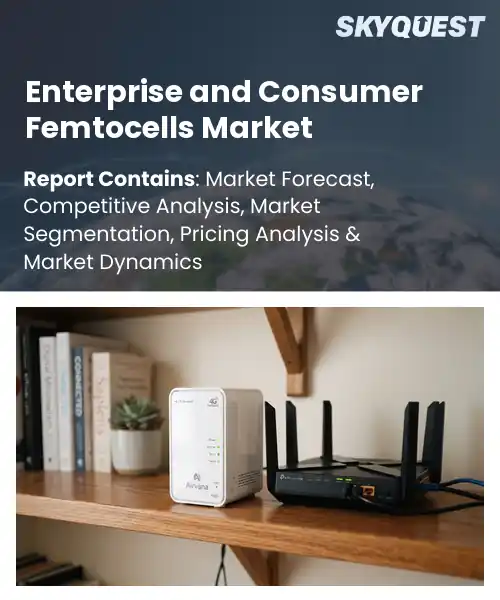
Enterprise and Consumer Femtocells Market
Report ID: SQMIG45H2329
Report ID: SQMIG45H2329
[email protected]
USA +1 351-333-4748
Report ID:
SQMIG45H2329 |
Region:
Global |
Published Date: August, 2026
Pages:
157
|Tables:
116
|Figures:
77


Global Enterprise And Consumer Femtocells Market size was valued at USD 5.91 Billion in 2024 and is poised to grow from USD 6.64 Billion in 2025 to USD 16.79 Billion by 2033, growing at a CAGR of 12.3% during the forecast period (2026-2033).
Femtocells are compact, low‑power cellular base stations that extend indoor coverage by linking to the operator’s core network via broadband. The primary driver of this market has been the exponential rise in indoor data demand, as smartphones and IoT devices generate traffic that macro cells cannot reliably serve. Over the past decade the market has shifted from early 3G home units, such as AT&T’s Small Cell, to today’s multi‑band 5G solutions that enable seamless hand‑off and lower latency. Femtocells improve signal quality, offload macro traffic, and support applications like tele‑medicine and AR, making them vital to modern connectivity in networks. The next factor propelling the femtocell market is network densification combined with enterprise digital transformation, which creates a feedback loop that fuels adoption. As operators densify their 5G footprints to meet latency and capacity targets, they deploy femtocells to fill indoor gaps, prompting enterprises to integrate these nodes into private‑LTE or 5G private‑network schemes. Examples include a hospital network that installed femtocells to guarantee patient‑monitoring data, and a logistics company that uses them to enable forklift communication in warehouses. These deployments reduce macro‑cell load, lower operational expenses, and open new revenue streams for carriers through leasing agreements and service contracts.
How is AI enhancing performance and management in enterprise and consumer femtocell deployments?
AI boosts femtocell performance by continuously analyzing traffic patterns and adjusting power levels to match user demand. Machine learning models predict interference zones and reconfigure antennas without human input, keeping signal quality high even as devices move. Predictive maintenance alerts technicians before hardware fails, lowering downtime. In the enterprise arena, AI‑driven analytics prioritize bandwidth for critical applications, while consumer deployments benefit from automated onboarding that reduces setup steps. These capabilities make dense indoor networks more reliable and cost‑effective, encouraging operators to expand coverage in offices, campuses and homes. The result is a more responsive network that scales with the growing need for seamless connectivity.In August 2026, the femtocell market highlighted AI‑enabled management tools that streamline deployment and improve operational efficiency, reinforcing growth momentum.
Market snapshot - (2026-2033)
Global Market Size
USD 5.91 Billion
Largest Segment
Residential Femtocells
Fastest Growth
Enterprise Femtocells
Growth Rate
12.3% CAGR
To get more insights on this market click here to Request a Free Sample Report
Global enterprise and consumer femtocells market is segmented by deployment type, technology, application, end user and region. Based on deployment type, the market is segmented into Residential Femtocells and Enterprise Femtocells. Based on technology, the market is segmented into 3G Femtocells, 4G/LTE Femtocells and 5G Femtocells. Based on application, the market is segmented into Indoor Coverage Enhancement, Network Capacity Offloading and Voice & Data Communication. Based on end user, the market is segmented into Residential Users, Small & Medium Enterprises and Large Enterprises. Based on region, the market is segmented into North America, Europe, Asia Pacific, Latin America and Middle East & Africa.
Residential Femtocells segment dominates because homeowners prioritize seamless indoor connectivity, and these devices provide immediate signal improvement without extensive infrastructure. The ease of plug‑and‑play installation, coupled with low maintenance, creates strong appeal for consumers seeking reliable voice and data services. As broadband demands rise, the comfort of enhanced coverage within personal spaces drives sustained preference, reinforcing its leading position in the market and accelerates adoption across new housing developments nationwide.
Meanwhile, Enterprise Femtocells are witnessing the strongest growth momentum as businesses seek to extend secure Wi‑Fi‑backed cellular services to office floors and remote sites. The need for private, low‑latency connections for IoT devices and unified communications fuels rapid deployment, opening fresh revenue streams and encouraging operator investment across multiple verticals.
5G femtocells segment leads because they deliver ultra‑high throughput and low latency, satisfying the surge in bandwidth‑intensive applications such as AR/VR and edge computing within confined spaces. Operators leverage these units to complement macro networks, ensuring consistent quality of experience when users transition indoors. The convergence of device upgrades and enterprise digital transformation amplifies demand, positioning 5G femtocells at the forefront of market evolution and drives new service models globally.
Conversely, 4G LTE femtocells are experiencing rapid expansion as they provide a proven, interoperable solution for legacy devices while supporting contemporary data traffic. Their broad device compatibility and mature ecosystem lower adoption barriers, encouraging carriers to deploy them in indoor environments, thereby fueling market penetration and future upgrade paths.
To get detailed segments analysis, Request a Free Sample Report
The region benefits from a convergence of high mobile device usage, densely populated urban centers, and forward‑looking telecommunications policies that encourage the deployment of small‑cell solutions. Operators in the region have embraced advanced network architectures to address indoor coverage challenges, leveraging strong research ecosystems and robust manufacturing capabilities. Consumer expectations for seamless connectivity in homes and offices drive continuous innovation, while enterprise sectors seek reliable indoor capacity to support digital transformation initiatives. Collaborative industry initiatives and supportive regulatory frameworks further accelerate adoption, positioning the region as a leader in both enterprise and consumer femtocell deployments.
Enterprise and Consumer Femtocells Market in Japan thrives on a culture of technological excellence and a consumer base that demands high‑quality indoor connectivity. Mobile operators prioritize dense network densification to meet the expectations of a tech‑savvy population, while enterprises adopt femtocell solutions to ensure reliable performance in office environments. Strong government encouragement of next‑generation network rollouts complements industry investment, fostering a vibrant ecosystem for both consumer and enterprise applications.
Enterprise and Consumer Femtocells Market in South Korea is propelled by a national emphasis on ultra‑fast broadband and pervasive mobile usage. Operators focus on enhancing indoor coverage to support a highly connected society, and enterprises leverage femtocell technology to sustain productivity in high‑rise office complexes. The country’s proactive regulatory stance and commitment to cutting‑edge network standards create an environment where both consumer convenience and enterprise reliability are continuously advanced.
The market expands as businesses and households seek dependable indoor coverage to support increasingly digital lifestyles. Operators respond to heightened demand for seamless connectivity in dense office towers and residential complexes, integrating femtocell solutions to complement macro networks. The region’s strong emphasis on innovation, coupled with a regulatory climate that encourages spectrum efficiency, fuels investment in small‑cell technologies. Additionally, the rise of remote work and the proliferation of connected devices amplify the need for localized network capacity, reinforcing the growth trajectory across both enterprise and consumer segments.
Enterprise and Consumer Femtocells Market in the United States benefits from a large and diverse enterprise landscape that prioritizes reliable indoor connectivity for mission‑critical operations. Service providers enhance network performance in high‑rise office buildings and suburban homes by deploying femtocell solutions that address coverage gaps. Consumer expectations for uninterrupted streaming and communication further drive adoption, while industry collaborations promote the integration of femtocell technology into broader network strategies.
Enterprise and Consumer Femtocells Market in Canada is shaped by a focus on extending high‑quality indoor coverage to both urban centers and remote communities. Telecommunications firms leverage femtocell deployments to improve network resilience in office environments and residential settings, aligning with national objectives for digital inclusion. Regulatory encouragement of innovative small‑cell solutions supports the growth of enterprise applications, while consumers benefit from enhanced indoor signal strength and reliability.
Europe advances its market position through coordinated standards, sustainability initiatives, and a strong emphasis on research and development. Collaborative frameworks among operators and regulators facilitate the seamless integration of femtocell technology into existing network architectures, addressing indoor coverage challenges across diverse market segments. The region’s commitment to energy‑efficient solutions aligns with broader environmental goals, encouraging the adoption of low‑power femtocell deployments. Moreover, a focus on smart‑city projects and industrial automation drives demand for reliable indoor connectivity, reinforcing Europe’s role as a progressive player in both enterprise and consumer femtocell markets.
Enterprise and Consumer Femtocells Market in Germany is driven by a robust industrial base that requires dependable indoor coverage for automation and manufacturing processes. Operators enhance network density in office parks and residential complexes to meet the expectations of a digitally engaged population. Collaborative industry initiatives and a regulatory environment supportive of small‑cell integration further strengthen the market’s growth trajectory.
Enterprise and Consumer Femtocells Market in the United Kingdom benefits from a strategic focus on smart‑city development and the digital transformation of businesses. Service providers deploy femtocell solutions to improve indoor signal quality in high‑rise commercial districts and densely populated residential areas. Policy frameworks that encourage innovative network solutions support the expansion of both enterprise and consumer applications.
Enterprise and Consumer Femtocells Market in France is propelled by a national agenda that emphasizes network densification and sustainable connectivity. Operators integrate femtocell technology to address indoor coverage gaps in office environments and urban housing, aligning with consumer demand for reliable service. Ongoing collaboration between industry stakeholders and regulatory bodies fosters an ecosystem conducive to continued market advancement.
To know more about the market opportunities by region and country, click here to
Buy The Complete Report
Increasing Demand for Indoor Coverage
Adoption Of Small Cell Solutions
High Deployment Cost Concerns
Regulatory and Spectrum Limitations
Request Free Customization of this report to help us to meet your business objectives.
The competitive landscape is shaped by intense rivalry among leading vendors who are accelerating M&A activity, forging carrier partnerships, and deploying advanced 5G‑compatible femtocell platforms to capture enterprise and consumer segments. Recent collaborations, such as a major telecom operator integrating a new cloud‑native small‑cell solution from a leading hardware supplier, illustrate how strategic alliances and rapid technology upgrades are driving market positioning.
Top Player’s Company Profile
Recent Developments
SkyQuest’s ABIRAW (Advanced Business Intelligence, Research & Analysis Wing) is our Business Information Services team that Collects, Collates, Correlates, and Analyses the Data collected by means of Primary Exploratory Research backed by robust Secondary Desk research. As per SkyQuest analysis, the primary driver of market growth is the rising demand for indoor coverage as work and entertainment shift indoors, while a second driver is the broader adoption of small‑cell solutions that give enterprises scalable capacity and low latency. The residential femtocell segment leads the market because plug‑and‑play devices quickly improve signal quality in homes. Asia‑Pacific dominates the landscape, fueled by dense urban populations and supportive telecom policies. However, high deployment costs remain a notable restraint, especially for SMEs that must balance capital outlays against immediate benefits. Together, these forces shape a market poised for strong expansion through 2033.
| Report Metric | Details |
|---|---|
| Market size value in 2024 | USD 5.91 Billion |
| Market size value in 2033 | USD 16.79 Billion |
| Growth Rate | 12.3% |
| Base year | 2024 |
| Forecast period | (2026-2033) |
| Forecast Unit (Value) | USD Billion |
| Segments covered |
|
| Regions covered | North America (US, Canada), Europe (Germany, France, United Kingdom, Italy, Spain, Rest of Europe), Asia Pacific (China, India, Japan, Rest of Asia-Pacific), Latin America (Brazil, Rest of Latin America), Middle East & Africa (South Africa, GCC Countries, Rest of MEA) |
| Companies covered |
|
| Customization scope | Free report customization with purchase. Customization includes:-
|
To get a free trial access to our platform which is a one stop solution for all your data requirements for quicker decision making. This platform allows you to compare markets, competitors who are prominent in the market, and mega trends that are influencing the dynamics in the market. Also, get access to detailed SkyQuest exclusive matrix.
Table Of Content
Executive Summary
Market overview
Parent Market Analysis
Market overview
Market size
KEY MARKET INSIGHTS
COVID IMPACT
MARKET DYNAMICS & OUTLOOK
Market Size by Region
KEY COMPANY PROFILES
Methodology
For the Enterprise and Consumer Femtocells Market, our research methodology involved a mixture of primary and secondary data sources. Key steps involved in the research process are listed below:
1. Information Procurement: This stage involved the procurement of Market data or related information via primary and secondary sources. The various secondary sources used included various company websites, annual reports, trade databases, and paid databases such as Hoover's, Bloomberg Business, Factiva, and Avention. Our team did 45 primary interactions Globally which included several stakeholders such as manufacturers, customers, key opinion leaders, etc. Overall, information procurement was one of the most extensive stages in our research process.
2. Information Analysis: This step involved triangulation of data through bottom-up and top-down approaches to estimate and validate the total size and future estimate of the Enterprise and Consumer Femtocells Market.
3. Report Formulation: The final step entailed the placement of data points in appropriate Market spaces in an attempt to deduce viable conclusions.
4. Validation & Publishing: Validation is the most important step in the process. Validation & re-validation via an intricately designed process helped us finalize data points to be used for final calculations. The final Market estimates and forecasts were then aligned and sent to our panel of industry experts for validation of data. Once the validation was done the report was sent to our Quality Assurance team to ensure adherence to style guides, consistency & design.
Analyst Support
Customization Options
With the given market data, our dedicated team of analysts can offer you the following customization options are available for the Enterprise and Consumer Femtocells Market:
Product Analysis: Product matrix, which offers a detailed comparison of the product portfolio of companies.
Regional Analysis: Further analysis of the Enterprise and Consumer Femtocells Market for additional countries.
Competitive Analysis: Detailed analysis and profiling of additional Market players & comparative analysis of competitive products.
Go to Market Strategy: Find the high-growth channels to invest your marketing efforts and increase your customer base.
Innovation Mapping: Identify racial solutions and innovation, connected to deep ecosystems of innovators, start-ups, academics, and strategic partners.
Category Intelligence: Customized intelligence that is relevant to their supply Markets will enable them to make smarter sourcing decisions and improve their category management.
Public Company Transcript Analysis: To improve the investment performance by generating new alpha and making better-informed decisions.
Social Media Listening: To analyze the conversations and trends happening not just around your brand, but around your industry as a whole, and use those insights to make better Marketing decisions.
REQUEST FOR SAMPLE
 REQUEST FREE CUSTOMIZATION


Want to customize this report? This report can be personalized according to your needs. Our analysts and industry experts will work directly with you to understand your requirements and provide you with customized data in a short amount of time. We offer $1000 worth of FREE customization at the time of purchase.
Feedback From Our Clients


 USA (+1) 351-333-4748

