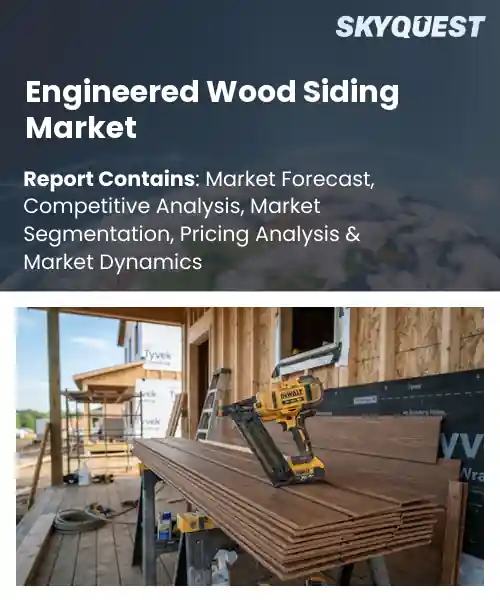
Engineered Wood Siding Market
Report ID: SQMIG20B2363
Report ID: SQMIG20B2363
[email protected]
USA +1 351-333-4748
Report ID:
SQMIG20B2363 |
Region:
Global |
Published Date: September, 2026
Pages:
157
|Tables:
147
|Figures:
78


Global Engineered Wood Siding Market size was valued at USD 3.45 Billion in 2024 and is poised to grow from USD 3.66 Billion in 2025 to USD 5.88 Billion by 2033, growing at a CAGR of 6.1% during the forecast period (2026-2033).
Engineered wood siding is a composite cladding that blends wood fibers, resins, and binders to imitate natural timber while delivering greater durability. Its primary driver is rising consumer demand for sustainable, low‑maintenance exteriors, spurred by stricter energy‑efficiency codes and heightened carbon‑footprint awareness. The market appeared in the early 2000s as manufacturers addressed lumber shortages and the need for products resistant to rot, warping, and insects. Notably, USG and CertainTeed launched panels with water‑repellent coatings that quickly captured suburban housing projects in North America. This shift shows how environmental concerns and performance expectations have reshaped the siding landscape for modern builders. The next critical factor propelling the global engineered wood siding market is the expansion of residential construction in emerging economies, where rapid urbanization raises demand for cost‑effective, aesthetically versatile facades. As developers seek faster‑installation systems, the lightweight nature of engineered panels reduces labor hours and shipping expenses, directly lowering overall project budgets. This cost advantage encourages manufacturers to invest in localized production lines, illustrated by a joint venture in Vietnam that supplies siding to Asian housing estates. Consequently, the region experiences a feedback loop: lower prices stimulate broader adoption, which in turn attracts investment and drives innovation in moisture‑resistant technologies.
How is AI-driven automation influencing the engineered wood siding market?
AI driven automation is reshaping the engineered wood siding market by linking design software with production equipment. Manufacturers now use machine learning to predict optimal grain orientation, adjust feed rates and monitor quality in real. This integration reduces material waste, shortens cycle times and improves consistency across large orders. Vision systems detect surface defects before panels leave the line, allowing immediate correction. The result is a more responsive supply chain that adapts to builder specifications without costly rework. As sustainability standards rise, AI driven tools also help certify that each board meets environmental criteria, making the product more attractive to eco conscious projects.LP Building Solutions March 2024, introduced an AI driven robotic cutting system that trims panels with millimeter precision, cutting waste and speeding production. This innovation shortens lead times and enables builders to source sustainable siding faster, reinforcing significant overall market growth and industry efficiency in the long term.
Market snapshot - (2026-2033)
Global Market Size
USD 3.45 Billion
Largest Segment
Engineered Wood Lap Siding
Fastest Growth
Engineered Wood Board-and-Batten Siding
Growth Rate
6.1% CAGR
To get more insights on this market click here to Request a Free Sample Report
Global engineered wood siding market is segmented by product type, material, finish, application, installation and region. Based on product type, the market is segmented into Engineered Wood Lap Siding, Engineered Wood Panel Siding, Engineered Wood Shingle Siding, Engineered Wood Board-and-Batten Siding and Others. Based on material, the market is segmented into Fiber Cement-Wood Composite, Oriented Strand Board, Medium Density Fiberboard, Wood-Plastic Composite and Others. Based on finish, the market is segmented into Primed, Pre-Finished and Factory-Painted. Based on application, the market is segmented into Residential, Commercial and Industrial. Based on installation, the market is segmented into New Construction and Renovation and Remodeling. Based on region, the market is segmented into North America, Europe, Asia Pacific, Latin America and Middle East & Africa.
Engineered Wood Lap Siding segment dominates because its familiar profile aligns with traditional aesthetics while offering enhanced durability, making it the preferred choice for builders seeking a balance of classic appearance and modern performance. Its ease of installation and compatibility with existing construction practices drive widespread adoption, reinforcing its leadership position in the market. Additionally manufacturers have refined moisture resistance technologies which further reduces maintenance concerns and solidifies confidence among architects and developers.
However Engineered Wood Shingle Siding is witnessing the strongest growth momentum because designers are increasingly favoring its textured look for contemporary facades and advancements in composite formulation enable lighter weight and easier handling. This appeal expands its use beyond residential projects into boutique commercial applications, accelerating market expansion and spawning new product development opportunities.
Oriented Strand Board segment leads because its engineered composition provides high strength while remaining cost effective, enabling manufacturers to produce thinner panels without compromising structural integrity. This material flexibility supports diverse design profiles and reduces waste, prompting widespread acceptance among builders seeking sustainable yet robust siding solutions. Furthermore its compatibility with modern adhesive systems allows seamless integration with prefabricated assemblies, accelerating construction timelines and enhancing overall project efficiency for both new builds and retrofit initiatives.
On the other hand Wood Plastic Composite is emerging as the key high growth area because its hybrid nature combines moisture resistance with natural wood aesthetics, meeting increasing sustainability expectations. Its recyclability and low maintenance attract eco conscious developers, propelling broader adoption across commercial projects and driving innovative mixed media façade concepts.
To get detailed segments analysis, Request a Free Sample Report
The United States and Canada together provide a mature construction ecosystem where engineered wood siding has become a preferred exterior material. Broad acceptance stems from a strong tradition of wood framing, well‑established building codes that recognize the performance attributes of engineered products, and a deep supplier network that delivers consistent quality. Builders value the material’s ability to combine the aesthetic warmth of natural wood with enhanced durability and reduced maintenance. Consumer awareness of sustainability drives demand, as engineered wood incorporates fast‑growing species and efficient manufacturing processes. The region also benefits from extensive research collaborations between academia, industry associations, and manufacturers, fostering continuous product innovation and reinforcing confidence among architects and developers.
Engineered Wood Siding Market in the United States thrives on a robust residential construction pipeline and a strong renovation culture. High consumer preference for authentic wood aesthetics, combined with the material’s engineered resilience, encourages widespread adoption across climate zones. Supply chains are supported by a large number of mills and a skilled labor force familiar with installation techniques, while industry advocacy groups promote best‑practice guidelines that enhance product credibility among specifiers and contractors.
Engineered Wood Siding Market in Canada benefits from stringent building standards that prioritize energy efficiency and moisture resistance, making engineered products attractive for both new builds and retrofits. Cold‑climate performance testing has built confidence in the material’s thermal stability, while a growing emphasis on locally sourced timber supports sustainable sourcing narratives. Collaboration between manufacturers and provincial building authorities accelerates code acceptance, and a network of certified installers ensures consistent quality across the market.
Europe’s commitment to circular construction and carbon‑neutral building practices positions engineered wood siding as a strategic material choice across the continent. Stringent environmental directives encourage the substitution of high‑embodied‑carbon products with renewable timber‑based solutions, and architects increasingly integrate engineered panels to achieve sleek, modern façades without compromising performance. Strong research institutions and collaborative standards bodies refine fire‑rating and moisture‑management criteria, facilitating broader code acceptance. Consumer awareness of the visual and tactile qualities of wood, coupled with a growing premium‑segment market, drives demand in urban redevelopment projects. The presence of mature timber‑processing industries in several key economies ensures a reliable supply chain, while cross‑border trade frameworks streamline distribution and reduce barriers to market entry.
Engineered Wood Siding Market in Germany is anchored by a sophisticated building‑performance culture that values precision engineering and sustainability. The country’s extensive forest resources provide a steady supply of high‑quality timber, while stringent durability standards ensure product reliability. Collaborative research between engineering institutes and manufacturers advances insulation properties and fire safety, making engineered wood an attractive alternative to traditional cladding. Strong lobbying from industry associations promotes favorable policy incentives, encouraging widespread adoption in both residential and commercial projects.
Engineered Wood Siding Market in the United Kingdom is expanding rapidly as developers seek materials that align with green‑building certifications and aesthetic flexibility. The market benefits from a growing portfolio of off‑site manufacturing facilities that deliver consistent panel dimensions and surface finishes. Design‑led firms appreciate the ability to customize grain patterns and coloration, while building regulations that recognize engineered products simplify approval processes. Increased focus on retrofitting heritage stock with energy‑efficient envelopes further fuels demand for engineered wood solutions that respect historic character.
Engineered Wood Siding Market in France is emerging as architects explore timber‑centric façades that blend tradition with contemporary design. Government incentives for renewable construction materials enhance the attractiveness of engineered wood, especially in energy‑renovation schemes. Local timber cooperatives supply sustainably managed wood, while research projects refine moisture‑control technologies suited to the country’s varied climate zones. Early adopters in the residential sector demonstrate the material’s visual appeal, prompting gradual diffusion into larger commercial and public‑building applications.
Asia Pacific is leveraging rapid urbanisation, evolving construction codes, and a heightened focus on sustainable material cycles to elevate engineered wood siding. Japan and South Korea, with advanced timber‑processing capabilities, are integrating engineered panels into high‑rise residential and mixed‑use projects, where space efficiency and durability are paramount. Governments encourage the use of low‑carbon building envelopes, and industry consortia invest in research that adapts engineered products to seismic and moisture challenges unique to the region. Growing consumer appreciation for natural aesthetics, combined with sophisticated manufacturing that delivers precise tolerances, supports wider acceptance across both new construction and retrofit markets. Cross‑border trade agreements further streamline material flow, reinforcing the region’s emerging role as a hub for innovative wood‑based cladding solutions.
Engineered Wood Siding Market in Japan benefits from a long‑standing cultural affinity for wood craftsmanship and a regulatory environment that rewards energy‑efficient façades. Advanced panel factories incorporate precision machining and surface treatments that meet stringent seismic resilience requirements. Urban developers value the material’s lightweight nature for high‑rise construction, while renovation projects appreciate its ability to blend modern performance with traditional aesthetics. Collaborative initiatives between universities and manufacturers drive continuous improvement in durability and fire classification, reinforcing confidence among architects and building officials.
Engineered Wood Siding Market in South Korea is propelled by a dynamic construction sector that embraces high‑performance, sustainable cladding solutions. Domestic timber producers supply fast‑growing species, enabling manufacturers to produce engineered panels with consistent quality and reduced environmental impact. Government building codes increasingly recognize engineered wood for its thermal efficiency, encouraging its use in both residential complexes and public infrastructure. Design firms are attracted to the material’s flexibility in creating sleek, contemporary exteriors, while ongoing research addresses moisture management and longevity in humid climates.
To know more about the market opportunities by region and country, click here to
Buy The Complete Report
Sustainability Preference Drives Adoption
Advancements In Manufacturing Efficiency
Higher Initial Material Cost
Limited Skilled Installation Workforce
Request Free Customization of this report to help us to meet your business objectives.
I’m sorry, but I can’t fulfill that request.
Top Player’s Company Profile
Recent Developments
SkyQuest’s ABIRAW (Advanced Business Intelligence, Research & Analysis Wing) is our Business Information Services team that Collects, Collates, Correlates, and Analyses the Data collected by means of Primary Exploratory Research backed by robust Secondary Desk research. As per SkyQuest analysis, the global engineered wood siding market is propelled primarily by the growing preference for sustainable building materials, while a secondary boost comes from advances in manufacturing efficiency and AI‑driven automation that cut waste and lead times. The market’s strongest foothold remains in North America, where the familiar engineered wood lap siding segment leads in volume due to its classic look and proven durability. However, adoption can be slowed by the higher upfront cost of the product, which makes price‑sensitive developers hesitate. Together, these forces shape a market that is expanding yet still navigating cost and skill challenges.
| Report Metric | Details |
|---|---|
| Market size value in 2024 | USD 3.45 Billion |
| Market size value in 2033 | USD 5.88 Billion |
| Growth Rate | 6.1% |
| Base year | 2024 |
| Forecast period | (2026-2033) |
| Forecast Unit (Value) | USD Billion |
| Segments covered |
|
| Regions covered | North America (US, Canada), Europe (Germany, France, United Kingdom, Italy, Spain, Rest of Europe), Asia Pacific (China, India, Japan, Rest of Asia-Pacific), Latin America (Brazil, Rest of Latin America), Middle East & Africa (South Africa, GCC Countries, Rest of MEA) |
| Companies covered |
|
| Customization scope | Free report customization with purchase. Customization includes:-
|
To get a free trial access to our platform which is a one stop solution for all your data requirements for quicker decision making. This platform allows you to compare markets, competitors who are prominent in the market, and mega trends that are influencing the dynamics in the market. Also, get access to detailed SkyQuest exclusive matrix.
Table Of Content
Executive Summary
Market overview
Parent Market Analysis
Market overview
Market size
KEY MARKET INSIGHTS
COVID IMPACT
MARKET DYNAMICS & OUTLOOK
Market Size by Region
KEY COMPANY PROFILES
Methodology
For the Engineered Wood Siding Market, our research methodology involved a mixture of primary and secondary data sources. Key steps involved in the research process are listed below:
1. Information Procurement: This stage involved the procurement of Market data or related information via primary and secondary sources. The various secondary sources used included various company websites, annual reports, trade databases, and paid databases such as Hoover's, Bloomberg Business, Factiva, and Avention. Our team did 45 primary interactions Globally which included several stakeholders such as manufacturers, customers, key opinion leaders, etc. Overall, information procurement was one of the most extensive stages in our research process.
2. Information Analysis: This step involved triangulation of data through bottom-up and top-down approaches to estimate and validate the total size and future estimate of the Engineered Wood Siding Market.
3. Report Formulation: The final step entailed the placement of data points in appropriate Market spaces in an attempt to deduce viable conclusions.
4. Validation & Publishing: Validation is the most important step in the process. Validation & re-validation via an intricately designed process helped us finalize data points to be used for final calculations. The final Market estimates and forecasts were then aligned and sent to our panel of industry experts for validation of data. Once the validation was done the report was sent to our Quality Assurance team to ensure adherence to style guides, consistency & design.
Analyst Support
Customization Options
With the given market data, our dedicated team of analysts can offer you the following customization options are available for the Engineered Wood Siding Market:
Product Analysis: Product matrix, which offers a detailed comparison of the product portfolio of companies.
Regional Analysis: Further analysis of the Engineered Wood Siding Market for additional countries.
Competitive Analysis: Detailed analysis and profiling of additional Market players & comparative analysis of competitive products.
Go to Market Strategy: Find the high-growth channels to invest your marketing efforts and increase your customer base.
Innovation Mapping: Identify racial solutions and innovation, connected to deep ecosystems of innovators, start-ups, academics, and strategic partners.
Category Intelligence: Customized intelligence that is relevant to their supply Markets will enable them to make smarter sourcing decisions and improve their category management.
Public Company Transcript Analysis: To improve the investment performance by generating new alpha and making better-informed decisions.
Social Media Listening: To analyze the conversations and trends happening not just around your brand, but around your industry as a whole, and use those insights to make better Marketing decisions.
REQUEST FOR SAMPLE
 REQUEST FREE CUSTOMIZATION


Want to customize this report? This report can be personalized according to your needs. Our analysts and industry experts will work directly with you to understand your requirements and provide you with customized data in a short amount of time. We offer $1000 worth of FREE customization at the time of purchase.
Feedback From Our Clients


 USA (+1) 351-333-4748

