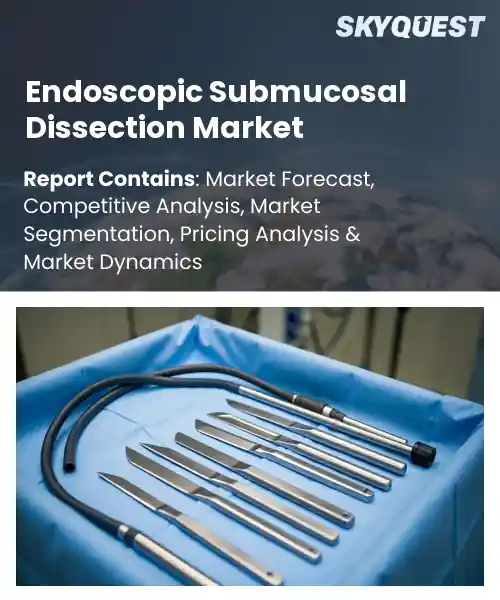
Endoscopic Submucosal Dissection Market
Report ID: SQMIG35A3195
Report ID: SQMIG35A3195
[email protected]
USA +1 351-333-4748
Report ID:
SQMIG35A3195 |
Region:
Global |
Published Date: February, 2026
Pages:
171
|Tables:
89
|Figures:
68


Global Endoscopic Submucosal Dissection Market size was valued at USD 360.0 Million in 2024 and is poised to grow from USD 379.44 Million in 2025 to USD 577.92 Million by 2033, growing at a CAGR of 5.4% during the forecast period (2026-2033).
The endoscopic submucosal dissection market is expected to continue to grow due to the increasing incidence of gastrointestinal cancers and precancerous lesions, as well as the growing trend toward the use of minimally invasive procedures for diagnosis and treatment.
The growth of the market is also being driven by the increasing awareness among practitioners and patients, the advancement of endoscopic imaging technologies, and the development of more sophisticated ESD instruments such as high-precision blades, electrosurgical devices, and hemostatic instruments. Hospitals and specialty clinics are increasingly investing in advanced endoscopy technology, and as the expansion of training programs and guidelines related to ESD increases the number of clinicians who are able to perform the procedure, the adoption and use of ESD will grow in areas beyond those that are the most frequent users of the procedure. However, the market for ESD is still faced with obstacles related to the technical complexity of performing ESD; a long learning curve; and longer procedure durations when compared to the conventional type of endoscopy. Ongoing innovations, the increasing need to screen for early-stage cancers, and the global trend to use less invasive treatment options are expected to continue to significantly influence the long-term outlook for the market.
How Does AI Support Training and Skill Development in ESD?
The use of Artificial Intelligence (AI) in the endoscopic submucosal dissection market is helping to improve procedural accuracy, accelerate the process, and provide better training for those performing these procedures. In 2024, a research team developed an AI-based automated phase recognition system that can recognize each phase of an ESD procedure, which allows further analysis of an endoscopic video and potentially supports the establishment of quality benchmarks as an indicator of both device innovation and clinical efficacy.
An additional area of innovation is that AI-based models used to detect marks and predict incision guidelines perform at a level comparable to that of an experienced endoscopist in terms of assisting with the annotation and guidance of mucosal incision, which is critical when performing ESD. These innovations provide immediate access to key information regarding ESD practices that allow for reduced operator variation, real-time decision-making, increased speed of training, and access to labeled procedural insights that improve the ability to understand complex workflow processes. With the continued integration of AI into endoscopic workflows, the potential impact of AI on the market will continue to be substantial, as it will result in increased standardization and safety when used for ESD, which will ultimately lead to more widespread acceptance of ESD techniques across many areas of clinical practice.
Market snapshot - 2026-2033
Global Market Size
USD 390.77 Million
Largest Segment
Knives
Fastest Growth
Gastroscopes & Colonoscopes
Growth Rate
5.5% CAGR
To get more insights on this market click here to Request a Free Sample Report
Global Endoscopic Submucosal Dissection Market is segmented by Device Type, Application, End-user, Technology and region. Based on Device Type, the market is segmented into Endoscopes and Surgical Tools. Based on Application, the market is segmented into Gastrointestinal and Pulmonary. Based on End-user, the market is segmented into Hospitals and Ambulatory Surgical Centers. Based on Technology, the market is segmented into Conventional Techniques and Robotic-assisted Techniques. Based on region, the market is segmented into North America, Europe, Asia Pacific, Latin America and Middle East & Africa.
As per the global endoscopic submucosal dissection market outlook, gastroscopes & colonoscopes segment dominate the market as they are one of the primary tools used by endoscopists to perform endoscopic procedures. The gastroscope provides primary access and direct visualization of the submucosal layer of the gastrointestinal tract, allowing endoscopists to accurately identify and assess any potential lesions. Most hospitals and specialty clinics have already invested in using this instrument, making this product area the highest revenue-generating segment within the overall market. The number of gastroscopes and colonoscopes now used in both onshore and urbanized healthcare facilities guarantees a large share of the overall market.
As per the global endoscopic submucosal dissection market forecast, knives segment is one of the fastest-growing segments in terms of product development. The growing use of these knives is driven by the need for more precise procedures and shorter operative times, along with improved safety during the resection of tumors. Additionally, advances in technology have introduced items such as insulated-tip knives and hybrid multifunctional knives to increase the efficiency of use and decrease the incidence of complications, resulting in an increase in hospitals and ASCs choosing to invest in these products.
As per the global endoscopic submucosal dissection market analysis, stomach cancer remains the leading indication for endoscopic submucosal dissection (ESD) procedures, particularly in Asia-Pacific countries such as Japan and China. Unlike traditional surgical approaches where stomach function is compromised and surgical complications are higher, ESD allows the total removal of early-stage gastric tumors with a reduction in recovery time, discomfort and length of stay in hospital. Thus, ESD is now a preferred option by many patients and their healthcare providers compared to other forms of surgery.
As per the global endoscopic submucosal dissection market analysis, colon cancer is the highest increasing indication for ESD due to increasing numbers of colorectal cancer cases worldwide and the emergence of structured screening programs in both developed and developing countries. ESD as an option for patients diagnosed with early colon cancer represents another minimally invasive alternative to a colectomy. This mode of treatment allows for preservation of the colon and the associated benefits of fewer complications and shorter length of stay after surgery than with traditional colectomy procedures.
To get detailed segments analysis, Request a Free Sample Report
As per endoscopic submucosal dissection market regional forecast, North America is an advanced, developing and continuing to grow technologically advanced region for ESD, because of the level of sophistication within their healthcare system, the public's knowledge about the incidence of gastrointestinal (GI) cancer, and the existing programs that support early detection. Hospitals and ASCs will continue to invest in endoscopic systems, imaging systems powered by artificial intelligence (AI) and specialty tools to enhance both the quality of care and efficiencies associated with surgical procedures.
The United States has the largest endoscopic submucosal dissection market share in the North America region, largely due to the high prevalence of cancers and the presence of early detection programs. Most Hospitals and ASCs are now investing in advanced endoscopic equipment and developing training programs for endoscopic dissection. The adoption of AI assisted imaging and procedural assistance systems will allow providers to progressively enhance their procedural accuracy and safety. ESD is preferred over traditional surgical forms of treatment due to decreased hospital length of stay, increased speed of recovery, and improved organ preservation.
Canada is an emerging North America market, and a strong infrastructure in Canada's healthcare system, coupled with government-sponsored screening initiatives, continue to drive growth. Hospitals in Canada are expanding their endoscopic services, and structured training programs are allowing greater numbers of clinicians to safely perform ESDs. The trend of patients preferring minimally invasive treatment options is contributing to continuing growth in the Canada market.
As per endoscopic submucosal dissection regional outlook, Asia-Pacific is the largest and fastest growing market, due to the prevalence of gastrointestinal cancers, the level of expertise in performing gastrointestinal endoscopic procedures, existing programs for early detection, and increased levels of investment into healthcare infrastructure. The region has strong government policies with strong leaders educating clinicians and the general public about the benefits associated with using MIP.
Japan leads the world in ESD utilization based on its high levels of early detection of GI cancers and its large amount of clinical experience with ESD procedures. Similarly, hospitals and specialty practices perform a high number of ESD procedures each year. Continuous refinement through innovative techniques and furthermore, as high-def (HD) endoscope manufacturing technology continues to progress, the Japan market maintains its global position. Japan is the model for developing standards for both ESD procedures and ESD training globally.
As per endoscopic submucosal dissection industry analysis, South Korea market is relatively new but is growing at a rapid pace. Increasing early diagnosis rates of GI cancers, increased public knowledge about the benefits of minimally invasive treatment options, as well as increased government support for establishing ESD treatment methods and education initiatives for endoscopists, support significant growth in ESD procedures within the country. Hospitals continue to implement modern endoscopic systems as well as the latest HD technology.
Europe is a mature but innovative market for ESD. Growth in this market is supported by a strong healthcare infrastructure, an initiative from national governments to develop national cancer screening programs, and growing use of minimally invasive types of procedures. Within the European healthcare market, hospitals are focused on standardizing their procedures, implementing advanced imaging technology, and developing physician training programs to improve both patient outcomes and operational efficiencies.
The Germany endoscopic submucosal dissection market is one of Europe's largest, as Germany's hospitals support an advanced endoscopic environment, a solid commitment to research and the standardizing of ESD procedures. The availability of highly trained ESD specialists and the utilization of digital imaging technology has contributed to the growth of ESD and the increased acceptance of minimally invasive techniques for treating gastrointestinal cancers.
The endoscopic submucosal dissection market in the United Kingdom is growing primarily due to the presence of government-sponsored national health service screening programs, greater public interest in endoscopic solutions as a viable alternative, and increased investment in the clinical use of artificial intelligence. Greater focus on the training of endoscopists and the establishment of standardized protocols for performing ESDs are also assisting in the widespread implementation of these procedures in Britain’s major hospitals.
In Italy, the endoscopic submucosal dissection market continues to show moderate but sustained growth. Ongoing investments in endoscopic technology and the increased awareness among patients about the effectiveness of ESDs, coupled with a gradual introduction of standardized process protocols, are driving the adoption of ESDs in both hospitals and specialist clinics throughout the country.
To know more about the market opportunities by region and country, click here to
Buy The Complete Report
Increasing Burden of Gastrointestinal Cancers and Emphasis on Early Intervention
Growing Preference for Minimally Invasive Endoscopic Therapies
Procedure Complexity and Limited Availability of Skilled Endoscopists
High Costs of Equipment and Support to Implement ESD
Request Free Customization of this report to help us to meet your business objectives.
The competitive landscape of the endoscopic submucosal dissection industry is moderately concentrated. It is primarily driven by continuous technological innovation and advancement. Manufacturers with comprehensive product portfolios hold a competitive advantage, particularly those offering integrated solutions such as endoscopic systems, electrosurgical knives, advanced visualization technologies, and related accessories. These offerings support higher procedural throughput and improved accuracy, strengthening market positioning. Market leaders including Olympus Corporation, FUJIFILM Holdings Corporation and Boston Scientific Corporation maintain their respective leadership positions through their broad range of endoscopic systems, electrosurgical knives, advanced visualization platform products, and clinical and institutional support services provided through their respective global distribution networks, extensive clinical training and ongoing research and development of new products which are geared toward enhancing procedural volume, increasing procedural accuracy, and improving safety and comfort for patients undergoing therapeutic endoscopic procedures at home or in a medical facility.
The emergence of startups in the ESD and the minimally invasive GI space is indicative of the development of innovative technologies that seek to eliminate traditional barriers to procedural access to therapeutic endoluminal surgery and/or expand the clinical capabilities of therapeutic endoscopy.
SkyQuest’s ABIRAW (Advanced Business Intelligence, Research & Analysis Wing) is our Business Information Services team that Collects, Collates, Correlates, and Analyses the Data collected by means of Primary Exploratory Research backed by robust Secondary Desk research.
As per SkyQuest analysis, the endoscopic submucosal dissection market is growing consistently because of the increased incidence of gastrointestinal cancer, as well as the rising popularity of minimally invasive surgery (MIS) methods that help preserve organs and speed up recovery. Nonetheless, endoscopic submucosal dissection market growth has been limited because of the high technical difficulty of performing ESD procedures, the extended length of time for an endoscopist to become proficient with the technique, and the shortage of qualified professionals in developing countries. There are several major endoscopic submucosal dissection market trends influencing the development of the market, including the creation of advanced techniques of imaging along with the development of safer and more ergonomic instruments, and an increased emphasis on training/familiarization of physicians and standardizing ESD procedures. Geographically, the market is led by Asia-Pacific, due to a large number of procedures being performed and a large amount of clinical experience in ESD. Europe is in the second position, reflecting a growing trend in the acceptance of endoscopic MIS techniques within the region. North America is experiencing a steady increase in market size, as a result of improved training programs and increased awareness of early-stage cancer. Emerging markets are also experiencing growth, due to the expanding healthcare infrastructure and increased recognition of early treatment of gastrointestinal cancers.
| Report Metric | Details |
|---|---|
| Market size value in 2024 | USD 360.0 Million |
| Market size value in 2033 | USD 577.92 Million |
| Growth Rate | 5.4% |
| Base year | 2024 |
| Forecast period | 2026-2033 |
| Forecast Unit (Value) | USD Million |
| Segments covered |
|
| Regions covered | North America (US, Canada), Europe (Germany, France, United Kingdom, Italy, Spain, Rest of Europe), Asia Pacific (China, India, Japan, Rest of Asia-Pacific), Latin America (Brazil, Rest of Latin America), Middle East & Africa (South Africa, GCC Countries, Rest of MEA) |
| Companies covered |
|
| Customization scope | Free report customization with purchase. Customization includes:-
|
To get a free trial access to our platform which is a one stop solution for all your data requirements for quicker decision making. This platform allows you to compare markets, competitors who are prominent in the market, and mega trends that are influencing the dynamics in the market. Also, get access to detailed SkyQuest exclusive matrix.
Table Of Content
Executive Summary
Market overview
Parent Market Analysis
Market overview
Market size
KEY MARKET INSIGHTS
COVID IMPACT
MARKET DYNAMICS & OUTLOOK
Market Size by Region
KEY COMPANY PROFILES
Methodology
For the Endoscopic Submucosal Dissection Market, our research methodology involved a mixture of primary and secondary data sources. Key steps involved in the research process are listed below:
1. Information Procurement: This stage involved the procurement of Market data or related information via primary and secondary sources. The various secondary sources used included various company websites, annual reports, trade databases, and paid databases such as Hoover's, Bloomberg Business, Factiva, and Avention. Our team did 45 primary interactions Globally which included several stakeholders such as manufacturers, customers, key opinion leaders, etc. Overall, information procurement was one of the most extensive stages in our research process.
2. Information Analysis: This step involved triangulation of data through bottom-up and top-down approaches to estimate and validate the total size and future estimate of the Endoscopic Submucosal Dissection Market.
3. Report Formulation: The final step entailed the placement of data points in appropriate Market spaces in an attempt to deduce viable conclusions.
4. Validation & Publishing: Validation is the most important step in the process. Validation & re-validation via an intricately designed process helped us finalize data points to be used for final calculations. The final Market estimates and forecasts were then aligned and sent to our panel of industry experts for validation of data. Once the validation was done the report was sent to our Quality Assurance team to ensure adherence to style guides, consistency & design.
Analyst Support
Customization Options
With the given market data, our dedicated team of analysts can offer you the following customization options are available for the Endoscopic Submucosal Dissection Market:
Product Analysis: Product matrix, which offers a detailed comparison of the product portfolio of companies.
Regional Analysis: Further analysis of the Endoscopic Submucosal Dissection Market for additional countries.
Competitive Analysis: Detailed analysis and profiling of additional Market players & comparative analysis of competitive products.
Go to Market Strategy: Find the high-growth channels to invest your marketing efforts and increase your customer base.
Innovation Mapping: Identify racial solutions and innovation, connected to deep ecosystems of innovators, start-ups, academics, and strategic partners.
Category Intelligence: Customized intelligence that is relevant to their supply Markets will enable them to make smarter sourcing decisions and improve their category management.
Public Company Transcript Analysis: To improve the investment performance by generating new alpha and making better-informed decisions.
Social Media Listening: To analyze the conversations and trends happening not just around your brand, but around your industry as a whole, and use those insights to make better Marketing decisions.
REQUEST FOR SAMPLE
 REQUEST FREE CUSTOMIZATION
Global Endoscopic Submucosal Dissection Market size was valued at USD 390.77 Million in 2025 and is poised to grow from USD 412.26 Million in 2026 to USD 599.71 Million by 2033, growing at a CAGR of 5.5% during the forecast period (2026-2033).
The competitive landscape of the endoscopic submucosal dissection industry is moderately concentrated. It is primarily driven by continuous technological innovation and advancement. Manufacturers with comprehensive product portfolios hold a competitive advantage, particularly those offering integrated solutions such as endoscopic systems, electrosurgical knives, advanced visualization technologies, and related accessories. These offerings support higher procedural throughput and improved accuracy, strengthening market positioning. Market leaders including Olympus Corporation, FUJIFILM Holdings Corporation and Boston Scientific Corporation maintain their respective leadership positions through their broad range of endoscopic systems, electrosurgical knives, advanced visualization platform products, and clinical and institutional support services provided through their respective global distribution networks, extensive clinical training and ongoing research and development of new products which are geared toward enhancing procedural volume, increasing procedural accuracy, and improving safety and comfort for patients undergoing therapeutic endoscopic procedures at home or in a medical facility. 'Olympus Corporation', 'FUJIFILM Holdings Corporation', 'Boston Scientific Corporation', 'Medtronic plc', 'ERBE Elektromedizin GmbH', 'Pentax Medical (HOYA Corporation)', 'CONMED Corporation', 'STERIS plc', 'KARL STORZ SE & Co. KG', 'Cook Medical', 'Micro‑Tech Endoscopy', 'Taewoong Medical Co., Ltd.'
The rise in gastrointestinal cancers has resulted in higher rates of disease diagnosis at an earlier stage where endoscopic submucosal dissection (ESD) can provide a curative organ-sparing treatment method. The growing number of patients diagnosed at this stage has been enabled by increasing public awareness of early cancer detection (through community outreach and education), expanded screening programs, and therefore, an increased number of cases diagnosed earlier. As a result, the benefits of ESD over traditional surgical approaches have resulted in clinicians' greater preference towards ESD about achieving complete lesion removal while providing significantly less post-operative morbidity than traditional surgery.
Rising Adoption of AI-Assisted and Digital Endoscopy Solutions: The role of Artificial Intelligence (AI) in the workflow of digital endoscopy devices (DED) is on the rise, especially as they assist endoscopists in detecting lesions, determining margin areas, guiding incisions, and analyzing procedures. AI systems improve accuracy, reduce variability among operators, and provide a way for the operator to learn new skills with the help of AI systems, thus lowering the barrier to entry for ESD procedures. As a result, there will be more standardization of ESD procedures among various healthcare providers.
How is the Endoscopic Submucosal Dissection Market Performing in North America?


Want to customize this report? This report can be personalized according to your needs. Our analysts and industry experts will work directly with you to understand your requirements and provide you with customized data in a short amount of time. We offer $1000 worth of FREE customization at the time of purchase.
Feedback From Our Clients


 USA (+1) 351-333-4748

