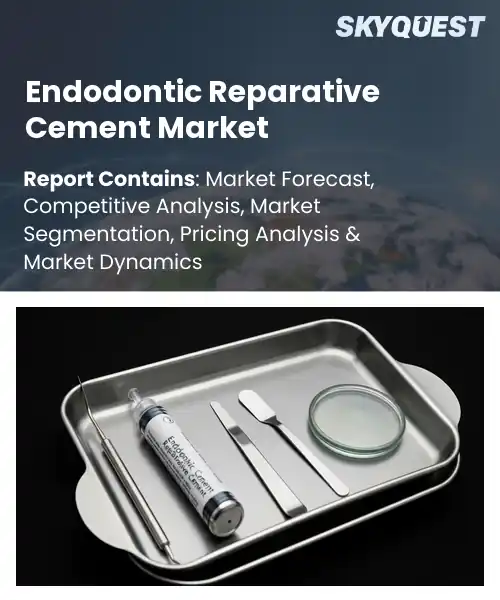
Endodontic Reparative Cement Market
Report ID: SQMIG15E3399
Report ID: SQMIG15E3399
[email protected]
USA +1 351-333-4748
Report ID:
SQMIG15E3399 |
Region:
Global |
Published Date: April, 2026
Pages:
157
|Tables:
119
|Figures:
77


Global Endodontic Reparative Cement Market size was valued at USD 412.8 Million in 2024 and is poised to grow from USD 438.39 Million in 2025 to USD 415.1 Million by 2033, growing at a CAGR of 6.2% during the forecast period (2026-2033).
Primary driver of the endodontic reparative cement market is the clinical superiority and expanded indications of bioactive calcium silicate materials, which have redefined root repair and pulp preservation therapies. The market encompasses formulation, manufacturing, and distribution of cements used for root-end fillings, perforation repair, apexification, and pulp capping and matters because these products improve sealing, biocompatibility, and healing outcomes. Historically the sector evolved from zinc oxide eugenol and amalgam substitutes toward mineral trioxide aggregate in the 1990s and newer premixed bioceramics such as Biodentine and bioactive sealers, prompting wider clinician adoption and formulation innovation. Clinical trials expanded overall clinician confidence.Building on clinician confidence, a pivotal growth factor is the demonstrable clinical outcome improvement associated with reparative cements, which causes higher procedure volumes and creates opportunities for premium product positioning. As bioactive cements reduce postoperative complications and shorten chair time, practices can increase throughput and justify investment in advanced materials. In real-world cases a practitioner repairing a lower molar perforation with a premixed bioceramic achieves predictable sealing and avoids extraction, which in turn fuels referral rates and product demand. Coupled with rising dental service access in emerging markets and targeted R&D into faster-setting, radiopaque formulations, manufacturers encounter clear expansion pathways.
How is AI transforming market forecasting in the endodontic reparative cement market?
AI is reshaping market forecasting for endodontic reparative cement by enabling richer data fusion and smarter pattern recognition. Key aspects include machine learning models that combine sales histories clinical adoption signals regulatory updates and supply chain indicators. The current state finds vendors and distributors using AI to sense demand shifts earlier and to align production with practitioner preference. This matters in a market where adoption depends on clinician confidence innovation cycles and regulatory review. Examples include natural language processing that mines clinical literature and professional forums for sentiment demand sensing from distributor orders and scenario modeling that reduces launch risk and improves agility.COLTENE March 2026, announced plans to optimize regulatory cost through digitalization and AI which reinforces internal forecasting by accelerating insight into product performance and clinical uptake. This focused use of AI supports better demand sensing and faster go to market decisions which improves efficiency and helps market growth for endodontic reparative cements.
Market snapshot - (2026-2033)
Global Market Size
USD 412.8 Million
Largest Segment
Mineral Trioxide Aggregate (MTA) Based
Fastest Growth
Bioceramic/Calcium Silicate Based
Growth Rate
6.2% CAGR
To get more insights on this market click here to Request a Free Sample Report
Global endodontic reparative cement market is segmented by material base, clinical application, form factor, end-user and region. Based on material base, the market is segmented into Mineral Trioxide Aggregate (MTA) Based, Bioceramic/Calcium Silicate Based, Resin-based Reparative Cements and Calcium Hydroxide Based. Based on clinical application, the market is segmented into Root Canal Sealing & Filling, Pulp Capping & Pulpotomy, Perforation Repair & Root Resorption and Apexification & Root-end Filling. Based on form factor, the market is segmented into Pre-mixed Putty/Syringe, Powder-Liquid System (Hand-mix) and Self-curing vs. Dual-curing Systems. Based on end-user, the market is segmented into Specialized Endodontic Clinics, General Dental Practices and Academic Dental Hospitals. Based on region, the market is segmented into North America, Europe, Asia Pacific, Latin America and Middle East & Africa.
Mineral Trioxide Aggregate (MTA) Based segment dominates because its long clinical history and proven biological sealing properties have generated deep clinician trust and widespread recommendation across key endodontic indications. Established performance in critical procedures encourages incorporation into clinical protocols, which drives manufacturer investment and distribution focus. This trust reduces perceived clinical risk, eases guideline acceptance, and sustains demand through predictable healing outcomes and compatibility with existing restorative and instrumentation workflows.
However, Bioceramic/Calcium Silicate Based materials are emerging as the most rapidly expanding material base because innovations in bioactivity and handling have increased clinician uptake and regulatory momentum. Improved bonding and compatibility with pre mixed delivery formats expand practical applications, prompting accelerated product introductions and opening new commercial opportunities across diverse clinical settings.
Pre mixed Putty/Syringe segment dominates because it delivers predictable consistency, simplified preparation, and faster chairside workflows that align with clinician demand for efficiency and reduced contamination risk. Ready to use formats eliminate variability from manual mixing, enabling reproducible clinical outcomes and streamlined staff training. Manufacturer emphasis on convenient packaging, dosage control, and compatibility with bioactive chemistries reinforces adoption among practitioners prioritizing reliability and simplified inventory management.
However, Powder-Liquid System (Hand-mix) is emerging as the most rapidly expanding form factor because refined formulations and pre measured packaging restore clinician control over viscosity and working time while lowering material costs. Improved ease of hand mixing and adaptable physical properties are prompting renewed adoption and stimulating niche product development that widens clinical options.
To get detailed segments analysis, Request a Free Sample Report
North America dominates due to a combination of advanced clinical infrastructure, concentrated specialist networks and a mature commercial ecosystem that supports rapid adoption of innovative dental materials. Strong presence of leading manufacturers and well established distribution channels ensure wide product availability and local technical support. Academic institutions and specialist societies collaborate on clinical validation and professional education, reinforcing clinician confidence in new reparative cements. Favorable regulatory and reimbursement environments in key markets facilitate market entry and sustained uptake, while robust continuing education and training programs help integrate novel materials into routine endodontic practice. The interplay of research, regulatory guidance, and commercial capability underpins sustained leadership and market resilience.
Endodontic Reparative Cement Market in United States benefits from concentration of academic research centers, a dense network of specialist endodontists and well developed clinical pathways that favor adoption of innovative materials. Established relationships between manufacturers and dental providers support product rollout and training. Professional societies and continuing education influence clinical choices, while private practice dynamics and referral patterns sustain demand for reliable reparative solutions and ensure technical support across markets.
Endodontic Reparative Cement Market in Canada is shaped by a mix of public and private dental care, emphasizing evidence based adoption and regional procurement. Ties between academic dental faculties and health authorities encourage rigorous evaluation of materials, while specialist practices drive demand for advanced reparative solutions. Manufacturers focus on targeted training and localized service to navigate provincial systems. Clinical confidence is built through peer reviewed studies, initiatives and product support.
Europe is witnessing rapid expansion driven by strong clinical research ecosystems, emphasis on minimally invasive endodontic techniques and harmonized regulatory frameworks that ease product introduction across multiple markets. High standards of clinical practice and influential professional associations contribute to guideline development and clinician education, accelerating adoption of advanced reparative cements. Established manufacturers and regional distributors enhance market reach, while collaboration between academic centers and industry supports localized evidence generation and hands on training. Diverse payer landscapes and procurement approaches encourage choices that balance cost effectiveness with clinical performance, fostering demand for materials that offer predictable handling and outcomes. Cross border professional exchange and conferences further disseminate best practices and clinical insights.
Endodontic Reparative Cement Market in Germany benefits from a robust medical device manufacturing base, a strong network of specialist dental clinics and rigorous clinical evaluation culture. Clinician preference for evidence backed materials and organized professional societies support incorporation of advanced cements into practice. Reimbursement frameworks and procurement processes favor reliable validated products, while close cooperation between industry and academic institutions fosters innovation and localized training programs that reinforce clinician confidence.
Endodontic Reparative Cement Market in United Kingdom is characterized by clinician adoption driven by private practice expansion, active professional networks and strong training programs. Emphasis on minimally invasive techniques and patient outcomes has encouraged uptake of advanced reparative materials. Manufacturers prioritize accessible training, clinical support and product designs that suit practice settings. Collaborations with academic centers and professional bodies help disseminate clinical evidence and practices, sustaining momentum across local communities.
Endodontic Reparative Cement Market in France is emerging as clinicians explore advanced materials aligned with conservative practice. Engagement between academic and local researchers and practitioners supports clinical evaluation and broad awareness. Regional distributors and training workshops facilitate hands on exposure and clinician confidence. Decision making emphasizes clinical performance alongside cost considerations, prompting manufacturers to provide tailored support and demonstration programs that showcase practical benefits and ease of integration into routine dental care.
Asia Pacific is strengthening its position through rising clinical expertise, investment in specialized dental education and growing collaborations between regional manufacturers and international partners. Enhanced focus on hands on training and workshops increases clinician familiarity with reparative cement techniques, while academic centers contribute to local evidence generation and knowledge dissemination. Improved distribution networks and targeted commercialization strategies adapt global product platforms to regional practice patterns. Regulatory authorities in key markets are enhancing product evaluation pathways, encouraging localized studies and post market engagement. With a widening base of specialist practitioners and evolving patient expectations for durable, minimally invasive treatments, the region is progressively influencing global material adoption and clinical practice norms.
Endodontic Reparative Cement Market in Japan is driven by a culture of meticulous clinical practice, strong ties between academic research and industry and demand for high quality, advanced materials. Specialist societies and education programs encourage adoption of evidence based products, while manufacturers emphasize precise formulation and rigorous quality control to meet clinician expectations. Local distributors provide support and training to help integrate reparative cements into endodontic workflows across settings nationally.
Endodontic Reparative Cement Market in South Korea reflects technology transfer, a strong medical device innovation ecosystem and high clinician receptivity to novel materials. Extensive training, workshops and active specialist networks support practical skills acquisition for reparative techniques. Local manufacturers and multinational firms collaborate on product adaptation and clinician engagement, offering training and service nationally. Clinical adoption is fostered by emphasis on predictable outcomes and streamlined integration into digital endodontic workflows.
To know more about the market opportunities by region and country, click here to
Buy The Complete Report
Increasing Adoption Of Bioceramic Materials
Rising Demand For Minimally Invasive Procedures
High Cost Of Specialized Materials
Limited Reimbursement and Awareness
Request Free Customization of this report to help us to meet your business objectives.
Competition in the global endodontic reparative cement market is driven by rapid product innovation, regulatory clearances, and technology transfers that reshape supplier positioning. Multinationals expand premixed bioceramic lines while licensing and acquisitions accelerate market access. Examples include large-scale product rollouts of bioceramic sealers, FDA clearances of ready-to-use putties, institutional tech transfers to manufacturers, and deep-tech startups commercializing novel delivery platforms.
Top Player’s Company Profile
Recent Developments
SkyQuest’s ABIRAW (Advanced Business Intelligence, Research & Analysis Wing) is our Business Information Services team that Collects, Collates, Correlates, and Analyses the Data collected by means of Primary Exploratory Research backed by robust Secondary Desk research. As per SkyQuest analysis, the global endodontic reparative cement market is being driven by the clinical superiority and broader indications of bioactive calcium silicate materials, supported further by rising demand for minimally invasive procedures that favor predictable, tissue-preserving cements. North America remains the dominant region due to advanced clinical infrastructure and strong specialist networks, while Mineral Trioxide Aggregate based formulations continue to lead product preference because of long-term clinical trust. A key restraint is the high cost of specialized bioceramic and advanced resin-based materials, which can slow uptake among cost-sensitive providers despite clear outcome advantages. Continued innovation and education will shape near-term adoption.
| Report Metric | Details |
|---|---|
| Market size value in 2024 | USD 412.8 Million |
| Market size value in 2033 | USD 415.1 Million |
| Growth Rate | 6.2% |
| Base year | 2024 |
| Forecast period | (2026-2033) |
| Forecast Unit (Value) | USD Million |
| Segments covered |
|
| Regions covered | North America (US, Canada), Europe (Germany, France, United Kingdom, Italy, Spain, Rest of Europe), Asia Pacific (China, India, Japan, Rest of Asia-Pacific), Latin America (Brazil, Rest of Latin America), Middle East & Africa (South Africa, GCC Countries, Rest of MEA) |
| Companies covered |
|
| Customization scope | Free report customization with purchase. Customization includes:-
|
To get a free trial access to our platform which is a one stop solution for all your data requirements for quicker decision making. This platform allows you to compare markets, competitors who are prominent in the market, and mega trends that are influencing the dynamics in the market. Also, get access to detailed SkyQuest exclusive matrix.
Table Of Content
Executive Summary
Market overview
Parent Market Analysis
Market overview
Market size
KEY MARKET INSIGHTS
COVID IMPACT
MARKET DYNAMICS & OUTLOOK
Market Size by Region
KEY COMPANY PROFILES
Methodology
For the Endodontic Reparative Cement Market, our research methodology involved a mixture of primary and secondary data sources. Key steps involved in the research process are listed below:
1. Information Procurement: This stage involved the procurement of Market data or related information via primary and secondary sources. The various secondary sources used included various company websites, annual reports, trade databases, and paid databases such as Hoover's, Bloomberg Business, Factiva, and Avention. Our team did 45 primary interactions Globally which included several stakeholders such as manufacturers, customers, key opinion leaders, etc. Overall, information procurement was one of the most extensive stages in our research process.
2. Information Analysis: This step involved triangulation of data through bottom-up and top-down approaches to estimate and validate the total size and future estimate of the Endodontic Reparative Cement Market.
3. Report Formulation: The final step entailed the placement of data points in appropriate Market spaces in an attempt to deduce viable conclusions.
4. Validation & Publishing: Validation is the most important step in the process. Validation & re-validation via an intricately designed process helped us finalize data points to be used for final calculations. The final Market estimates and forecasts were then aligned and sent to our panel of industry experts for validation of data. Once the validation was done the report was sent to our Quality Assurance team to ensure adherence to style guides, consistency & design.
Analyst Support
Customization Options
With the given market data, our dedicated team of analysts can offer you the following customization options are available for the Endodontic Reparative Cement Market:
Product Analysis: Product matrix, which offers a detailed comparison of the product portfolio of companies.
Regional Analysis: Further analysis of the Endodontic Reparative Cement Market for additional countries.
Competitive Analysis: Detailed analysis and profiling of additional Market players & comparative analysis of competitive products.
Go to Market Strategy: Find the high-growth channels to invest your marketing efforts and increase your customer base.
Innovation Mapping: Identify racial solutions and innovation, connected to deep ecosystems of innovators, start-ups, academics, and strategic partners.
Category Intelligence: Customized intelligence that is relevant to their supply Markets will enable them to make smarter sourcing decisions and improve their category management.
Public Company Transcript Analysis: To improve the investment performance by generating new alpha and making better-informed decisions.
Social Media Listening: To analyze the conversations and trends happening not just around your brand, but around your industry as a whole, and use those insights to make better Marketing decisions.
REQUEST FOR SAMPLE
 REQUEST FREE CUSTOMIZATION


Want to customize this report? This report can be personalized according to your needs. Our analysts and industry experts will work directly with you to understand your requirements and provide you with customized data in a short amount of time. We offer $1000 worth of FREE customization at the time of purchase.
Feedback From Our Clients


 USA (+1) 351-333-4748

