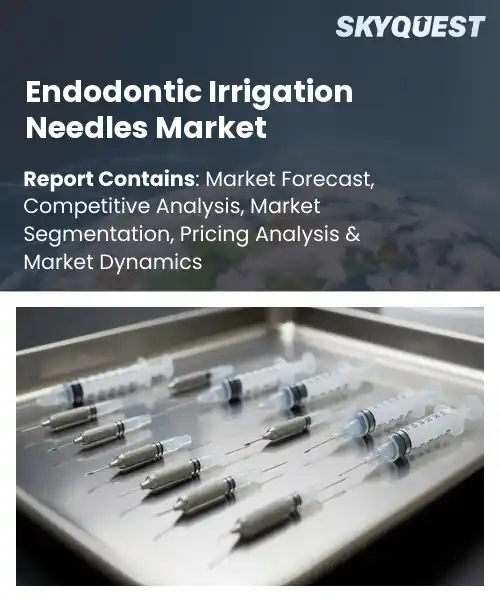
Endodontic Irrigation Needles Market
Report ID: SQMIG35A3289
Report ID: SQMIG35A3289
[email protected]
USA +1 351-333-4748
Report ID:
SQMIG35A3289 |
Region:
Global |
Published Date: February, 2026
Pages:
157
|Tables:
141
|Figures:
78


Global Endodontic Irrigation Needles Market size was valued at USD 1.27 Billion in 2024 and is poised to grow from USD 1.34 Billion in 2025 to USD 2.09 Billion by 2033, growing at a CAGR of 5.7% during the forecast period (2026-2033).
The various devices included in the endodontic irrigation needles marker include those used for irrigation of root canals with antimicrobial solutions at the time of their treatment. Therefore, the quality of that irrigation would help determine how well disinfected the root canal is and how long the tooth can be retained after endodontic treatment. The primary factor supporting the endodontic irrigation needles market growth has been the increasing number of endodontic procedures due to the growing incidence of dental caries, increased accessibility to restorative dental care.
The endodontic irrigation needles industry has changed significantly over time from the use of open-ended metal cannulas to the development of disposable, side-vented, flexible, safety-engineered single-use needles. The primary growth driver in the entire market over the last several decades has been innovation related to products and the stringent infection-control standards that impact the procurement process within individual clinics and throughout procurement cycles across health systems.
In addition, because of the increased focus on use of single-use devices and safe designs that minimize extrusion, manufacturers are responding with products that are side-vented, closed-end, and flexible that reduce complications and minimize time spent in the office.
How is AI Improving Precision in the Endodontic Irrigation Needles Market?
Precise irrigation needles are gaining Internet of Things (IoT)-based AI flexibility because of collaboration between imaging data, fluid dynamics, and needle engineering, which will serve to optimize function. Key components include machine-learning-based design optimization, which will improve tip shape and vent location, creating a functional relationship; image analysis, which will effectively capture the complex anatomy of canals; and smart delivery controls that will regulate the delivery of fluid and pressure based on predictions and projections.
The blending of proven side vented and flexible plastic needles with AI-based modifications will provide targeted shear forces while minimizing the risk of apical extrusion. Multiple applications involve clinical data supporting dual vent tips that direct jets of irrigants toward dentin walls, and the use of AI metamodels to accelerate the current design cycle of needles by increased safety.
Market snapshot - (2026-2033)
Global Market Size
USD 1.27 Billion
Largest Segment
Single-Use Needles
Fastest Growth
Single-Use Needles
Growth Rate
5.7% CAGR
To get more insights on this market click here to Request a Free Sample Report
Global endodontic irrigation needles market is segmented into product type, material type, application area, end user, distribution channel and region. Based on product type, the market is segmented into single-use needles and reusable needles. Based on material type, the market is segmented into stainless steel, plastic, and nickel-titanium. Based on application area, the market is segmented into root canal procedures and endodontic treatments. Based on end user, the market is segmented into dental clinics, hospitals and academic & research institutes. Based on distribution channel, the market is segmented into online sales and offline sales. Based on region, the market is segmented into North America, Europe, Asia Pacific, Latin America and Middle East & Africa.
As per global endodontic irrigation needles market analysis, stainless steel segment dominates because clinicians and suppliers favor its proven mechanical strength, manufacturing consistency, and sterilization compatibility, which together ensure predictable irrigation performance and low failure rates. Together these factors provide predictable irrigation performance as well as low failure rates. The familiarity of clinicians with stainless steel throughout dental training including established pathways for regulation encourages them both to procure stainless steel and standardize their instrumentation based on that choice of material. This creates a tendency toward inertia in procurement as well as broad trust among clinicians leading to its continued dominance in all routine endodontic irrigation applications.
As per global endodontic irrigation needles market forecast, nickel-titanium is becoming the fastest growing segment of the market because of the unique properties it exhibits which provide greater access to curved canals, therefore improving endodontic irrigation in complicated anatomical cases. Additionally, the introduction of new nickel-titanium materials along with the adoption of these materials by cutting edge dental practices increases the demand for specialized needles used in conjunction with nickel-titanium. All of these factors create premium position opportunities in the marketplace for manufacturers to accelerate future growth in this market.
As per global endodontic irrigation needles market outlook, single-use needles segment dominates because heightened infection control priorities and streamlined clinic workflows favor disposable options that eliminate reprocessing risks and reduce turnaround time between procedures. Convenience, continued assurance of sterility, and ease of inventory management are three major criteria for both manufacturers and purchasing agents in their decisions to procure single-use products. Therefore, the increase in demand for single-use products has created incentives for product innovation, standardization of packaging, and increased investment by suppliers. Thus, establishing single-use devices as the predominant form of product usage in virtually all types of dental practices.
Conversely, reusable needles are growing at the fastest rate because institutions are looking for long-term cost efficiencies and sustainable solutions, while enhancements in durable materials used to manufacture needles as well as improvements in sterilization processes. As a result of increased interest in reducing waste and determining lifecycle cost, the use of sterilizable needle products will create service models to increase the speed of adoption.
To get detailed segments analysis, Request a Free Sample Report
Advanced clinical practices, concentrated manufacturing capabilities, and established distribution networks help lead to the dominance of North America in this market. Clinicians' familiarity with evidence-based irrigation protocols, coupled with a well-trained endodontist community, leads to preference for innovative needle designs for increased safety and efficacy. A favorable regulatory environment and collaborative relationships between device manufacturers and research institutions accelerate product development and application. High standards for infection control and procedural effectiveness are established by both private and institutional dental practices, maintaining demand for high quality single-use and safety-engineered irrigation needles.
The endodontic irrigation needles market in the United States is driven by significant clinical integration of advanced irrigation techniques, a high density of specialized practices and ongoing partnerships with universities and other dental research organizations to develop and implement best practices. Manufacturer/supplier relationships with key opinion leaders are used to continually enhance product performance; together with distribution channels that enable rapid delivery of products throughout the U.S.
The endodontic irrigation needles market in Canada is driven by high clinical standards and centralized purchasing practices in certain parts of the country; as well as concentrations of endodontic centers of excellence. Infection control, single-use protocols, and advanced needle designs are emphasized by the practitioners and professional organizations and heavily impact their purchasing decisions.
The endodontic irrigation needles market in Europe is experiencing strong growth due to harmonized clinical guidelines, developed professional connections, and active engagement of specialized manufacturers. The increased focus on patient safety and less invasive endodontic procedures is leading dentists to adopt new methods of irrigating teeth with carefully designed instruments for these purposes. Established distribution systems operating within country boundaries and cooperative research efforts between manufacturers and dental organizations will contribute to facilitating the flow of knowledge and usage of products within dental practices. The distribution of endodontic irrigation needles varies from country to country, with established purchasing channels in Central Europe providing relatively quick access to premium disposable solutions.
The endodontic irrigation needles market in Germany benefits from a well-developed manufacturing base, close ties between academia and industry through collaborative research, and a focus on maintaining very stringent clinical standards. Demand for precision-manufactured endodontic irrigation devices is generated primarily from university dental clinics and specialist dental practices, both of which typically conform to national standards for quality. Well-developed distribution systems and a high level of export business enable manufacturers to quickly and efficiently introduce new innovations. The promotion of product usage within multiple settings by professional associations and training programs is another factor that aids the continuous refinement and enhancement of endodontic irrigation devices and the level of confidence clinical practitioners have in using these products.
The endodontic irrigation needles market in the U.K. is currently experiencing a lot of growth because of an increasing number of private practices and urban based specialty clinics that are adopting advanced endodontic irrigation solutions at a rapid pace due to this growth. The U.K. also has many dental associations which are developing best practice guidelines to inform clinicians about the most up-to-date and evidence-based irrigation protocols available to them. As a result of this environment, there have been significant investments made by suppliers into developing local partnerships and providing training to local dentists. This combination of factors provides a foundation for the rapid adoption of new needle designs by dentists across a wide variety of practice settings.
The France endodontic irrigation needles market is growing rapidly due to practices replacing outdated instrumentation with new endodontic specialty equipment. As a result of the increased awareness of patient safety and hygiene as well as improved clinical outcomes that are being associated with new types of irrigation instruments, there has been an increasing demand placed on the manufacturers and distributors in the French dental industry to create local distributor partnerships and to provide support and training to providers in order to encourage further adoption of these types of equipment. As new irrigation instrument designs are developed and validated by urban based academic dental centers, dentists across the French dental community are being referred to one another with referral networks.
The Asia Pacific region is enhancing its position in the market due to improved dental care infrastructure, growing local manufacturing capacity, and more clinical training for practitioners. The advancement of the market is bolstered by investments to improve practitioner education and partnerships that facilitate technology transfer from existing manufacturers to new markets. With rising expectations of quality care from patients and the growth of private dental services in many markets, an increasing number of clinicians are using endodontic irrigation needles with enhanced capabilities.
The Japan endodontic irrigation needles market is characterized by high expectations related to quality, well defined clinical protocols and a large base of human resources focused on precision manufacturing. Therefore, clinicians want to use instruments that can easily fit into their well-developed endodontic workflows, to provide reliable procedures. Domestic manufacturers emphasize product quality, regulatory compliance, and incremental improvements to their products; clinical performance is primarily validated through academic centres.
The South Korea endodontic irrigation needles market has seen a dramatic increase in the clinical application of new dental technology and a well-established medical device industry. As a result, there are a few clinical facilities that are beginning to practice minimally invasive procedures and are using one-time use irrigation tools that will provide more comfort to patients during the procedure and give clinicians greater predictability of the procedure. In addition to industry collaborating with clinicians to validate and modify products to fit locally, there are also distributor networks that support the domestic availability of endodontic irrigation needles as well as their distribution to new regions, enabling a wider dissemination of endodontic irrigation needles across clinical settings.
To know more about the market opportunities by region and country, click here to
Buy The Complete Report
Rising Adoption of Single-Use Needles
Technological Developments in Needles
Stringent Regulatory Approval Processes
High Cost of Premium Products
Request Free Customization of this report to help us to meet your business objectives.
Competition in the market is constantly evolving due to product innovation as well as industry consolidation, with incumbent firms pursuing mergers and acquisitions or developing distribution partnerships while challenger companies pursue clinical innovations. Recent examples include Septodont's acquisition of dental brands from Sanofi, Ultradent developing strategic distribution partnerships, and the addition of technology-based entrants, i.e., hydrodynamic cleaning platforms from Sonendo and Odne, that are shifting consumer demand from traditional irrigation needles to proprietary delivery systems.
SkyQuest’s ABIRAW (Advanced Business Intelligence, Research & Analysis Wing) is our Business Information Services team that Collects, Collates, Correlates, and Analyses the Data collected by means of Primary Exploratory Research backed by robust Secondary Desk research.
As per SkyQuest analysis, the increasing prevalence of single-use, disposable endodontic irrigation needles helps drive global growth for the endodontic irrigation needle market, as these products enhance infection control and clinic workflow. Moreover, technological developments in endodontic irrigation needle design, as well as the use of AI to optimize endodontic irrigation needle usage, continue to improve product development and increase clinical adoption. However, strict regulations on approval processes create a material constraint to manufacturers by delaying time to market and increasing compliance costs. North America is the largest market for endodontic irrigation needles because of close geographic proximity to endodontic irrigation needle manufacturing, robust distribution systems within the region, and an emphasis on the delivery of safe, sterile, and convenient products. Thus, these factors support strong ongoing growth in the endodontic irrigation needles market and create an opportunity for low-cost alternatives in emerging markets. The global endodontic irrigation needles market share is largely concentrated among leading dental device and consumable manufacturers, while dental clinics represent the dominant end-use segment due to the high volume of root canal procedures and the routine use of irrigation needles in endodontic treatments.
| Report Metric | Details |
|---|---|
| Market size value in 2024 | USD 1.27 Billion |
| Market size value in 2033 | USD 2.09 Billion |
| Growth Rate | 5.7% |
| Base year | 2024 |
| Forecast period | (2026-2033) |
| Forecast Unit (Value) | USD Billion |
| Segments covered |
|
| Regions covered | North America (US, Canada), Europe (Germany, France, United Kingdom, Italy, Spain, Rest of Europe), Asia Pacific (China, India, Japan, Rest of Asia-Pacific), Latin America (Brazil, Rest of Latin America), Middle East & Africa (South Africa, GCC Countries, Rest of MEA) |
| Companies covered |
|
| Customization scope | Free report customization with purchase. Customization includes:-
|
To get a free trial access to our platform which is a one stop solution for all your data requirements for quicker decision making. This platform allows you to compare markets, competitors who are prominent in the market, and mega trends that are influencing the dynamics in the market. Also, get access to detailed SkyQuest exclusive matrix.
Table Of Content
Executive Summary
Market overview
Parent Market Analysis
Market overview
Market size
KEY MARKET INSIGHTS
COVID IMPACT
MARKET DYNAMICS & OUTLOOK
Market Size by Region
KEY COMPANY PROFILES
Methodology
For the Endodontic Irrigation Needles Market, our research methodology involved a mixture of primary and secondary data sources. Key steps involved in the research process are listed below:
1. Information Procurement: This stage involved the procurement of Market data or related information via primary and secondary sources. The various secondary sources used included various company websites, annual reports, trade databases, and paid databases such as Hoover's, Bloomberg Business, Factiva, and Avention. Our team did 45 primary interactions Globally which included several stakeholders such as manufacturers, customers, key opinion leaders, etc. Overall, information procurement was one of the most extensive stages in our research process.
2. Information Analysis: This step involved triangulation of data through bottom-up and top-down approaches to estimate and validate the total size and future estimate of the Endodontic Irrigation Needles Market.
3. Report Formulation: The final step entailed the placement of data points in appropriate Market spaces in an attempt to deduce viable conclusions.
4. Validation & Publishing: Validation is the most important step in the process. Validation & re-validation via an intricately designed process helped us finalize data points to be used for final calculations. The final Market estimates and forecasts were then aligned and sent to our panel of industry experts for validation of data. Once the validation was done the report was sent to our Quality Assurance team to ensure adherence to style guides, consistency & design.
Analyst Support
Customization Options
With the given market data, our dedicated team of analysts can offer you the following customization options are available for the Endodontic Irrigation Needles Market:
Product Analysis: Product matrix, which offers a detailed comparison of the product portfolio of companies.
Regional Analysis: Further analysis of the Endodontic Irrigation Needles Market for additional countries.
Competitive Analysis: Detailed analysis and profiling of additional Market players & comparative analysis of competitive products.
Go to Market Strategy: Find the high-growth channels to invest your marketing efforts and increase your customer base.
Innovation Mapping: Identify racial solutions and innovation, connected to deep ecosystems of innovators, start-ups, academics, and strategic partners.
Category Intelligence: Customized intelligence that is relevant to their supply Markets will enable them to make smarter sourcing decisions and improve their category management.
Public Company Transcript Analysis: To improve the investment performance by generating new alpha and making better-informed decisions.
Social Media Listening: To analyze the conversations and trends happening not just around your brand, but around your industry as a whole, and use those insights to make better Marketing decisions.
REQUEST FOR SAMPLE
 REQUEST FREE CUSTOMIZATION
Global Endodontic Irrigation Needles Market size was valued at USD 1.27 Billion in 2024 and is poised to grow from USD 1.34 Billion in 2025 to USD 2.09 Billion by 2033, growing at a CAGR of 5.7% during the forecast period (2026-2033).
Competition is driven by product innovation and consolidation, with incumbents using M&A and distribution partnerships while challengers push clinical innovations. Recent examples include Septodont acquiring dental brands from Sanofi, Ultradent forming strategic distribution partnerships, and technology entrants such as Sonendo and Odne introducing hydrodynamic cleaning platforms that shift demand from traditional irrigation needles to proprietary delivery systems. 'BD (Becton, Dickinson and Company)', 'Dentsply Sirona', 'Kerr Corporation', 'Zirc Dental Products', 'DiaDent Group International', 'Henry Schein Dental', 'Hu-Friedy Mfg. Co., LLC', 'TDO Dental', 'EndoSequence', 'Brasseler USA', 'VDW GmbH', 'Medidenta', 'FKG Dentaire', 'Hahnenkratt', '3M ESPE', 'Coltene', 'Septodont', 'Dental Wings', 'YDM Corporation', 'Cengiz Aydin'
Greater clinician preference for single-use endodontic irrigation needles has enhanced perceived safety and workflow efficiency in dental practices. By reducing cross-contamination risk and simplifying instrument turnover, clinicians are more likely to select these products as standard procedural components. The clearer infection-control profile supports purchasing decisions by practice managers and aligns with heightened hygiene protocols in clinics and hospitals. This sustained preference for disposables stimulates repeat procurement and development of product variants, encouraging manufacturers to expand offerings that meet clinical convenience and safety expectations.
Minimally Invasive Irrigation: Clinicians are increasingly favoring minimally invasive irrigation techniques that prioritize preservation of tooth structure while enhancing cleaning efficacy. This trend reflects a broader shift toward conservative endodontic philosophies and patient expectations for less invasive care. Device makers are responding with finer gauge needles, improved flow control and compatibility with adjunctive activation methods to achieve thorough irrigation without excessive dentin removal. Adoption is driven by perceived clinical benefits, streamlined workflows and greater emphasis on long term tooth survival in routine practice.
Advanced clinical practices, concentrated manufacturing capabilities, and established distribution networks help lead to the dominance of North America in this market. Clinicians' familiarity with evidence-based irrigation protocols, coupled with a well-trained endodontist community, leads to preference for innovative needle designs for increased safety and efficacy.


Want to customize this report? This report can be personalized according to your needs. Our analysts and industry experts will work directly with you to understand your requirements and provide you with customized data in a short amount of time. We offer $1000 worth of FREE customization at the time of purchase.
Feedback From Our Clients


 USA (+1) 351-333-4748

