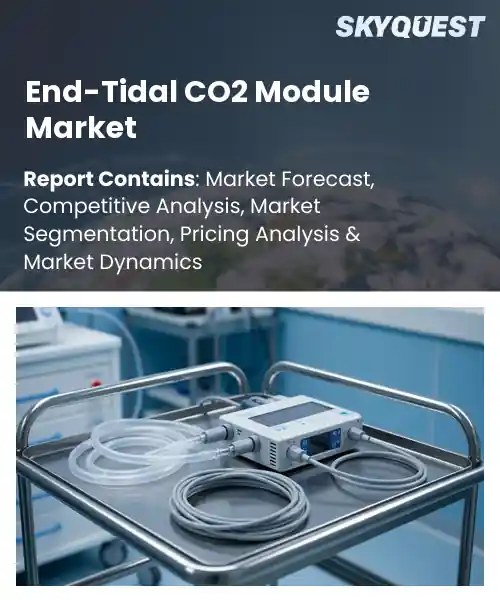
End-Tidal CO2 Module Market
Report ID: SQMIG35A4284
Report ID: SQMIG35A4284
[email protected]
USA +1 351-333-4748
Report ID:
SQMIG35A4284 |
Region:
Global |
Published Date: July, 2026
Pages:
157
|Tables:
144
|Figures:
78


Global End-Tidal Co2 Module Market size was valued at USD 318.70 Million in 2024 and is poised to grow from USD 339.73 Million in 2025 to USD 566.50 Million by 2033, growing at a CAGR of 6.6% during the forecast period (2026-2033).
The global end-tidal CO2 module market trends includes sensor systems that measure the concentration of carbon dioxide in exhaled breath continuously, as an indicator of ventilation status inside hospitals, ambulances and operating rooms. The reason for its importance is that it can detect hypoventilation, airway obstruction or metabolic disturbances immediately, thus reducing morbidity and mortality. The market began historically in the late 1990s when capnography devices entered intensive‑care units, with adoption accelerating after the American Heart Association recommended routine EtCO₂ monitoring in cardiac arrest in 2004. Integration with wireless platforms and health records over the past decade has increased use from peri-operative care to pre-hospital emergency services.
End-Tidal CO2 module market share is driven by increasing demand for patient safety technologies stemming from a rise in regulations and reimbursement incentives. Governments also require real-time monitoring of ventilation in surgical and emergency settings, pushing manufacturers to come up with more accurate miniaturized sensors and lowering the cost of the devices to encourage wider adoption. This effect can be seen in pediatric intensive-care where low-weight modules allow for ongoing surveillance of neonates without invasive lines, improving survival and forcing hospitals to upgrade legacy equipment. The evolution of tele-medicine and remote intensive-care units also creates the opportunities for cloud-based EtCO₂ analytics, allowing physicians to monitor trends across sites and intervene proactively in real time.
How is AI-driven Analytics Reshaping the End‑tidal CO₂ Module Market?
The end-tidal CO2 module market GROWTH is becoming a data rich environment, driven by AI-powered analytics. They build machine learning algorithms that combine waveform data and patient vital signs for early detection of ventilation problems. Real time pattern recognition allows clinicians to adjust therapy before alarms are triggered, thus reducing intervention time. Predictive maintenance algorithms look at sensor drift and usage trends to extend the life of the device and reduce service costs. Integration with hospital information systems allows for continuous quality dashboards to support evidence based practice and regulatory reporting. These features make modules more attractive to hospitals looking for efficiency and higher patient safety standards and better clinical results across departments.
In June 2024 a leading medical device company released an AI enabled end tidal CO2 module which automates waveform interpretation and streams alerts to bedside monitors. The innovation shortens decision cycles, increases diagnostic confidence and shows how analytics are driving market growth and operational efficiency for healthcare providers around the world today.
Market snapshot - (2026-2033)
Global Market Size
USD 318.7 Million
Largest Segment
Mainstream ETCO₂ Modules
Fastest Growth
Microstream ETCO₂ Modules
Growth Rate
6.6% CAGR
To get more insights on this market click here to Request a Free Sample Report
Global end-tidal co2 module market is segmented by product type, technology, application, end user, compatibility and region. Based on product type, the market is segmented into mainstream ETCO₂ modules, sidestream ETCO₂ modules and microstream ETCO₂ modules. Based on technology, the market is segmented into infrared spectroscopy and raman spectroscopy. Based on application, the market is segmented into operating rooms, intensive care units, emergency care, procedural sedation and patient transport. Based on end user, the market is segmented into hospitals, ambulatory surgical centers and emergency medical services. Based on compatibility, the market is segmented into multiparameter patient monitors and standalone capnography systems. Based on region, the market is segmented into North America, Europe, Asia Pacific, Latin America and Middle East & Africa.
Mainstream ETCO₂ modules segment dominates because they are widely integrated into standard patient monitors, offering reliable continuous monitoring with established technology. Their ease of use, cost‑effectiveness, and compatibility with existing hospital infrastructure drive preference among clinicians, solidifying market share. This broad acceptance fuels consistent demand and reinforces their central position in product portfolios. Its proven reliability under varied clinical conditions also reduces maintenance cycles, while vendor support and training programs enhance user confidence, further embedding the technology in routine operative workflows.
However, microstream ETCO₂ modules segment emerges as the key high‑growth area in the End‑Tidal CO2 Module Market. Its ultra‑low sampling volume enables accurate monitoring in pediatric and neonatal care where traditional modules are limited. Rising minimally invasive procedures and demand for precise capnography in small airways drive rapid adoption, creating revenue streams, expanding market horizons.
Infrared spectroscopy segment leads because it delivers mature, highly accurate CO₂ detection with well‑established calibration standards. Its robustness against environmental interference and proven reliability make it the default choice for most clinical settings, ensuring consistent performance. This trust translates into strong supplier relationships and persistent procurement, anchoring the technology’s prominence across diverse applications and reinforcing its central role in device design, while also supporting regulatory compliance and facilitating integration with existing monitor platforms.
Meanwhile, raman spectroscopy segment stands out as the most rapidly expanding area in the End‑Tidal CO2 Module Market. Its ability to perform non‑contact multi‑gas analysis opens pathways for integrated monitoring solutions and portable devices. Growing interest in advanced diagnostics and regulatory incentives for innovative sensing technologies accelerate its uptake, positioning Raman as a catalyst for future market diversification.
To get detailed segments analysis, Request a Free Sample Report
North America leads the pack with a mature healthcare ecosystem that focuses on patient safety and the adoption of advanced monitoring technologies. Strong clinical guidelines support widespread use of capnography in surgical, emergency and intensive care settings. Strong research partnerships between universities and device makers speed up the innovation process, while mature supply chains allow fast market introduction. Reimbursement structures and regulatory clarity also increase provider confidence, supporting widespread uptake of End-Tidal CO 2 modules into new and legacy equipment. Further, the region’s focus on training and competency development enhances clinician proficiency and reinforces its leadership role in the global landscape.
End‑tidal CO₂ module market outlook in the United States benefits from a large network of tertiary care centers that champion evidence‑based monitoring practices. Extensive collaborations between hospitals and technology firms drive continuous product refinement, while a strong emphasis on patient outcomes sustains demand. Educational initiatives and certification programs reinforce skilled usage, ensuring that advanced capnography becomes routine in critical care environments.
End‑tidal CO₂ module market forecast in Canada is supported by a publicly funded health system that emphasizes cost‑effective, high‑quality care. Integration of capnography into national clinical pathways promotes uniform adoption across provinces. Close partnerships between research hospitals and device suppliers facilitate customization to meet regional needs, while ongoing professional development programs maintain a high level of clinical competence.
Fast growth in Europe is driven by concerted emphasis on patient safety standards and cross-border regulatory harmonization. Standardized clinical guidelines across member countries support homogeneous use of capnography in the operating theatre and emergency room. Collaborative research networks accelerate the adoption of next-generation sensor technologies and public health initiatives raise awareness around the benefits of continuous CO₂ monitoring. Strong reimbursement schemes and increasing focus on value-based care also motivate healthcare providers to integrate End-Tidal CO₂ modules into their existing infrastructure, positioning Europe as a flourishing growth centre.
End‑tidal CO₂ module market regional outlook in Germany is driven by a rigorous quality assurance culture and extensive hospital networks that prioritize advanced monitoring. Close ties between engineering firms and clinical institutions foster rapid translation of research into practice, enhancing device reliability and functionality. National guidelines underscore the importance of capnography, prompting widespread implementation across surgical and critical care settings.
End‑tidal CO₂ module market regional forecast in the United Kingdom experiences fast growth due to proactive health policies that endorse continuous monitoring standards. Strategic initiatives within the National Health Service promote adoption of modern capnography solutions, while academic collaborations generate innovative sensor designs. Training programs and competency frameworks ensure clinicians are equipped to utilise the technology effectively, accelerating market uptake.
End‑tidal CO₂ module market analysis in France is emerging as hospitals integrate capnography into broader patient safety agendas. Collaborative projects between research centers and manufacturers stimulate the development of tailored solutions for diverse clinical environments. National health directives encourage consistent monitoring practices, supporting gradual market expansion and heightened awareness of the technology’s clinical value.
A combination of strategic investments in healthcare infrastructure and increased emphasis on patient monitoring standards is helping Asia Pacific to consolidate its position. The regional manufacturers are proceeding with miniaturization of sensors and connectivity in line with the growing demand for integrated operating room solutions. Government initiatives are encouraging the adoption of modern monitoring equipment along with the growing network of private health care. Educational outreach and skills development programs improve clinical competency, resulting in End‑Tidal CO₂ modules being a standard part of peri‑operative and emergency care throughout the region.
End‑tidal CO₂ module market penetration in Japan benefits from a sophisticated medical device ecosystem that emphasizes precision and reliability. Strong collaboration between research universities and industry leaders drives continual enhancements in sensor accuracy. National guidelines support widespread implementation in surgical and intensive care settings, while ongoing clinician training sustains high usage rates.
End‑tidal CO₂ module industry in South Korea is propelled by rapid adoption of advanced monitoring technologies within modern hospitals. Government health programs promote integration of capnography into critical care protocols, and close ties between technology firms and clinical practitioners facilitate swift product customization. Continuous professional education ensures clinicians maintain proficiency in using the latest monitoring solutions.
To know more about the market opportunities by region and country, click here to
Buy The Complete Report
Growing Adoption Of Non-Invasive Monitoring
Increasing Emphasis On Patient Safety
High Cost Of Advanced Modules
Complex Integration With Legacy Systems
Request Free Customization of this report to help us to meet your business objectives.
The competitive landscape of the global End‑Tidal CO₂ Module market is shaped by intense rivalry among established medical device leaders such as Philips, Spacelabs Healthcare, CONTEC, UN‑Medical and Becton. Companies are accelerating growth through strategic acquisitions, joint development agreements and rapid integration of wireless connectivity and AI‑driven analytics into their monitoring platforms, aiming to capture hospital and emergency‑care contracts while differentiating on data accuracy and device interoperability.
Top Player’s Company Profile
Recent Developments in the End-Tidal CO2 Module Market
SkyQuest’s ABIRAW (Advanced Business Intelligence, Research & Analysis Wing) is our Business Information Services team that Collects, Collates, Correlates, and Analyses the Data collected by means of Primary Exploratory Research backed by robust Secondary Desk research. As per SkyQuest analysis the global end‑tidal CO2 module market is propelled primarily by growing adoption of non‑invasive monitoring that gives clinicians continuous ventilation data without invasive lines and speeds workflow in operating rooms and emergency departments. A second driver is heightened focus on patient safety that pushes hospitals to install real‑time CO2 alerts and meet accreditation standards. The market is led by North America where mature reimbursement frameworks and strong clinical guidelines sustain rapid uptake. Mainstream ETCO₂ modules dominate the product landscape because of their cost‑effectiveness and seamless integration with existing monitors. However, the high cost of advanced sensor modules and complexity of integrating new units with legacy systems act as restraints that could slow adoption.
| Report Metric | Details |
|---|---|
| Market size value in 2024 | USD 318.7 Million |
| Market size value in 2033 | USD 566.5 Million |
| Growth Rate | 6.6% |
| Base year | 2024 |
| Forecast period | (2026-2033) |
| Forecast Unit (Value) | USD Million |
| Segments covered |
|
| Regions covered | North America (US, Canada), Europe (Germany, France, United Kingdom, Italy, Spain, Rest of Europe), Asia Pacific (China, India, Japan, Rest of Asia-Pacific), Latin America (Brazil, Rest of Latin America), Middle East & Africa (South Africa, GCC Countries, Rest of MEA) |
| Companies covered |
|
| Customization scope | Free report customization with purchase. Customization includes:-
|
To get a free trial access to our platform which is a one stop solution for all your data requirements for quicker decision making. This platform allows you to compare markets, competitors who are prominent in the market, and mega trends that are influencing the dynamics in the market. Also, get access to detailed SkyQuest exclusive matrix.
Table Of Content
Executive Summary
Market overview
Parent Market Analysis
Market overview
Market size
KEY MARKET INSIGHTS
COVID IMPACT
MARKET DYNAMICS & OUTLOOK
Market Size by Region
KEY COMPANY PROFILES
Methodology
For the End-Tidal CO2 Module Market, our research methodology involved a mixture of primary and secondary data sources. Key steps involved in the research process are listed below:
1. Information Procurement: This stage involved the procurement of Market data or related information via primary and secondary sources. The various secondary sources used included various company websites, annual reports, trade databases, and paid databases such as Hoover's, Bloomberg Business, Factiva, and Avention. Our team did 45 primary interactions Globally which included several stakeholders such as manufacturers, customers, key opinion leaders, etc. Overall, information procurement was one of the most extensive stages in our research process.
2. Information Analysis: This step involved triangulation of data through bottom-up and top-down approaches to estimate and validate the total size and future estimate of the End-Tidal CO2 Module Market.
3. Report Formulation: The final step entailed the placement of data points in appropriate Market spaces in an attempt to deduce viable conclusions.
4. Validation & Publishing: Validation is the most important step in the process. Validation & re-validation via an intricately designed process helped us finalize data points to be used for final calculations. The final Market estimates and forecasts were then aligned and sent to our panel of industry experts for validation of data. Once the validation was done the report was sent to our Quality Assurance team to ensure adherence to style guides, consistency & design.
Analyst Support
Customization Options
With the given market data, our dedicated team of analysts can offer you the following customization options are available for the End-Tidal CO2 Module Market:
Product Analysis: Product matrix, which offers a detailed comparison of the product portfolio of companies.
Regional Analysis: Further analysis of the End-Tidal CO2 Module Market for additional countries.
Competitive Analysis: Detailed analysis and profiling of additional Market players & comparative analysis of competitive products.
Go to Market Strategy: Find the high-growth channels to invest your marketing efforts and increase your customer base.
Innovation Mapping: Identify racial solutions and innovation, connected to deep ecosystems of innovators, start-ups, academics, and strategic partners.
Category Intelligence: Customized intelligence that is relevant to their supply Markets will enable them to make smarter sourcing decisions and improve their category management.
Public Company Transcript Analysis: To improve the investment performance by generating new alpha and making better-informed decisions.
Social Media Listening: To analyze the conversations and trends happening not just around your brand, but around your industry as a whole, and use those insights to make better Marketing decisions.
REQUEST FOR SAMPLE
 REQUEST FREE CUSTOMIZATION
Global End-Tidal Co2 Module Market size was valued at USD 318.7 Million in 2024 and is poised to grow from USD 339.73 Million in 2025 to USD 566.5 Million by 2033, growing at a CAGR of 6.6% during the forecast period (2026-2033).
The competitive landscape of the global End‑Tidal CO₂ Module market is shaped by intense rivalry among established medical device leaders such as Philips, Spacelabs Healthcare, CONTEC, UN‑Medical and Becton. Companies are accelerating growth through strategic acquisitions, joint development agreements and rapid integration of wireless connectivity and AI‑driven analytics into their monitoring platforms, aiming to capture hospital and emergency‑care contracts while differentiating on data accuracy and device interoperability. 'Masimo Corporation', 'Medtronic plc', 'Philips Holding B.V.', 'GE HealthCare Technologies Inc.', 'Drägerwerk AG & Co. KGaA', 'Nihon Kohden Corporation', 'Mindray Medical International Limited', 'Edan Instruments, Inc.', 'Schiller AG', 'Spacelabs Healthcare, Inc.', 'Infinium Medical, Inc.', 'BPL Medical Technologies Pvt. Ltd.', 'Nonin Medical, Inc.', 'ZOLL Medical Corporation', 'Fukuda Denshi Co., Ltd.', 'Penlon Limited', 'Smiths Group plc', 'OSI Systems, Inc.', 'Criticare Technologies, Inc.', 'Creative Industry Co., Ltd.'
The shift toward non‑invasive capnography enables clinicians to monitor ventilation without inserting invasive catheters, reducing patient discomfort and infection risk. This improvement aligns with minimally invasive procedural trends, encouraging hospitals to replace older technologies with end‑tidal CO₂ modules. Enhanced workflow efficiency and quicker setup times further motivate adoption, as staff can focus on critical care tasks. Consequently, healthcare providers prioritize investment in these solutions, propelling market expansion. The broader clinical acceptance also supports training programs, which further accelerates diffusion across diverse care settings.
Portable Monitoring Adoption: The shift toward lightweight, battery‑powered capnography units is driven by increasing demand in emergency medicine and pre‑hospital care. Clinicians value the ability to deploy devices quickly across diverse settings, from ambulances to remote clinics. Manufacturers respond by integrating wireless data transmission and intuitive interfaces, enhancing usability. This mobility trend expands market reach beyond traditional operating rooms, creating new revenue streams and fostering partnerships with ambulance services, disaster‑response agencies, and telehealth platforms and improving patient safety outcomes worldwide through real‑time analytics
Why does North America Dominate the Global End-Tidal CO2 Module Market? |@12


Want to customize this report? This report can be personalized according to your needs. Our analysts and industry experts will work directly with you to understand your requirements and provide you with customized data in a short amount of time. We offer $1000 worth of FREE customization at the time of purchase.
Feedback From Our Clients


 USA (+1) 351-333-4748

