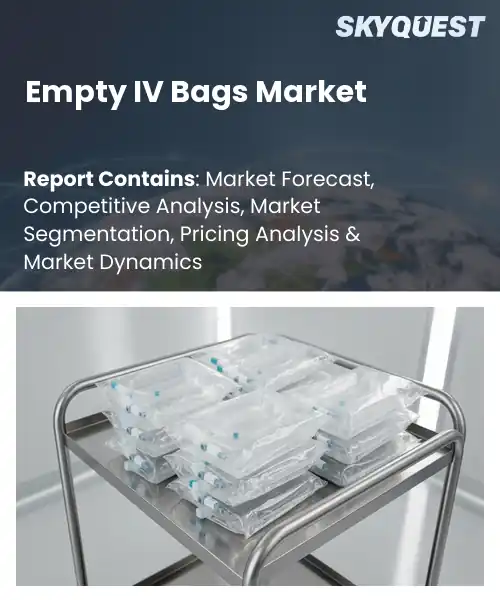
Empty IV Bags Market
Report ID: SQMIG35B2338
Report ID: SQMIG35B2338
[email protected]
USA +1 351-333-4748
Report ID:
SQMIG35B2338 |
Region:
Global |
Published Date: June, 2026
Pages:
157
|Tables:
144
|Figures:
78


Global Empty IV Bags Market size was valued at USD 1.52 Billion in 2024 and is poised to grow from USD 1.61 Billion in 2025 to USD 2.52 Billion by 2033, growing at a CAGR of 5.81% during the forecast period (2026-2033).
The empty IV bags industry comprises sterile single-use polymer containers designed to hold intravenous fluids and medications prior to patient administration, and its primary driver is rising global demand for safe infusion practices. Hospitals and ambulatory care centers increasingly prefer prefilled or filled bags to reduce contamination risk and streamline workflows, prompting manufacturers to innovate materials and connectors for compatibility with infusion pumps. Over the past two decades the sector evolved from glass and rubberized solutions toward flexible PVC and non‑PVC formulations as regulatory emphasis on infection control and waste management intensified, illustrated by adoption during outbreak responses and resilience.
The key factor driving growth is expansion of home healthcare coupled with needs for supply chain resilience, which increases demand for user-friendly sterile bags fillable offsite for safe transport. As home infusion providers scale manufacturers develop unit-dose compatible bags with secure connectors thereby reducing hospital stays and lowering costs for chronic therapy patients. Simultaneously environmental regulations spur research into non‑PVC recyclable polymers prompting partnerships between suppliers and waste managers that enable hospitals to meet sustainability targets. In practice this has translated into procurement tenders favoring versatile sterile bags used by hospitals, clinics, and humanitarian teams.
How is automation improving production efficiency in the empty IV bags market?
The empty IV bags industry has experienced a great increase in efficiency due to automation and robotic technology used in the production of empty IV bags by speeding up the processes of forming, filling, sealing, inline quality inspection and automated handling of bags. Automation has allowed manufacturers to greatly increase their production rates by decreasing the amount of time it takes them to switch from one size bag to another, consistently provide quality seals, and decrease the number of manual handling steps in the production process. Manufacturers of empty IV bags have been faced with fluctuating customer demand and supplier demands for supply chain resiliency as a result of the current market conditions; thus, being able to utilize flexible automated systems to maintain a steady output has been important to them. Manufacturers of empty IV bags have utilized examples such as roll stock forming equipment with integrated vision inspection cameras and automated packaging systems to maximise their use of automation.
In April 2026, Baxter implemented its automation solution for standardizing labelling on finished products with the introduction of their new IV Verify Line Labeling System. This automation has allowed Baxter to reduce the lead times for final packaging, increase product traceability, and improve accuracy in labelling finished products by reducing the total number of human interactions required to produce the same amount of product. As a result, Baxter will see significant improvements to their overall manufacturing efficiency and will be able to provide a consistent supply of empty IV bags to their customers.
Market snapshot - (2026-2033)
Global Market Size
USD 1.52 Billion
Largest Segment
PVC (Polyvinyl Chloride)
Fastest Growth
PVC (Polyvinyl Chloride)
Growth Rate
5.81% CAGR
To get more insights on this market click here to Request a Free Sample Report
Global empty IV bags market is segmented by material, capacity, application, end-user, distribution and region. Based on material, the market is segmented into PVC (Polyvinyl Chloride) and Non-PVC (Polyolefin, EVA). Based on capacity, the market is segmented into Below 100 mL, 100-500 mL, 500-1000 mL and Above 1000 mL. Based on application, the market is segmented into Drug Admixture & Compounding, Blood Collection and Nutrition (TPN/Enteral). Based on end-user, the market is segmented into Hospitals, Compounding Pharmacies and Clinics. Based on distribution, the market is segmented into Direct to Hospital and Distributors. Based on region, the market is segmented into North America, Europe, Asia Pacific, Latin America and Middle East & Africa.
PVC segment dominates with large empty IV bags market share because longstanding manufacturing familiarity, material flexibility and predictable barrier properties create a reliable platform for producing empty IV bags that meet diverse clinical requirements. Established processing methods and broad supplier networks reduce supply friction and support tight quality control, enabling consistent compatibility with a wide range of fluids and additives.
As per empty IV bags market outlook, polyolefin is emerging as the most rapidly expanding material thanks to its solvent free chemistry and lower extractables profile that appeal to safety focused procurement. Improved thermal stability and recyclability enable lighter, more durable bags compatible with advanced formulations, encouraging manufacturers and care providers to adopt these products for sustainability and complex-drug handling needs.
As per empty IV bags market analysis, drug admixture & compounding segment dominates because it drives demand for sterile, customizable IV bags tailored to complex formulations and on site preparation workflows. Clinical emphasis on aseptic processing and the need to minimize admixture incompatibilities compel hospitals and compounding pharmacies to source bags with validated material compatibility and puncture resistant construction. This creates a procurement focus on reliable suppliers who can deliver compliant packaging that supports pharmacy operations and reduces medication preparation risk.
As per empty IV bags market forecast, nutrition (TPN/Enteral) is emerging as the fastest growing application because escalating demand for parenteral and enteral feeding necessitates specialized multi chamber designs and superior barrier materials to preserve nutrient stability. Innovations enabling extended shelf life, easy bedside administration and home infusion compatibility are accelerating adoption, opening opportunities for manufacturers to develop dedicated bag formats and value added services.
To get detailed segments analysis, Request a Free Sample Report
As per empty IV bags market regional outlook, North America leads the market owing to the combination of modern healthcare infrastructure, established domestic production capacity, and mature procurement channels which focus on quality and supply continuity. The region benefits from close cooperation between clinical players and manufacturers, allowing for fast adoption of specific bag forms and material advances. Rigorous regulatory frameworks and well developed quality systems reinforce market confidence and drive investments in sterile production capabilities. Integrated distribution networks and experienced logistics providers further enable reliable delivery to hospitals and home care settings, underpinning continued leadership in product research and commercialization.
As per empty IV bags market regional forecast, United States market is characterized by sophisticated hospital networks, strong domestic manufacturing capabilities and high level of clinical use of single use infusion devices. Procurement processes emphasize quality, sterile and reliable supply chains. Big private and public health providers are driving demand for various types and materials of bags. Product innovation is driven by collaboration with manufacturers and clinical stakeholders, while regulatory control protects patient safety and traceability.
As per empty IV bags industry analysis, Canada market is characterized by a publically funded healthcare system that stresses centralized procurement, uniform quality standards, and patient safety. Hospitals and community care providers rely on strong supply chains and good supplier relationships. The regional distribution is backed by focus on domestic production capability and collaborative procurement strategies. While regulators are concerned with quality assurance and conformance to regional standards, clinical stakeholders are interested in sterile, user friendly bag designs.
In Europe, integrated healthcare networks, harmonised regulatory requirements and a strong industrial base focused on security of supply and customisation are driving rapid growth. Demand for different bag shapes and convenience features is driven by trends of moving care to the home and ambulatory care, while sustainability is driving material innovation and less packaging waste. Efficient cross border distribution channels and strategic relationships between suppliers and healthcare providers fuel speedier clinical adoption. Market momentum is maintained through sustained investment in research and training of clinicians and methods of cooperative procurement that catalyze ongoing value chain improvement.
Germany market is anchored by a strong manufacturing ecosystem and stringent quality expectations that favor domestically produced sterile infusion solutions. Hospital networks demand high reliability and product traceability, driving supplier investment in advanced production. Strong ties between industry and research institutions support material innovation. Procurement practices emphasize long term supplier relationships and capacity to meet complex clinical specifications, reinforcing Germany role as a manufacturing hub.
United Kingdom market is expanding due to growth in community care and home infusion services and evolving procurement strategies that enable agility. Collaboration between private providers and public health systems accelerates adoption of user friendly bag formats. Emphasis on resilience, flexible sourcing, and clinician training supports supply diversification. Suppliers respond with modular manufacturing approaches and tailored distribution to meet shifting care pathways across local settings.
France market is emerging on the back of a focus on local production, hospital renovation, and the expansion of ambulatory infusion treatment through regulatory assistance. Centralized buying structures and joint tenders incentivize participation and investment in local capabilities by suppliers. Sterile and ergonomic bags and environmentally conscious materials are appreciated by clinical stakeholders. Better regulatory harmonisation with regional norms and more cooperation between producers and healthcare organisations improve supply security and foster product innovation.
Asia Pacific is solidifying its position through a mix of advanced clinical adoption, expansion of domestic sterile manufacturing, and policy initiatives to encourage local production and quality assurance. The region is expanding sterile manufacturing capacity and packaging technologies to support both inpatient and home infusion settings. Industry, research centers and healthcare providers are working together to speed the development of lightweight, durable bag designs and effective sterilizing methods. Greater emphasis on supply chain resilience, regional distribution hubs and clinician training, and response to cost and sustainability demands is driving competitiveness and enabling broader adoption of new empty IV bag solutions.
The market in Japan benefits from advanced manufacturing technology, rigorous quality control, and collaboration between medical device makers and researchers. Demand is supported by a focus on sophisticated hospital care and expanding ambulatory infusion services that require reliable, high quality sterile bags. Suppliers invest in automation and material science to meet exacting specifications, while regulatory clarity and skilled workforce enable steady introduction of innovative bag formats.
The market in South Korea is driven by strong technological capabilities, agile contract manufacturing, and regulatory support for device quality. Hospitals and clinics adopt advanced infusion practices, prompting suppliers to deliver high purity lightweight bag materials and efficient sterilization processes. Export firms leverage regional supply chains to scale production. Collaborations with logistics and clinical partners strengthen distribution reliability and foster translation of innovations into clinical use.
To know more about the market opportunities by region and country, click here to
Buy The Complete Report
Increasing Intravenous Therapy Demand
Shift Toward Single Use Devices
Environmental Concerns Over Plastic Waste
Stringent Regulatory Compliance Requirements
Request Free Customization of this report to help us to meet your business objectives.
Competitive intensity in the global empty IV bags industry is rising as sustainability, supply resilience and sterile manufacturing innovation redefine advantage. Incumbents deploy recycling pilots like Baxter with Northwestern Medicine, product shifts to PVC free containers such as B. Braun Ecoflac plus, and capacity M&A exemplified by ICU Medical’s purchase of Smiths Medical, while startups form tech partnerships to industrialize new sterile processes such as Persist AI with Nivagen.
SkyQuest’s ABIRAW (Advanced Business Intelligence, Research & Analysis Wing) is our Business Information Services team that Collects, Collates, Correlates, and Analyses the Data collected by means of Primary Exploratory Research backed by robust Secondary Desk research.
As per SkyQuest analysis, the global empty IV bags market is being driven by rising demand for safe infusion practices that prioritize single use sterile containers and reduce contamination risk, and by expanding home healthcare services that increase need for portable, user-friendly bags and resilient supply chains. Growth is tempered by environmental concerns around single-use plastics and pressure to adopt PVC alternatives. North America remains the dominant region due to mature healthcare systems and strong domestic manufacturing, while the PVC material segment continues to lead the market because of proven compatibility, supply networks and cost efficiencies. Manufacturers are investing in material innovation and automation to balance safety and sustainability. The empty IV bags market trend is experiencing steady growth due to rising hospitalization rates, increasing demand for intravenous therapies, and expanding adoption of ready-to-fill sterile packaging solutions in healthcare facilities.
| Report Metric | Details |
|---|---|
| Market size value in 2024 | USD 1.52 Billion |
| Market size value in 2033 | USD 2.52 Billion |
| Growth Rate | 5.81% |
| Base year | 2024 |
| Forecast period | (2026-2033) |
| Forecast Unit (Value) | USD Billion |
| Segments covered |
|
| Regions covered | North America (US, Canada), Europe (Germany, France, United Kingdom, Italy, Spain, Rest of Europe), Asia Pacific (China, India, Japan, Rest of Asia-Pacific), Latin America (Brazil, Rest of Latin America), Middle East & Africa (South Africa, GCC Countries, Rest of MEA) |
| Companies covered |
|
| Customization scope | Free report customization with purchase. Customization includes:-
|
To get a free trial access to our platform which is a one stop solution for all your data requirements for quicker decision making. This platform allows you to compare markets, competitors who are prominent in the market, and mega trends that are influencing the dynamics in the market. Also, get access to detailed SkyQuest exclusive matrix.
Table Of Content
Executive Summary
Market overview
Parent Market Analysis
Market overview
Market size
KEY MARKET INSIGHTS
COVID IMPACT
MARKET DYNAMICS & OUTLOOK
Market Size by Region
KEY COMPANY PROFILES
Methodology
For the Empty IV Bags Market, our research methodology involved a mixture of primary and secondary data sources. Key steps involved in the research process are listed below:
1. Information Procurement: This stage involved the procurement of Market data or related information via primary and secondary sources. The various secondary sources used included various company websites, annual reports, trade databases, and paid databases such as Hoover's, Bloomberg Business, Factiva, and Avention. Our team did 45 primary interactions Globally which included several stakeholders such as manufacturers, customers, key opinion leaders, etc. Overall, information procurement was one of the most extensive stages in our research process.
2. Information Analysis: This step involved triangulation of data through bottom-up and top-down approaches to estimate and validate the total size and future estimate of the Empty IV Bags Market.
3. Report Formulation: The final step entailed the placement of data points in appropriate Market spaces in an attempt to deduce viable conclusions.
4. Validation & Publishing: Validation is the most important step in the process. Validation & re-validation via an intricately designed process helped us finalize data points to be used for final calculations. The final Market estimates and forecasts were then aligned and sent to our panel of industry experts for validation of data. Once the validation was done the report was sent to our Quality Assurance team to ensure adherence to style guides, consistency & design.
Analyst Support
Customization Options
With the given market data, our dedicated team of analysts can offer you the following customization options are available for the Empty IV Bags Market:
Product Analysis: Product matrix, which offers a detailed comparison of the product portfolio of companies.
Regional Analysis: Further analysis of the Empty IV Bags Market for additional countries.
Competitive Analysis: Detailed analysis and profiling of additional Market players & comparative analysis of competitive products.
Go to Market Strategy: Find the high-growth channels to invest your marketing efforts and increase your customer base.
Innovation Mapping: Identify racial solutions and innovation, connected to deep ecosystems of innovators, start-ups, academics, and strategic partners.
Category Intelligence: Customized intelligence that is relevant to their supply Markets will enable them to make smarter sourcing decisions and improve their category management.
Public Company Transcript Analysis: To improve the investment performance by generating new alpha and making better-informed decisions.
Social Media Listening: To analyze the conversations and trends happening not just around your brand, but around your industry as a whole, and use those insights to make better Marketing decisions.
REQUEST FOR SAMPLE
 REQUEST FREE CUSTOMIZATION
Global Empty Iv Bags Market size was valued at USD 1.52 Billion in 2024 and is poised to grow from USD 1.61 Billion in 2025 to USD 2.52 Billion by 2033, growing at a CAGR of 5.81% during the forecast period (2026-2033).
Competitive intensity in the global empty IV bags market is rising as sustainability, supply resilience and sterile manufacturing innovation redefine advantage. Incumbents deploy recycling pilots like Baxter with Northwestern Medicine, product shifts to PVC free containers such as B. Braun Ecoflac plus, and capacity M&A exemplified by ICU Medical’s purchase of Smiths Medical, while startups form tech partnerships to industrialize new sterile processes such as Persist AI with Nivagen. 'Baxter International', 'B. Braun SE', 'Fresenius Kabi', 'ICU Medical', 'Hospira (Pfizer)', 'Otsuka Pharmaceutical Factory', 'JW Pharmaceutical', 'CR Double-Crane Pharmaceuticals', 'Rontis Corporation', 'Anhui Huayuan', 'Technoflex SA', 'Haemotronic SpA', 'Hardy Diagnostics', 'Ace Medical Co.', 'Coval Medical', 'Renolit SE', 'Leventon SAU', 'Technoflex', 'Sparton Corporation', 'Progressive Medical'
Rising demand for intravenous therapies and expanded care settings increase the volume of empty IV bags required to support fluid delivery, medication administration, and patient hydration. Hospitals, clinics, and outpatient facilities convert treatment needs into sustained procurement of sterile single-use bags, and this continuous consumption supports manufacturers' production planning and capacity investments. The predictable replacement cycle for disposable fluid containers encourages suppliers to scale manufacturing and distribution networks, reinforcing economies of scale and enabling broader market availability across diverse healthcare systems.
Rise Of Prefilled Administration Systems: Healthcare providers and manufacturers increasingly favor prefilled IV bags designed for seamless integration with automated filling and closed-system transfer technologies. Demand is driven by the need to reduce compounding time, enhance dose accuracy, and lower contamination risk through standardized connectors and compatibility with ready-to-administer workflows. Suppliers are offering customizable port configurations and material choices to support diverse therapeutic formats, enabling faster adoption in hospital pharmacies and specialty infusion centers while fostering partnerships across the supply chain for tailored supply solutions.
Why does North America Dominate the Global Empty IV Bags Market? |@12


Want to customize this report? This report can be personalized according to your needs. Our analysts and industry experts will work directly with you to understand your requirements and provide you with customized data in a short amount of time. We offer $1000 worth of FREE customization at the time of purchase.
Feedback From Our Clients


 USA (+1) 351-333-4748

