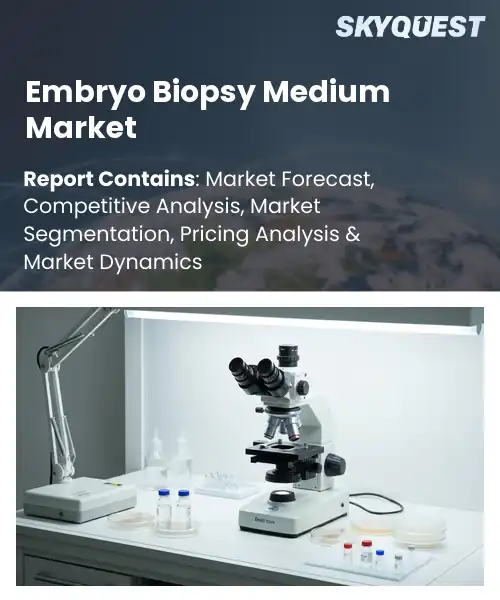
Embryo Biopsy Medium Market
Report ID: SQMIG35I2514
Report ID: SQMIG35I2514
[email protected]
USA +1 351-333-4748
Report ID:
SQMIG35I2514 |
Region:
Global |
Published Date: February, 2026
Pages:
157
|Tables:
61
|Figures:
75


Global Embryo Biopsy Medium Market size was valued at USD 877.8 Million in 2024 and is poised to grow from USD 926.96 Million in 2025 to USD 1433.41 Million by 2033, growing at a CAGR of 5.6% during the forecast period (2026-2033).
The primary driver of the embryo biopsy medium market is rising clinical demand for assisted reproductive technologies and preimplantation genetic testing, which compels laboratories to use media that maintain embryo viability during cell removal. This market provides specialized culture formulations used when extracting embryonic cells for genetic analysis, and it matters because media composition directly affects cell survival, diagnostic accuracy and implantation success. Over two decades the sector evolved from generalized culture solutions to bespoke biopsy media engineered for osmotic balance, buffered pH and reduced stress, with IVF centers and genetics labs adopting to improve diagnostic yield and patient outcomes.A pivotal factor driving market expansion is continuous innovation in media formulations that improve embryo resilience during biopsy and enable more reliable genetic testing, which encourages broader clinical adoption. As media reduce cellular stress and preserve morphology, clinics perform fewer repeat cycles, lowering patient costs and increasing throughput, while labs prioritize validated products. This shift causes vendors to pursue strategic partnerships with fertility networks, diagnostic companies to bundle media with sequencing services, and emerging markets to adopt preimplantation testing more rapidly, creating openings for niche suppliers and improves global access.
How is AI improving predictive quality control in the embryo biopsy medium market?
AI improves predictive quality control in the embryo biopsy medium market by linking image analysis, time lapse monitoring and incubator sensor data to media performance and embryo responses. Key aspects are automated anomaly detection, predictive alerts for pH shifts or contamination and standardized scoring that reduces technician variability. The current state blends pilot AI models used for embryo assessment with established biopsy media from major suppliers, creating feedback loops that make quality control proactive instead of reactive. These capabilities help clinics adopt reproducible workflows and reduce unexpected failures during preimplantation genetic testing, improving confidence in media handling and embryo integrity.Nexpring Health March 2025, the Astorg led consolidation of several ART media and device businesses, is speeding R D and commercialization of AI enabled QC for biopsy media and related lab systems, supporting faster adoption, improved lot to lot consistency and more efficient laboratory workflows.
Market snapshot - (2026-2033)
Global Market Size
USD 877.8 Million
Largest Segment
Artificial Medium
Fastest Growth
Semi-Solid Medium
Growth Rate
5.6% CAGR
To get more insights on this market click here to Request a Free Sample Report
Global embryo biopsy medium market is segmented by type of medium, end user and region. Based on type of medium, the market is segmented into Artificial Medium and Semi-Solid Medium. Based on end user, the market is segmented into Research Institutions and Fertility Clinics. Based on region, the market is segmented into North America, Europe, Asia Pacific, Latin America and Middle East & Africa.
Artificial Medium segment dominates because its defined compositions provide predictable osmotic and ionic conditions that support embryo integrity during biopsy procedures. Manufacturers optimize these formulations for consistency across laboratories, enabling standardized protocols and minimizing procedural variability. This leads to stronger practitioner confidence and integration with lab automation and diagnostics, which in turn drives preference by clinics and research teams seeking reliable outcomes and streamlined workflows during delicate embryonic manipulation.
However, Semi-Solid Medium is emerging as the most rapidly expanding area because its viscous matrix improves embryo positioning and reduces medium displacement during micromanipulation. Advances in formulation and usability have increased adoption in specialized labs, spurring new protocol development and enabling niche applications that expand market opportunities and encourage product innovation.
Fertility Clinics segment leads because clinics drive direct clinical demand for embryo biopsy media that deliver predictable viability and ease of use during high volume assisted reproduction procedures. Their procedural requirements prioritize products that integrate with existing IVF workflows and laboratory automation, prompting manufacturers to tailor formulations and packaging for clinical practicality. This clinician driven feedback loop accelerates product refinement, procurement preferences, and widespread adoption across clinical practices seeking improved implantation and diagnostic reliability.
However, Research Institutions are witnessing the strongest growth momentum as expanding basic research and translational efforts increase demand for specialized media optimized for experimental reproducibility. Rising academic collaborations drive adoption of novel formulations, fostering innovation and creating commercialization pathways that broaden market scope and attract investment into embryo biopsy medium technologies.
To get detailed segments analysis, Request a Free Sample Report
North America dominates due to a concentration of advanced reproductive medicine infrastructure, strong clinical research networks, and early clinical adoption of embryo biopsy techniques. Robust collaboration between academic centers, private laboratories, and industry supports development of specialized culture media and optimized protocols, while a favorable regulatory environment encourages controlled clinical implementation. High levels of clinician expertise and established quality management systems facilitate consistent product performance and clinician trust. Active engagement by manufacturers in local validation studies and customer support further consolidates market leadership. In addition, well developed distribution channels and reimbursement frameworks enhance accessibility across clinics and laboratories, enabling widespread integration of embryo biopsy medium into assisted reproductive workflows and reinforcing North America position at the forefront of market innovation.
Embryo Biopsy Medium Market in the United States benefits from concentration of leading fertility clinics, extensive clinical research, and close ties between manufacturers and academic centers. Clinician familiarity with advanced embryo manipulation and strong laboratory accreditation drive preference for validated media. Emphasis on product performance, user training, and postmarket support shapes procurement choices, while established supply chains and specialized service providers enable efficient adoption across diverse clinical settings and scalability.
Embryo Biopsy Medium Market in Canada is shaped by collaborative networks linking academic research institutions and fertility clinics, fostering methodical evaluation of media formulations. Clinical laboratories emphasize consistency, quality control, and procedural harmonization across provinces, guiding procurement toward reliable suppliers. Close engagement between clinicians and manufacturers supports localized validation and technical support. Regional distribution infrastructure and professional training initiatives further enable adoption in both urban specialist centers and clinical laboratories.
Rapid expansion in Europe is driven by a combination of advanced clinical expertise, growing networks of specialized fertility centers, and increasing collaboration between industry and academic research. Harmonization of laboratory standards and cross border knowledge exchange accelerate adoption of optimized media formulations across the region. Strong emphasis on quality assurance and accredited laboratory practices encourages procurement of validated products, while diverse healthcare funding models and expanding patient access create sustained clinical demand. Investment in training programs and regional centers of excellence facilitates dissemination of best practices, and manufacturers increasingly tailor offerings to local regulatory expectations and laboratory workflows, reinforcing market momentum throughout Europe. Enhanced regional clinical validation initiatives and targeted partnerships with fertility networks elevate confidence among embryologists and clinicians, while growing patient awareness supports broader utilization across both private and public care settings.
Embryo Biopsy Medium Market in Germany benefits from a robust clinical research base and well established fertility infrastructure that prioritizes laboratory excellence. Strong regulatory oversight and accredited laboratory networks promote use of rigorously validated media, while close cooperation between academic centers and industry fosters iterative product refinement. Clinical preference toward high quality, reproducible media and comprehensive technical support shapes procurement, with centers serving as hubs for training and protocol standardization.
Embryo Biopsy Medium Market in the United Kingdom reflects dynamic clinical adoption supported by innovative research programs. Emphasis on rapid clinical translation and practice innovation encourages uptake of tailored media solutions, while responsive regulatory pathways and strong private clinic networks facilitate implementations. Manufacturers focus on localized support, training, and collaborative validation to meet clinician needs. Patient awareness and competitive service models stimulate demand across urban fertility centers and diagnostic laboratories.
Embryo Biopsy Medium Market in France is characterized by growing integration of advanced laboratory practices within the healthcare environment. Emphasis on clinical validation and alignment with national laboratory standards encourages cautious adoption of validated media. Collaboration among academic centers, clinical laboratories, and manufacturers supports localized testing and training. Focus on quality assurance, technical support, and procedural consistency guides procurement decisions, enabling expansion of embryo biopsy medium use across fertility services.
Asia Pacific is strengthening its position through targeted investments in reproductive medicine infrastructure, expanded clinical research programs, and growing collaboration between regional centers and global manufacturers. Improved laboratory capabilities and focused training for embryologists support adoption of standardized embryo biopsy protocols and compatible culture media. Local manufacturers and distributors are enhancing supply reliability and tailoring product features to regional laboratory workflows, while regulatory clarity in key markets facilitates product registration and clinical validation. Rising clinician engagement in multicenter studies and peer networks fosters knowledge transfer, and increasing demand from patients seeking advanced reproductive services encourages broader availability and integration of embryo biopsy medium solutions across diverse healthcare settings. Partnerships that enable technology transfer and localized validation activities, together with the emergence of regional centers of excellence, are reinforcing confidence among clinicians and accelerating adoption of high quality media across both urban referral centers and broader laboratory networks.
Embryo Biopsy Medium Market in Japan is shaped by strong biomedical research and a culture of precise laboratory practice favoring validated media and strict protocol adherence. Collaboration between research institutions and fertility clinics supports careful evaluation and localized optimization of media formulations. Manufacturers offer technical training and responsive support to meet high laboratory standards, promoting selective adoption and integration of advanced embryo biopsy media within specialist clinical and laboratory environments.
Embryo Biopsy Medium Market in South Korea is advancing through concentrated clinical expertise, research collaborations, and industry partnerships focused on media performance. Fertility clinics and diagnostic laboratories emphasize standardized procedures and laboratory accreditation, creating demand for validated culture media. Manufacturers conduct localized validation studies and deliver training to align products with laboratory workflows. This combination of clinical rigor and supplier support facilitates adoption across centers and expanding laboratory networks nationally.
To know more about the market opportunities by region and country, click here to
Buy The Complete Report
Rising Adoption Of PGT Techniques
Expansion Of Assisted Reproductive Services
Complex Regulatory Approval Requirements
High Cost Of Specialized Media
Request Free Customization of this report to help us to meet your business objectives.
Competitive dynamics in the global embryo biopsy medium market are driven by consolidation through strategic M&A such as Vitrolife’s acquisition of Igenomix and CooperSurgical’s aggressive asset buys, partnerships to commercialize non invasive workflows, and rapid tech innovation including commercial niPGT launches. Vendors now compete on integrated service bundles, clinic and lab partnerships and AI enabled diagnostics rather than commodity pricing, accelerating clinical adoption and vertical integration.
Top Player’s Company Profile
Recent Developments
SkyQuest’s ABIRAW (Advanced Business Intelligence, Research & Analysis Wing) is our Business Information Services team that Collects, Collates, Correlates, and Analyses the Data collected by means of Primary Exploratory Research backed by robust Secondary Desk research. As per SkyQuest analysis, the global embryo biopsy medium market growth is led by the key driver which is rising clinical demand for assisted reproductive technologies and preimplantation genetic testing that increases procedural volumes and need for specialized media. The dominating region is North America due to advanced reproductive infrastructure and early clinical adoption, and the dominating segment is artificial medium because defined formulations enable standardized protocols and consistent outcomes. A second driver is ongoing innovation in media composition that enhances embryo resilience during biopsy and improves diagnostic accuracy, encouraging wider clinical use. The restraint is complex regulatory approval requirements that lengthen time to market and raise development costs for manufacturers.
| Report Metric | Details |
|---|---|
| Market size value in 2024 | USD 877.8 Million |
| Market size value in 2033 | USD 1433.41 Million |
| Growth Rate | 5.6% |
| Base year | 2024 |
| Forecast period | (2026-2033) |
| Forecast Unit (Value) | USD Million |
| Segments covered |
|
| Regions covered | North America (US, Canada), Europe (Germany, France, United Kingdom, Italy, Spain, Rest of Europe), Asia Pacific (China, India, Japan, Rest of Asia-Pacific), Latin America (Brazil, Rest of Latin America), Middle East & Africa (South Africa, GCC Countries, Rest of MEA) |
| Companies covered |
|
| Customization scope | Free report customization with purchase. Customization includes:-
|
To get a free trial access to our platform which is a one stop solution for all your data requirements for quicker decision making. This platform allows you to compare markets, competitors who are prominent in the market, and mega trends that are influencing the dynamics in the market. Also, get access to detailed SkyQuest exclusive matrix.
Table Of Content
Executive Summary
Market overview
Parent Market Analysis
Market overview
Market size
KEY MARKET INSIGHTS
COVID IMPACT
MARKET DYNAMICS & OUTLOOK
Market Size by Region
KEY COMPANY PROFILES
Methodology
For the Embryo Biopsy Medium Market, our research methodology involved a mixture of primary and secondary data sources. Key steps involved in the research process are listed below:
1. Information Procurement: This stage involved the procurement of Market data or related information via primary and secondary sources. The various secondary sources used included various company websites, annual reports, trade databases, and paid databases such as Hoover's, Bloomberg Business, Factiva, and Avention. Our team did 45 primary interactions Globally which included several stakeholders such as manufacturers, customers, key opinion leaders, etc. Overall, information procurement was one of the most extensive stages in our research process.
2. Information Analysis: This step involved triangulation of data through bottom-up and top-down approaches to estimate and validate the total size and future estimate of the Embryo Biopsy Medium Market.
3. Report Formulation: The final step entailed the placement of data points in appropriate Market spaces in an attempt to deduce viable conclusions.
4. Validation & Publishing: Validation is the most important step in the process. Validation & re-validation via an intricately designed process helped us finalize data points to be used for final calculations. The final Market estimates and forecasts were then aligned and sent to our panel of industry experts for validation of data. Once the validation was done the report was sent to our Quality Assurance team to ensure adherence to style guides, consistency & design.
Analyst Support
Customization Options
With the given market data, our dedicated team of analysts can offer you the following customization options are available for the Embryo Biopsy Medium Market:
Product Analysis: Product matrix, which offers a detailed comparison of the product portfolio of companies.
Regional Analysis: Further analysis of the Embryo Biopsy Medium Market for additional countries.
Competitive Analysis: Detailed analysis and profiling of additional Market players & comparative analysis of competitive products.
Go to Market Strategy: Find the high-growth channels to invest your marketing efforts and increase your customer base.
Innovation Mapping: Identify racial solutions and innovation, connected to deep ecosystems of innovators, start-ups, academics, and strategic partners.
Category Intelligence: Customized intelligence that is relevant to their supply Markets will enable them to make smarter sourcing decisions and improve their category management.
Public Company Transcript Analysis: To improve the investment performance by generating new alpha and making better-informed decisions.
Social Media Listening: To analyze the conversations and trends happening not just around your brand, but around your industry as a whole, and use those insights to make better Marketing decisions.
REQUEST FOR SAMPLE
 REQUEST FREE CUSTOMIZATION


Want to customize this report? This report can be personalized according to your needs. Our analysts and industry experts will work directly with you to understand your requirements and provide you with customized data in a short amount of time. We offer $1000 worth of FREE customization at the time of purchase.
Feedback From Our Clients


 USA (+1) 351-333-4748

