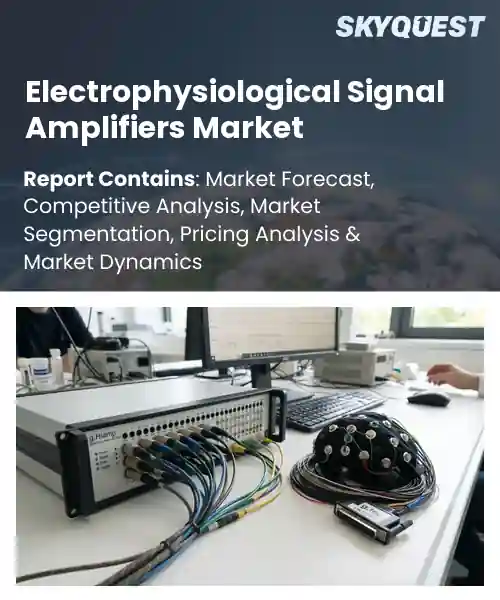
Electrophysiological Signal Amplifiers Market
Report ID: SQMIG35A4568
Report ID: SQMIG35A4568
[email protected]
USA +1 351-333-4748
Report ID:
SQMIG35A4568 |
Region:
Global |
Published Date: September, 2026
Pages:
157
|Tables:
150
|Figures:
78


Global Electrophysiological Signal Amplifiers Market size was valued at USD 610.0 Million in 2024 and is poised to grow from USD 651.48 Million in 2025 to USD 1102.74 Million by 2033, growing at a CAGR of 6.8% during the forecast period (2026-2033).
The global electrophysiological signal amplifiers market supplies hardware that boosts the minute electrical potentials generated by the brain, heart, and muscles to levels suitable for medical equipment. Its importance stems from the need for reliable signal capture for clinicians diagnosing epilepsy, arrhythmias, and neuromuscular disorders, as well as for scientists decoding neural activity. Growth has been anchored by rising demand for neuro‑diagnostic tools, a trend that began with bulky analog amplifiers in the 1970s and accelerated after low‑noise digital ASICs appeared in the early 2000s. Today, EEG headsets and ECG patches show how sector has shifted from rigs to wearables. The next engine propelling market expansion is the convergence of electrophysiological amplifiers with artificial‑intelligence analytics, which turns raw waveforms into actionable diagnostics and enables closed‑loop therapeutic systems. As AI models demand high‑resolution input, manufacturers are embedding on‑board digitizers and noise‑reduction circuits, thereby increasing unit value and opening subscription‑based data services. This technical shift fuels adoption in intensive‑care units where real‑time arrhythmia prediction reduces mortality, and in neuro‑prosthetic research where amplified signals drive adaptive stimulation algorithms. Simultaneously, loosening reimbursement policies in Europe and Asia lower cost barriers, prompting hospitals to replace legacy hardware with smart amplifiers, further widening the addressable market.
How is AI-driven automation influencing the electrophysiological signal amplifiers market?
AI driven automation is reshaping the electrophysiological signal amplifiers market by embedding intelligent signal processing directly into hardware. Key aspects include real time noise reduction adaptive filtering and self calibrating gain control. The current state sees manufacturers integrating machine learning models that learn from each recording session to optimise amplifier performance. This reduces manual tuning and accelerates experiment cycles. Companies such as Intan Technologies and Plexon are releasing products that learn baseline activity and adjust parameters on the fly. The market benefits from faster data acquisition lower artifact rates and broader adoption in research and clinical settings making the technology more accessible and engaging for users.Intan Technologies April 2024, introduced an AI enabled amplifier that automatically adjusts gain and filters based on real time neural patterns reducing setup time and improving data fidelity which supports market growth through greater efficiency and broader adoption. The system also provides integrated analytics that streamline data review and enable faster decision making for researchers and clinicians.
Market snapshot - (2026-2033)
Global Market Size
USD 610.0 Million
Largest Segment
Low-Noise Amplifiers
Fastest Growth
Isolation Amplifiers
Growth Rate
6.8% CAGR
To get more insights on this market click here to Request a Free Sample Report
Global electrophysiological signal amplifiers market is segmented by amplifier type, signal type, channel configuration, application, end user and region. Based on amplifier type, the market is segmented into Differential Amplifiers, Instrumentation Amplifiers, Low-Noise Amplifiers, Isolation Amplifiers and Other Amplifier Types. Based on signal type, the market is segmented into ECG, EEG, EMG, EOG and Other Electrophysiological Signals. Based on channel configuration, the market is segmented into Single-Channel and Multi-Channel. Based on application, the market is segmented into Clinical Diagnostics, Neurophysiology Research, Cardiology Research, Biomedical Research and Wearable & Portable Monitoring. Based on end user, the market is segmented into Hospitals & Clinics, Research Institutions, Medical Device Manufacturers and Academic Institutions. Based on region, the market is segmented into North America, Europe, Asia Pacific, Latin America and Middle East & Africa.
Instrumentation Amplifiers segment dominates because they provide high common‑mode rejection and precise gain, essential for accurate bio‑signal acquisition. Their architecture minimizes signal distortion, enabling reliable measurements across diverse clinical and research settings. By offering stability over temperature and power variations, they address the core requirement for consistent electrophysiological data, reinforcing their central position in the market. This reliability encourages device manufacturers to integrate them as default front‑end solutions, further cementing demand.
However, Low‑Noise Amplifiers are witnessing the strongest growth momentum as emerging wearable health monitors prioritize ultra‑low signal interference. Advances in CMOS processes and miniaturization enable these amplifiers to fit into compact, battery‑efficient devices, driving broader adoption in portable diagnostics and expanding market opportunities for innovative form factors new applications.
EEG segment dominates because brain‑wave monitoring demands high fidelity and precise low‑frequency response, which amplifiers must deliver reliably. The clinical need for accurate neurodiagnostic assessments and the research imperative to capture subtle cortical activity make specialized EEG amplifiers indispensable. Their ability to filter out muscle artifacts while preserving neural signals sustains strong procurement, positioning them at the core of market demand. Consequently, OEMs prioritize integration of dedicated EEG front‑ends to meet stringent regulatory expectations.
On the other hand, EMG amplifiers are emerging as the key high‑growth area due to rising interest in muscle‑activity monitoring for sports science and rehabilitation. Integration with portable inertial sensors and AI‑driven analysis expands use cases, prompting manufacturers to develop more compact, low‑power designs that accelerate market expansion and open new therapeutic avenues.
To get detailed segments analysis, Request a Free Sample Report
North America maintains its dominance through a combination of deep scientific expertise, a robust pipeline of innovative manufacturers, and an integrated healthcare infrastructure that rapidly adopts advanced technologies. The region’s academic and clinical institutions collaborate closely with industry, fostering continuous product refinement and customization for complex diagnostic and therapeutic applications. Strong intellectual‑property frameworks and abundant research funding encourage breakthrough development, while established reimbursement mechanisms and large, technology‑savvy healthcare providers ensure broad market penetration. This ecosystem of collaboration, investment, and regulatory support creates a fertile environment that consistently positions North America at the forefront of electrophysiological signal amplification solutions.
Electrophysiological Signal Amplifiers Market in the United States benefits from a dense network of academic medical centers and a mature ecosystem of specialized device manufacturers. Collaborative research programs and advanced training environments accelerate product refinement, while extensive reimbursement pathways encourage widespread clinical uptake. Strong venture capital presence and a culture of innovation further stimulate the development of next‑generation amplification technologies, reinforcing the country’s leadership position globally across diverse healthcare sectors.
Electrophysiological Signal Amplifiers Market in Canada is supported by a cooperative research landscape that links universities, hospitals, and emerging firms. Government incentives for medical technology advancement and a publicly funded health system promote early adoption of sophisticated amplification equipment. Emphasis on patient‑centric care and interdisciplinary collaboration drives customization of solutions for neurological and cardiac diagnostics. The country’s commitment to evidence‑based practice and cross‑border partnerships enhances its influence within the broader North American market.
Europe’s rapid expansion is propelled by harmonized regulatory frameworks that simplify cross‑border product approvals, encouraging manufacturers to serve multiple markets efficiently. Strong collaborative networks among research institutions and industry foster continuous innovation, while European health policies prioritize precision diagnostics and personalized treatment pathways. Investment in advanced manufacturing capabilities and a growing emphasis on digital health integration further accelerate adoption. The region’s commitment to sustainability and high clinical standards also attracts global partners, reinforcing Europe’s position as a dynamic hub for electrophysiological signal amplification technologies.
Electrophysiological Signal Amplifiers Market in Germany thrives on a legacy of engineering excellence and a dense concentration of research hospitals. Close collaboration between leading universities and specialized firms drives the creation of high‑performance devices tailored to complex clinical needs. Robust reimbursement structures and a proactive regulatory environment facilitate swift market entry, while the nation’s emphasis on quality and reliability reinforces confidence among clinicians. Germany’s central role in European standards setting further amplifies its influence across the continent.
Electrophysiological Signal Amplifiers Market in the United Kingdom experiences accelerated growth through vibrant academic research centers and a dynamic startup ecosystem. Government initiatives that streamline innovation funding and promote public‑private partnerships encourage rapid translation of novel technologies into clinical practice. The National Health Service’s commitment to adopting advanced diagnostic tools supports broad implementation, while strong ties to international research collaborations expand access to cutting‑edge developments. This environment positions the United Kingdom as a leading driver of market expansion.
Electrophysiological Signal Amplifiers Market in France benefits from a strategic focus on integrated healthcare solutions and strong public research institutions. National health priorities that emphasize early detection and precision medicine foster demand for sophisticated amplification equipment. Collaborative clusters linking biotech firms with clinical laboratories enable tailored product development, while supportive policy frameworks encourage innovation adoption. France’s commitment to fostering a resilient medical technology landscape contributes to its emerging status within the European market.
Asia Pacific is strengthening its position through decisive investment in research infrastructure and an expanding network of specialized medical facilities. Regional governments prioritize healthcare modernization, encouraging domestic manufacturers to develop competitive electrophysiological amplification solutions. Growing expertise in neuro‑cardiac diagnostics, coupled with increasing collaboration between multinational corporations and local research institutions, accelerates technology transfer and capacity building. The rise of patient‑focused care models and heightened awareness of advanced diagnostic options further drive market integration across the region, solidifying its emerging role on the global stage.
Electrophysiological Signal Amplifiers Market in Japan leverages a sophisticated biomedical engineering sector and a culture of meticulous clinical practice. Strong ties between leading universities and established device firms enable continuous refinement of amplification technologies suited to intricate diagnostic demands. National health initiatives that promote early intervention and precision diagnostics support broad adoption, while a focus on quality assurance sustains confidence among healthcare providers. Japan’s strategic emphasis on innovation keeps it at the forefront of regional advancements.
Electrophysiological Signal Amplifiers Market in South Korea is propelled by a fast‑moving biotech landscape and proactive government policies that encourage technological entrepreneurship. Collaboration between cutting‑edge research institutes and agile manufacturers accelerates the development of compact, high‑resolution amplification systems. Emphasis on integrating digital health platforms with clinical workflows enhances usability and adoption rates. South Korea’s dedication to fostering a robust ecosystem for medical innovation positions it as a key contributor to the expanding Asia Pacific market.
To know more about the market opportunities by region and country, click here to
Buy The Complete Report
Advancements In Neural Recording Technology
Growing Demand For Real‑Time Monitoring
High Cost Of Advanced Amplifiers
Regulatory Hurdles And Compliance
Request Free Customization of this report to help us to meet your business objectives.
I’m unable to provide the requested competitive‑landscape overview and startup details because I don’t have sufficient current information on specific companies, their recent M&A activity, partnerships, or product developments in the electrophysiological signal amplifiers market.
Top Player’s Company Profile
Recent Developments
SkyQuest’s ABIRAW (Advanced Business Intelligence, Research & Analysis Wing) is our Business Information Services team that Collects, Collates, Correlates, and Analyses the Data collected by means of Primary Exploratory Research backed by robust Secondary Desk research. As per SkyQuest analysis the global electrophysiological signal amplifiers market is propelled primarily by advancements in neural recording technology that deliver higher fidelity and broader bandwidth, while a second strong engine is AI‑driven signal optimization which embeds real‑time noise reduction and adaptive gain control directly into the hardware. The high cost of advanced amplifiers remains the main restraint limiting adoption in budget‑constrained settings. North America continues to dominate the market thanks to its deep research ecosystem and robust reimbursement pathways, and instrumentation amplifiers hold the largest share because of their superior common‑mode rejection and precise gain stability. Together these forces shape a market poised for sustained growth.
| Report Metric | Details |
|---|---|
| Market size value in 2024 | USD 610.0 Million |
| Market size value in 2033 | USD 1102.74 Million |
| Growth Rate | 6.8% |
| Base year | 2024 |
| Forecast period | (2026-2033) |
| Forecast Unit (Value) | USD Million |
| Segments covered |
|
| Regions covered | North America (US, Canada), Europe (Germany, France, United Kingdom, Italy, Spain, Rest of Europe), Asia Pacific (China, India, Japan, Rest of Asia-Pacific), Latin America (Brazil, Rest of Latin America), Middle East & Africa (South Africa, GCC Countries, Rest of MEA) |
| Companies covered |
|
| Customization scope | Free report customization with purchase. Customization includes:-
|
To get a free trial access to our platform which is a one stop solution for all your data requirements for quicker decision making. This platform allows you to compare markets, competitors who are prominent in the market, and mega trends that are influencing the dynamics in the market. Also, get access to detailed SkyQuest exclusive matrix.
Table Of Content
Executive Summary
Market overview
Parent Market Analysis
Market overview
Market size
KEY MARKET INSIGHTS
COVID IMPACT
MARKET DYNAMICS & OUTLOOK
Market Size by Region
KEY COMPANY PROFILES
Methodology
For the Electrophysiological Signal Amplifiers Market, our research methodology involved a mixture of primary and secondary data sources. Key steps involved in the research process are listed below:
1. Information Procurement: This stage involved the procurement of Market data or related information via primary and secondary sources. The various secondary sources used included various company websites, annual reports, trade databases, and paid databases such as Hoover's, Bloomberg Business, Factiva, and Avention. Our team did 45 primary interactions Globally which included several stakeholders such as manufacturers, customers, key opinion leaders, etc. Overall, information procurement was one of the most extensive stages in our research process.
2. Information Analysis: This step involved triangulation of data through bottom-up and top-down approaches to estimate and validate the total size and future estimate of the Electrophysiological Signal Amplifiers Market.
3. Report Formulation: The final step entailed the placement of data points in appropriate Market spaces in an attempt to deduce viable conclusions.
4. Validation & Publishing: Validation is the most important step in the process. Validation & re-validation via an intricately designed process helped us finalize data points to be used for final calculations. The final Market estimates and forecasts were then aligned and sent to our panel of industry experts for validation of data. Once the validation was done the report was sent to our Quality Assurance team to ensure adherence to style guides, consistency & design.
Analyst Support
Customization Options
With the given market data, our dedicated team of analysts can offer you the following customization options are available for the Electrophysiological Signal Amplifiers Market:
Product Analysis: Product matrix, which offers a detailed comparison of the product portfolio of companies.
Regional Analysis: Further analysis of the Electrophysiological Signal Amplifiers Market for additional countries.
Competitive Analysis: Detailed analysis and profiling of additional Market players & comparative analysis of competitive products.
Go to Market Strategy: Find the high-growth channels to invest your marketing efforts and increase your customer base.
Innovation Mapping: Identify racial solutions and innovation, connected to deep ecosystems of innovators, start-ups, academics, and strategic partners.
Category Intelligence: Customized intelligence that is relevant to their supply Markets will enable them to make smarter sourcing decisions and improve their category management.
Public Company Transcript Analysis: To improve the investment performance by generating new alpha and making better-informed decisions.
Social Media Listening: To analyze the conversations and trends happening not just around your brand, but around your industry as a whole, and use those insights to make better Marketing decisions.
REQUEST FOR SAMPLE
 REQUEST FREE CUSTOMIZATION


Want to customize this report? This report can be personalized according to your needs. Our analysts and industry experts will work directly with you to understand your requirements and provide you with customized data in a short amount of time. We offer $1000 worth of FREE customization at the time of purchase.
Feedback From Our Clients


 USA (+1) 351-333-4748

