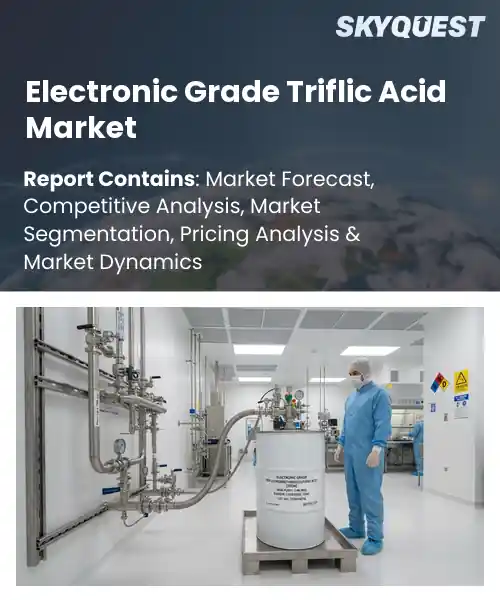
Electronic Grade Triflic Acid Market
Report ID: SQMIG15E4243
Report ID: SQMIG15E4243
[email protected]
USA +1 351-333-4748
Report ID:
SQMIG15E4243 |
Region:
Global |
Published Date: August, 2026
Pages:
157
|Tables:
143
|Figures:
78


Global Electronic Grade Triflic Acid Market size was valued at USD 184.6 Million in 2024 and is poised to grow from USD 197.89 Million in 2025 to USD 345.14 Million by 2033, growing at a CAGR of 7.2% during the forecast period (2026-2033).
The global electronic‑grade trifluoromethanesulfonic acid (triflic acid) market supplies a super‑acid reagent essential for fabricating high‑performance semiconductors, organic light‑emitting diodes, and advanced nanolithography patterns. Its importance stems from unparalleled proton‑conductivity and chemical stability, which enable precise etching and doping processes that conventional acids cannot achieve. Historically, demand surged in the early 2010s as manufacturers transitioned from silicon to compound‑semiconductor platforms, exemplified by the rise of gallium nitride transistors. Subsequent adoption in flexible‑display production amplified volume, while stricter impurity thresholds enforced by automotive and aerospace standards further propelled the market’s expansion. These advances cement triflic acid as a key enabler today. Rising demand for ultra‑high‑resolution display panels constitutes the principal growth catalyst, because manufacturers require finer line‑widths that only triflic acid can reliably produce through atomic‑layer etching. Korean OLED producers have integrated the acid into their pixel‑definition steps, achieving sub‑10‑micron precision and reducing defect density by 30 percent. This performance advantage triggers a feedback loop: improved yields lower production costs, encouraging further investment in next‑generation screen technologies such as micro‑LED and quantum‑dot arrays. The expansion of 5G infrastructure fuels the need for power‑amplifier modules, where triflic acid‑mediated doping enhances carrier mobility, thereby extending device efficiency and opening new revenue streams for suppliers.
How is AI-driven automation influencing the electronic-grade triflic acid market?
AI-driven automation is reshaping the electronic‑grade triflic acid market by streamlining synthesis pathways, tightening quality control, and reducing waste. Advanced process‑control algorithms monitor reaction temperatures and reagent feeds in real time, ensuring consistent purity that meets tight electronic standards. Machine‑learning models predict optimal catalyst loads, cutting cycle times and lowering energy consumption. Integrated data platforms link production floors with supply‑chain systems, allowing manufacturers to adjust output instantly in response to demand spikes. These capabilities make scaling up more reliable and help manufacturers meet the growing need for high‑purity acids in semiconductor fabrication and advanced display technologies.Sigma‑Aldrich announced in June 2024, its new AI‑optimized pilot plant for electronic‑grade triflic acid, showcasing faster batch turnover and higher yield, which directly supports market expansion and operational efficiency.
Market snapshot - (2026-2033)
Global Market Size
USD 184.6 Million
Largest Segment
99.9%
Fastest Growth
99.999%
Growth Rate
7.2% CAGR
To get more insights on this market click here to Request a Free Sample Report
Global electronic grade triflic acid market is segmented by purity, form, application, end-use industry, packaging and region. Based on purity, the market is segmented into 99.9%, 99.99% and 99.999%. Based on form, the market is segmented into Liquid and Solution. Based on application, the market is segmented into Semiconductor Manufacturing, Photoresist Processing and Chemical Synthesis. Based on end-use industry, the market is segmented into Semiconductor, Electronics and Specialty Chemicals. Based on packaging, the market is segmented into Bottles, Drums and Specialty Containers. Based on region, the market is segmented into North America, Europe, Asia Pacific, Latin America and Middle East & Africa.
99.99% Purity segment dominates because manufacturers prioritize purity to meet stringent defect‑free requirements in semiconductor processes. This level of purity minimizes ionic contaminants that can degrade photoresist performance, ensuring consistent etch rates and pattern fidelity. Consequently, suppliers invest heavily in refined distillation and analytical testing, reinforcing the market’s preference for this grade. These investments also enable tighter control over trace moisture, critical for lithography reliability, and foster collaborations that lock in demand.
However, 99.999% purity segment is witnessing the strongest growth momentum because emerging sub‑10nm nodes demand ever‑lower impurity thresholds to avoid pattern collapse. Advanced lithography tools are adopting this grade to achieve higher resolution, driving suppliers to expand capacity and innovate purification technologies, thereby creating new market opportunities and expanding overall demand.
Liquid form segment dominates because process engineers favor a pure, anhydrous liquid that can be directly metered into high‑volume manufacturing equipment without dilution steps. Its inherent stability under ambient conditions simplifies storage and handling, reducing contamination risk and minimizing downtime on fabs. The direct‑feed capability also aligns with tight cycle times in lithography, prompting suppliers to prioritize liquid production lines and tailor packaging to meet fab‑level logistics requirements.
Meanwhile, solution form segment emerges as the key high‑growth area because fab designers are integrating automated dispensing systems that require pre‑diluted formulations for precise dosing. The convenience of ready‑to‑use solutions accelerates workflow adoption in emerging 3D‑stacked architectures, prompting manufacturers to develop specialized solvent blends, thereby expanding market reach and stimulating new application niches.
To get detailed segments analysis, Request a Free Sample Report
North America benefits from a mature ecosystem of semiconductor fabrication and advanced electronics research that demands high‑purity reagents such as electronic grade triflic acid. The region hosts leading chemical manufacturers with deep expertise in producing specialty acids, supported by extensive infrastructure that ensures reliable supply and rapid distribution. Strong collaboration between academia, industry, and government fosters continuous innovation, while rigorous quality standards and regulatory frameworks reinforce confidence in product integrity. These combined strengths create a self‑reinforcing cycle that sustains leadership in the global market.
Electronic Grade Triflic Acid Market in the United States is propelled by the country’s dominant position in semiconductor design and manufacturing, where ultra‑clean processing environments require the highest chemical purity. Domestic producers benefit from sophisticated production facilities and a skilled workforce, enabling swift response to evolving industry specifications. Close proximity to major research institutions further accelerates product development and customization, reinforcing the United States as a pivotal hub for high‑performance electronic grade chemicals.
Electronic Grade Triflic Acid Market in Canada is supported by a growing tech sector that emphasizes precision electronics and emerging quantum computing initiatives. Canadian chemical firms leverage strong environmental and safety regulations to maintain exceptional product quality, while strategic partnerships with North American manufacturers ensure seamless integration into supply chains. The country’s emphasis on innovation and sustainable practices attracts investment in specialty chemical capabilities, positioning Canada as an important contributor to the regional market.
Asia Pacific experiences vigorous growth due to the region’s aggressive expansion of electronics manufacturing and the rapid adoption of next‑generation devices. Strong governmental support for advanced materials and a focus on high‑tech industrial policy encourage investment in specialty chemical production. Local manufacturers are increasingly adopting stringent purity standards to meet the demands of sophisticated semiconductor processes, while cross‑border collaborations enhance technology transfer and capacity building. This dynamic environment catalyzes a swift rise in demand for electronic grade triflic acid across the region.
Electronic Grade Triflic Acid Market in Japan is driven by the nation’s leadership in precision electronics and high‑density integrated circuit production. Japanese chemical firms are renowned for meticulous quality control and innovation in specialty acid synthesis, aligning closely with the exacting requirements of domestic manufacturers. The synergies between advanced research institutes and industry create an ecosystem that prioritizes purity and reliability, ensuring that Japan remains a critical consumer and producer of high‑grade triflic acid.
Electronic Grade Triflic Acid Market in South Korea benefits from the country’s robust semiconductor ecosystem and its emphasis on cutting‑edge process technologies. Korean manufacturers demand consistently pure reagents to support high‑performance chip fabrication, prompting local producers to enhance capabilities in specialty acid production. Collaborative initiatives between research centers and chemical companies accelerate the development of tailored solutions, reinforcing South Korea’s position as a fast‑growing market for electronic grade triflic acid.
Europe solidifies its role through a strategic focus on high‑value electronics, stringent regulatory frameworks, and a tradition of excellence in chemical manufacturing. Investment in sustainable production methods and a commitment to maintaining rigorous quality standards elevate the region’s appeal to electronics firms seeking reliable, high‑purity acids. Collaborative networks linking research institutions, industry leaders, and policy makers drive continuous improvement and foster innovation in specialty chemical processes. These coordinated efforts enhance Europe’s competitiveness and reinforce its contribution to the global electronic grade triflic acid supply.
Electronic Grade Triflic Acid Market in Germany is anchored by the country’s advanced chemical industry and its deep integration with precision engineering sectors. German producers emphasize meticulous process control and adherence to exacting purity benchmarks, meeting the stringent demands of local semiconductor and electronics manufacturers. Strong ties between research laboratories and industrial partners facilitate rapid adoption of new technologies, ensuring that Germany remains a key supplier of high‑quality triflic acid for electronic applications.
Electronic Grade Triflic Acid Market in the United Kingdom is shaped by a vibrant electronics ecosystem and a focus on high‑tech research. UK chemical firms prioritize innovative synthesis routes and rigorous quality assurance to align with the precise needs of domestic chip makers and research facilities. Collaborative projects across academia and industry promote the development of customized acid solutions, reinforcing the United Kingdom’s role as a significant participant in the European market.
Electronic Grade Triflic Acid Market in France benefits from the nation’s strong chemical heritage and its emphasis on sustainable manufacturing practices. French producers combine expertise in specialty chemistry with strict compliance to European purity standards, serving the sophisticated requirements of the country’s electronics and aerospace sectors. Strategic alliances between research institutions and industry developers drive continuous improvement, positioning France as a vital contributor to the regional electronic grade triflic acid landscape.
To know more about the market opportunities by region and country, click here to
Buy The Complete Report
Increasing Demand For High Purity
Expansion Of Specialty Chemical Applications
Stringent Environmental Regulations
Limited Availability Of High‑Purity Feedstock
Request Free Customization of this report to help us to meet your business objectives.
The competitive landscape is shaped by a handful of established chemical manufacturers leveraging strategic M&A and collaborative partnerships to secure supply chains and expand capacity for electronic‑grade triflic acid. Recent joint ventures between Solvay and regional distributors aim to enhance low‑impurity production, while Central Glass’s acquisition of niche specialty acid assets illustrates consolidation as a response to rising semiconductor demand.
Top Player’s Company Profile
Recent Developments
SkyQuest’s ABIRAW (Advanced Business Intelligence, Research & Analysis Wing) is our Business Information Services team that Collects, Collates, Correlates, and Analyses the Data collected by means of Primary Exploratory Research backed by robust Secondary Desk research. As per SkyQuest analysis, the electronic‑grade triflic acid market is propelled primarily by soaring demand for ultra‑high‑purity reagents that enable finer line‑widths in advanced semiconductor and display manufacturing, while AI‑driven automation further accelerates growth by tightening quality control and reducing waste, and the widening use of the acid in specialty chemical applications such as organic electronics and high‑performance polymers creates additional demand. The 99.99 % purity segment remains the dominant share because manufacturers prioritize defect‑free processes, and North America leads the market thanks to its mature semiconductor ecosystem and strong chemical manufacturers. However, increasingly stringent environmental regulations pose a restraint, adding compliance costs and limiting adoption for smaller players, which tempers the otherwise robust expansion.
| Report Metric | Details |
|---|---|
| Market size value in 2024 | USD 184.6 Million |
| Market size value in 2033 | USD 345.14 Million |
| Growth Rate | 7.2% |
| Base year | 2024 |
| Forecast period | (2026-2033) |
| Forecast Unit (Value) | USD Million |
| Segments covered |
|
| Regions covered | North America (US, Canada), Europe (Germany, France, United Kingdom, Italy, Spain, Rest of Europe), Asia Pacific (China, India, Japan, Rest of Asia-Pacific), Latin America (Brazil, Rest of Latin America), Middle East & Africa (South Africa, GCC Countries, Rest of MEA) |
| Companies covered |
|
| Customization scope | Free report customization with purchase. Customization includes:-
|
To get a free trial access to our platform which is a one stop solution for all your data requirements for quicker decision making. This platform allows you to compare markets, competitors who are prominent in the market, and mega trends that are influencing the dynamics in the market. Also, get access to detailed SkyQuest exclusive matrix.
Table Of Content
Executive Summary
Market overview
Parent Market Analysis
Market overview
Market size
KEY MARKET INSIGHTS
COVID IMPACT
MARKET DYNAMICS & OUTLOOK
Market Size by Region
KEY COMPANY PROFILES
Methodology
For the Electronic Grade Triflic Acid Market, our research methodology involved a mixture of primary and secondary data sources. Key steps involved in the research process are listed below:
1. Information Procurement: This stage involved the procurement of Market data or related information via primary and secondary sources. The various secondary sources used included various company websites, annual reports, trade databases, and paid databases such as Hoover's, Bloomberg Business, Factiva, and Avention. Our team did 45 primary interactions Globally which included several stakeholders such as manufacturers, customers, key opinion leaders, etc. Overall, information procurement was one of the most extensive stages in our research process.
2. Information Analysis: This step involved triangulation of data through bottom-up and top-down approaches to estimate and validate the total size and future estimate of the Electronic Grade Triflic Acid Market.
3. Report Formulation: The final step entailed the placement of data points in appropriate Market spaces in an attempt to deduce viable conclusions.
4. Validation & Publishing: Validation is the most important step in the process. Validation & re-validation via an intricately designed process helped us finalize data points to be used for final calculations. The final Market estimates and forecasts were then aligned and sent to our panel of industry experts for validation of data. Once the validation was done the report was sent to our Quality Assurance team to ensure adherence to style guides, consistency & design.
Analyst Support
Customization Options
With the given market data, our dedicated team of analysts can offer you the following customization options are available for the Electronic Grade Triflic Acid Market:
Product Analysis: Product matrix, which offers a detailed comparison of the product portfolio of companies.
Regional Analysis: Further analysis of the Electronic Grade Triflic Acid Market for additional countries.
Competitive Analysis: Detailed analysis and profiling of additional Market players & comparative analysis of competitive products.
Go to Market Strategy: Find the high-growth channels to invest your marketing efforts and increase your customer base.
Innovation Mapping: Identify racial solutions and innovation, connected to deep ecosystems of innovators, start-ups, academics, and strategic partners.
Category Intelligence: Customized intelligence that is relevant to their supply Markets will enable them to make smarter sourcing decisions and improve their category management.
Public Company Transcript Analysis: To improve the investment performance by generating new alpha and making better-informed decisions.
Social Media Listening: To analyze the conversations and trends happening not just around your brand, but around your industry as a whole, and use those insights to make better Marketing decisions.
REQUEST FOR SAMPLE
 REQUEST FREE CUSTOMIZATION


Want to customize this report? This report can be personalized according to your needs. Our analysts and industry experts will work directly with you to understand your requirements and provide you with customized data in a short amount of time. We offer $1000 worth of FREE customization at the time of purchase.
Feedback From Our Clients


 USA (+1) 351-333-4748

