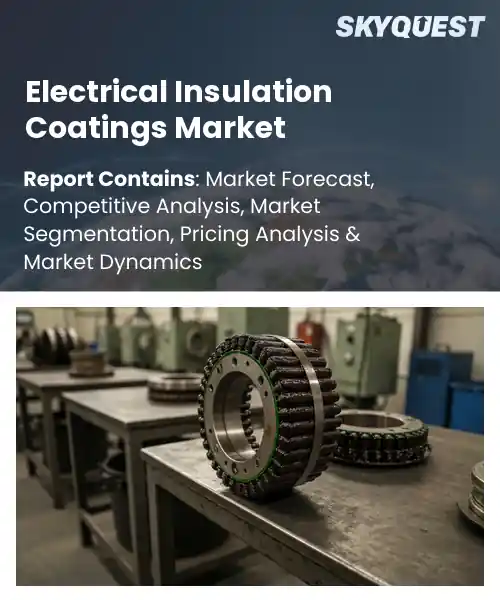
Electrical Insulation Coatings Market
Report ID: SQMIG15E3581
Report ID: SQMIG15E3581
[email protected]
USA +1 351-333-4748
Report ID:
SQMIG15E3581 |
Region:
Global |
Published Date: May, 2026
Pages:
157
|Tables:
164
|Figures:
78


Global Electrical Insulation Coatings Market size was valued at USD 3.2 Billion in 2024 and is poised to grow from USD 3.26 Billion in 2025 to USD 3.76 Billion by 2033, growing at a CAGR of 1.8% during the forecast period (2026-2033).
The main reason the electrical insulation coatings market is growing is because of increasing electrification worldwide. This market provides different types of coatings like polymers, ceramics, and epoxies that protect against electrical breakdown, corrosion, and heat damage. Without these coatings, equipment could fail, causing huge costs and safety risks. That's why companies now prefer top-notch materials and careful installation methods. Historically, insulation started with basic stuff like varnish and asbestos but has progressed to complex nanomaterials and thin protective films. For instance, modern wind turbine generators and high voltage lines use these advanced coatings to last longer.
Tech advances boosting demand for heat-resistant and thinner coatings are pushing market growth. With more electric vehicles on the road, makers need better protection against motor heat and batteries' temperature swings. That led suppliers to create new stuff like silica-filled epoxies and ceramic layers to avoid failures. Offshore wind and high-voltage power setups are also expanding. These harsh environments speed up corrosion, making folks seek out water-repelling and shape-following materials for their cables and equipment. Producers cashing in are those putting effort into low-VOC products and robotized coating systems. By doing this, they not only handle tough regulations but also lower overall costs.
How is AI Improving Testing and Quality Control in the Electrical Insulation Coatings Market?
AI is enhancing testing and quality control in the electrical insulation coatings market by using automated inspection, predictive modeling, and virtual testing. Machine vision spots defects early on, while sensor fusion ties electrical and surface measurements together. AI models then predict long-term performance from short-term data. Right now, there's growing use of lab automation and explainable AI to quicken qualification processes and reduce trial and error. These advancements help manufacturers cut down development times, decrease waste, and provide more reliable coatings for stuff like EV powertrain and industrial transformers. This boost reliability and supplier trust.
Market snapshot - (2026-2033)
Global Market Size
USD 3.2 Billion
Largest Segment
Epoxy Coatings
Fastest Growth
Polyimide Coatings
Growth Rate
1.8% CAGR
To get more insights on this market click here to Request a Free Sample Report
Global electrical insulation coatings market is segmented by resin type, product type, technology, application, end-use industry and region. Based on resin type, the market is segmented into Epoxy Coatings, Polyurethane Coatings, Acrylic Coatings, Silicone Coatings, Polyester Coatings, Alkyd Coatings, Polyimide Coatings and Others. Based on product type, the market is segmented into Varnishes, Enamels, Powder Coatings, Liquid Insulation Coatings, UV-Cured Coatings and Others. Based on technology, the market is segmented into Solvent-Based Coatings, Water-Based Coatings, Powder-Based Coatings and UV-Curable Coatings. Based on application, the market is segmented into Electric Motors & Generators, Transformers, Wires & Cables, Printed Circuit Boards (PCBs), Electrical Appliances, Automotive Electrical Components, Industrial Equipment, Consumer Electronics and Others. Based on end-use industry, the market is segmented into Electrical & Electronics, Automotive, Energy & Power, Industrial Manufacturing, Aerospace & Defense, Consumer Goods, Construction & Infrastructure and Others. Based on region, the market is segmented into North America, Europe, Asia Pacific, Latin America and Middle East & Africa.
The Epoxy Coatings segment leads the way because of its awesome dielectric strength, fantastic adhesion to various surfaces, and tough resistance to heat and chemicals. This makes it the go-to option for crucial insulation tasks. It works well with typical curing methods, and you can tweak its consistency and hardness. That's why manufacturers use it in motors, transformers, and PCBs—ensuring reliable performance and less risk of failures in demanding electrical stuff.
On the other side, Polyimide Coatings are becoming the quickest growing part of the market. They excel in high-temperature stability, work great as thin films for insulation, and can handle solvents. This fits perfectly with the need for smaller electronics and equipment needed to deal with more power. Also, advances in how they're applied at lower temps and fitted for automated processes are speeding up their uptake, opening doors to cool new designs and high-end uses.
The Solvent-Based Coatings lead due to their mature formulation science, which gives superior film formation, quick curing times, and reliable dielectric performance. These properties match well with current manufacturing processes. They work great with many resins and apply easily through dipping, spraying, or brushing. This means higher production rates. Plus, their long-term reliability and easy maintenance keep them preferred by manufacturers seeking performance alongside consistency.
Water-Based Coatings, on the other hand, grow fast because of stricter regulations, better formulas, and safer factory practices. Progress in resin technology and linking agents is making them catch up to solvent-based rivals. As a result, they're becoming popular in motors, transformers, and electronics manufacturing. This boost pushes industries toward more eco-friendly choices and process updates.
To get detailed segments analysis, Request a Free Sample Report
Asia Pacific is in a strong position because of its concentrated industrial demand, advanced manufacturing areas, and well-connected supply chains for coatings. Industrial hubs in electronics, automotive electrification, and renewable infrastructure push tech teamwork between material makers and users. With flexible production and easy access to key parts makers, there's fast iteration and scaling of custom insulation solutions. Local policies pushing energy efficiency and reliable high-voltage transmission boost both investment and product creation. Strong supplier networks and set distribution routes speed up time to market and favor local formulations. Plus, cross-value-chain partnerships beef up the ability to tackle intricate insulation needs across various sectors. Manufacturers also gain from a capable workforce and targeted R&D, which speeds up top-notch product results and reliability.
The Electrical Insulation Coatings Market in Japan thrives due to the country's strong electronics and precision manufacturing industries. These sectors look for top-notch reliability and performance. They work closely with material scientists and original equipment manufacturers to develop custom solutions. This teamwork results in products perfect for demanding, high temperature uses. Additionally, there's a big emphasis on quality checks, long-lasting materials, and rigorous tests. To boot, suppliers support clients by helping them navigate integration and regulations across worldwide supply chains.
South Korea's Electrical Insulation Coatings Market is defined by robust electronics production and increasing electrification, boosting the need for reliable coatings. The push for speedy innovation and teamwork between material makers and system integrators leads to custom solutions. This benefits compact power modules and high-frequency uses. Meanwhile, local suppliers are into prototyping and offering tech support and compliance help. As a result, advanced insulation tech spreads easily through both manufacturing hubs and export-focused supply chains.
North America is seeing a big push towards more electricity use in things like cars, industries, and upgraded grids. These upgrades focus on making systems more reliable and safer. Companies making tech, utilities, and car makers all work together to speed up using special coatings that stand up to tough conditions. Innovation gets boosted by tests and rules that match up across regions, helping make better insulating products. This means we see improved supply chains and local factories pumping out tailor-made solutions. Suppliers not only sell stuff but help with setting up the new tech too. Plus, different sectors join forces to set common standards and speed up installing advanced insulation. Finally, hubs for research and pilot projects help bring the latest coating types and processes to the market.
The Electrical Insulation Coatings Market in the US thrives because of strong demand from electric vehicles, aerospace, and utility industries. These sectors need top-notch insulation to keep equipment reliable and safe. Advanced coatings with better thermal stability and dielectric strength are thus more widely used. Material suppliers and system integrators run collaborative programs for application tests. Plus, domestic manufacturers offer customizations, testing, and ensure compliance, making it easier to integrate these coatings into complicated systems.
The Electrical Insulation Coatings Market in Canada thrives because of a diverse industrial base and efforts to modernize grids. Material suppliers closely work with utilities to develop coatings for tough environments and lasting reliability. They focus on thorough testing and certification, making Original Equipment Manufacturers and system integrators more likely to adopt these products. Plus, local production and engineering know-how allow for customized solutions that fit regional needs across various sectors.
Europe's clout is growing thanks to beefed-up investments in research, unified rules, and a strong push for energy efficiency in power transmission and industrial uses. Schools, material makers, and gear builders are teaming up to cook up eco-friendly recipes and rigorous test methods. By pushing standard setting and seamless tech sharing, they make advanced insulation methods more common across countries. Producers are using top-notch manufacturing skills and support systems to dish out customized answers for various weather and ops setups. Europe also boosts supply chain strength and cranks up cross-border pacts, smoothing the rollout of cutting-edge chemical stuff and giving pro smarts to vital industries. Plus, they're speeding up eco coating tech growth through demos and industrial get-togethers, moving insights around within different national spots.
The Electrical Insulation Coatings Market in Germany thrives due to robust industrial manufacturing, top-notch engineering know-how, and a big focus on energy transmission. Material and equipment makers working together help develop reliable coatings for tough, high voltage uses. Insistences on strict tests, standard compliance, and excellent service push OEMs to join in. Local suppliers blend cutting-edgeproduction with application support, offering customized solutions that ace both performance and eco-criteria in various sectors.
The Electrical Insulation Coatings Market in the UK thrives due to solid research and an engineering industry committed to reliable power and transportation tech. Universities, material innovators, and system integrators team up to speed the development of eco-friendly formulas. Plus, a focus on certifications and rigorous tests makes original equipment manufacturers more likely to adopt these products. To boot, local suppliers give the needed know-how and production choices to handle varied weather and operations throughout the region.
France's Electrical Insulation Coatings Market thrives because of solid research and specialty chemical skills, boosted by close cooperation between manufacturers and integrators. There's a big focus on making eco-friendly formulas and ensuring durability in different weather conditions, which drives the creation of bespoke coatings. Tests, certifications, and tech support are key, helping OEMs and utility companies get on board with new insulations. Local suppliers mix formula smarts with application services to fit the bill for both eco and operation needs in industry and energy realms.
To know more about the market opportunities by region and country, click here to
Buy The Complete Report
Growth in Renewable Integration
Expanding renewable energy boosts the need for reliable insulating materials across generation and transmission equipment. Wind turbines, solar inverters, cable systems, and transformers need coatings that improve electrical resistance and offer protection from moisture, salt, and UV rays. These advanced insulating coatings boost long-term reliability and cut down failure rates, enabling higher capacity system deployments with less maintenance. So, they make renewable projects more practical and appealing, directly driving procurement and use of specialized coating products in the power industry.
Advancements in Coating Technology
Improvements in coating formulas and application methods have really expanded what we can do with electrical insulation systems. They now offer better thermal stability, super thin coatings, and better adhesion to intricate parts. With nanoscale fillers, low temp cures, and solvent-free options, these innovations cut down on performance issues and fit well with today’s power electronics and electric vehicles. This opens up all sorts of new uses too. By reducing risks throughout their lifespan and making stronger value cases, they convince engineers and buyers to specify these technologies more often. As a result, markets expand and adoption rates rise.
High Raw Material Variability
Variability in key raw materials, like base resins, curing agents, and specialty additives, causes problems for consistent coating performance and reliable manufacturing. Because of differences in material properties from different suppliers and batches, manufacturers must do lots of testing and reformulating. This lengthens development times and makes scaling tough. Additionally, companies have higher quality control needs and might need various formulations for different customer specs. As a result, operations get more complex, making quick product launches less likely. Slower launches mean slower market penetration and less growth momentum overall.
Stringent Environmental Regulations Compliance
Stringent environmental and safety rules limit what chemistries we can use and change how we make stuff. Limits on volatile organic compounds and dangerous stuff mean we must come up with greener options, get extra certifications, and do more tests – which all take more time. These requirements push up costs and slow down getting new insulation coatings out there. They also stop some high-performance ingredients from being used and vary depending on where you are. So, launching across different sectors has become really tough.
Request Free Customization of this report to help us to meet your business objectives.
The global electrical insulation coatings market is shaped by companies merging, forming alliances, and investing in startups. For instance, Specialty Coating Systems bought Diamond MT, Dymax teamed up with HZO to boost their protective coating options, and investors are supporting new conformal technology growth to speed up market entry and commercial use.
Electrification Driving Coating Demand: The quick rise in electric vehicles and growth of renewable energy sources are changing what insulation coatings need to do—handle higher heat, work better with electricity, and last longer. Companies want coatings that allow for sleeker, lighter products but still stand up to high temps and voltage. Because of this, there's more teamwork among coating makers, car manufacturers, and material experts. They're working together to speed up approvals, cut down development time, and make specialized products for new uses in cars, power distribution, and energy production.
Smart Manufacturing and Digitalization: Automation, process analytics, and digital twins are really changing coating production. It's moving from a craft-based process to one that's more about consistent, scalable platforms. Real-time monitoring helps with that, improving product consistency and cutting down on time when getting new formulas out there. Better tracking lets companies work closer with customers too. To keep up with their position in the market, suppliers invest in data-driven R&D and connected production lines. This speeds up innovation and allows for flexible, small batch runs to meet specific needs. Ultimately, it strengthens collaborations throughout the industry to satisfy various performance demands and hit market goals.
SkyQuest’s ABIRAW (Advanced Business Intelligence, Research & Analysis Wing) is our Business Information Services team that Collects, Collates, Correlates, and Analyses the Data collected by means ofPrimary Exploratory Research backed by robust Secondary Desk research.
As per SkyQuest analysis, the global electrical insulation coatings market is pushed mainly by increasing electrification and the need for dependable power. It also benefits from advances in coating tech, which offer better heat resistance, thinner films, and lower-VOC options. However, growth gets slowed by strict environmental rules requiring new formulas and stretching out the time to market. Asia Pacific leads the market, thanks to its focused manufacturing, robust supply chains, and tight cooperation with original equipment manufacturers. Epoxy coatings top the charts due to their excellent dielectric strength, adhesion, and thermal stability. As innovation and automation continue, suppliers who can handle both performance needs and regulatory limits will come ahead.
| Report Metric | Details |
|---|---|
| Market size value in 2024 | USD 3.2 Billion |
| Market size value in 2033 | USD 3.76 Billion |
| Growth Rate | 1.8% |
| Base year | 2024 |
| Forecast period | (2026-2033) |
| Forecast Unit (Value) | USD Billion |
| Segments covered |
|
| Regions covered | North America (US, Canada), Europe (Germany, France, United Kingdom, Italy, Spain, Rest of Europe), Asia Pacific (China, India, Japan, Rest of Asia-Pacific), Latin America (Brazil, Rest of Latin America), Middle East & Africa (South Africa, GCC Countries, Rest of MEA) |
| Companies covered |
|
| Customization scope | Free report customization with purchase. Customization includes:-
|
To get a free trial access to our platform which is a one stop solution for all your data requirements for quicker decision making. This platform allows you to compare markets, competitors who are prominent in the market, and mega trends that are influencing the dynamics in the market. Also, get access to detailed SkyQuest exclusive matrix.
Table Of Content
Executive Summary
Market overview
Parent Market Analysis
Market overview
Market size
KEY MARKET INSIGHTS
COVID IMPACT
MARKET DYNAMICS & OUTLOOK
Market Size by Region
KEY COMPANY PROFILES
Methodology
For the Electrical Insulation Coatings Market, our research methodology involved a mixture of primary and secondary data sources. Key steps involved in the research process are listed below:
1. Information Procurement: This stage involved the procurement of Market data or related information via primary and secondary sources. The various secondary sources used included various company websites, annual reports, trade databases, and paid databases such as Hoover's, Bloomberg Business, Factiva, and Avention. Our team did 45 primary interactions Globally which included several stakeholders such as manufacturers, customers, key opinion leaders, etc. Overall, information procurement was one of the most extensive stages in our research process.
2. Information Analysis: This step involved triangulation of data through bottom-up and top-down approaches to estimate and validate the total size and future estimate of the Electrical Insulation Coatings Market.
3. Report Formulation: The final step entailed the placement of data points in appropriate Market spaces in an attempt to deduce viable conclusions.
4. Validation & Publishing: Validation is the most important step in the process. Validation & re-validation via an intricately designed process helped us finalize data points to be used for final calculations. The final Market estimates and forecasts were then aligned and sent to our panel of industry experts for validation of data. Once the validation was done the report was sent to our Quality Assurance team to ensure adherence to style guides, consistency & design.
Analyst Support
Customization Options
With the given market data, our dedicated team of analysts can offer you the following customization options are available for the Electrical Insulation Coatings Market:
Product Analysis: Product matrix, which offers a detailed comparison of the product portfolio of companies.
Regional Analysis: Further analysis of the Electrical Insulation Coatings Market for additional countries.
Competitive Analysis: Detailed analysis and profiling of additional Market players & comparative analysis of competitive products.
Go to Market Strategy: Find the high-growth channels to invest your marketing efforts and increase your customer base.
Innovation Mapping: Identify racial solutions and innovation, connected to deep ecosystems of innovators, start-ups, academics, and strategic partners.
Category Intelligence: Customized intelligence that is relevant to their supply Markets will enable them to make smarter sourcing decisions and improve their category management.
Public Company Transcript Analysis: To improve the investment performance by generating new alpha and making better-informed decisions.
Social Media Listening: To analyze the conversations and trends happening not just around your brand, but around your industry as a whole, and use those insights to make better Marketing decisions.
REQUEST FOR SAMPLE
 REQUEST FREE CUSTOMIZATION
Global Electrical Insulation Coatings Market size was valued at USD 3.2 Billion in 2024 and is poised to grow from USD 3.26 Billion in 2025 to USD 3.76 Billion by 2033, growing at a CAGR of 1.8% during the forecast period (2026-2033).
Competitive dynamics in the global electrical insulation coatings market are driven by mergers and acquisitions, strategic alliances, and corporate venturing that secure formulation portfolios and application expertise. Examples include Specialty Coating Systems acquiring Diamond MT, Dymax forming a strategic alliance with HZO to expand protective coating portfolios, and corporate investors backing novel conformal technologies to accelerate commercialization and channel access. 'PPG Industries', 'Akzo Nobel N.V.', 'The Sherwin-Williams Company', 'Axalta Coating Systems', 'Nippon Paint Holdings Co., Ltd.', 'Jotun A/S', 'Kansai Paint Co., Ltd.', 'WEG S.A.', 'Von Roll Holding AG', 'Elantas GmbH', 'ALTANA AG', '3M Company', 'Hempel A/S', 'Sika AG', 'RPM International Inc.', 'Aremco Products, Inc.', 'Mascoat', 'Taihu Electric Insulating Coatings Co., Ltd.', 'Kyocera Corporation', 'M&I Materials Ltd.'
Renewable energy expansion drives demand for reliable insulating solutions across generation and transmission assets, as wind turbines, solar inverters, cable systems, and transformers require coatings that enhance dielectric strength and protect against moisture, salt, and ultraviolet exposure. By improving long term reliability and reducing failure rates, advanced insulation coatings enable utilities and developers to deploy higher capacity systems with lower maintenance burdens, thus making renewable projects more viable and attractive, and directly stimulating procurement and specification of specialized coating products across power infrastructure sectors.
Electrification Driving Coating Demand: Rapid adoption of electric vehicles and expansion of renewable energy infrastructure is reshaping demand for electrical insulation coatings that offer higher thermal stability, improved dielectric performance and longer field life. Manufacturers prioritize formulations that support thinner, lighter designs while maintaining reliability under elevated temperatures and voltages. This trend is encouraging collaboration between coating suppliers, OEMs and material scientists to accelerate product qualification, shorten development cycles and deliver tailored solutions for evolving applications across automotive, power distribution and energy generation sectors.
Why does Asia Pacific Dominate the Global Electrical Insulation Coatings Market? |@12


Want to customize this report? This report can be personalized according to your needs. Our analysts and industry experts will work directly with you to understand your requirements and provide you with customized data in a short amount of time. We offer $1000 worth of FREE customization at the time of purchase.
Feedback From Our Clients


 USA (+1) 351-333-4748

