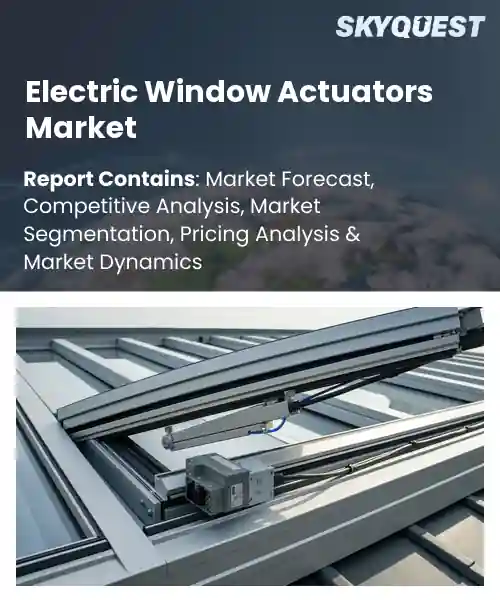
Electric Window Actuators Market
Report ID: SQMIG25A2891
Report ID: SQMIG25A2891
[email protected]
USA +1 351-333-4748
Report ID:
SQMIG25A2891 |
Region:
Global |
Published Date: August, 2026
Pages:
157
|Tables:
115
|Figures:
77


Global Electric Window Actuators Market size was valued at USD 4.72 Billion in 2024 and is poised to grow from USD 5.02 Billion in 2025 to USD 8.25 Billion by 2033, growing at a CAGR of 6.4% during the forecast period (2026-2033).
The global electric window actuator market comprises devices that automate the opening and closing of vehicle windows, replacing manual levers with motorized units. Its significance stems from the growing consumer demand for convenience, safety, and integration with driver‑assistance systems. Historically, the segment was confined to premium models in the early 2000s, but widespread adoption followed the introduction of low‑cost brushless motors and electronic control modules in mid‑2010s. For example, a leading European OEM introduced an actuator‑sensor package in 2017, prompting tier‑one suppliers to mass‑produce compatible designs. This evolution has expanded market size and set a baseline for future electrification trends.
Regulations limiting vehicle emissions and the shift to fully electric powertrains drive the electric window actuator market, because manufacturers replace hydraulic or cable mechanisms with lightweight, energy‑efficient units. This demand for high‑torque, low‑loss brushless DC actuators creates space for suppliers to embed predictive diagnostics that link to onboard telematics, enabling over‑the‑air updates and lowering warranty costs. A North American sedan brand recently added a cloud‑linked actuator that warns drivers of motor wear, cutting service visits by 12 %. The added functionality spurs investment in miniaturized electronics, expanding the addressable market from passenger cars to commercial vans and autonomous shuttles in future.
How is IoT Integration Reshaping The Electric Window Actuators Market?
IoT integration is turning electric window actuators from simple mechanical devices into connected components that can be monitored, controlled and optimized in real time. By embedding sensors and wireless modules, manufacturers can collect data on usage patterns, fault conditions and energy consumption. This visibility enables predictive maintenance, reduces warranty costs and improves passenger comfort through seamless automatic opening and closing. Automakers are now designing vehicle architectures that treat window actuators as part of a broader body control network, allowing software updates and remote diagnostics. The shift also opens opportunities for aftermarket services that leverage over the air updates and usage based billing, accelerating market adoption.
Valeo announced in May 2023, an IoT enabled electric window actuator that streams diagnostic data to the cloud and supports over the air firmware upgrades. This capability shortens service cycles, improves reliability and demonstrates how connectivity is driving growth and efficiency in the market.
Market snapshot - (2026-2033)
Global Market Size
USD 4.72 Billion
Largest Segment
Linear Actuators
Fastest Growth
Rotary Actuators
Growth Rate
6.4% CAGR
To get more insights on this market click here to Request a Free Sample Report
Global electric window actuators market is segmented by actuator type, vehicle type, sales channel, application and region. Based on actuator type, the market is segmented into Linear Actuators and Rotary Actuators. Based on vehicle type, the market is segmented into Passenger Vehicles, Commercial Vehicles and Off-Highway Vehicles. Based on sales channel, the market is segmented into OEM and Aftermarket. Based on application, the market is segmented into Side Windows, Sunroofs and Rear Windows. Based on region, the market is segmented into North America, Europe, Asia Pacific, Latin America and Middle East & Africa.
Linear Actuators segment dominates because vehicle architects prioritize compact, low‑profile mechanisms that integrate seamlessly within door frames, delivering smooth motion with minimal space consumption. Their direct push‑pull action aligns with the structural design of side windows and sunroofs, reducing mechanical complexity. This inherent suitability drives broad adoption across manufacturers seeking reliability, ease of assembly, and long‑term durability, cementing linear devices as the preferred choice in electric window actuation.
However, Rotary Actuators segment is witnessing the strongest growth momentum as automakers explore pillar‑mount designs that free interior door space and enable new styling cues. The rotating motion suits panoramic roof concepts and advanced glass technologies, prompting manufacturers to invest in compact motor solutions that enhance aesthetics while maintaining performance, spurring market expansion.
Passenger Vehicles segment dominates because the majority of new car sales incorporate electric window systems, making high volume production a central focus for suppliers. Consumer expectations for seamless glass operation, safety integration, and interior comfort drive automakers to standardize advanced actuation solutions across sedan, SUV, and crossover platforms. This concentration of demand ensures economies of scale, steady component orders, and continuous refinement of designs to meet evolving ergonomic standards.
Meanwhile, Commercial Vehicles segment emerges as a high‑growth area as fleet operators require window solutions that withstand tougher cycles and varied climates. manufacturers tailor actuator housings and seal designs for greater durability, while safety and comfort regulations for trucks and buses drive investment, accelerating rapid expansion of this niche.
To get detailed segments analysis, Request a Free Sample Report
Asia Pacific dominance stems from a confluence of advanced automotive engineering, strong manufacturing ecosystems, and early adoption of vehicle electrification. The region hosts a dense network of original equipment manufacturers that integrate electric window actuators into high‑volume vehicle lines, driving economies of scale and continuous innovation. Robust supply chains and proximity to component makers reduce lead times and foster collaborative R&D, allowing rapid iteration of lightweight, energy‑efficient actuator designs. Government incentives promoting fuel‑efficient vehicles further stimulate demand, while consumer preferences for premium comfort features reinforce market uptake. Together, these factors create a virtuous cycle that positions Asia Pacific as the primary hub for both production capacity and technological leadership in electric window actuators.
Electric Window Actuators Market in Japan benefits from a legacy of precision engineering and a strong emphasis on automotive safety and comfort. Domestic manufacturers prioritize integration of compact, low‑noise actuator solutions, aligning with stringent vehicle interior standards. Close collaboration between tier‑one suppliers and major car makers accelerates product refinement, while a culture of continuous improvement sustains high reliability expectations among end users.
Electric Window Actuators Market in South Korea thrives on a dynamic automotive sector that blends high‑tech innovation with aggressive export orientation. Local suppliers focus on smart actuator systems that interface with advanced vehicle electronics, supporting trends toward connectivity and autonomous features. Government support for advanced manufacturing and a well‑established parts ecosystem enable rapid scaling of production, reinforcing the country’s role as a key supplier to global automakers.
Europe’s expansion is propelled by stringent regulatory frameworks that emphasize vehicle efficiency, noise reduction, and occupant comfort. Automakers across the continent are integrating electric window actuators to meet emission‑related targets by reducing mechanical drag and improving aerodynamic performance. A mature supplier landscape, characterized by strong engineering capabilities and collaborative R&D clusters, facilitates the development of lightweight, energy‑saving actuator designs. Consumer demand for premium cabin experiences, coupled with increasing adoption of electric and hybrid powertrains, further fuels market growth. Additionally, strong emphasis on sustainability drives manufacturers to adopt components that support recyclability and reduced material usage, reinforcing Europe’s position as a leader in sophisticated, environmentally conscious vehicle technologies.
Electric Window Actuators Market in Germany is anchored by world‑renowned automotive manufacturers that set high standards for component performance and durability. The country’s extensive engineering talent pool drives innovation in compact, high‑torque actuators suited for luxury and performance vehicles. Integrated supply chains and close proximity between OEMs and tier‑one suppliers enable rapid prototyping and swift implementation of next‑generation solutions, reinforcing Germany’s dominant role in the European market.
Electric Window Actuators Market in the United Kingdom is emerging through a blend of legacy automotive expertise and a growing focus on electric vehicle platforms. Collaborative research initiatives between universities and industry accelerate the adoption of smart, lightweight actuator technologies. While the market size remains modest, increasing investment in EV production and a regulatory push for enhanced cabin comfort position the United Kingdom as a rising contributor to Europe’s overall growth.
Electric Window Actuators Market in France is experiencing fast growth driven by a vibrant automotive sector that emphasizes design elegance and passenger experience. French manufacturers prioritize actuators that deliver silent operation and seamless integration with interior styling cues. Government incentives for green mobility encourage the incorporation of energy‑efficient components, while a strong network of specialized suppliers fuels rapid product development, making France a focal point for innovative actuator solutions within Europe.
North America reinforces its market position through a combination of technological leadership, extensive vehicle production capacity, and a consumer base that values convenience and premium features. Automakers prioritize integration of electric window actuators that complement advanced driver‑assistance systems and connected vehicle architectures, creating synergistic benefits across interior electronics. Robust research institutions and a culture of open innovation foster the development of actuator designs that emphasize reliability, lightweight construction, and seamless software integration. Strategic partnerships between original equipment manufacturers and component specialists accelerate time‑to‑market for next‑generation solutions. Moreover, a strong aftermarket ecosystem sustains long‑term demand, ensuring that North America remains a pivotal arena for both original and replacement electric window actuator technologies.
Electric Window Actuators Market in the United States is shaped by a large, diversified automotive industry that embraces cutting‑edge electronics and high‑comfort cabin features. Domestic suppliers focus on developing actuators with smart control modules that interact with vehicle infotainment and safety systems. Aggressive adoption of electric and autonomous vehicle programs drives continuous improvement in actuator efficiency and integration, while a well‑established aftermarket network supports ongoing component refreshes and upgrades.
Electric Window Actuators Market in Canada benefits from close alignment with North American automakers and a strong emphasis on reliability in harsh climate conditions. Suppliers concentrate on producing robust, corrosion‑resistant actuator designs that meet the durability expectations of both original equipment and replacement markets. Collaborative research initiatives with U.S. partners and government support for green vehicle technologies further enhance Canada’s contribution to the regional electric window actuator landscape.
To know more about the market opportunities by region and country, click here to
Buy The Complete Report
Increasing Vehicle Automation
Stringent Fuel Efficiency Standards
High Initial Component Cost
Complex Integration Challenges
Request Free Customization of this report to help us to meet your business objectives.
The electric window actuators market features a fragmented yet innovation-driven competitive landscape, with players ranging from established European specialists to regional manufacturers competing across residential, commercial, and industrial segments. Companies such as TOPP, Somfy (through Mingardi), and D+H hold significant market share, while a substantial portion is occupied by numerous smaller, regional players, a fragmentation particularly pronounced in the residential segment. Other notable participants include Ultraflex Control Systems, Window Master, Aprimatic, Aumuller, AXA, Lockwood under ASSA ABLOY, GEZE, and K + G Pneumatik, among others. On strategy, firms are forming alliances with construction companies, smart home technology providers, and building management system integrators to strengthen market reach and penetration, while channeling research and development investment toward more energy-efficient, reliable, and smart actuator solutions that meet evolving end-user needs. Partnerships remain a central lever for competitive advantage, alongside steady new product launches aimed at broadening portfolios, with mergers and acquisitions also used to expand product ranges and capabilities. Overall, competitive dynamics are shaped by established players emphasizing innovation and geographic expansion, even as emerging companies push into the space with differentiated offerings
SkyQuest’s ABIRAW (Advanced Business Intelligence, Research & Analysis Wing) is our Business Information Services team that Collects, Collates, Correlates, and Analyses the Data collected by means of Primary Exploratory Research backed by robust Secondary Desk research.
As per SkyQuest analysis, the global electric window actuators market is expanding rapidly driven primarily by increasing vehicle automation that pushes manufacturers to replace mechanical linkages with smart motorized units, while stringent fuel‑efficiency standards provide a second boost by encouraging lightweight, low‑loss designs. The market is led by the linear actuator segment, favored for its compact push‑pull action that fits easily into door frames, and Asia Pacific dominates overall due to its strong manufacturing base and early electrification adoption. However, high initial component cost remains a restraint, slowing uptake in price‑sensitive models until economies of scale lower prices for OEMs and aftermarket players alike.
| Report Metric | Details |
|---|---|
| Market size value in 2024 | USD 4.72 Billion |
| Market size value in 2033 | USD 8.25 Billion |
| Growth Rate | 6.4% |
| Base year | 2024 |
| Forecast period | (2026-2033) |
| Forecast Unit (Value) | USD Billion |
| Segments covered |
|
| Regions covered | North America (US, Canada), Europe (Germany, France, United Kingdom, Italy, Spain, Rest of Europe), Asia Pacific (China, India, Japan, Rest of Asia-Pacific), Latin America (Brazil, Rest of Latin America), Middle East & Africa (South Africa, GCC Countries, Rest of MEA) |
| Companies covered |
|
| Customization scope | Free report customization with purchase. Customization includes:-
|
To get a free trial access to our platform which is a one stop solution for all your data requirements for quicker decision making. This platform allows you to compare markets, competitors who are prominent in the market, and mega trends that are influencing the dynamics in the market. Also, get access to detailed SkyQuest exclusive matrix.
Table Of Content
Executive Summary
Market overview
Parent Market Analysis
Market overview
Market size
KEY MARKET INSIGHTS
COVID IMPACT
MARKET DYNAMICS & OUTLOOK
Market Size by Region
KEY COMPANY PROFILES
Methodology
For the Electric Window Actuators Market, our research methodology involved a mixture of primary and secondary data sources. Key steps involved in the research process are listed below:
1. Information Procurement: This stage involved the procurement of Market data or related information via primary and secondary sources. The various secondary sources used included various company websites, annual reports, trade databases, and paid databases such as Hoover's, Bloomberg Business, Factiva, and Avention. Our team did 45 primary interactions Globally which included several stakeholders such as manufacturers, customers, key opinion leaders, etc. Overall, information procurement was one of the most extensive stages in our research process.
2. Information Analysis: This step involved triangulation of data through bottom-up and top-down approaches to estimate and validate the total size and future estimate of the Electric Window Actuators Market.
3. Report Formulation: The final step entailed the placement of data points in appropriate Market spaces in an attempt to deduce viable conclusions.
4. Validation & Publishing: Validation is the most important step in the process. Validation & re-validation via an intricately designed process helped us finalize data points to be used for final calculations. The final Market estimates and forecasts were then aligned and sent to our panel of industry experts for validation of data. Once the validation was done the report was sent to our Quality Assurance team to ensure adherence to style guides, consistency & design.
Analyst Support
Customization Options
With the given market data, our dedicated team of analysts can offer you the following customization options are available for the Electric Window Actuators Market:
Product Analysis: Product matrix, which offers a detailed comparison of the product portfolio of companies.
Regional Analysis: Further analysis of the Electric Window Actuators Market for additional countries.
Competitive Analysis: Detailed analysis and profiling of additional Market players & comparative analysis of competitive products.
Go to Market Strategy: Find the high-growth channels to invest your marketing efforts and increase your customer base.
Innovation Mapping: Identify racial solutions and innovation, connected to deep ecosystems of innovators, start-ups, academics, and strategic partners.
Category Intelligence: Customized intelligence that is relevant to their supply Markets will enable them to make smarter sourcing decisions and improve their category management.
Public Company Transcript Analysis: To improve the investment performance by generating new alpha and making better-informed decisions.
Social Media Listening: To analyze the conversations and trends happening not just around your brand, but around your industry as a whole, and use those insights to make better Marketing decisions.
REQUEST FOR SAMPLE
 REQUEST FREE CUSTOMIZATION
Global Electric Window Actuators Market size was valued at USD 4.72 Billion in 2024 and is poised to grow from USD 5.02 Billion in 2025 to USD 8.25 Billion by 2033, growing at a CAGR of 6.4% during the forecast period (2026-2033).
I’m unable to provide the requested Competitive Landscape section because there is no available information on verified companies operating in the Global Electric Window Actuators market. 'Brose Fahrzeugteile SE & Co. KG', 'Bosch Mobility', 'Continental AG', 'Aisin Corporation', 'DENSO Corporation', 'Magna International Inc.', 'Mitsuba Corporation', 'Valeo SA', 'Inteva Products, LLC', 'HI-LEX Corporation', 'Mabuchi Motor Co., Ltd.', 'Nidec Corporation', 'Kiekert AG', 'Shiroki Corporation', 'Johnson Electric Holdings Limited', 'Motherson Group', 'IFB Automotive Private Limited', 'Tokai Rika Co., Ltd.', 'Strattec Security Corporation', 'Marelli Holdings Co., Ltd.'
The shift toward fully automated vehicle interiors is driving manufacturers to replace traditional mechanical linkages with electronic components that can be seamlessly managed by central control units. Electric window actuators enable precise positioning, programmable opening schedules, and integration with occupant comfort systems, thereby enhancing overall vehicle intelligence. As automakers aim to deliver seamless user experiences and meet consumer expectations for smart features, the demand for reliable, compact actuator solutions escalates, directly supporting market expansion across diverse vehicle segments and emerging markets.
Smart Connectivity Integration: Automakers are embedding advanced connectivity protocols into window actuators, enabling remote diagnostics, over‑the‑air updates, and seamless integration with vehicle infotainment systems. This convergence allows manufacturers to monitor actuator performance in real time, anticipate maintenance needs, and improve user experience through customizable opening profiles. As consumer demand for connected features rises, suppliers are prioritizing firmware‑driven solutions that support OTA capabilities, positioning window actuators as a strategic touchpoint within the broader vehicle IoT ecosystem across multiple vehicle segments and enhancing brand differentiation.
Why does Asia Pacific Dominate the Global Electric Window Actuators Market? |@12


Want to customize this report? This report can be personalized according to your needs. Our analysts and industry experts will work directly with you to understand your requirements and provide you with customized data in a short amount of time. We offer $1000 worth of FREE customization at the time of purchase.
Feedback From Our Clients


 USA (+1) 351-333-4748

