
Electric VTOL (eVTOL) Aircraft Infrastructure Market
Report ID: SQMIG20W2020
Report ID: SQMIG20W2020
[email protected]
USA +1 351-333-4748
Report ID:
SQMIG20W2020 |
Region:
Global |
Published Date: February, 2026
Pages:
157
|Tables:
121
|Figures:
77


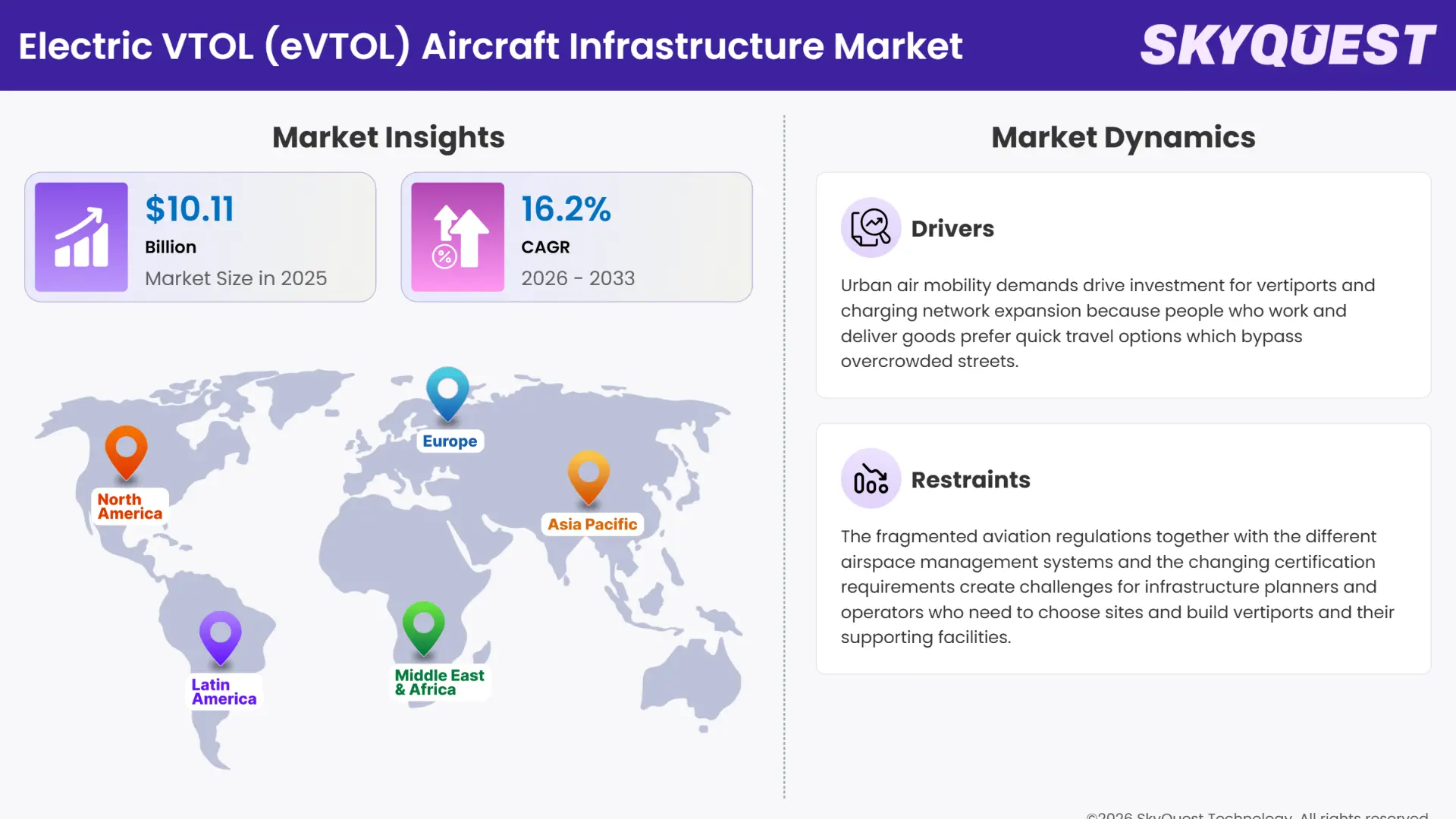
Global Electric Vtol (Evtol) Aircraft Infrastructure Market size was valued at USD 8.7 Billion in 2024 and is poised to grow from USD 10.11 Billion in 2025 to USD 33.6 Billion by 2033, growing at a CAGR of 16.2% during the forecast period (2026-2033).
Urban areas expand quickly, which leads to increased need for ground traffic relief through eco-friendly air transportation, so this situation has generated funding for vertiport and charging infrastructure and airspace control systems. The market includes essential operational components, which consist of physical airport facilities, charging and power distribution equipment, maintenance facilities, storage spaces, and digital systems that manage aircraft traffic. The infrastructure expansion operates as a decisive element that impacts passenger safety and operational dependability and travel expenses, while advancements in battery energy capacity and distributed propulsion systems and automated air traffic control systems have transitioned Joby and Volo copter and Lilium from concept development to practical piloting.
The eVTOL infrastructure development process develops from existing demonstrators through its energy and charging architecture, which controls how aircraft range and turnaround constraints establish the layout and building sites of the necessary facilities. The airports and hospitals need fast, high-power charging along with predictable grid capacity to maintain continuous flight operations so they need to upgrade their distribution systems through storage deployment, which creates business opportunities for microgrid developers and charging providers to establish contracts with vertiport operators. Energy solutions drive the site selection process and pricing models and partnerships through their real-world application, which includes airport shuttle services requiring fast turnarounds, emergency medical evacuations needing backup power, and nighttime cargo flights operating at lower rates.
How is AI Optimizing Vertiport Traffic Management in the Evtol Aircraft Infrastructure Market?
AI optimizes vertiport traffic management by combining predictive scheduling demand forecasting and real time conflict resolution with sensor fusion and adaptive routing. The system incorporates dynamic slot assignments, which enables smoother flight operations, and machine learning models, which predict times of maximum passenger demand while the system includes safety features through anomaly detection. The present state of the market has advanced to building operational networks for vertiports, which will enable airspace managers and operators to exchange information with each other. The system combines automated vertiport operation platforms with advanced low altitude traffic systems to create a seamless vehicle sequencing process, which enables reduced ground dwell time while supporting various vehicle types and charging requirements.
To get more insights on this market click here to Request a Free Sample Report
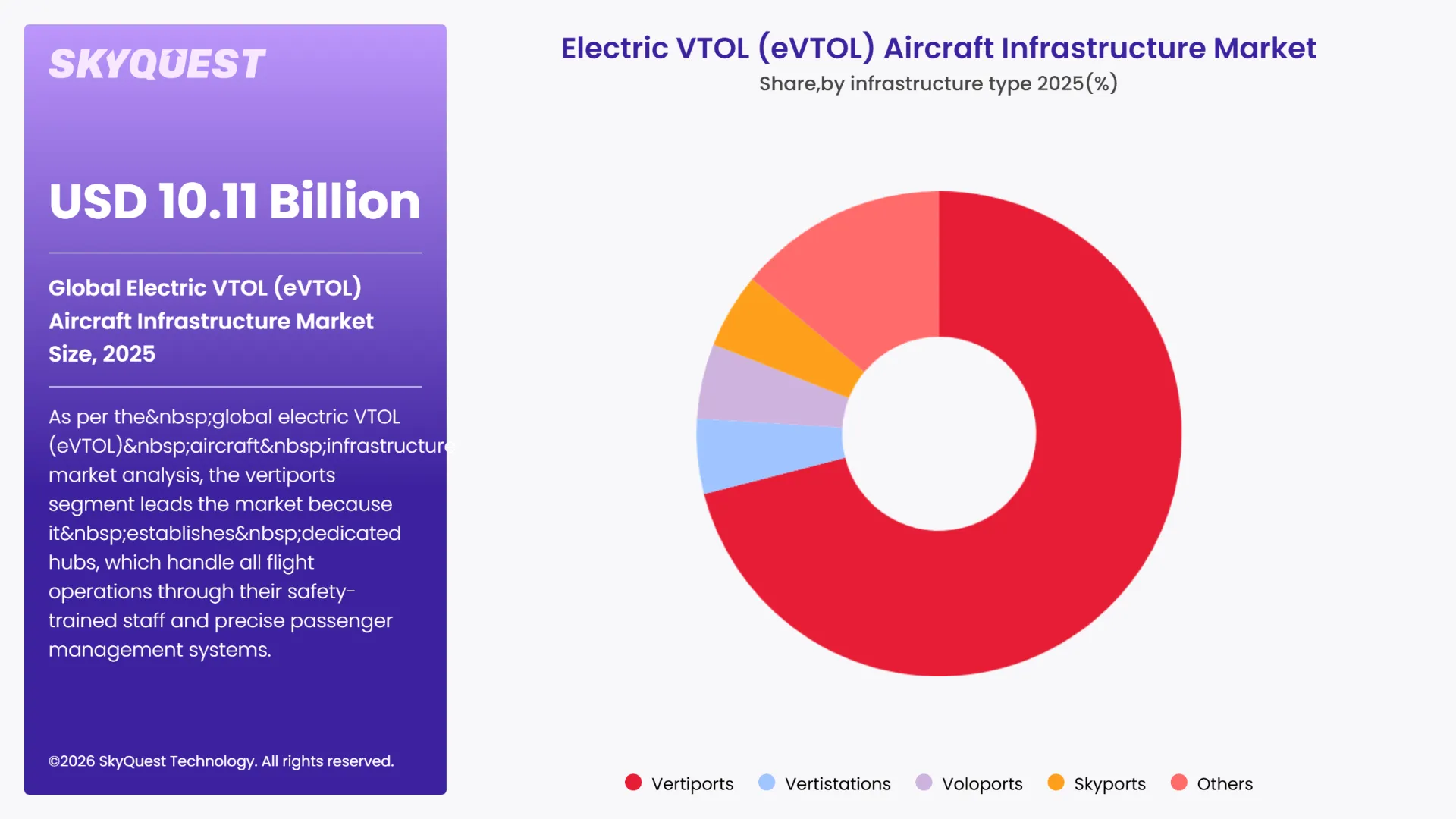
The global electric VTOL (eVTOL) aircraft infrastructure market is segmented based on infrastructure type, charging infrastructure, application, end user, and region. By infrastructure type, the market is categorized into vertiports, vertistations, voloports, skyports, and others. Based on charging infrastructure, it is segmented into wired charging and wireless charging. In terms of application, the market includes urban air mobility (UAM), intercity/regional air mobility, cargo & logistics, air ambulance & medical services, and others. Based on end users, it is divided into commercial operators, infrastructure developers, airport authorities, and others. Geographically, the market is segmented into North America, Europe, Asia Pacific, Latin America, and the Middle East & Africa.
As per the global electric VTOL (eVTOL) aircraft infrastructure market analysis, the vertiports segment leads the market because it establishes dedicated hubs, which handle all flight operations through their safety-trained staff and precise passenger management systems. Their capacity to expand through multimodal connection systems creates operational advantages, which leads to more funding from transportation firms and infrastructure construction companies. The centralized system design streamlines all regulatory approval steps through its unified processing, which generates early network effects that transform vertiports into the main centers for eVTOL route establishment and service reliability.
Whereas the skyports category has achieved the fastest growth rate because their modular rooftop deployment system allows quick installation into existing urban spaces through their compact design. The combination of their minimal land requirement and ability to cooperate with mixed use developments leads to increased interest from private developers and nontraditional operators, which fast-tracks the approval process for establishing extensive distributed networks that connect high-frequency short-range routes and new business use cases.
According to the global electric VTOL (eVTOL) aircraft infrastructure market forecast, the wired charging segment leads the market because it provides operators with charging power transfer, which has proven reliability and works with current battery systems, which enables operators to predict their aircraft turnaround times through the certification process. The system enables all existing electrical systems to connect with its low technical complexity while conducting training and maintenance operations, which helps infrastructure owners and service providers to establish charging workflows that maintainoperation reliability.
Whereas the wireless charging category is anticipated to have the largest electric VTOL (eVTOL) aircraft infrastructure market share because contactless power transfer technology removes the need for plug handling, which diminishes the requirement for ground crew presence, thus enabling autonomous operations that speed up turnaround times. The technology advances create pilot projects, which attract regulatory authorities and private investors who develop noninvasive eVTOL installations at vertical sites and rooftop areas that promote the distributed use of eVTOL services.
To get detailed segments analysis, Request a Free Sample Report
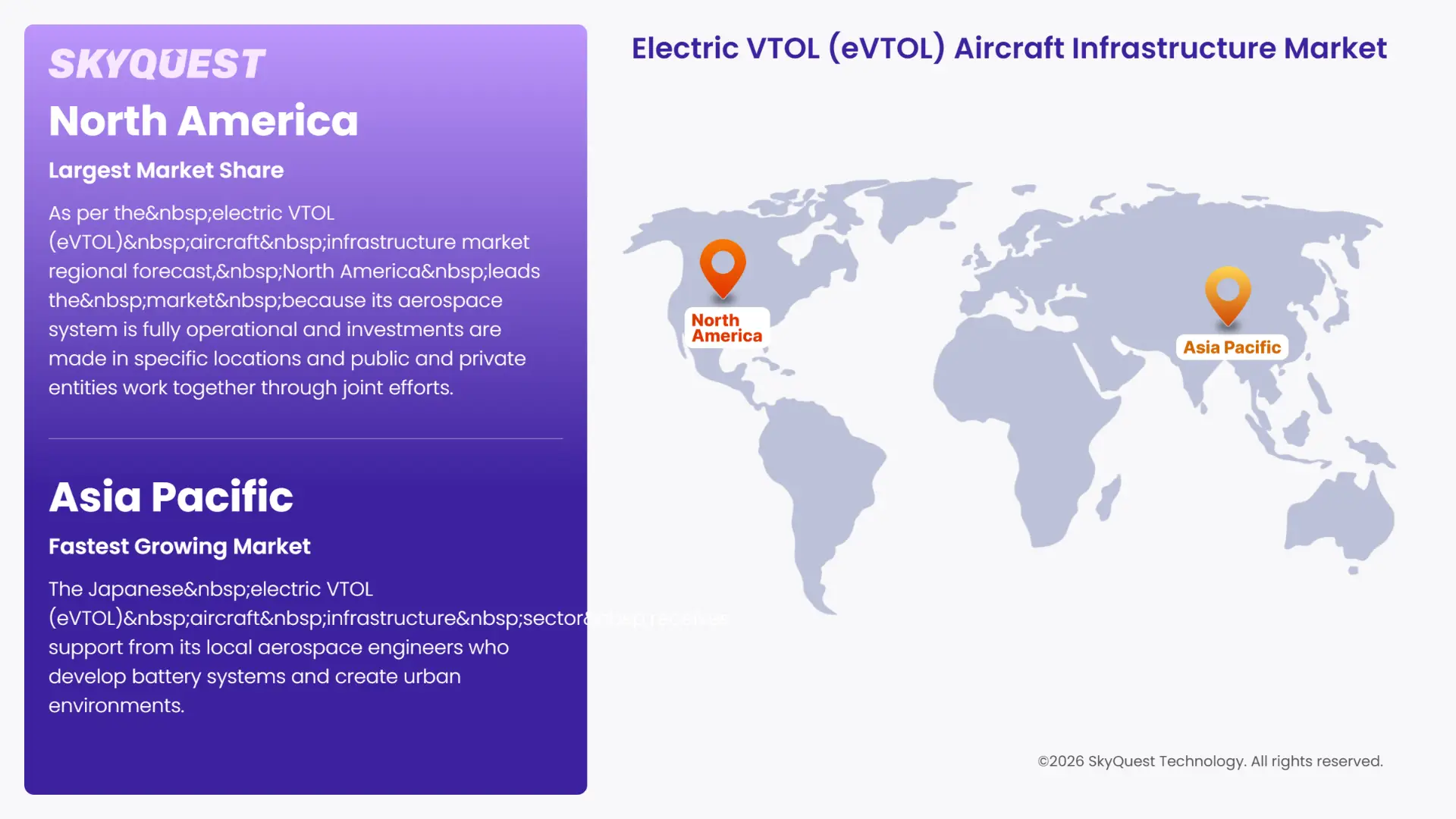
As per the electric VTOL (eVTOL) aircraft infrastructure market regional forecast, North America leads the market because its aerospace system is fully operational and investments are made in specific locations and public and private entities work together through joint efforts. Existing companies and creative new businesses unite to create experimental vertiport systems with major airports and energy companies and city planners. The testing corridors together with the certification pathways are enabled by the forward-thinking regulatory system which research institutions and testing facilities use to validate their technical work. The cross-sector partnerships and established supply chains enable organizations to implement airspace management systems and ground infrastructure systems while the demonstration programs create stakeholder relationships that help cities and customers become more confident in their ability to use large-scale systems.
The United States electric VTOL (eVTOL) aircraft infrastructure market outlook develops through its extensive network of manufacturers who supply equipment to research centers. The partnership between major airports and city planners helps to determine the appropriate locations for vertiports while combining energy requirements with operational methods. The combination of private funding and trained aviation professionals supports testing operations which can be expanded throughout urban transportation routes. The process of stakeholder engagement creates public trust which helps to shape urban development plans.
The Canadian electric VTOL (eVTOL) aircraft infrastructure sector benefits from its ability to create vertiport networks which connect distant areas with urban centers throughout its wide geographical coverage. The energy solutions testing activities and safety protocols of the provincial programs together with industry-government partnerships work toward building energy resilient systems. Existing heliport facilities and regional airlines can be utilized to create transportation services which fulfill the needs of remote communities and develop local supply chains and workforce training programs. The process of stakeholder engagement creates public acceptance, which leads to policy alignment.
The electric VTOL aircraft infrastructure industry in Asia Pacific experiences rapid development from cities establishing modern transportation systems together with their ability to create advanced manufacturing facilities and their commitment from governments to support development. The high levels of urban density and traffic congestion in cities lead them to investigate vertiports as additionaltransportation options alongside their existing mass transit systems. Domestic technology sectors in the country enable businesses to develop their own charging solutions through their expertise in batteries and power electronics and automation systems. The public sector initiation programs together with carrier airport and local authority collaboration pilots provide operational concept validation which speeds up regulatory processes. The regional collaboration together with knowledge sharing practices leads to the establishment of standardized solutions which enable efficient business operations across different urban environments.
The Japanese electric VTOL (eVTOL) aircraft infrastructure sector receives support from its local aerospace engineers who develop battery systems and create urban environments. The municipalities together with private developers work to establish vertiport sites while they build charging stations and develop routes for public transportation. The operational trials proceed through a controlled safety approach which includes both sound reduction and space management of land. The supply chain development and workforce training process is enabled by technology clusters which create a local workforce and both research and development resources. The process of stakeholder engagement creates public trust which helps to shape urban development plans.
The South Korean electric VTOL (eVTOL) aircraft infrastructure market uses its electronics and battery technologies together with its smart city projects to encourage the use of vertiports. The technology companies work closely with transportation operators and city governments to create unified charging systems which will enable both airspace management testing and multiple modes of transportation to operate together. The pilot demonstrations, which focus on safety and passenger experience, build confidence among stakeholders who will support the development of urban areas and the growth of domestic supply chains. Public-private partnerships create an environment where local innovation can occur.
The electric VTOL aircraft infrastructure market growth in Europe achieves its three main activities which include shared regulatory development, environmentally friendly urban development, and joint industrial projects. National authorities and regional aviation agencies work together to create certification methods and operational procedures which help simplify cross-border operations. Urban areas and transportation organizations require vertiport systems to connect with public transportation networks which create smooth multimodal travel routes while reducing land requirements. Research organizations in Europe and their industrial partners develop designs which produce less noise while their charging systems use energy efficiently through infrastructure which can be used in both urban and regional settings. The joint efforts of airports and mobility service providers and utility companies together with public involvement activities create social acceptance for infrastructure deployment while enabling cities to build their transport systems based on different regional laws.
The German electric VTOL (eVTOL) aircraft infrastructure market advances vertiport technologies through its combination of engineering resources and active manufacturing operations and joint research activities. The city authorities and transportation agencies assess how their systems can integrate with the main rail network and public transit stations while the utility companies and infrastructure operators develop secure charging networks and electricity grid synchronization methods. The development of operational frameworks requires standard sable safety procedures which provide essential environmental information to stakeholders. The targeted pilots drive innovation together with local adoption.
The United Kingdom electric VTOL (eVTOL) aircraft infrastructure market establishes requirements for vertiport facilities through its integration of urban areas with public transit systems and its active engagement of local communities. The airport authorities work together with city officials to test their charging systems and their airspace management operations and their passenger processing methods.The policy forums and their pilot programs establish procedures which enable operational standards to be developed while the private transportation organizations use their financial resources to create multimodal transportation systems which will operate in city regions. The public acceptance base established through noise management processes enables environmental-friendly expansion projects.
The French electric VTOL (eVTOL) aircraft infrastructure market uses its robust aerospace industry and its regional transit systems to establish its vertiport development initiatives. The airports and local authorities with technology companies work together to create solutions which reduce energy consumption and lower noise emissions and create efficient plans for land development. The pilot initiatives evaluate passenger journeys and the safety of operations while establishing links between new transportation systems and current transportation networks. The public outreach activities and the regulatory dialogues enable them to deploy their systems into regions which possess social licenses. Regional partnerships boost both innovation and execution of projects.
To know more about the market opportunities by region and country, click here to
Buy The Complete Report
Urban Air Mobility Demand
Urban air mobility demands drive investment for vertiports and charging network expansion because people who work and deliver goods prefer quick travel options which bypass overcrowded streets. The demand for development requires stakeholders to build infrastructure, create standardized landing areas, and establish ground connections to current transportation facilities. The private sector and municipal authorities work together to create infrastructure routes which assist eVTOL service operators in service planning and route selection through their space allocation of permissions and intermodal connections.
Advancements in Battery Technology
The advances in battery chemistry and energy density and thermal management systems create better practical range and reliability for eVTOL aircraft, which results in an increased need for charging stations and maintenance facilities to handle frequent aircraft operations. The improved battery performance enables designers to create fewer vertiports which should be situated at key locations to enhance charging solutions and safety procedures and ground handling systems. The manufacturing companies and infrastructure organizations create an ecosystem through their technology agreements which help them deploy their systems while decreasing the perceived obstacles for building widespread eVTOL networks.
Complex Regulatory Airspace Challenges
The fragmented aviation regulations together with the different airspace management systems and the changing certification requirements create challenges for infrastructure planners and operators who need to choose sites and build vertiports and their supporting facilities. The process to secure airspace integration and noise reduction and land use permissions from multiple authorities requires time which creates both time delays and complex project evaluations. The investors hold back because of regulatory uncertainties, which creates delays in reaching technical agreement and they stop the progress towards developing unified charging solutions and standard ground operations which are critical for statewide eVTOL system growth.
High Capital Investment Requirements
The infrastructure development process faces delays because of the high expenses which come with constructing vertiports and installing advanced charging systems and establishing proper urban locations. The specialized building projects require major financial investment for building safety measures and existing transport station system links which will deter small companies and municipal operators from supporting the project. The stakeholders make investment decisions based on their risk assessment and demand uncertainty which leads to gradual network development and reduced need for planning scalable infrastructure that can connect different transport systems.
Request Free Customization of this report to help us to meet your business objectives.
The market environment changes because charging providers and eVTOL manufacturers and vertiport developers compete to establish urban locations and gain permission to operate their vertical takeoff and landing aircraft. Companies gain market power through mergers and joint ventures and strategic investments which include Skyports obtaining significant city contracts and technical approvals while Urban-Air Port received strategic backing from Hyundai Supernal and niche companies developed modular charging solutions and vertical takeoff and landing product innovations.
Urban Vertiport Network Expansion: Strategic vertiport locations within urban centers and their outer areas emerge as a response to rising demand for quick air travel between cities and within city borders. To achieve site acceptance, developers implement three core factors which include multimodal linkages, land-use matching, and local community participation. The two groups work together to create better routes which reduce noise and make it easier for people to reach their destinations. The use of modular vertiport designs which can be expanded after their first phase boosts the speed of airport development. This development process allows airports to start with basic services which will build into complete airport networks while meeting both urban development plans and local business needs and sustainable transportation requirements.
Integrated Energy Infrastructure: The growth of eVTOL operations creates new funding opportunities for organizations which develop decentralized energy systems and smart charging stations that enable quick aircraft turnarounds while maintaining operational dependability. The three stakeholders work together to create a system which integrates battery storage facilities with renewable power generation and grid-responsive charging to decrease operational downtime and environmental damage. Infrastructure providers create their systems to work with multiple systems while they manage energy use and maintain system reliability during grid power outages. The current situation leads energy companies to team up with airport operators and technology providers to create systems which deliver operational reliability together with adaptable load management while achieving sustainability targets which match urban energy plans and international aviation decarbonization efforts.
SkyQuest’s ABIRAW (Advanced Business Intelligence, Research & Analysis Wing) is our Business Information Services team that Collects, Collates, Correlates, and Analyses the Data collected by means ofPrimary Exploratory Research backed by robust Secondary Desk research.
As per SkyQuest analysis, the global electric VTOL (eVTOL) aircraft infrastructure market will experience major expansion because urban areas are expanding rapidly and people want to reduce ground transportation congestion while battery technologies enhance both operational range and turnaround speed and operational dependability. North America leads the market because of its established aviation industry and successful collaboration between public and private organizations whereas vertiports have become the primary infrastructure category that handles all functions including aircraft landing, charging, and maintenance activities which connect with multiple transportation methods. The process of gaining location permits through standardization procedures becomes slower because of existing airspace regulations which create intricate challenges that must be resolved first. The success of urban air mobility networks depends on organizations from utilities and operators and regulators working together to convert technological potential into safe operational systems for urban areas.
| Report Metric | Details |
|---|---|
| Market size value in 2024 | USD 8.7 Billion |
| Market size value in 2033 | USD 33.6 Billion |
| Growth Rate | 16.2% |
| Base year | 2024 |
| Forecast period | 2026-2033 |
| Forecast Unit (Value) | USD Billion |
| Segments covered |
|
| Regions covered | North America (US, Canada), Europe (Germany, France, United Kingdom, Italy, Spain, Rest of Europe), Asia Pacific (China, India, Japan, Rest of Asia-Pacific), Latin America (Brazil, Rest of Latin America), Middle East & Africa (South Africa, GCC Countries, Rest of MEA) |
| Companies covered |
|
| Customization scope | Free report customization with purchase. Customization includes:-
|
To get a free trial access to our platform which is a one stop solution for all your data requirements for quicker decision making. This platform allows you to compare markets, competitors who are prominent in the market, and mega trends that are influencing the dynamics in the market. Also, get access to detailed SkyQuest exclusive matrix.
Table Of Content
Executive Summary
Market overview
Parent Market Analysis
Market overview
Market size
KEY MARKET INSIGHTS
COVID IMPACT
MARKET DYNAMICS & OUTLOOK
Market Size by Region
KEY COMPANY PROFILES
Methodology
For the Electric VTOL (eVTOL) Aircraft Infrastructure Market, our research methodology involved a mixture of primary and secondary data sources. Key steps involved in the research process are listed below:
1. Information Procurement: This stage involved the procurement of Market data or related information via primary and secondary sources. The various secondary sources used included various company websites, annual reports, trade databases, and paid databases such as Hoover's, Bloomberg Business, Factiva, and Avention. Our team did 45 primary interactions Globally which included several stakeholders such as manufacturers, customers, key opinion leaders, etc. Overall, information procurement was one of the most extensive stages in our research process.
2. Information Analysis: This step involved triangulation of data through bottom-up and top-down approaches to estimate and validate the total size and future estimate of the Electric VTOL (eVTOL) Aircraft Infrastructure Market.
3. Report Formulation: The final step entailed the placement of data points in appropriate Market spaces in an attempt to deduce viable conclusions.
4. Validation & Publishing: Validation is the most important step in the process. Validation & re-validation via an intricately designed process helped us finalize data points to be used for final calculations. The final Market estimates and forecasts were then aligned and sent to our panel of industry experts for validation of data. Once the validation was done the report was sent to our Quality Assurance team to ensure adherence to style guides, consistency & design.
Analyst Support
Customization Options
With the given market data, our dedicated team of analysts can offer you the following customization options are available for the Electric VTOL (eVTOL) Aircraft Infrastructure Market:
Product Analysis: Product matrix, which offers a detailed comparison of the product portfolio of companies.
Regional Analysis: Further analysis of the Electric VTOL (eVTOL) Aircraft Infrastructure Market for additional countries.
Competitive Analysis: Detailed analysis and profiling of additional Market players & comparative analysis of competitive products.
Go to Market Strategy: Find the high-growth channels to invest your marketing efforts and increase your customer base.
Innovation Mapping: Identify racial solutions and innovation, connected to deep ecosystems of innovators, start-ups, academics, and strategic partners.
Category Intelligence: Customized intelligence that is relevant to their supply Markets will enable them to make smarter sourcing decisions and improve their category management.
Public Company Transcript Analysis: To improve the investment performance by generating new alpha and making better-informed decisions.
Social Media Listening: To analyze the conversations and trends happening not just around your brand, but around your industry as a whole, and use those insights to make better Marketing decisions.
REQUEST FOR SAMPLE
 REQUEST FREE CUSTOMIZATION
Global Electric Vtol (Evtol) Aircraft Infrastructure Market size was valued at USD 8.7 Billion in 2024 and is poised to grow from USD 10.11 Billion in 2025 to USD 33.6 Billion by 2033, growing at a CAGR of 16.2% during the forecast period (2026-2033).
The competitive landscape is defined by rapid vertical integration and alliance formation as vertiport developers, charging providers and eVTOL OEMs race to secure urban sites and regulatory acceptance. Mergers, joint ventures and strategic investments are driving advantage; for example Skyports has secured major city projects and technical approvals while Urban-Air Port won strategic investment from Hyundai Supernal and niche firms are pushing modular charging and vertiport product innovation. 'Joby Aviation', 'Archer Aviation', 'Vertical Aerospace', 'Lilium', 'Bell Textron', 'Volocopter', 'BAE Systems', 'Hyundai Urban Air Mobility', 'Pipistrel', 'Zunum Aero', 'United Technologies (Collins Aerospace)', 'AeroMobil', 'electricVTOL', 'EHang', 'Karem Aircraft', 'Terrafugia', 'Wisk Aero', 'Skydrive', 'Ascent Flight Technologies', 'Vertiia'
Investment in vertiports and charging networks is encouraged by rising urban air mobility demand, as commuters and logistics providers seek efficient alternatives to congested surface transport. This demand motivates stakeholders to prioritize infrastructure development, standardize landing zones, and integrate ground systems with existing transport hubs. As operators plan routes and services, municipal authorities and private investors increasingly consider space allocation, permitting, and intermodal connectivity, creating a supportive environment for coordinated infrastructure deployment that enables the expansion and operational viability of eVTOL services.
Urban Vertiport Network Expansion: Demand for rapid intercity and intracity air mobility is driving strategic placement of vertiports within urban cores and peripheries. Developers prioritize multimodal connectivity, land-use compatibility, and community engagement to ensure site acceptance. Operators and planners coordinate with municipalities to optimize routing, noise mitigation, and ground access. The emphasis on modular, scalable vertiport designs accelerates phased rollouts, enabling initial service pilots to expand into full networks while aligning with urban planning objectives and local stakeholder priorities and sustainable transport integration goals.
North America Dominate the Global Electric VTOL (eVTOL) Aircraft Infrastructure Market?
eVTOL aircraft infrastructure refers to the ecosystem required to support electric vertical takeoff and landing operations, including vertiports, charging stations, air traffic management systems, and digital communication networks. This infrastructure is critical for enabling safe, efficient, and scalable urban air mobility, especially in densely populated cities where traditional runways are not feasible.
The market is driven by the rising demand for urban air mobility, increasing traffic congestion in cities, and the global push for sustainable transportation. Additionally, integration with smart city initiatives and advancements in 5G connectivity are accelerating infrastructure development by enabling real-time data sharing and efficient airspace management.


Want to customize this report? This report can be personalized according to your needs. Our analysts and industry experts will work directly with you to understand your requirements and provide you with customized data in a short amount of time. We offer $1000 worth of FREE customization at the time of purchase.
Feedback From Our Clients


 USA (+1) 351-333-4748

