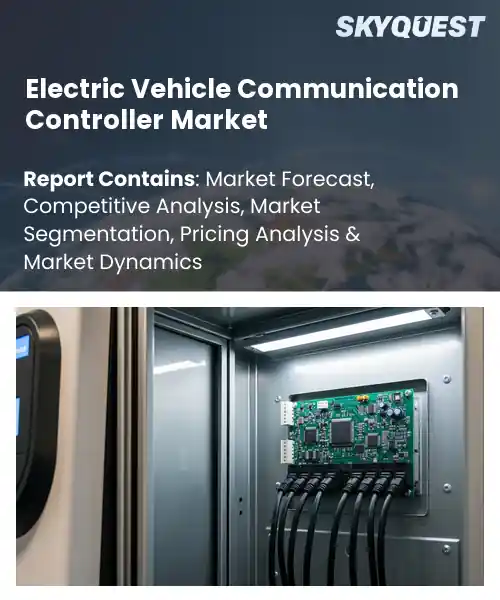
Electric Vehicle Communication Controller Market
Report ID: SQMIG25A2671
Report ID: SQMIG25A2671
[email protected]
USA +1 351-333-4748
Report ID:
SQMIG25A2671 |
Region:
Global |
Published Date: May, 2026
Pages:
157
|Tables:
143
|Figures:
78


Global Electric Vehicle Communication Controller Market size was valued at USD 1.82 Billion in 2024 and is poised to grow from USD 2.13 Billion in 2025 to USD 7.52 Billion by 2033, growing at a CAGR of 17.12% during the forecast period (2026-2033).
The electric vehicle communication controller industry is about hardware and software bits that handle encrypted information swapping between EVs, charging stations, and backend platforms. The main push behind this is the fast electrification of transportation, and the constant need for secure interoperable charging, not just “works sometimes” connections. This market matters because the communication controllers make smart charging possible, enable V2G services, and also support OTA updates, which help keep vehicles both safe and running efficiently.
In the past, the sector started with simple CAN bus gateways, then moved toward well-known protocols like ISO 15118 and OCPP. For instance, CCS stations adopting Plug and Charge show the shift from something niche into a necessary ingredient for scaling global charging networks. As these controllers sit underneath interoperable charging ecosystems, standardization becomes a major factor driving the global electric vehicle communication controller market growth. When automakers and charge point operators use ISO 15118 for Plug and Charge, and use OCPP as well, the integration headache decreases, and with it the deployment cost. That tends to speed up rollouts in places like Europe and North America. Less friction then turns into more opportunities for V2G trials, where energy can be bid into wholesale markets, and where fleet operators can orchestrate charging for cost reductions. It also lets utilities use aggregated EV demand for grid balancing. As a result, vendors offering modular, certified controllers can win share through smoother integration and services that actually monetize, and recurring revenue from ongoing connectivity and support.
Adding Internet of Things-style integration to electric vehicle communication controllers links vehicles, charging points, and grid services into one ongoing data flow. The key elements tend to be secure authentication, over-the-air software updates, real-time telemetry, and bidirectional energy movement. Together, these features allow smarter charging strategies and fleet management that feels more adaptive. Right now, the market is moving toward standards-driven interoperability, along with modular controller hardware that fits both vehicles and supply equipment. At the same time, vendors are rolling in edge processing and cloud-based diagnostics to improve uptime and reduce downtime surprises. Things like remote fault detection and flexible charging session management can make deployments more efficient, and also open new service pathways for OEMs and operators.
Market snapshot - (2026-2033)
Global Market Size
USD 1.82 Billion
Largest Segment
On-Board Communication Controllers
Fastest Growth
Off-Board Communication Controllers
Growth Rate
17.12% CAGR
To get more insights on this market click here to Request a Free Sample Report
The global electric vehicle communication controller market is segmented by type, protocol, application, vehicle type, sales, and region. Based on type, the market is segmented into On-Board Communication Controllers and Off-Board Communication Controllers. Based on protocol, the market is segmented into CAN Bus, CAN FD, Ethernet, and FlexRay. Based on application, the market is segmented into Battery Management, Charging Control, and Vehicle-to-Grid (V2G). Based on vehicle type, the market is segmented into BEV, PHEV, and HEV. Based on sales, the market is segmented into OEM and Aftermarket. Based on region, the market is segmented into North America, Europe, Asia Pacific, Latin America, and the Middle East & Africa.
As per the electric vehicle communication controller market analysis, the On-Board Communication Controllers segment shows up as the main part, because on-vehicle controllers act like the central hub for sensor fusion, domain controllers, and safety logic, all together making sure those real-time deterministic links stay in place between powertrain, battery management, and charging subsystems. When these are built into the vehicle ECUs, latency gets lower, and functional safety gets ensured, so OEMs lean toward hardened, automotive-grade controllers. Also, the way they tie in with in-vehicle networks and the validation routines are already well established, which makes their position stronger in control-critical architectures, reinforcing it all.
Meanwhile, Off-Board Communication Controllers are growing the fastest in a more noticeable way, since they let vehicles do bidirectional grid interactions, remote diagnostics, and over-the-air updates for fleets and even charging stations. The electrification of charging infrastructure keeps moving upward, and V2G services are expanding, so the need increases for cloud-linked, interoperable controllers. These help create recurring service revenues and also open additional business modes for energy management, which is why this part looks especially fast.
According to the electric vehicle communication controller market forecast, the Ethernet segment leads overall, mainly due to its high bandwidth and its support for time-sensitive networking. This means consolidated data transport can happen for cameras, lidar, and high-speed diagnostics, so domain convergence starts to look more realistic, and centralized compute becomes easier in EVs. Ethernet also scales well when large sensor loads show up, and it supports over-the-air software management, which reduces wiring clutter and speeds up system-level innovation. Due to that, controller designs tend to prioritize deterministic Ethernet stacks, and secure gateway functionality across different vehicle architectures.
Whereas the CAN FD category is predicted to have the largest electric vehicle communication controller market share. Manufacturers want higher throughput, but they still prefer keeping the existing CAN infrastructure, especially for more complicated battery management and charging control messages. At the same time, they try to retain familiar wiring practices. Backward compatibility helps a lot, and the implementation cost is lower too, so adoption is faster. This allows controllers that connect legacy networks to future higher-speed domains while keeping ecosystem alignment, without forcing a full replacement immediately.
To get detailed segments analysis, Request a Free Sample Report
As per the electric vehicle communication controller market regional forecast, Asia Pacific dominance is driven by concentrated manufacturing capacity, integrated supply chains, and strong alignment between vehicle makers and electronic component suppliers. There are established automotive clusters in key markets that help with rapid adoption of advanced communication controller architectures, while also diverse mobility ecosystems push deployment across passenger as well as commercial platforms. Policy support and urban charging infrastructure make it easier for interoperability standards to stick, and for vendor collaboration to happen. Then you get robust supplier ecosystems that keep a close feedback loop between controller developers and automakers, so refinement of protocols, cybersecurity defenses, and functional safety approaches speeds up. Also regional leadership in semiconductor production and systems integration locks in the advantage, which basically positions Asia Pacific as the primary innovator and manufacturer in the global electric vehicle communication controller space. And because component suppliers are close by, lead times shrink, and iterative development cycles are smoother, bringing more resilient, standards compliant controller solutions to market faster, more efficiently.
Japan Electric Vehicle Communication Controller Market
The Electric Vehicle Communication Controller Market in Japan benefits from a mature automotive supply chain and deep expertise in systems integration. OEMs and tier suppliers do protocol convergence and cybersecurity practices together, and that leads to tailored controller designs for electrified platforms. Reliability, compactness, and software-defined features shape the product road maps, while domestic semiconductor and electronic manufacturing strengths give secure sourcing and support for sophisticated controller development and iterative validation with automaker partners.
South Korea Electric Vehicle Communication Controller Market
The Electric Vehicle Communication Controller Market in South Korea reflects strong electronics manufacturing capability and advanced semiconductor integration. Tier suppliers and vehicle manufacturers work closely to roll out high-performance controller solutions, optimized for local powertrain architectures. There’s a heavy emphasis on connectivity, real-time diagnostics, and security, which helps drive innovative controller functionality. Also, the culture of rapid prototyping helps speed up software updates. Supply chain agility and partnerships with chipset vendors boost competitiveness and accelerate integration across vehicle platforms.
The European rapid electric vehicle communication controller market penetration is being boosted by coordinated regulatory frameworks, a serious OEM push toward electrification, and a rising focus on interoperable charging and communication standards. In practice, it offers solid supplier pool and collaborative research ecosystems that help shape controllers able to address local safety, functional, and cyber resilience needs, even when requirements differ a bit by region. Meanwhile, public and private funding for charging infrastructure and pilot rollouts basically give real-world test benches for advanced controller features, along with diagnostics that can be observed in motion. The market shape rewards modular, software-driven designs, so vendors can localize faster and still satisfy multiple national rules without too much friction. Strategic alliances between automakers and electronics specialists make scalable integration more doable, while the appetite for premium as well as commercial electrified vehicles drives more distinctive controller functions and service-centric offerings.
Germany Electric Vehicle Communication Controller Market
In Germany, the Electric Vehicle Communication Controller Market benefits from a tight automotive manufacturing ecosystem and solid engineering know-how. OEMs and tier suppliers co-develop sturdy controller solutions that lean on safety, functional integration, and compatibility with European communication protocols, too. People with experience in power electronics and systems integration help shape controller topologies, and the after-sales networks then enable maintenance and software support, overall. There’s also collaboration with research institutions and pilot deployments in commercial fleets, which speeds up pragmatic refinement and adoption, in a way.
United Kingdom Electric Vehicle Communication Controller Market
In the United Kingdom, the Electric Vehicle Communication Controller Market has an innovation environment where software talent really nudges the controller design. Startups, together with well-known suppliers, pioneer more adaptable, software-led architectures that focus on connectivity and over-the-air update capabilities. When they collaborate with fleet operators and technology firms, the result tends to be better real-world validation and clearer commercial applications. On top of that, policy backing for low-emission mobility and the expansion of charging networks encourage more localized solutions and partnerships between automakers and tech specialists.
France Electric Vehicle Communication Controller Market
The Electric Vehicle Communication Controller Market in France features integration with domestic vehicle programs and collaboration with system integrators. Suppliers prioritize adaptable controller platforms that meet national safety norms and support varied charging ecosystems. R&D in urban mobility and energy management informs controller feature sets, while partnerships with European consortia aid protocol alignment. Interest in commercial electrification and retrofit solutions expands opportunities for localized controller innovations and services, and aftermarket support models.
North America is strengthening its position via concentrated technology spending, really strong software ecosystems, and partnerships that bridge the automotive world with semiconductor capabilities. Automotive OEMs are folding in advanced controller features, largely driven by a big focus on connectivity, cybersecurity, and over-the-air serviceability, so the whole thing feels smoother than before. At the same time, there’s a solid startup scene and an active supplier network, which helps with rapid prototyping and custom controller designs for different vehicle types. On top of that, regional incentives are leaning toward domestic sourcing, and collaboration with chipset vendors, which in turn supports secure supply chains.
Cross-border cooperation between manufacturers and technology firms also helps with scalable integration and keeps the whole thing aligned with regional regulatory expectations, which can be a bit of a moving target. This reinforces North America as a growing hub for controller innovation and deployment, since the ecosystem seems to mature faster there. Investment in testing facilities, cybersecurity certification programs, and telematics platforms helps ensure those controllers meet tight reliability standards and data protection needs. And it also enables new service models that weren’t really feasible before.
United States Electric Vehicle Communication Controller Market
The Electric Vehicle Communication Controller Market in the United States is defined by strong software development abilities, with an emphasis on cybersecurity and telematics. OEMs and technology companies work together on scalable, cloud-enabled controller architectures that support over-the-air updates and data-led service models. There’s also strong demand for commercial vehicle connectivity and fleet telematics, which pushes specialized controller functions forward. Partnerships with semiconductor firms and testing organizations validate performance and security, and that makes it easier to integrate into real vehicle programs.
Canada Electric Vehicle Communication Controller Market
The Electric Vehicle Communication Controller Market in Canada shows collaboration between automotive suppliers and energy utilities to align controllers with distributed charging infrastructure. Suppliers tend to prioritize interoperability, energy management features, and resilience for different climate conditions. Pilot projects with fleet operators and municipal initiatives give real-world testing, along with practical feedback, for later refinement. Partnerships with research institutions and suppliers help adjust designs for North American regulatory requirements and connectivity expectations, while still supporting local service models.
To know more about the market opportunities by region and country, click here to
Buy The Complete Report
Drivers
Increasing Demand For Connected Vehicles
Expanding Charging Infrastructure Integration
Restraints
High Implementation Complexity
Fragmented Industry Standards
Request Free Customization of this report to help us to meet your business objectives.
Competition in the EV communication controller market is getting more intense as AFIR-driven ISO 15118 rules start to bite and basically force suppliers to ship ISO 15118-20-ready EVCC and SECC solutions. The big, established vendors keep going for M&A and various partnerships, for instance, Wallbox bought ABL in 2023, and Blink stitched together regional networks. Meanwhile, the tier one suppliers AND smaller startups are pushing product novelty, like Sensata, which rolled out a next-generation EVCC in January 2026, and KameCore is selling modular SECC modules.
Top Player’s Company Profile
Recent Developments in the Electric Vehicle Communication Controller Market
SkyQuest’s ABIRAW (Advanced Business Intelligence, Research & Analysis Wing) is our Business Information Services team that Collects, Collates, Correlates, and Analyses the Data collected by means of Primary Exploratory Research backed by robust Secondary Desk research.
As per SkyQuest analysis, the global electric vehicle communication controller market is set up for strong growth. One main reason is the fast electrification push, along with the need for secure, interoperable charging that supports smart charging and V2G-style services. Another reason is IoT integration, using edge and cloud diagnostics, which makes over-the-air updates more practical and supports fleet optimization. A downside, though, is the high implementation complexity and fragmented standards that can slow adoption, and also push up integration expenses a bit. Asia Pacific is leading the market, mostly because of dense manufacturing clusters and well-knit supply chains. At the same time, the onboard communication controller segment is the one moving out front, functioning like the central hub for vehicle system integration and safety logic. Vendors who deliver modular, certified controllers can pick up market share, since they help teams accelerate the integration work, and they can also earn recurring service revenues.
| Report Metric | Details |
|---|---|
| Market size value in 2024 | USD 1.82 Billion |
| Market size value in 2033 | USD 7.52 Billion |
| Growth Rate | 17.12% |
| Base year | 2024 |
| Forecast period | (2026-2033) |
| Forecast Unit (Value) | USD Billion |
| Segments covered |
|
| Regions covered | North America (US, Canada), Europe (Germany, France, United Kingdom, Italy, Spain, Rest of Europe), Asia Pacific (China, India, Japan, Rest of Asia-Pacific), Latin America (Brazil, Rest of Latin America), Middle East & Africa (South Africa, GCC Countries, Rest of MEA) |
| Companies covered |
|
| Customization scope | Free report customization with purchase. Customization includes:-
|
To get a free trial access to our platform which is a one stop solution for all your data requirements for quicker decision making. This platform allows you to compare markets, competitors who are prominent in the market, and mega trends that are influencing the dynamics in the market. Also, get access to detailed SkyQuest exclusive matrix.
Table Of Content
Executive Summary
Market overview
Parent Market Analysis
Market overview
Market size
KEY MARKET INSIGHTS
COVID IMPACT
MARKET DYNAMICS & OUTLOOK
Market Size by Region
KEY COMPANY PROFILES
Methodology
For the Electric Vehicle Communication Controller Market, our research methodology involved a mixture of primary and secondary data sources. Key steps involved in the research process are listed below:
1. Information Procurement: This stage involved the procurement of Market data or related information via primary and secondary sources. The various secondary sources used included various company websites, annual reports, trade databases, and paid databases such as Hoover's, Bloomberg Business, Factiva, and Avention. Our team did 45 primary interactions Globally which included several stakeholders such as manufacturers, customers, key opinion leaders, etc. Overall, information procurement was one of the most extensive stages in our research process.
2. Information Analysis: This step involved triangulation of data through bottom-up and top-down approaches to estimate and validate the total size and future estimate of the Electric Vehicle Communication Controller Market.
3. Report Formulation: The final step entailed the placement of data points in appropriate Market spaces in an attempt to deduce viable conclusions.
4. Validation & Publishing: Validation is the most important step in the process. Validation & re-validation via an intricately designed process helped us finalize data points to be used for final calculations. The final Market estimates and forecasts were then aligned and sent to our panel of industry experts for validation of data. Once the validation was done the report was sent to our Quality Assurance team to ensure adherence to style guides, consistency & design.
Analyst Support
Customization Options
With the given market data, our dedicated team of analysts can offer you the following customization options are available for the Electric Vehicle Communication Controller Market:
Product Analysis: Product matrix, which offers a detailed comparison of the product portfolio of companies.
Regional Analysis: Further analysis of the Electric Vehicle Communication Controller Market for additional countries.
Competitive Analysis: Detailed analysis and profiling of additional Market players & comparative analysis of competitive products.
Go to Market Strategy: Find the high-growth channels to invest your marketing efforts and increase your customer base.
Innovation Mapping: Identify racial solutions and innovation, connected to deep ecosystems of innovators, start-ups, academics, and strategic partners.
Category Intelligence: Customized intelligence that is relevant to their supply Markets will enable them to make smarter sourcing decisions and improve their category management.
Public Company Transcript Analysis: To improve the investment performance by generating new alpha and making better-informed decisions.
Social Media Listening: To analyze the conversations and trends happening not just around your brand, but around your industry as a whole, and use those insights to make better Marketing decisions.
REQUEST FOR SAMPLE
 REQUEST FREE CUSTOMIZATION
Global Electric Vehicle Communication Controller Market size was valued at USD 1.82 Billion in 2024 and is poised to grow from USD 2.13 Billion in 2025 to USD 7.52 Billion by 2033, growing at a CAGR of 17.12% during the forecast period (2026-2033).
Competition in the EV communication controller market is intensifying as AFIR driven ISO 15118 mandates force suppliers to deliver ISO 15118-20 ready EVCC and SECC solutions. Established vendors pursue M&A and partnerships, for example Wallbox acquired ABL in 2023 and Blink consolidated regional networks. Tier one suppliers and startups push product innovation, for example Sensata launched a next generation EVCC in January 2026 and KameCore offers modular SECC modules. 'Robert Bosch GmbH', 'Continental AG', 'Denso Corporation', 'Aptiv plc', 'NXP Semiconductors', 'Texas Instruments', 'STMicroelectronics', 'Infineon Technologies', 'Renesas Electronics', 'Valeo SA', 'Lear Corporation', 'Delphi Technologies', 'Qualcomm Technologies', 'Nvidia Corporation', 'Harman International (Samsung)', 'Visteon Corporation', 'Panasonic Automotive', 'Marelli Holdings', 'Ficosa International', 'ACTIA Group'
Growing consumer and manufacturer preference for connected electric vehicles is driving adoption of advanced communication controllers, as these components enable seamless data exchange between vehicle subsystems, external infrastructure, and cloud services. The need for reliable, secure in-vehicle communication to support functions such as remote diagnostics, firmware updates, energy management, and coordination with charging networks increases the importance of robust controllers. As automakers integrate more software-defined features and connectivity services, demand for sophisticated communication controllers rises to ensure interoperability, reduce latency, and maintain safety and user experience.
Connectivity Platform Convergence: EV communication controllers are evolving from isolated modules into integrated connectivity hubs that unify vehicle networks, telematics, cloud services and third-party ecosystems. This trend emphasizes modular software frameworks, secure over-the-air update pathways and seamless integration with smart charging and mobility services. OEMs and suppliers prioritize interoperability, reduced development cycles and enhanced customer experience through continuous feature delivery. The shift fosters strategic partnerships, recurring revenue models and differentiated service offerings tied to vehicle lifecycle management and data-driven services.
Why does Asia Pacific Dominate the Global Electric Vehicle Communication Controller Market? |@12


Want to customize this report? This report can be personalized according to your needs. Our analysts and industry experts will work directly with you to understand your requirements and provide you with customized data in a short amount of time. We offer $1000 worth of FREE customization at the time of purchase.
Feedback From Our Clients


 USA (+1) 351-333-4748

