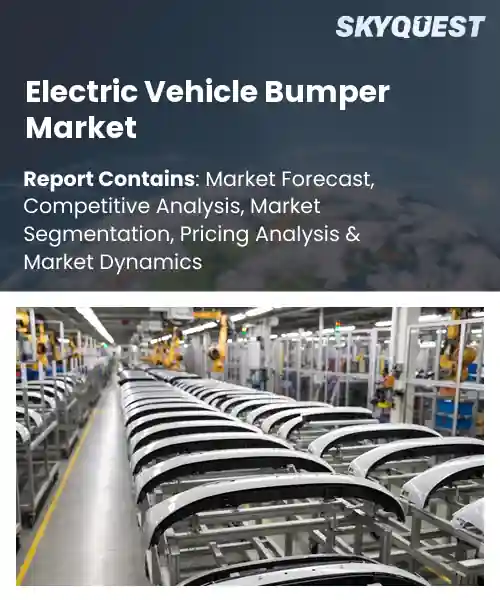
Electric Vehicle Bumper Market
Report ID: SQMIG25A2642
Report ID: SQMIG25A2642
[email protected]
USA +1 351-333-4748
Report ID:
SQMIG25A2642 |
Region:
Global |
Published Date: February, 2026
Pages:
157
|Tables:
114
|Figures:
77


Global Electric Vehicle Bumper Market size was valued at USD 3.1 Billion in 2024 and is poised to grow from USD 3.78 Billion in 2025 to USD 18.29 Billion by 2033, growing at a CAGR of 21.8% during the forecast period (2026-2033).
The electric vehicle bumper industry centers on front and rear assemblies that combine impact management, pedestrian protection and sensor integration specifically tailored for battery electric drivetrains. It matters because bumpers serve as structural and electronic platforms that protect costly battery packs and enable advanced driver assistance, changing value for OEMs and suppliers.
Market development has moved from simple energy absorbers to multifunctional modules as early EVs prompted redesigns; for example, Tesla and BMW integrated radar mounts and reinforced crash structures while Chinese manufacturers adopted thermoplastic composites.
Regulatory tightening and consumer demand for safety have steadily elevated bumper innovation and differentiation. A key growth driver is convergence of advanced driver assistance sensors with structural bumper design, because mounting radars, cameras and ultrasonic modules into bumpers shifts priorities toward electromagnetic transparency, precise alignment and impact energy management. As a result suppliers invest in sensor-friendly thermoplastics and modular architectures that reduce assembly and repair costs while improving crash performance. Examples include Tesla embedding radar and ultrasonics in front fascias while European OEMs tune bumper structures to score high in Euro NCAP pedestrian and safety assist tests. Consequently, aftermarket demand for OEM-grade replacements rises, and opportunities emerge in recyclable materials and digital manufacturing solutions.
How is AI-driven Automation Reshaping the Electric Vehicle Bumper Market?
AI driven automation is reshaping the electric vehicle bumper market by linking smarter design with more reliable production. Key aspects include computer vision for surface inspection, machine learning for predictive maintenance, and flexible robots for precise assembly. The market context is shifting because bumpers now house sensors and must be lighter and more durable. Manufacturers are moving from purely mechanical lines to data driven operations that improve fit and finish and support complex sensor integration. Companies that combine advanced materials with automated quality systems can deliver bumpers that meet safety and aerodynamic goals while shortening development cycles and reducing rework.
Market snapshot - 2026-2033
Global Market Size
USD 3.1 Billion
Largest Segment
Plastic Bumpers
Fastest Growth
Plastic Bumpers
Growth Rate
21.8% CAGR
To get more insights on this market click here to Request a Free Sample Report
Global electric vehicle bumper market is segmented into material type, vehicle type, manufacturing process, distribution channel and region. Based on material type, the market is segmented into plastic bumpers and metal bumpers. Based on vehicle type, the market is segmented into passenger vehicles and commercial vehicles. Based on manufacturing process, the market is segmented into injection molding, blow molding and others. Based on distribution channel, the market is segmented into OEMs and aftermarket suppliers. Based on region, the market is segmented into North America, Europe, Asia Pacific, Latin America and Middle East & Africa.
As per electric vehicle bumper market outlook, the plastic bumpers segment of the market is leading all other segments of the market due to their lightweight construction and ability to provide design flexibility; both of these characteristics help satisfy electric vehicle priorities, such as efficiency in range and ability to create complex energy absorption geometries. The design of bumpers made of plastic provides a means for the manufacturer to decrease the number of parts that will be required for assembly, thus decreasing manufacturing complexity and costs at the same time supporting aerodynamics and corrosion resistance, both attributes that contribute to overall vehicle durability and serviceability. As per electric vehicle bumper market analysis, the metal bumpers segment is currently one of the fastest-growing segments as a result of the increasing need for strength, stiffness, and durability due to the changing architecture of electric vehicles, which is resulting in greater demand for new construction methods in the assembly of all types of vehicles especially in heavier vehicle platforms and vehicles using robust and durable attachment points for battery enclosures or active safety systems. Growing interest from the aftermarket sector combined with technological advancements in the use of hybrid materials in the manufacture of bumpers has created new opportunities to provide premium safety products using premium raw materials and provides consumers with the safest possible options.
As per electric vehicle bumper market forecast, injection molding technology leads to their precision and repeatability. This process reduces the need for secondary assembly, improves fit and finish favored by OEMs, and accommodates a wide range of thermoplastic materials including formulations designed for recyclability, thereby aligning production efficiency with emerging sustainability requirements.
The blow molding segment is seeing the highest increase in terms of as manufacturers explore new lightweight hollow bumper designs that have excellent impact energy absorption while minimizing the amount of material used. New developments in the tools and materials used in blow molding will expand the use of large parts for manufacturers and provide new and exciting design possibilities for designers looking to create new styles for EVs and increase their efficiencies with alternative material sources.
To get detailed segments analysis, Request a Free Sample Report
As per electric vehicle bumper market regional forecast, the Asia Pacific region has a strong presence in the automotive supply chain by virtue of its vast automotive manufacturing supply chain infrastructure, which also benefits from major electric vehicle manufacturing investments and electric vehicle component engineering investments. Some examples of strengths to the Asia Pacific automotive supply chain include existing established automotive supplier networks with the capability of quickly scaling up production of automotive bumpers, existing established automotive supply chain capabilities to integrate sensors and active safety features into vehicle bumpers, and existing cost-effective manufacturing operations, which provide both an attractive platform for domestic and export demand.
The Japan electric vehicle bumper market is characterized by high levels of precision in the manufacturing process and strong collaborative relationships between OEM's and specialized suppliers. Integration of advanced safety systems, superior surface finishes, and lightweight composite bumper structures are key attributes of the JVEBM, along with adherence to high quality standards. Engineering excellence and disciplined manufacturing practices allow for the development of sensor-ready bumper modules that have consistent fit and finish.
The South Korea electric vehicle bumper market is characterized by highly innovative and agile manufacturing clusters, along with close collaboration/coordination between automotive manufacturers and electronic component suppliers, which allows for rapid integration of sensors. Suppliers emphasize the use of lightweight thermoplastic resins, advanced coating processes, and modular bumper designs that facilitate high-speed assembly and exportability. The Korean automotive supply chain is comprised of a culture that is focused on quickly evolving the material used to produce automotive products through continuous improvement of production processes to achieve cost effective scalability and innovation using new materials and accommodation of sensors.
As per electric vehicle bumper market regional outlook, the market is growing rapidly throughout Europe due to a combination of exceptional automotive engineering, a strong focus on regulatory safety and environmental sustainability, and an active supplier community focused on lightweight materials and integrating driver assistance systems. Europe has a well-developed network of cross-border supply chains as well as an established aftermarket for specialized, customized bumper systems. Many suppliers are investing in testing, certification, and crashworthiness design to establish the credibility of their products. Market growth has also resulted from a vibrant design culture that values the aesthetic integration of products with functional safety, driving suppliers to develop unique and sensor-ready bumper systems.
The electric vehicle bumper market in Germany is supported by deep-rooted automotive engineering traditions and a strong supplier network focused on high-performance bumper systems that are compliant to regulations. Strong collaboration between OEMs and specialized bumper manufacturers helps advance the integration of sensors, crash-management functionality, and lightweight composite bumper structures. In addition, the bumper market utilizes precision tooling, robust testing protocols, and modular design approaches in support of premium vehicle supply chains and continuous improvement to technology leadership.
The UK electric vehicle bumper market has a rapidly developing ecosystem of innovative designers and flexible suppliers who are focusing on creating a combination of lightweight materials and bumpers compatible with various types of sensors. Collaboration among automotive start-ups, tier suppliers and academic institutions enables the rapid prototyping and testing of new composites and their integration methods. Modular manufacturing practices that allow for customization support the development of niche vehicle segments and the aftermarket, allowing for greater supplier responsiveness to changing market conditions and further driving design innovation across the market.
The France electric vehicle bumper market continues to develop rapidly because of the country’s long-standing design-oriented culture and focus on achieving a lightweight and aesthetically pleasing integration of their bumper systems. Manufacturers work to achieve the latest in materials science by incorporating cutting-edge composites with sophisticated surface finish techniques and providing for the installation of sensors into all principal components of the bumper system. Collaborative efforts between automakers, material scientists, and design firms are resulting in a more rapid and effective transition from concept to production. Investment in modular manufacturing lines and in the innovation of new techniques has created an excellent environment for the differentiation of suppliers within this industry, while also enhancing the ability of suppliers to provide additional capabilities to their customers.
As per electric vehicle bumper industry analysis, the role of North America is being improved by three strategies supplier consolidation; investment in local manufacturing;collaboration between automotive manufacturers, electronics firms, and materials companies. The application of advanced manufacturing technologies (i.e., sensor-ready and modular bumpered systems) enables manufacturers to create products that can accommodate the changing architecture of vehicles.
Electric vehicle bumper market in the United States is shaped by major automotive manufacturers and a broad supplier ecosystem that emphasizes scalable production, integration of advanced safety sensors, and materials innovation. Emphasis on modular design and rapid tooling enables adaptation across vehicle segments while collaboration with electronics suppliers accelerates sensor-ready bumper modules.
The Canada electric vehicle bumper market is focused on the local supply chain partners; researching and developing lightweight composite materials; Corrosion resistant coatings; Finishing quality that meets or exceeds the requirements dictated by extreme environmental climates; To support growth of North America’s major automotive OEM Centers by sharing technical design and development competence; Building supplier capacity for sustainable, recyclable material production; Developing engineering partnerships with the university or commercial research institutions to create differentiated bumper solutions to meet domestic market requirements and niche export opportunities.
To know more about the market opportunities by region and country, click here to
Buy The Complete Report
Rising Electric Vehicle Adoption
With the increasing adoption of electric vehicles (EVs), the demand for specialized components such as bumpers, designed specifically to meet the new standards for safety, weight, and aerodynamics, will grow as more manufacturers transition to EV platforms. In terms of design for these new vehicle types, manufacturers will increasingly focus on materials and structures that will optimize energy absorption and improve battery packaging and thermal energy management through research and collaboration with suppliers to produce the EV-specific bumpers. As a result, suppliers will expand their product catalogs and support market growth by increasing their procurement and specification of bumpers that comply with EVs.
Favorable Government Incentives
As the demand for EVs increases, government incentives encourage both manufacturers and consumers to focus on EVs, which, in turn, will increase the demand for EV-specific components such as ergonomically designed bumpers that meet the requirements for both safety and efficiency. Government policies that support the electrification of vehicles result in manufacturers working toward refining the specifications of the product they purchase from suppliers. Therefore, manufacturers will want to ensure their suppliers are able to properly supply them with the products that comply with current standards and are in compliance with all regulatory and performance testing criteria, which will lead to an assurance of procurement for many years for EV-specific components such as bumpers.
High Material and Manufacturing Costs
Rising material and production costs are creating additional price pressures on OEMs and suppliers, making the implementation of new advanced bumper technologies economically less attractive for a variety of vehicle programs. Suppliers have significantly higher costs associated with using lightweight alloys, composites and specializedtooling which may hinder the ability to invest in product innovations and building capacity. For those vehicle classes where cost sensitivity represents significantly high-volume demand, buyers may choose lower-cost options or design changes to current specifications, thus hindering new bumper designs developed for electric vehicles from entering the marketplace and aiding the overall growth of the market.
Lack of Standardization of Components
Lack of standardization of components across electric vehicle platforms will require bumper suppliers to design multiple bespoke bumper designs to support different dimension, safety and integration requirements which will lead to increased development times and resource commitments. Resulting fragmentation will reduce economies of scale and will create additional complexity for suppliers to become qualified by OEMs, thus providing additional barriers to producing in quantities needed for mass production and widespread adoption of new advanced bumper technologies. Manufacturers may postpone updates to their specifications or favour modular, yet far less optimized, alternatives which will limit the rapid expansion and efficiency improvements in the electric vehicle bumper market.
Request Free Customization of this report to help us to meet your business objectives.
The competitive landscape of the global electric vehicle bumper market comprises factors like consolidation amongst Tier 1 Suppliers; rising OEM requirements for lightweight recyclable materials and integrated sensors; and Supplier differentiation based on technology, alliance/partnerships and product offering(s). Many leading players are looking for M&A and co-development opportunities as evidenced by the recent intelligent exterior expansion initiative by Plastic Omnium and the other collaborations undertaken for research purposes. Additionally, many suppliers are currently investing in automated production methods or EV specific supply arrangements to secure OEM contracts.
Sustainability Driven Materials Shift: To meet the growing demand for lightweight, recyclable, and bio-based materials for bumpers, manufacturers are collaborating with automotive companies on the development of materials that support broader sustainability efforts and meet consumer demands. Together, they are working toward developing sustainable solutions that promote the recycling of products at the end of life through circularity and have less of an impact on the environment throughout their lifecycle. The way vehicles and their components are designed increasingly reflects the ability to be repaired or modified to reduce total ownership costs, achieve regulatory compliance goals, and enhance brand equity. In addition, the increasing use of sustainable materials in bumpers will have a significant impact on the way suppliers are selected and how electric vehicle bumpers are designed and developed across the entire ecosystem.
Demand for Advanced Sensor Integration: Demand for bumpers that incorporate advanced sensor technology and active safety systems is rapidly increasing. To enhance pedestrian safety and enable autonomous operation of vehicles, automotive manufacturers are looking for ways to integrate sensors, wiring, and energy-absorbing structures into bumpers without compromising the appearance or performance of the vehicle. This electric vehicle bumper market trend is leading to the creation of cross-disciplinary engineering teams that bring together engineers from the body, electrical, and safety disciplines to create bumpers that can accommodate the space and structure required for sensors while maintaining their intended function. To accommodate this growing demand, suppliers are enhancing their capabilities in embedded electronics, thermal management, and software calibration, which will allow them to offer their customers complete module solutions.
SkyQuest’s ABIRAW (Advanced Business Intelligence, Research & Analysis Wing) is our Business Information Services team that Collects, Collates, Correlates, and Analyses the Data collected by means of Primary Exploratory Research backed by robust Secondary Desk research.
As per SkyQuest analysis, electric vehicle adoption is on the rise and drives OEMs (original equipment manufacturers) to embrace integrated lightweight bumper systems. Another driver of this trend is the increased need for ADAS (advanced driver assistance systems) to be embedded directly into bumper assemblies to enhance vehicle safety and provide an avenue for the vehicle to operate autonomously. A challenge holding back the adoption of advanced materials and custom-designed products is the high costof both material and manufacturing processes. Asia Pacific currently dominates this market as it has a significant EV manufacturing ecosystem and is considered to have the lowest price of a supply base for the same.
| Report Metric | Details |
|---|---|
| Market size value in 2024 | USD 3.1 Billion |
| Market size value in 2033 | USD 18.29 Billion |
| Growth Rate | 21.8% |
| Base year | 2024 |
| Forecast period | 2026-2033 |
| Forecast Unit (Value) | USD Billion |
| Segments covered |
|
| Regions covered | North America (US, Canada), Europe (Germany, France, United Kingdom, Italy, Spain, Rest of Europe), Asia Pacific (China, India, Japan, Rest of Asia-Pacific), Latin America (Brazil, Rest of Latin America), Middle East & Africa (South Africa, GCC Countries, Rest of MEA) |
| Companies covered |
|
| Customization scope | Free report customization with purchase. Customization includes:-
|
To get a free trial access to our platform which is a one stop solution for all your data requirements for quicker decision making. This platform allows you to compare markets, competitors who are prominent in the market, and mega trends that are influencing the dynamics in the market. Also, get access to detailed SkyQuest exclusive matrix.
Table Of Content
Executive Summary
Market overview
Parent Market Analysis
Market overview
Market size
KEY MARKET INSIGHTS
COVID IMPACT
MARKET DYNAMICS & OUTLOOK
Market Size by Region
KEY COMPANY PROFILES
Methodology
For the Electric Vehicle Bumper Market, our research methodology involved a mixture of primary and secondary data sources. Key steps involved in the research process are listed below:
1. Information Procurement: This stage involved the procurement of Market data or related information via primary and secondary sources. The various secondary sources used included various company websites, annual reports, trade databases, and paid databases such as Hoover's, Bloomberg Business, Factiva, and Avention. Our team did 45 primary interactions Globally which included several stakeholders such as manufacturers, customers, key opinion leaders, etc. Overall, information procurement was one of the most extensive stages in our research process.
2. Information Analysis: This step involved triangulation of data through bottom-up and top-down approaches to estimate and validate the total size and future estimate of the Electric Vehicle Bumper Market.
3. Report Formulation: The final step entailed the placement of data points in appropriate Market spaces in an attempt to deduce viable conclusions.
4. Validation & Publishing: Validation is the most important step in the process. Validation & re-validation via an intricately designed process helped us finalize data points to be used for final calculations. The final Market estimates and forecasts were then aligned and sent to our panel of industry experts for validation of data. Once the validation was done the report was sent to our Quality Assurance team to ensure adherence to style guides, consistency & design.
Analyst Support
Customization Options
With the given market data, our dedicated team of analysts can offer you the following customization options are available for the Electric Vehicle Bumper Market:
Product Analysis: Product matrix, which offers a detailed comparison of the product portfolio of companies.
Regional Analysis: Further analysis of the Electric Vehicle Bumper Market for additional countries.
Competitive Analysis: Detailed analysis and profiling of additional Market players & comparative analysis of competitive products.
Go to Market Strategy: Find the high-growth channels to invest your marketing efforts and increase your customer base.
Innovation Mapping: Identify racial solutions and innovation, connected to deep ecosystems of innovators, start-ups, academics, and strategic partners.
Category Intelligence: Customized intelligence that is relevant to their supply Markets will enable them to make smarter sourcing decisions and improve their category management.
Public Company Transcript Analysis: To improve the investment performance by generating new alpha and making better-informed decisions.
Social Media Listening: To analyze the conversations and trends happening not just around your brand, but around your industry as a whole, and use those insights to make better Marketing decisions.
REQUEST FOR SAMPLE
 REQUEST FREE CUSTOMIZATION
Global Electric Vehicle Bumper Market size was valued at USD 3.1 Billion in 2024 and is poised to grow from USD 3.78 Billion in 2025 to USD 18.29 Billion by 2033, growing at a CAGR of 21.8% during the forecast period (2026-2033).
Competitive landscape in the global electric vehicle bumper market is defined by consolidation among Tier 1 suppliers, escalating OEM requirements for lightweight recyclable materials and integrated sensors, and supplier differentiation through technology and partnerships. Leading players pursue M&A and co development deals, for example Plastic Omnium’s intelligent exterior expansion and research collaborations, while suppliers invest in automated production and EV specific supply agreements to win OEM contracts. 'Tesla, Inc.', 'Rivian Automotive, Inc.', 'Lucid Motors, Inc.', 'Fisker Inc.', 'NIO Inc.', 'BYD Auto Co., Ltd.', 'Polestar Automotive Holding UK PLC', 'Canoo Inc.', 'VinFast Auto Ltd.', 'Lordstown Motors Corp.', 'Workhorse Group Inc.', 'Faraday Future Inc.', 'Xpeng Inc.', 'Blink Charging Co.', 'ChargePoint Holdings, Inc.', 'Arrival Ltd.', 'Aptera Motors Corp.', 'Electric Last Mile Solutions, Inc.', 'Nikola Corporation', 'Canoo Technologies, Inc.'
Rising Electric Vehicle Adoption drives demand for specialized components such as bumpers that are engineered to meet new safety, weight, and aerodynamic requirements. As more manufacturers transition to electric platforms, design priorities shift toward materials and structures that optimize crash energy management while supporting battery packaging and thermal considerations. This encourages investment in research and collaborations between automakers and suppliers to develop bumpers tailored for electric vehicles, thereby expanding product portfolios and stimulating market growth through heightened procurement and specification of EV compatible bumper solutions.
Sustainability Driven Materials Shift: Manufacturers are prioritizing lightweight, recyclable and bio based polymers for bumper systems to align with broader sustainability commitments and consumer expectations. This drives collaborative development between automakers and material suppliers focusing on circularity, end of life recycling streams and reduced lifecycle environmental impact. Design choices increasingly reflect reparability and modular replacement to lower total ownership costs and support regulatory and brand reputation goals. Adoption of sustainable materials is reshaping supplier selection criteria and product roadmaps across the electric vehicle bumper ecosystem.
As per electric vehicle bumper market regional forecast, the Asia Pacific region has a strong presence in the automotive supply chain by virtue of its vast automotive manufacturing supply chain infrastructure, which also benefits from major electric vehicle manufacturing investments and electric vehicle component engineering investments.


Want to customize this report? This report can be personalized according to your needs. Our analysts and industry experts will work directly with you to understand your requirements and provide you with customized data in a short amount of time. We offer $1000 worth of FREE customization at the time of purchase.
Feedback From Our Clients


 USA (+1) 351-333-4748

