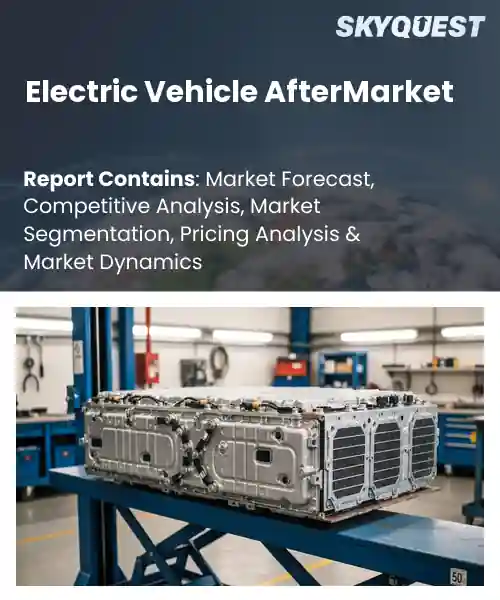
Electric Vehicle AfterMarket
Report ID: SQMIG25A2631
Report ID: SQMIG25A2631
[email protected]
USA +1 351-333-4748
Report ID:
SQMIG25A2631 |
Region:
Global |
Published Date: February, 2026
Pages:
157
|Tables:
182
|Figures:
79


Global Electric Vehicle Aftermarket size was valued at USD 85.2 Billion in 2024 and is poised to grow from USD 92.53 Billion in 2025 to USD 179.02 Billion by 2033, growing at a CAGR of 8.6% during the forecast period (2026-2033).
Rapid adoption of battery electric vehicles has emerged as the primary driver of the electric vehicle aftermarket because it creates persistent demand for specialized parts, diagnostics, and service ecosystems that differ from internal combustion engine vehicles. The aftermarket comprises replacement components, software updates, charging infrastructure maintenance, battery second-life services, and retrofit solutions, and it matters because fleet operators, independent garages, and consumers require reliable, cost-effective upkeep to maximize total cost of ownership. Over the past decade the market evolved from niche conversions and OEM-controlled service networks to a diverse landscape featuring independent suppliers, third-party telematics providers, and specialty repair shops.Building on this expanded service ecosystem, battery health management stands out as the pivotal factor driving aftermarket growth because degraded battery performance directly increases demand for diagnostics, refurbishment, and second-life applications. As batteries age, fleet managers deploy predictive analytics to schedule pack reconditioning, which reduces downtime and extends usable life while creating revenue for remanufacturers. Similarly, standardized charging connector services and modular battery components enable aftermarket customization for ride-hailing fleets, driving retrofit kit uptake in Southeast Asia. These dynamics create opportunities for software-as-a-service monitoring, localized cell recycling facilities, and franchised EV service centers that capture value previously retained by OEMs.
How is AI improving predictive maintenance in the electric vehicle aftermarket?
Predictive maintenance in the electric vehicle aftermarket uses AI to turn continuous sensor and telematics streams into early fault warnings and clear repair guidance. Key aspects are anomaly detection, battery state and remaining useful life estimation, and component specific diagnostics for motors, inverters and tyres. The current state of the market shows a shift from reactive shop visits to condition based service and software driven diagnostics because richer vehicle data and onboard edge compute let models run in near real time. That transition reduces surprise failures, extends component life and opens new service and parts opportunities for independent providers. Examples include AI driven root cause analysis and fleet monitoring that prioritize repairs and parts provisioning.Sonatus January 2026, showcased its AI Director and a Michelin predictive tyre maintenance demo at CES, demonstrating in vehicle edge AI that provides real time tyre health and diagnostic insights and supports faster, more efficient aftermarket repairs and improved fleet uptime.
Market snapshot - (2026-2033)
Global Market Size
USD 85.2 Billion
Largest Segment
Battery Packs
Fastest Growth
Battery Management Systems (BMS)
Growth Rate
8.6% CAGR
To get more insights on this market click here to Request a Free Sample Report
Global electric vehicle aftermarket is segmented by component type, vehicle type, service type, propulsion type, sales channel, end user and region. Based on component type, the market is segmented into Battery Packs, Battery Management Systems (BMS), Electric Motors, Inverters & Converters, Onboard Chargers, DC-DC Converters and Others. Based on vehicle type, the market is segmented into Passenger Cars and Commercial Vehicles. Based on service type, the market is segmented into Maintenance & Repair, Battery Replacement, Battery Refurbishment / Remanufacturing, Software Updates & Diagnostics, Tire Replacement Services, Collision Repair Services and Others. Based on propulsion type, the market is segmented into Battery Electric Vehicles (BEV), Plug-in Hybrid Electric Vehicles (PHEV), Hybrid Electric Vehicles (HEV) and Fuel Cell Electric Vehicles (FCEV). Based on sales channel, the market is segmented into OEM Authorized Service Centers, Independent Aftermarket Service Providers, Online Retailers / E-commerce Platforms, Specialty EV Workshops and Fleet Service Providers. Based on end user, the market is segmented into Individual Consumers, Commercial Fleet Operators, Government & Municipal Fleets and Others. Based on region, the market is segmented into North America, Europe, Asia Pacific, Latin America and Middle East & Africa.
Battery Packs segment dominates because battery packs are the core energy source that defines vehicle range, performance, and lifecycle economics, making pack-level interventions central to aftermarket priorities. Repairers, remanufacturers, and fleet managers focus on restoring or replacing packs to maintain value, which drives investment in diagnostic standards, thermal management solutions, and supply chain arrangements that prioritize pack availability and reliability across repair and refurbishment channels.
However, Battery Management Systems are the most rapidly expanding area as software-driven monitoring, cell balancing, and firmware updates become indispensable to preserving battery health and extending usable life. BMS innovations enable retrofit opportunities, advanced diagnostics, and recurring software services that create new revenue streams for workshops and accelerate demand for specialized tools and integration expertise.
Battery Refurbishment / Remanufacturing segment dominates because converting end-of-life packs into validated, requalified modules restores asset value and delays costly replacements, embedding refurbishment into lifecycle strategies for owners and fleet operators. This drives collaboration among remanufacturers, recyclers, and service providers, promotes standardized quality protocols, and encourages warranty and resale frameworks that make refurbished packs an accepted aftermarket solution.
Meanwhile, Software Updates & Diagnostics are experiencing the strongest growth as connected vehicles and more sophisticated battery chemistry require frequent firmware tuning and remote troubleshooting to sustain performance. Rising demand for over-the-air updates, cloud-based diagnostic platforms, and advanced fault detection creates recurring service opportunities, fosters partnerships between tool vendors and workshops, and expands subscription-style aftermarket business models.
To get detailed segments analysis, Request a Free Sample Report
Asia Pacific leads the global electric vehicle aftermarket through a combination of mature supply chains, concentrated manufacturing expertise, and proactive industry collaboration. Strong domestic OEM presence and tiered supplier networks create deep aftermarket parts availability and repair skills, while local service ecosystems prioritize EV-specific training and diagnostic capabilities. Policy alignment and investments in charging infrastructure encourage broader vehicle electrification, which in turn bolsters aftermarket demand for specialized batteries, power electronics, thermal systems, and software maintenance. The region benefits from high integration between component makers and service providers, enabling rapid parts localization and cost-effective remanufacturing. Robust aftermarket research and development within regional centers supports continuous improvement in repairability and parts standardization, reinforcing Asia Pacific position as the primary hub for electric vehicle aftermarket activity.
Electric Vehicle AfterMarket Japan combines OEM engineering heritage with a dense service network that supports specialized EV maintenance and parts remanufacturing. Focus on battery technology, powertrain diagnostics, and high standards for quality control drives aftermarket development. Collaboration between manufacturers, independent repairers, and component suppliers fosters efficient parts distribution and technical training. Cultural emphasis on long vehicle lifecycles and precision maintenance sustains a sophisticated aftermarket that prioritizes reliability and parts traceability.
Electric Vehicle AfterMarket South Korea emphasizes integration between leading battery manufacturers and service networks, producing a skilled ecosystem for EV repairs and component refurbishment. Strong focus on electronic powertrain systems and diagnostic tool adoption supports technician specialization. Partnerships between OEMs and workshops enable parts standardization and efficient reverse logistics. Consumer expectations for advanced connectivity and performance drive aftermarket innovation in software updates, thermal management service, and modular component replacement strategies.
North America expansion in the electric vehicle aftermarket is driven by a vibrant mix of technological innovation, aftermarket entrepreneurship, and evolving consumer expectations. Independent service providers and multi-brand repair networks are increasingly building EV expertise while software-focused entrants offer over the air maintenance and diagnostic services. Close collaboration among parts distributors, battery recyclers, and charging network operators creates resilient aftermarket value chains. Emphasis on fleet electrification and commercial vehicle servicing stimulates specialized maintenance models and reverse logistics for battery modules. Regulatory and industry emphasis on repairability and data access encourages wider technician training and third-party parts ecosystems, positioning North America as a rapidly diversifying aftermarket landscape with strong opportunities for service specialization and supply chain optimization. Investment in specialized training centers and collaboration with technology providers is improving diagnostics and repairability, while growing remanufacturing capabilities reduce reliance on new components and support resilient supply chains across member markets.
Electric Vehicle AfterMarket United States is characterized by a diverse network of dealers, independent repair shops, and service entrants focusing on diagnostics, battery health. Activity around fleet service and vehicle electrification drives specialization in module refurbishment and thermal system repair. Aftermarket players collaborate with parts distributors and recyclers to manage lifecycle value of battery components. Emphasis on open data policies and technician certification accelerates third-party service growth and parts standardization.
Electric Vehicle AfterMarket Canada pairs geography with urban service hubs that prioritize technician training, parts logistics and battery refurbishment capabilities. Independent workshops and dealer networks work with parts distributors to maintain availability across markets. Emphasis on cold-weather battery conditioning and system servicing shapes specialized maintenance offerings. Collaboration between recycling firms and remanufacturers supports sustainable end of life management, while focus on interoperability and data access enables third-party participation in aftermarket.
Europe is strengthening its role in the electric vehicle aftermarket through coordinated industry standards, dense service networks, and a strong emphasis on sustainability and circularity. Collaboration among OEMs, aftermarket specialists, and recycling firms drives parts remanufacturing, battery second-life applications, and standardized repair protocols that support technician training and interoperability. Urban mobility patterns and wide aftermarket professionalization encourage specialized repair hubs for high-voltage systems, thermal management, and software maintenance. Policy and industry focus on consumer rights to repair and data access foster a competitive third-party service market. Cross-border parts distribution and pan-European certification efforts enhance parts availability and quality assurance, reinforcing Europe position as a leading, sustainability-focused aftermarket region. Investment in specialized training centers and collaboration with technology providers is improving diagnostics and repairability, while growing remanufacturing capabilities reduce reliance on new components and support resilient supply chains across member markets.
Electric Vehicle AfterMarket Germany leverages deep automotive manufacturing expertise and dense OEM-affiliated service networks to support complex EV maintenance, diagnostics and remanufacturing. Strong supplier ecosystems enable parts sourcing for power electronics, battery modules and thermal systems. Emphasis on rigorous training and certification programs fosters technician competence. Aftermarket players focus on interoperability, quality assurance and sustainable repair practices, while coordination between manufacturers and independent specialists advances reuse and battery lifecycle management.
Electric Vehicle AfterMarket United Kingdom emphasizes adaptability through a mix of independent workshops, dealer networks and remanufacturers that address urban and fleet servicing needs. Focus on diagnostics, telematics integration and battery conditioning supports technician upskilling and service differentiation. Aftermarket firms collaborate with recycling and refurbishment partners to enable second-life battery applications and parts reuse. Policy emphasis on repairability and data access encourages competitive third-party service offerings and network parts distribution.
Electric Vehicle AfterMarket France combines industrial supply chains with growing network of specialized service centers focused on battery maintenance, thermal management and systems. Collaboration between OEMs, independent remanufacturers and recycling firms supports circular economy approaches and second-life battery pathways. Aftermarket stakeholders prioritize technician certification, parts traceability and interoperability to maintain service quality across regional markets. Emphasis on sustainable repair practices and parts reuse helps integrate environmental goals with aftermarket resilience.
To know more about the market opportunities by region and country, click here to
Buy The Complete Report
Electrified Vehicle Population Growth
Advancements In Battery Technology
High Cost Of Specialized Equipment
Limited Technician Skill Availability
Request Free Customization of this report to help us to meet your business objectives.
Competitive landscape in the global electric vehicle aftermarket is driven by OEM vertical plays, specialist consolidators, and diagnostic and refurbishment startups competing on battery reuse and parts sourcing. Strategic responses are concrete: major suppliers pursue targeted acquisitions to add power electronics and battery capabilities, OEMs deploy swap and second-life programs, and aftermarket firms form partnerships to scale reverse logistics and grading systems.
Top Player’s Company Profile
Recent Developments
SkyQuest’s ABIRAW (Advanced Business Intelligence, Research & Analysis Wing) is our Business Information Services team that Collects, Collates, Correlates, and Analyses the Data collected by means of Primary Exploratory Research backed by robust Secondary Desk research. As per SkyQuest analysis, rapid adoption of battery electric vehicles is a key driver for the global EV aftermarket, while the high cost of specialized equipment remains a major restraint. The dominating region is Asia Pacific due to deep supply chains and manufacturing scale, and the dominating segment is battery packs, which drive replacement, refurbishment and diagnostics demand. A second driver is software and AI-enabled predictive maintenance that unlocks recurring services, second-life battery workflows and fleet optimization. Together these forces favor growth in remanufacturing, connected diagnostics and franchised service networks, but wider technician training and equipment affordability will determine how quickly independent providers scale.
| Report Metric | Details |
|---|---|
| Market size value in 2024 | USD 85.2 Billion |
| Market size value in 2033 | USD 179.02 Billion |
| Growth Rate | 8.6% |
| Base year | 2024 |
| Forecast period | (2026-2033) |
| Forecast Unit (Value) | USD Billion |
| Segments covered |
|
| Regions covered | North America (US, Canada), Europe (Germany, France, United Kingdom, Italy, Spain, Rest of Europe), Asia Pacific (China, India, Japan, Rest of Asia-Pacific), Latin America (Brazil, Rest of Latin America), Middle East & Africa (South Africa, GCC Countries, Rest of MEA) |
| Companies covered |
|
| Customization scope | Free report customization with purchase. Customization includes:-
|
To get a free trial access to our platform which is a one stop solution for all your data requirements for quicker decision making. This platform allows you to compare markets, competitors who are prominent in the market, and mega trends that are influencing the dynamics in the market. Also, get access to detailed SkyQuest exclusive matrix.
Table Of Content
Executive Summary
Market overview
Parent Market Analysis
Market overview
Market size
KEY MARKET INSIGHTS
COVID IMPACT
MARKET DYNAMICS & OUTLOOK
Market Size by Region
KEY COMPANY PROFILES
Methodology
For the Electric Vehicle AfterMarket, our research methodology involved a mixture of primary and secondary data sources. Key steps involved in the research process are listed below:
1. Information Procurement: This stage involved the procurement of Market data or related information via primary and secondary sources. The various secondary sources used included various company websites, annual reports, trade databases, and paid databases such as Hoover's, Bloomberg Business, Factiva, and Avention. Our team did 45 primary interactions Globally which included several stakeholders such as manufacturers, customers, key opinion leaders, etc. Overall, information procurement was one of the most extensive stages in our research process.
2. Information Analysis: This step involved triangulation of data through bottom-up and top-down approaches to estimate and validate the total size and future estimate of the Electric Vehicle AfterMarket.
3. Report Formulation: The final step entailed the placement of data points in appropriate Market spaces in an attempt to deduce viable conclusions.
4. Validation & Publishing: Validation is the most important step in the process. Validation & re-validation via an intricately designed process helped us finalize data points to be used for final calculations. The final Market estimates and forecasts were then aligned and sent to our panel of industry experts for validation of data. Once the validation was done the report was sent to our Quality Assurance team to ensure adherence to style guides, consistency & design.
Analyst Support
Customization Options
With the given market data, our dedicated team of analysts can offer you the following customization options are available for the Electric Vehicle AfterMarket:
Product Analysis: Product matrix, which offers a detailed comparison of the product portfolio of companies.
Regional Analysis: Further analysis of the Electric Vehicle AfterMarket for additional countries.
Competitive Analysis: Detailed analysis and profiling of additional Market players & comparative analysis of competitive products.
Go to Market Strategy: Find the high-growth channels to invest your marketing efforts and increase your customer base.
Innovation Mapping: Identify racial solutions and innovation, connected to deep ecosystems of innovators, start-ups, academics, and strategic partners.
Category Intelligence: Customized intelligence that is relevant to their supply Markets will enable them to make smarter sourcing decisions and improve their category management.
Public Company Transcript Analysis: To improve the investment performance by generating new alpha and making better-informed decisions.
Social Media Listening: To analyze the conversations and trends happening not just around your brand, but around your industry as a whole, and use those insights to make better Marketing decisions.
REQUEST FOR SAMPLE
 REQUEST FREE CUSTOMIZATION


Want to customize this report? This report can be personalized according to your needs. Our analysts and industry experts will work directly with you to understand your requirements and provide you with customized data in a short amount of time. We offer $1000 worth of FREE customization at the time of purchase.
Feedback From Our Clients


 USA (+1) 351-333-4748

