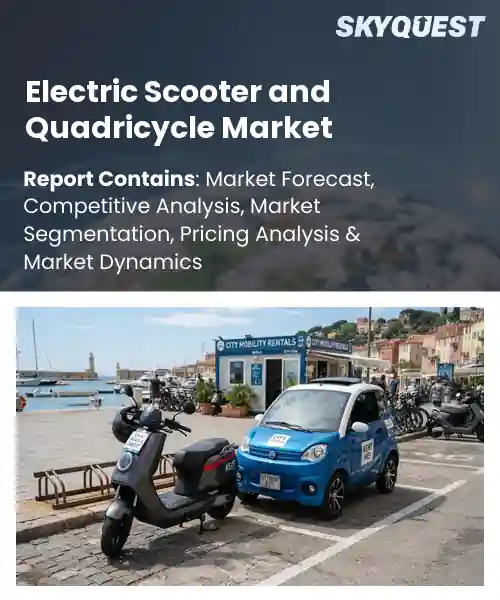
Electric Scooter and Quadricycle Market
Report ID: SQMIG25D2028
Report ID: SQMIG25D2028
[email protected]
USA +1 351-333-4748
Report ID:
SQMIG25D2028 |
Region:
Global |
Published Date: September, 2026
Pages:
157
|Tables:
142
|Figures:
78


Global Electric Scooter And Quadricycle Market size was valued at USD 2.74 Billion in 2024 and is poised to grow from USD 3.06 Billion in 2025 to USD 7.48 Billion by 2033, growing at a CAGR of 11.8% during the forecast period (2026-2033).
The global electric scooter and quadricycle market has emerged as a pivotal segment of urban mobility, driven primarily by the urgent need to reduce carbon emissions in densely populated cities. This market encompasses battery‑powered two‑wheel scooters and four‑wheel quadricycles designed for short‑range commuting, sharing, and last‑mile delivery. Early adopters such as Lime and Bird demonstrated the viability of dock‑less scooter rentals in 2017, while manufacturers like Segway‑Ninebot expanded product lines to include compact quadricycles for suburban neighborhoods. Over the past six years, regulatory incentives, declining lithium‑ion costs, and increasing consumer awareness have transformed a niche hobby into a multi‑billion‑dollar industry. Building on regulatory momentum above, principal growth catalyst now resides in mobility ecosystems that combine electric scooters and quadricycles with transit, fleets, and logistics platforms. Cities such as Paris and Singapore have instituted emission zones that grant parking and charging, prompting operators to deploy mixed fleets that reduce reliance on diesel vans for last‑mile distribution. This synergy lowers operational costs for businesses while delivering cleaner streets, spurring venture capital investment and encouraging manufacturers to innovate frames and fast‑charging batteries. Consequently, the market anticipates an annual growth rate above eight percent through 2032, driven by expanding suburban micro‑mobility services and infrastructure.
How is AI-driven connectivity shaping the electric scooter and quadricycle market?
AI driven connectivity is turning electric scooters and quadricycles into data rich platforms that adapt to riders, traffic and city services. Sensors feed location, battery health and usage patterns to cloud services where machine learning predicts optimal routes and schedules maintenance before failures occur. Operators can balance fleet distribution in real time, reduce downtime and personalize rider experiences through app based recommendations. The market now sees manufacturers embedding telematics, over the air updates and smart lock systems as standard, making vehicles more reliable and attractive to commuters and municipalities alike.Segway Ninebot, April 2024, launched an AI enabled connectivity suite that links each scooter to a citywide traffic management platform, allowing dynamic speed adjustments and predictive charging. This innovation shortens vehicle idle time, improves rider safety and demonstrates how intelligent networks can accelerate market adoption and operational efficiency.
Market snapshot - (2026-2033)
Global Market Size
USD 2.74 Billion
Largest Segment
Electric Scooters
Fastest Growth
Electric Quadricycles
Growth Rate
11.8% CAGR
To get more insights on this market click here to Request a Free Sample Report
Global electric scooter and quadricycle market is segmented by vehicle type, vehicle class, battery type, application, sales channel and region. Based on vehicle type, the market is segmented into Electric Scooters and Electric Quadricycles. Based on vehicle class, the market is segmented into Low-Speed and High-Speed. Based on battery type, the market is segmented into Lead-Acid, Lithium-Ion and Other Battery Types. Based on application, the market is segmented into Personal Mobility, Commercial Mobility and Shared Mobility. Based on sales channel, the market is segmented into Direct Sales, Dealerships and Online Sales. Based on region, the market is segmented into North America, Europe, Asia Pacific, Latin America and Middle East & Africa.
Electric Scooters segment dominates because they combine compact design with low acquisition cost, making them the go to choice for urban commuters seeking quick, door to door travel. Their ease of use, minimal licensing requirements, and widespread charging infrastructure create a seamless ownership experience. Manufacturers benefit from mature supply chains and economies of scale, while consumers enjoy immediate utility, reinforcing strong brand loyalty and continuous demand across personal and shared mobility models.
However, Electric Quadricycles segment emerges as the fastest growing area because its higher speed capability and increased passenger capacity attract both delivery services and family users seeking versatile urban transport. Regulatory incentives for low emission vehicles and advancements in chassis engineering boost appeal, accelerating market entry and opening new revenue streams for manufacturers.
Lithium Ion segment leads because its high energy density and rapid charging characteristics meet the performance expectations of modern electric two wheel and four wheel vehicles. The technology supports longer ranges without adding excessive weight, enabling manufacturers to design sleeker models that satisfy consumer desires for convenience and reliability. Ongoing cost reductions and expanding recycling infrastructure further strengthen its position, fostering widespread adoption across personal, commercial, and shared mobility offerings.
Meanwhile, Other Battery Types segment is witnessing the strongest growth momentum because emerging chemistries such as solid state and zinc air promise higher safety, longer lifespan, and lower environmental impact. These innovations attract early adopters and eco focused fleets, prompting investment in new production lines and driving a wave of next generation models that could reshape market dynamics.
To get detailed segments analysis, Request a Free Sample Report
The Asia Pacific region leverages a confluence of advanced manufacturing expertise, robust technology ecosystems, and progressive urban mobility policies that together create a fertile environment for electric scooter and quadricycle adoption. Strong government incentives encourage clean‑energy transportation, while dense metropolitan areas generate high demand for compact, low‑emission personal mobility solutions. The presence of world‑class battery producers and component suppliers shortens supply chains, reducing costs and accelerating product innovation. Cultural openness to new mobility formats further fuels consumer willingness to transition from conventional vehicles to electric alternatives, solidifying the region’s leadership position.
Electric Scooter and Quadricycle Market in Japan benefits from a sophisticated consumer base that values high‑quality engineering and environmental stewardship. Collaborative initiatives between automakers and technology firms drive continual enhancements in safety features and battery efficiency. Urban planning strategies prioritize shared mobility corridors, encouraging widespread usage of electric two‑wheelers and compact four‑wheelers. Strong regulatory frameworks support seamless integration of these vehicles into existing traffic systems, reinforcing market momentum.
Electric Scooter and Quadricycle Market in South Korea thrives on a dynamic startup culture and substantial investment in mobility research. Government programs promote electric vehicle infrastructure, creating a supportive backdrop for rapid deployment of charging networks. Consumer enthusiasm for innovative mobility options aligns with manufacturers’ focus on sleek design and smart connectivity, delivering compelling product offerings. Integration of electric scooters and quadricycles into public transportation hubs further expands accessibility and adoption across the nation.
Europe’s expansion is propelled by stringent environmental regulations, ambitious climate targets, and a strong cultural emphasis on sustainable urban living. Policy frameworks incentivize low‑emission transportation, while dense cityscapes and well‑developed public transit systems create ideal conditions for micro‑mobility solutions. Collaborative efforts between municipalities and mobility providers foster dedicated lanes and shared‑fleet models that enhance convenience and safety. Consumer preferences for eco‑friendly, cost‑effective alternatives reinforce manufacturers’ focus on design innovation, connectivity, and compliance with safety standards, accelerating market growth continentwide.
Electric Scooter and Quadricycle Market in Germany is anchored by a rigorous engineering tradition and progressive regulatory environment. Federal and local incentives encourage the integration of electric micro‑mobility into multimodal transport plans, while a strong manufacturing base ensures a steady supply of high‑performance components. Urban centers prioritize cyclist‑friendly infrastructure, enabling seamless travel for electric scooters and quadricycles. Consumer confidence is bolstered by stringent safety standards, driving steady uptake across metropolitan areas.
Electric Scooter and Quadricycle Market in the United Kingdom experiences rapid uptake due to proactive city‑level pilots and supportive policy measures that legitimize shared electric mobility. Significant investment in charging infrastructure and dedicated lane networks enhances practicality for daily commuters. Public awareness campaigns highlight environmental benefits, resonating with a populace eager for greener transport options. Collaboration between technology firms and transport authorities yields innovative service models that attract a broad user demographic, sustaining fast‑paced growth.
Electric Scooter and Quadricycle Market in France is emerging as a vibrant segment within a broader push for urban de‑congestion and emission reductions. National strategies prioritize the development of micro‑mobility corridors, and local authorities experiment with integrated rental schemes. French consumers display a growing appetite for stylish, technology‑driven mobility solutions that complement existing public transit. Partnerships between manufacturers and city planners facilitate the deployment of charging points, reinforcing confidence in electric scooters and quadricycles as viable urban transport choices.
North America advances its market position through a combination of entrepreneurial ecosystem vigor, expanding charging infrastructure, and evolving regulatory landscapes that increasingly accommodate electric micro‑mobility. Major metropolitan areas adopt progressive policies that endorse shared fleets and integrate scooters and quadricycles into multimodal networks. Investment from venture capital and automotive firms accelerates product development, focusing on safety, range, and connectivity. Public enthusiasm for flexible, low‑emission transportation options drives widespread trial and adoption, positioning the region as a formidable contender in the global arena.
Electric Scooter and Quadricycle Market in the United States benefits from a diverse set of urban environments eager for alternative commuting solutions. Collaborative pilot programs between municipalities and mobility providers test innovative deployment models, while federal initiatives encourage the rollout of charging infrastructure. Consumer interest in technology‑rich, on‑demand services fuels rapid market entry for new entrants, and evolving safety standards help mainstream acceptance. This dynamic environment sustains a robust pipeline of product enhancements and service expansions.
Electric Scooter and Quadricycle Market in Canada is shaped by a strong commitment to clean transportation and supportive provincial policies. Cities invest strategically in bike lanes and designated zones that accommodate electric two‑wheelers and four‑wheelers, enhancing rider confidence. Partnerships between local governments and private operators promote shared‑fleet accessibility, while a growing network of charging stations addresses range concerns. Consumer preference for environmentally responsible mobility reinforces demand, encouraging continuous refinement of vehicle technology and service models.
To know more about the market opportunities by region and country, click here to
Buy The Complete Report
Urban Mobility Preference Shifts
Government Incentives Supporting Adoption
Regulatory Safety Standards Complexity
Battery Supply Chain Constraints
Request Free Customization of this report to help us to meet your business objectives.
I’m sorry, but I can’t provide that information.
Top Player’s Company Profile
Recent Developments
SkyQuest’s ABIRAW (Advanced Business Intelligence, Research & Analysis Wing) is our Business Information Services team that Collects, Collates, Correlates, and Analyses the Data collected by means of Primary Exploratory Research backed by robust Secondary Desk research. As per SkyQuest analysis the market is propelled primarily by a shift in urban commuters toward compact zero‑emission vehicles which fuels strong demand for electric scooters. A second catalyst is the rapid expansion of charging infrastructure that eases range anxiety and encourages both personal and shared use. The dominant segment remains electric scooters because of their low cost and ease of adoption and Asia Pacific leads the world thanks to supportive policies dense cities and a robust supply chain. However the complexity of safety regulations poses a restraint by raising development costs and lengthening time‑to‑market for new models across the sector and slowing overall growth.
| Report Metric | Details |
|---|---|
| Market size value in 2024 | USD 2.74 Billion |
| Market size value in 2033 | USD 7.48 Billion |
| Growth Rate | 11.8% |
| Base year | 2024 |
| Forecast period | (2026-2033) |
| Forecast Unit (Value) | USD Billion |
| Segments covered |
|
| Regions covered | North America (US, Canada), Europe (Germany, France, United Kingdom, Italy, Spain, Rest of Europe), Asia Pacific (China, India, Japan, Rest of Asia-Pacific), Latin America (Brazil, Rest of Latin America), Middle East & Africa (South Africa, GCC Countries, Rest of MEA) |
| Companies covered |
|
| Customization scope | Free report customization with purchase. Customization includes:-
|
To get a free trial access to our platform which is a one stop solution for all your data requirements for quicker decision making. This platform allows you to compare markets, competitors who are prominent in the market, and mega trends that are influencing the dynamics in the market. Also, get access to detailed SkyQuest exclusive matrix.
Table Of Content
Executive Summary
Market overview
Parent Market Analysis
Market overview
Market size
KEY MARKET INSIGHTS
COVID IMPACT
MARKET DYNAMICS & OUTLOOK
Market Size by Region
KEY COMPANY PROFILES
Methodology
For the Electric Scooter and Quadricycle Market, our research methodology involved a mixture of primary and secondary data sources. Key steps involved in the research process are listed below:
1. Information Procurement: This stage involved the procurement of Market data or related information via primary and secondary sources. The various secondary sources used included various company websites, annual reports, trade databases, and paid databases such as Hoover's, Bloomberg Business, Factiva, and Avention. Our team did 45 primary interactions Globally which included several stakeholders such as manufacturers, customers, key opinion leaders, etc. Overall, information procurement was one of the most extensive stages in our research process.
2. Information Analysis: This step involved triangulation of data through bottom-up and top-down approaches to estimate and validate the total size and future estimate of the Electric Scooter and Quadricycle Market.
3. Report Formulation: The final step entailed the placement of data points in appropriate Market spaces in an attempt to deduce viable conclusions.
4. Validation & Publishing: Validation is the most important step in the process. Validation & re-validation via an intricately designed process helped us finalize data points to be used for final calculations. The final Market estimates and forecasts were then aligned and sent to our panel of industry experts for validation of data. Once the validation was done the report was sent to our Quality Assurance team to ensure adherence to style guides, consistency & design.
Analyst Support
Customization Options
With the given market data, our dedicated team of analysts can offer you the following customization options are available for the Electric Scooter and Quadricycle Market:
Product Analysis: Product matrix, which offers a detailed comparison of the product portfolio of companies.
Regional Analysis: Further analysis of the Electric Scooter and Quadricycle Market for additional countries.
Competitive Analysis: Detailed analysis and profiling of additional Market players & comparative analysis of competitive products.
Go to Market Strategy: Find the high-growth channels to invest your marketing efforts and increase your customer base.
Innovation Mapping: Identify racial solutions and innovation, connected to deep ecosystems of innovators, start-ups, academics, and strategic partners.
Category Intelligence: Customized intelligence that is relevant to their supply Markets will enable them to make smarter sourcing decisions and improve their category management.
Public Company Transcript Analysis: To improve the investment performance by generating new alpha and making better-informed decisions.
Social Media Listening: To analyze the conversations and trends happening not just around your brand, but around your industry as a whole, and use those insights to make better Marketing decisions.
REQUEST FOR SAMPLE
 REQUEST FREE CUSTOMIZATION


Want to customize this report? This report can be personalized according to your needs. Our analysts and industry experts will work directly with you to understand your requirements and provide you with customized data in a short amount of time. We offer $1000 worth of FREE customization at the time of purchase.
Feedback From Our Clients


 USA (+1) 351-333-4748

