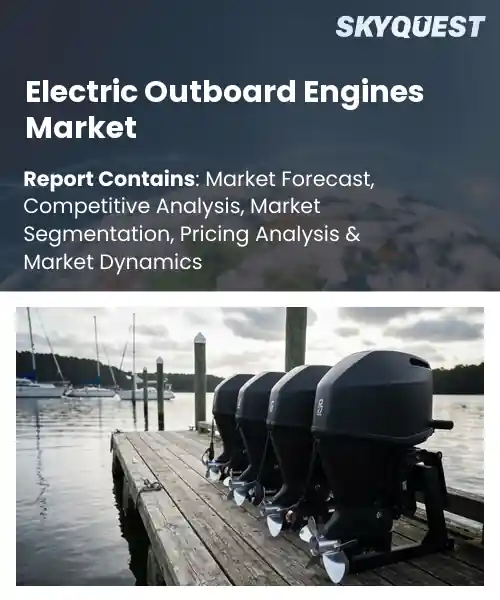
Electric Outboard Engines Market
Report ID: SQMIG25P2038
Report ID: SQMIG25P2038
[email protected]
USA +1 351-333-4748
Report ID:
SQMIG25P2038 |
Region:
Global |
Published Date: May, 2026
Pages:
157
|Tables:
181
|Figures:
79


Global Electric Outboard Engines Market size was valued at USD 0.95 Billion in 2024 and is poised to grow from USD 1.07 Billion in 2025 to USD 2.81 Billion by 2033, growing at a CAGR of 12.8% during the forecast period (2026-2033).
Regulations for the reduction of pollution and environmental concerns have been the driving factor behind the transformation of the electric outboard engines industry. These engines comprise propulsion units with batteries and electronics installed on recreational and commercial watercraft, and they are important due to the effects of their pollution on the air and water environments as well as the effort to cut operational costs. They were first used in small recreational fishing vessels before advances in battery capacity and inverters allowed for greater efficiency and led to competition among early adopters like Torqeedo and ePropulsion.
Lower costs and higher energy density are the crucial component that will drive growth in the market as they increase range while reducing life cycle costs. With cost reduction, producers provided batteries that were appropriate for bids as well as fishing boats and passenger boats, thus enabling the use of electric propellers when fueling was not practical. Examples from Norway’s use of electric ferry boats and Amsterdam’s use of silent boats for tours in canals show how cost effectiveness and policy incentives enable further investments in the development of charging infrastructure, which, in turn, fosters market growth.
How is AI Optimizing Battery Management in the Electric Outboard Engines Market?
AI-powered features in electric outboard engines are beneficial for enhancing state-of-charge and state-of-health calculations, thermal management, intelligent charging, and enabling predictive maintenance of batteries. Some key takeaways include effective state of charge and state of health estimation, thermal management, and optimal charge planning that allows extending battery lifespan. At the moment, the ideal approach would be one where edge BMS data analytics supported by cloud computing and digital twins enable proactive instead of reactive battery management. Growing interest from the market in efficient and lightweight battery solutions leads manufacturers and startups to introduce battery intelligence solutions and connected batteries. It can be observed, for instance, in the case of companies like Torqeedo and Blade, where innovative hardware and software solutions allow the realization of this concept. According to February 2026 press release by ePropulsion, they have released a novel battery with an advanced battery management system that includes state of charge calculation features, paving the road for better AI-powered charge scheduling and thermal management capabilities.
Market snapshot - (2026-2033)
Global Market Size
USD 0.95 Billion
Largest Segment
Portable Electric Outboard Engines
Fastest Growth
High-thrust Electric Outboard Engines
Growth Rate
12.8% CAGR
To get more insights on this market click here to Request a Free Sample Report
Global electric outboard engines market is segmented by product type, power output, battery type, application, end user, distribution channel and region. Based on product type, the market is segmented into Portable Electric Outboard Engines, High-thrust Electric Outboard Engines, Integrated Battery Electric Outboard Engines, External Battery Electric Outboard Engines, Hybrid Electric Outboard Engines and Others. Based on power output, the market is segmented into Below 5 kW, 5 kW to 20 kW and Above 20 kW. Based on battery type, the market is segmented into Lithium-ion Batteries, Lead-acid Batteries, Solid-state Batteries and Others. Based on application, the market is segmented into Recreational Boats, Fishing Boats, Commercial Boats, Rescue Boats, Sailboats and Others. Based on end user, the market is segmented into Individual Boat Owners, Commercial Marine Operators, Rental & Tourism Operators, Government & Defense Organizations and Others. Based on distribution channel, the market is segmented into OEM, Aftermarket, Online Sales and Specialty Marine Stores. Based on region, the market is segmented into North America, Europe, Asia Pacific, Latin America and Middle East & Africa.
Portable Electric Outboard Engines segment leads due to the small size of these engines and easy installation, meeting the needs of consumers who increasingly require mobility of propulsion systems. This trend increases the sales of after-market and online sales. The manufacturers focus on designing products that incorporate portable battery systems and modularity to ensure low-cost manufacturing and fast time-to-market, thus supporting partnership programs and ensuring wider availability of products.
Nevertheless, High-thrust Electric Outboard Engines represent the fastest growing area due to the growing need for propulsion systems suitable for powering large vessels. Thanks to recent advances in power electronics and scalable batteries, manufacturers can now provide high-thrust electric outboard engines, opening up a range of opportunities in transport and search-and-rescue missions.
Lithium-Ion Batteries is the leading product category since their energy density and favorable weight-to-capacity ratio offer increased cruising ranges and lighter-weight propulsion system configurations for various boat models. The proven manufacturing ecosystem and efficient standards for charging systems make them easier to integrate into production for Original Equipment Manufacturers (OEMs), thus promoting their widespread application. Advances in chemistry and manufacturing scalability continue reducing unit cost while improving life cycle performance.
Conversely, Solid-State Batteries represent the most rapidly expanding product category due to the prospects of better safety and energy density. Recent advances in materials science in the realm of solid electrolytes and manufacturing processes open up avenues for successful pilot programs that leverage lighter-weight battery packs with increased power capability for premium segments within marine electrification applications.
To get detailed segments analysis, Request a Free Sample Report
North America remains the leading region for the global market of electric outboard engines owing to the confluence of consumer uptake, strong supply chains, and favorable regulatory and infrastructural trends. The existence of strong boating traditions coupled with a large number of recreational vessels drives consumer preference for eco-friendly alternatives, while well-developed aftermarket and servicing infrastructure makes adopting the technology easier. Major players in both local and overseas markets have strong presence in the North American region, along with developing their products, training dealers, and distributing their goods. Industry cooperation with port operators and private marina facilities facilitates the construction of infrastructural facilities. Market maturity is further enhanced by availability of various financing schemes and marketing campaigns aimed at highlighting the benefits of adopting the technology in terms of operational advantages and value for money.
The Electric Outboard Engines Market in United States has already reached its mature stage due to high consumer awareness, many dealers and distributors, and wide availability of products. An efficient aftersales service channel has been set up by now to support further expansion of the market and make it easier for recreational and small-scale commercial users to adopt electric motors. Cooperation between engine makers and marinas promotes further development of charging and maintenance infrastructure.
Electric Outboard Engines in Canada Features: Market for Electric Outboard Engines in Canada exhibits features of demand concentration along coastlines and performance concerns regarding environmental impact. Service providers in regions of high potential offer demonstrations and post-purchase support to promote adoption. Local users prioritize reliability and low maintenance requirements, leading to changes in the service structure and training for technicians. Joint projects with marina and fleet owners demonstrate the benefits of operating such systems.
Fast expansion throughout Europe is possible due to the combination of regulatory focus on low emissions, consumer preference for environmentally-friendly options, and the increasing infrastructure to support charging and service needs. The fastest growth can be observed in Germany due to the strong industrial capabilities and supporting ecosystems that allow for the quick development and scaling up of the technology. United Kingdom demonstrates potential based on niche leisure markets and forward-thinking marina developments. In France, the fast adoption is seen due to local industry cooperation and demonstration projects that showcase the value of this solution for operations. Cooperation between countries, transfer of technologies, as well as the increasing involvement of major marine manufacturersallows for quicker commercialization. Focused marketing and after-sales services help overcome adoption barriers in leisure and smaller commercial settings. Financing options and standard coordination facilitate the lowering of commercial risks and suppliers' confidence.
Germany Electric Outboard Engines Market has advantages through its production knowledge, supplier networks, and cooperation on research initiatives by both industries and technical institutions. The existing manufacturers of marine components will facilitate the scaling process, while the coordination of trials will be handled by marinas and local bodies. There is a need to provide technical training and effective after sales networks to ensure that operators have faith in these systems.
The Electric Outboard Engines market in the United Kingdom is growing due to focused demand in leisure activities, advanced marinas developments, and dealerships involvement. The demonstration approach and the cooperation of local boat builders are an example of effective application within both recreational coastal and inland areas. The professionals in maintenance and sales staff are increasing their expertisein order to respond to adopters' expectations.
Electric Outboard Engines Market in France sees rapid growth through cooperation between domestic producers and marina owners. Pilot studies demonstrate clear advantages for tourists traveling along the coast and for renting firms. Dealers increase their training capacity and stock spare parts in order to satisfy growing demand. Marketing activities and cooperation with tourism entities raise awareness and facilitate switching by small businesses.
Asia Pacific countries are reinforcing their standing in the market of electric outboard engines by specializing in technologies and focusing research and development activities as well as growing their participation in the industry. Japan provides leading expertise in managing battery performance and energy systems as well as power electronics and system integration to contribute to reliability and efficiency of the product. The expertise of South Korea is related to manufacturing, material procurement, and electronics manufacturing to ensure fast product iteration and component localization. Cooperation of OEM manufacturers, battery providers, and marinas within the region allows integrating products to fit local conditions. An increase in demand for electric outboard engines to create electrified boat fleets for tourism, rent services, and small-scale business operations facilitates testing of the product.
The Japanese market for Electric Outboard Engines is supported by concentrated knowledge on miniaturized power electronics, battery management, and production. Joint cooperation between local component producers and research centers with marine original equipment manufacturers allows optimization of the design for high reliability and thermal efficiency under different operating conditions. High attention paid to the system integration and quality control provides reliable products suitable for reliability-minded consumers. Trial runs with tourism providers prove viability of the product in real environments.
The Electric Outboard Engines Market in South Korea benefits from its well-developed manufacturing of electronics and knowledge of materials to improve the quality of the product. Korean manufacturers concentrate on integration of batteries and power modules suitable for the marine environment, while cooperation with OEMs ensures technology transfer. Development of aftermarket sales and operator education raises customer trust, while demonstrations at tourism and commercial operators prove the appropriateness of use.
To know more about the market opportunities by region and country, click here to
Buy The Complete Report
Advancements in Battery Technology
Greater energy density, less weight, better cycle life, and fast charging of battery packs have made electric outboard engines feasible by making possible equivalent range and power with the help of battery packs, overcoming performance challenges that used to limit electric outboards. Safety and better performance features of battery packs help eliminate issues associated with battery packs and facilitateacceptance. Modular batteries make maintenance easy and facilitate easier integration with boat electrical systems.
Favorable Regulatory Support
Improving emissions standards, implementing zero emissions policies, and using incentives for electrification fosters an enabling policy framework where boat owners and fleets find electric outboard motors attractive compared to fossil-fueled motors. Regulatory support diminishes regulatory risks, leading to increased investments in innovation and supply chains, whereas incentives and ease of permitting decrease barriers to purchase and installation. The overall effect is that both manufacturers and users are more committed to adopting electric technologies.
High Upfront Purchase Costs
The higher initial costs of acquiring an electric outboard engine relative to the cost of obtaining a traditional petrol-driven outboard engine can discourage consumers from adopting the technology, considering that the operation costs are much lower for the former than the latter. Higher acquisition costs determine whether people will adopt the technology, hinder the upgrading process, and compel potential consumers to hold back on investing due to improved resale or financing possibilities in the near future.
Limited Charging Infrastructure Availability
Unreliable access to shore power, quick charging points, and standard infrastructure in marinas for electric boats hampers operators' willingness to travel for extended periods and makes certain routes commercially unfeasible, thus preventing a wider uptake. Boaters and fleet managers could be hampered by the lack of charging options while planning their journeys or venturing into areas where charging facilities might not be readily available. The lack of coordination and investment in such infrastructure on the part of manufacturers prevents further market development until more options emerge.
Request Free Customization of this report to help us to meet your business objectives.
The competitive nature of the global electric outboard market has been escalating due to the activities being undertaken by established OEM players and new entrants in the industry through new product introductions, alliances, and acquisitions of assets. Some of these activities include Mercury’s introduction of the Avator and the selection of VMT by Groupe Beneteau.
OEM and Fleet Adoption: The adoption by boat builders and companies who operate boat fleets is increasing, leading to increased cooperation in developing packaging, control and maintainability. This trend creates economies of scale, strong dealership and aftersales support structures that minimize user challenges. Such OEM coordination ensures uniformity of safety and performance standards, but allows customization according to various needs such as leisure, renting, and professional purposes. With increasing focus on electric propulsion systems, manufacturers will see a change in their supplier base, with modular designs making maintenance easier.
Smart Marine Connectivity: Connectivity to other onboard digital systems will change the notion of value through such capabilities as remote diagnostics, predictive maintenance, and software upgrades, making life easier for owners. Connectivity allows integration with navigation, power management, and performance displays to maximize the performance and safety of operations regardless of the environmental factors involved. Features enabled by software allow the implementation of subscription and service models and increase the customization of options for both recreational and commercial users. The adoption of data-driven assistance will result in a collaborative approach to ecosystem creation.
SkyQuest’s ABIRAW (Advanced Business Intelligence, Research & Analysis Wing) is our Business Information Services team that Collects, Collates, Correlates, and Analyses the Data collected by means ofPrimary Exploratory Research backed by robust Secondary Desk research.
As per SkyQuest analysis, there is growth within the global market of electric outboard engines as the major drivers include the requirement of reduction of emissions through regulation and technological development of batteries that make them affordable and increase their range. The major adopters are the portable electric outboard engines owing to the easy installation process along with consumer demand for the same whereas North America holds dominance in the industry due to the existing boating culture, supply chain network and infrastructure. The high upfront cost of purchasing the electric outboard engines over petrol variants acts as a restraint.
| Report Metric | Details |
|---|---|
| Market size value in 2024 | USD 0.95 Billion |
| Market size value in 2033 | USD 2.81 Billion |
| Growth Rate | 12.8% |
| Base year | 2024 |
| Forecast period | (2026-2033) |
| Forecast Unit (Value) | USD Billion |
| Segments covered |
|
| Regions covered | North America (US, Canada), Europe (Germany, France, United Kingdom, Italy, Spain, Rest of Europe), Asia Pacific (China, India, Japan, Rest of Asia-Pacific), Latin America (Brazil, Rest of Latin America), Middle East & Africa (South Africa, GCC Countries, Rest of MEA) |
| Companies covered |
|
| Customization scope | Free report customization with purchase. Customization includes:-
|
To get a free trial access to our platform which is a one stop solution for all your data requirements for quicker decision making. This platform allows you to compare markets, competitors who are prominent in the market, and mega trends that are influencing the dynamics in the market. Also, get access to detailed SkyQuest exclusive matrix.
Table Of Content
Executive Summary
Market overview
Parent Market Analysis
Market overview
Market size
KEY MARKET INSIGHTS
COVID IMPACT
MARKET DYNAMICS & OUTLOOK
Market Size by Region
KEY COMPANY PROFILES
Methodology
For the Electric Outboard Engines Market, our research methodology involved a mixture of primary and secondary data sources. Key steps involved in the research process are listed below:
1. Information Procurement: This stage involved the procurement of Market data or related information via primary and secondary sources. The various secondary sources used included various company websites, annual reports, trade databases, and paid databases such as Hoover's, Bloomberg Business, Factiva, and Avention. Our team did 45 primary interactions Globally which included several stakeholders such as manufacturers, customers, key opinion leaders, etc. Overall, information procurement was one of the most extensive stages in our research process.
2. Information Analysis: This step involved triangulation of data through bottom-up and top-down approaches to estimate and validate the total size and future estimate of the Electric Outboard Engines Market.
3. Report Formulation: The final step entailed the placement of data points in appropriate Market spaces in an attempt to deduce viable conclusions.
4. Validation & Publishing: Validation is the most important step in the process. Validation & re-validation via an intricately designed process helped us finalize data points to be used for final calculations. The final Market estimates and forecasts were then aligned and sent to our panel of industry experts for validation of data. Once the validation was done the report was sent to our Quality Assurance team to ensure adherence to style guides, consistency & design.
Analyst Support
Customization Options
With the given market data, our dedicated team of analysts can offer you the following customization options are available for the Electric Outboard Engines Market:
Product Analysis: Product matrix, which offers a detailed comparison of the product portfolio of companies.
Regional Analysis: Further analysis of the Electric Outboard Engines Market for additional countries.
Competitive Analysis: Detailed analysis and profiling of additional Market players & comparative analysis of competitive products.
Go to Market Strategy: Find the high-growth channels to invest your marketing efforts and increase your customer base.
Innovation Mapping: Identify racial solutions and innovation, connected to deep ecosystems of innovators, start-ups, academics, and strategic partners.
Category Intelligence: Customized intelligence that is relevant to their supply Markets will enable them to make smarter sourcing decisions and improve their category management.
Public Company Transcript Analysis: To improve the investment performance by generating new alpha and making better-informed decisions.
Social Media Listening: To analyze the conversations and trends happening not just around your brand, but around your industry as a whole, and use those insights to make better Marketing decisions.
REQUEST FOR SAMPLE
 REQUEST FREE CUSTOMIZATION
Global Electric Outboard Engines Market size was valued at USD 0.95 Billion in 2024 and is poised to grow from USD 1.07 Billion in 2025 to USD 2.81 Billion by 2033, growing at a CAGR of 12.8% during the forecast period (2026-2033).
Competitive pressures in the global electric outboard market are intensifying as legacy OEMs and specialist startups compete via product launches, partnerships, and asset acquisitions. Examples include Mercury's Avator launch and VMT's selection by Groupe Beneteau. Manufacturers pursue axial flux and rim drive innovations while strategic asset buys and OEM collaborations are reshaping supply chains and speeding commercialization. 'Torqeedo', 'Yamaha Motor', 'Mercury Marine', 'ePropulsion', 'Pure Watercraft', 'Minn Kota', 'Suzuki Motor Corporation', 'Honda Motor', 'Tohatsu Corporation', 'Elco Motor Yachts', 'Evoy', 'Vision Marine Technologies', 'Aquamot', 'Oceanvolt', 'Golden Motor', 'Bellmarine', 'Parsun Power Machine', 'Haswing', 'Ray Electric Outboards', 'Electine'
Improved energy density, lower weight, longer cycle life and faster charging of battery packs have expanded the viability of electric outboard engines by enabling comparable performance and range to small combustion motors, thereby addressing traditional performance barriers. Enhanced battery safety and lifecycle characteristics reduce ownership concerns and support broader adoption among recreational and commercial users, while modular battery systems simplify maintenance and integration with existing boat electrical systems, allowing manufacturers to design more efficient propulsion units and accelerate product introductions.
Oem And Fleet Adoption: Adoption by boat manufacturers and commercial fleets is accelerating integration of electric outboards into standard offerings, prompting closer collaboration on packaging, controls, and serviceability. This trend fosters economies of scale, stronger dealer networks, and shared aftersales infrastructure that reduce ownership friction. OEM alignment encourages consistent safety and performance standards while enabling tailored solutions for recreational, rental, and professional segments. As manufacturers prioritize electrified propulsion, supplier ecosystems shift to modular designs, simplifying maintenance and supporting market acceptance across boating use cases.
Why does North America Dominate the Global Electric Outboard Engines Market? |@12


Want to customize this report? This report can be personalized according to your needs. Our analysts and industry experts will work directly with you to understand your requirements and provide you with customized data in a short amount of time. We offer $1000 worth of FREE customization at the time of purchase.
Feedback From Our Clients


 USA (+1) 351-333-4748

