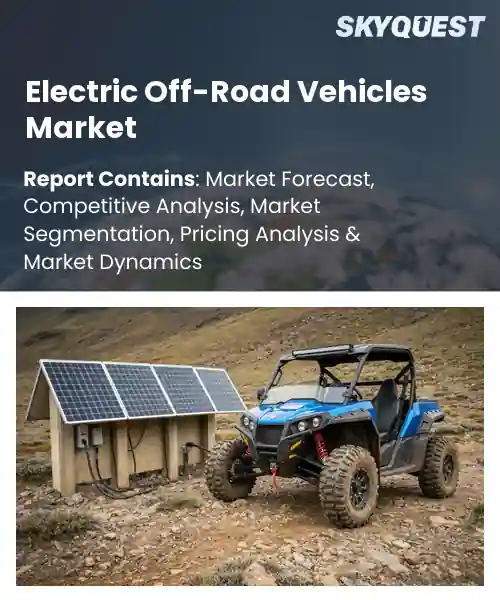
Electric Off-Road Vehicles Market
Report ID: SQMIG25C2245
Report ID: SQMIG25C2245
[email protected]
USA +1 351-333-4748
Report ID:
SQMIG25C2245 |
Region:
Global |
Published Date: May, 2026
Pages:
157
|Tables:
180
|Figures:
79


Global Electric Off-Road Vehicles Market size was valued at USD 189.6 Million in 2024 and is poised to grow from USD 214.59 Million in 2025 to USD 577.78 Million by 2033, growing at a CAGR of 13.18% during the forecast period (2026-2033).
The main reason the electric off-road vehicle market is taking off include better batteries, cheaper costs, and stricter rules on pollution. These vehicles include ATVs, utility vehicles, side-by-sides, and trail bikes. They impact farming, fun activities, and jobs in remote areas big time. It started with basic utility vehicles in the early 2000s, but now we've got speed demons like Rivian’s R1T prototype entering the scene. As charging gets easier and parts become more available, more folks want in on this eco-friendly ride trend.
Building on those tech and market foundations, the biggest influence on global growth is the steady drop in battery costs and boost in performance. Cheaper, more dense batteries extend vehicle ranges, lower overall costs, and allow for heavy-duty off-road designs. As range gets better, farm and park operators switch to electric UTVs to save fuel and reduce noise. This then drives demand for charging solutions and services. In response, manufacturers create modular platforms and solar-powered camp setups, opening new paths in rentals, tourism, and specialized uses where quiet, emission-free vehicles bring clear advantages.
How is AI Enhancing Performance and Safety in the Electric Off-road Vehicles Market?
AI's advancements are making electric off-road vehicles way safer and efficient. It does this by blending smarter perception, control, and energy management systems. Right now, car makers are adding AI for recognizing terrain, controlling power, tuning suspensions, and optimizing batteries to boost driving range in tough situations. These same manufacturers embed technology for spotting obstacles, assisting drivers, and checking issues remotely. All of this helps cut risks and save time. What we see now is electric vehicles from classic and new sports car companies. They stand out thanks to their software, which isn’t as common in the usual gas-guzzlers. From pricey pickup trucks with smart torque, to all-terrain vehicles built for fun and jobs, there's a lot going on.
Market snapshot - (2026-2033)
Global Market Size
USD 189.6 Million
Largest Segment
Electric Utility Task Vehicles (UTVs) / Side-by-Side Vehicles
Fastest Growth
Electric Utility Task Vehicles (UTVs) / Side-by-Side Vehicles
Growth Rate
13.18% CAGR
To get more insights on this market click here to Request a Free Sample Report
Global electric off-road vehicles market is segmented by vehicle type, battery type, drive type, power output, application, end user and region. Based on vehicle type, the market is segmented into Electric All-Terrain Vehicles (ATVs), Electric Utility Task Vehicles (UTVs) / Side-by-Side Vehicles, Electric Dirt Bikes, Electric Off-Road Motorcycles, Electric Snowmobiles, Electric Off-Road Go-Karts & Recreational Vehicles and Others. Based on battery type, the market is segmented into Lithium-Ion Batteries, Lead-Acid Batteries, Nickel-Based Batteries and Others. Based on drive type, the market is segmented into Two-Wheel Drive (2WD), Four-Wheel Drive (4WD) and All-Wheel Drive (AWD). Based on power output, the market is segmented into Low Power Vehicles, Medium Power Vehicles and High Power Vehicles. Based on application, the market is segmented into Recreational Use, Utility & Industrial Use, Agricultural Use, Military & Defense Use, Sports & Racing, Forestry & Hunting and Others. Based on end user, the market is segmented into Individual Consumers, Commercial Operators and Government & Defense Organizations. Based on region, the market is segmented into North America, Europe, Asia Pacific, Latin America and Middle East & Africa.
Electric Utility Task Vehicles (UTVs) or Side-by-Side vehicles lead the pack since they perfectly match the cargo and passenger needs for off-road jobs. This makes it easy for manufacturers to appeal to both fun-seeking and work-focused customers. These vehicles' sturdy frames, add-on parts, and big battery support make them great choices for farms, businesses, and fleet managers. At the same time, the makers’ dedication to durability and personalization helps dealers and keeps the sales pipeline full.
On the other side, the Electric All-Terrain Vehicles (ATVs) is the fastest growing segment. They cater to those looking for budget-friendly, easy-to-use electric rides. As developers get better at building small but strong engines, more people can afford ATVs. Plus, improved battery tech and cheaper upfront costs mean individuals are buying in bigger numbers. This surge is fueling new parts and accessories markets, sparking all sorts of fresh business chances across off-road fun and work activities.
The Lithium Ion Batteries segment rules due to their awesome energy density and great weight to power ratio. This lets off-road vehicles go further and perform better. It enables ATVs, UTVs, and dirt bikes to zoom at higher speeds for longer. Manufacturers love that they can integrate these batteries well and see suppliers pour in for the improved cycle life and charging benefits. Ongoing upgrades and dropping costs keep lithium ion on top for both power and profitability.
On the other side, other battery types are getting major investments too. Innovative chemistries and hybrid storage solutions draw funds for budget-conscious and niche needs. Solid state tech and capacitor hybrids in development promise wicked fast charging, beefed up safety, and specific performance perks for both light rec and rugged uses. All of this is crafting fresh supplier networks and cooler vehicle designs.
To get detailed segments analysis, Request a Free Sample Report
North America benefits from advanced manufacturing, deep supplier networks, and a strong culture of off-road fun, both professionally and for kicks. This mix creates a solid demand for electric vehicles. Big OEMs and a thriving aftermarket ecosystem quickly adapt products and offer reliable services for all kinds of terrains. Investments in battery and drivetrain tech, along with easy access to financing and leasing, make the shift from prototype to widespread use smoother. Regulations and various incentives from governments help push electrification in both leisure and utility markets. Research collaborations and venture capital keep improving vehicle range, durability, and maintenance. Efficient logistics and parts sourcing help in scaling up production and catering to consumer and fleet demands too.
The Electric Off-Road Vehicles Market in the US thrives because of a lot of Original Equipment Manufacturer involvement, various terrains needing such vehicles, and big support networks for quick model releases and easy repairs. People really like doing outdoor stuff and enjoy electric vehicles for both fun and jobs like farming and managing land. This all leads to new ideas in vehicle design. Along with that, solid research ties, private money, and set supply chains keep pushing innovation and help these vehicles grow bigger in both tech and popularity.
The Electric Off-Road Vehicles Market in Canada focuses on handling tough terrains, solid dealer networks, and reliable after-sales support for remote areas. Regional programs and preferences in utility fleet procurement boost use in forestry, mining, and rural maintenance. Local suppliers and research institutions work together on battery management in cold weather and sturdy design. Service providers stress accessibility, easy parts gettin', and uptime, making these systems extra dependable.
Europe is witnessing a fast-paced growth thanks to its solid stance on environmental policies, changing consumer preferences towards sustainability, and a robust industrial base from both traditional automakers and new innovators. This region makes entry easier with unified standards and industry groups, speeding up model releases and boosting cross-border sales. Beyond just the fun end of things, there's also growing public and private spending for uses like city cars and utility vehicles. Additionally, Europe is investing in charging stations that cater to both rural and leisure spots. They're also helping out with the supply chains for batteries and encouraging the making of parts right there locally. As a result, people get more choices for leasing, fleets can get better managed, and there's more service options too. On top of that, researchers and startups come up with cool stuff like lightweight materials and fancy ways to manage heat in their gadgets.
The Electric Off-Road Vehicles market in Germany thrives because of top-notch engineering, integrated supply chains, and a ton of testing and certification spots that keep quality and safety sky-high. Local Original Equipment Manufacturers (OEMs) and suppliers team up, speeding up the creation of sturdy drivetrains and flexible platforms for fun and work uses. Big bulk purchases and biz collaborations get these vehicles used in forestry and city services. Plus, there's a solid net of dealers and service providers that makes sure maintenance, parts, and tweak options are available for all types of terrains.
The Electric Off-Road Vehicles market in the UK is zooming thanks to lots of venture cash, energetic startups, and handy leasing options for testing out new gear. More folks in outdoorsy, land management, and light biz roles want in on the action, boosting various use cases. Makers focusing on slick designs, smart battery placement, and simple charging are scoring big with buyers. Meanwhile, service teams and aftermarket gurus cook up custom fits and upgrades, making these vehicles indispensable in countryside and city outskirts alike.
The Electric Off-Road Vehicles market in France is growing due to support in rural areas, tourism, and public sector buying, which encourages early adoption. Manufacturers and engineers zero in on durability and easy maintenance for farm and forestry use. Plus, pilot programs and local partnerships set up demo projects to boost fleet operators' trust. As service providers and parts sellers get more common, long-term operation becomes easier across diverse conditions.
Asia Pacific is boosting its market position thanks to manufacturing scale, advanced electronics integration, and a surge in local demand for multifunctional electric vehicles. They've got a strong local supply chain for battery cells, power electronics, and thermal management, which gives them a cost and integration edge. Plus, national and regional strategies promote cooperation between OEMs, tech firms, and research groups. This teamwork helps tailor products to different climates and terrains. By focusing on export readiness, modular platforms, and localized after-sales support, they're ramping up their international competition game. The quick growth of charging and service infrastructures — which caters to rural and peri-urban areas — along with creative financing and leasing options, is driving both consumer and commercial buy-in. All this lets them keep refining their products for the global market too.
Japan's electric off-road vehicle market excels through precise engineering and top-notch manufacturing. They make cars that handle rough terrain really well. Local producers aim for reliability and ease of use by focusing on sturdy but compact designs. Owing to teamwork with researchers, there are neat advances in thermal control and system integration. This helps keep vehicles safe and running smoothly. Moreover, well-established support networks provide consistent post-purchase care for all types of users – whether it’s for fun or work.
The Electric Off-Road Vehicles market in South Korea is really thriving because of its solid electronics and battery ecosystem, speedy tech adoption, and tight connections between suppliers and makers. Manufacturers have serious skills in power electronics and control systems that drive advanced drivetrain integration and cool vehicle features. Startups and big companies there speed up new prototypes hitting the market. Also, manufacturers looking to export make models work for different markets worldwide. On top of that, service networks and part suppliers keep stressing quick fixes for parts and software updates to stay ready for both fun and business use.
To know more about the market opportunities by region and country, click here to
Buy The Complete Report
Advancements in Battery Technology
Advancements in battery chemistry and pack design have boosted energy density and thermal management. This lets vehicles run longer before needing a charge and performing better in tough off-road conditions. Improvements in cell packaging, cooling systems, and battery management have also reduced weight and boosted durability, supporting vehicle handling and longevity. These tech upgrades push manufacturers to create diverse electric off-road models, boosting consumer confidence in what these vehicles can do and their upkeep. That builds broader acceptance and steady market demand for both recreational and commercial use.
Expanding Recreational and Commercial Use
The rise in rate of adoption for electric off-road vehicles for fun, work, and travel is a significant growth driver. This increased use, from recreation to industry, creates lots of ways manufacturers can invest and make different products. Operators want quiet and easy-to-maintain machines, especially for delicate or controlled areas. That's why there's a move towards custom-made electric models to fit these specific needs. These varied uses lead to more accessories, services, and special financing choices, which makes the electric vehicle market look more attractive overall. When folks see how well these vehicles perform in many fields, it helps make electric options seem normal and spurs growth in both consumer and business markets.
High Purchase Price Barriers
Higher upfront costs for electric off-road vehicles hold back their adoption, especially for those looking to spend less initially. While these vehicles might have operational benefits, the perceived higher price tag makes private buyers and small operators hesitant. It also slows down fleet updates because companies resist switching from what they know—internal combustion engines—even when better options are available. And limited, easy financing choices, along with differing incentives across regions, don’t help matters. So, this cost issue narrows who’s likely to buy these electric vehicles. Manufacturers and others involved are trying to find ways to reduce costs and get more policy support to encourage wider use over time.
Limited Charging Infrastructure Availability
The lack of charging infrastructure in remote and off-road spots harms operators' trust and limits the use of electric vehicles where access is key. The scarcity of durable, weather-proof charging gear and backup services raises doubts and could cause more downtime, pushing people to prefer well-known gas-powered options instead. Setting up and taking care of charging stations in tough or restricted zones complicates things for fleet managers a lot. This infrastructural hole slows wide acceptance, so makers and service teams need to invest in stand-alone charging tech and better deployment plans.
Request Free Customization of this report to help us to meet your business objectives.
The competition's getting tougher with legacy car makers, specialized brands, and startup firms all vying for attention. They're focusing on modular powertrains, lighter chassis, and unique features for hunts, farms, and races. Companies are buying each other out and snapping up talent to stay ahead. Partnerships help them get access to better chassis and motors too. For instance, LiveWire bought Dust Moto, Hypercraft teamed up with Geiser Brothers, and Volcon is growing thanks to new products.
Lifestyle and Experience Positioning: Manufacturers and brands are moving away from just focusing on utility and toward creating cool adventure lifestyles for those who love electric off-road vehicles. They team up with tourism operators and host community events while pushing digital integration. By stressing personalized touches and style choices, they create deeper emotional connections. This leads to ongoing revenue from things like rentals and subscriptions, not just sales, making the experiences more valuable than just the tech specs.
Platform Modularity and Customization: Manufacturers are using modular architectures and configurable parts to handle different off-road needs and speed up releases. They're making vehicles that can be easily adapted, which helps create streamlined add-ons from other companies, plus it lets them change things like powertrains and suspensions. Standardized connections make it easier for partners to get involved, leading to more innovation and quicker adaptations for smaller groups. This not only lets customers personalize their vehicles more but also cuts down on development time and opens ways to earn extra money through unique options and linked services.
SkyQuest’s ABIRAW (Advanced Business Intelligence, Research & Analysis Wing) is our Business Information Services team that Collects, Collates, Correlates, and Analyses the Data collected by means ofPrimary Exploratory Research backed by robust Secondary Desk research.
As per SkyQuest analysis, the global electric off-road vehicles market is driven by better battery energy density and cheaper batteries, and it's also boosted by more people using these vehicles for both fun and work. Yet, high initial costs hold back widespread adoption. North America dominates the market because of a strong presence from original equipment manufacturers, solid aftermarket support, and a real love for recreation there. Electric UTVs or side-by-side vehicles lead sales since you can adjust their cargo and passenger space. Companies are addressing cost and infrastructure issues with modular designs, smart features, and focused services.
| Report Metric | Details |
|---|---|
| Market size value in 2024 | USD 189.6 Million |
| Market size value in 2033 | USD 577.78 Million |
| Growth Rate | 13.18% |
| Base year | 2024 |
| Forecast period | (2026-2033) |
| Forecast Unit (Value) | USD Million |
| Segments covered |
|
| Regions covered | North America (US, Canada), Europe (Germany, France, United Kingdom, Italy, Spain, Rest of Europe), Asia Pacific (China, India, Japan, Rest of Asia-Pacific), Latin America (Brazil, Rest of Latin America), Middle East & Africa (South Africa, GCC Countries, Rest of MEA) |
| Companies covered |
|
| Customization scope | Free report customization with purchase. Customization includes:-
|
To get a free trial access to our platform which is a one stop solution for all your data requirements for quicker decision making. This platform allows you to compare markets, competitors who are prominent in the market, and mega trends that are influencing the dynamics in the market. Also, get access to detailed SkyQuest exclusive matrix.
Table Of Content
Executive Summary
Market overview
Parent Market Analysis
Market overview
Market size
KEY MARKET INSIGHTS
COVID IMPACT
MARKET DYNAMICS & OUTLOOK
Market Size by Region
KEY COMPANY PROFILES
Methodology
For the Electric Off-Road Vehicles Market, our research methodology involved a mixture of primary and secondary data sources. Key steps involved in the research process are listed below:
1. Information Procurement: This stage involved the procurement of Market data or related information via primary and secondary sources. The various secondary sources used included various company websites, annual reports, trade databases, and paid databases such as Hoover's, Bloomberg Business, Factiva, and Avention. Our team did 45 primary interactions Globally which included several stakeholders such as manufacturers, customers, key opinion leaders, etc. Overall, information procurement was one of the most extensive stages in our research process.
2. Information Analysis: This step involved triangulation of data through bottom-up and top-down approaches to estimate and validate the total size and future estimate of the Electric Off-Road Vehicles Market.
3. Report Formulation: The final step entailed the placement of data points in appropriate Market spaces in an attempt to deduce viable conclusions.
4. Validation & Publishing: Validation is the most important step in the process. Validation & re-validation via an intricately designed process helped us finalize data points to be used for final calculations. The final Market estimates and forecasts were then aligned and sent to our panel of industry experts for validation of data. Once the validation was done the report was sent to our Quality Assurance team to ensure adherence to style guides, consistency & design.
Analyst Support
Customization Options
With the given market data, our dedicated team of analysts can offer you the following customization options are available for the Electric Off-Road Vehicles Market:
Product Analysis: Product matrix, which offers a detailed comparison of the product portfolio of companies.
Regional Analysis: Further analysis of the Electric Off-Road Vehicles Market for additional countries.
Competitive Analysis: Detailed analysis and profiling of additional Market players & comparative analysis of competitive products.
Go to Market Strategy: Find the high-growth channels to invest your marketing efforts and increase your customer base.
Innovation Mapping: Identify racial solutions and innovation, connected to deep ecosystems of innovators, start-ups, academics, and strategic partners.
Category Intelligence: Customized intelligence that is relevant to their supply Markets will enable them to make smarter sourcing decisions and improve their category management.
Public Company Transcript Analysis: To improve the investment performance by generating new alpha and making better-informed decisions.
Social Media Listening: To analyze the conversations and trends happening not just around your brand, but around your industry as a whole, and use those insights to make better Marketing decisions.
REQUEST FOR SAMPLE
 REQUEST FREE CUSTOMIZATION
Global Electric Off-Road Vehicles Market size was valued at USD 189.6 Million in 2024 and is poised to grow from USD 214.59 Million in 2025 to USD 577.78 Million by 2033, growing at a CAGR of 13.18% during the forecast period (2026-2033).
Competitive landscape is fragmented and intensifying as legacy OEMs, specialist marques and VC backed startups compete on powertrain modularity, lightweight chassis and application specific features for hunting, farm and motorsports. Firms pursue consolidation via acquisitions and talent buys, partnerships to access chassis and motors, and rapid tech innovation exemplified by LiveWire's acquisition of Dust Moto, Hypercraft's alliance with Geiser Brothers, and Volcon's product driven scale up. 'Polaris Inc.', 'BRP Inc.', 'Yamaha Motor Co., Ltd.', 'Kawasaki Motors, Ltd.', 'Honda Motor Co., Ltd.', 'Textron Specialized Vehicles Inc.', 'Volcon Inc.', 'DRR USA', 'Daymak Inc.', 'Kuberg', 'Tacita Srl', 'Zero Motorcycles Inc.', 'Energica Motor Company S.p.A.', 'Cake 0 Emission AB', 'Sur-Ron', 'Segway Powersports', 'Hisun Motors Corp., USA', 'ODES Industries LLC', 'Eco Charger Ltd.', 'Razor USA LLC'
Advancements in battery chemistry and pack design have enhanced energy density and thermal management, enabling vehicles to operate longer between charges and perform more reliably under demanding off-road conditions. Improvements in cell packaging, cooling systems, and battery management have reduced weight and increased durability, which supports vehicle handling and longevity. These technology developments encourage manufacturers to introduce varied electric off-road models and give consumers greater confidence in vehicle capability and maintenance expectations, fostering broader acceptance and sustained market demand across recreational and commercial segments
Lifestyle And Experience Positioning: Manufacturers and brands are shifting focus from pure utility to curated lifestyle propositions, positioning electric off-road vehicles as aspirational gear for adventure seekers. This trend emphasizes branded experiences, partnerships with outdoor and tourism operators, community-driven events, and integrated digital platforms that extend ownership into rental, subscription and experience services. Product marketing highlights personalization, aesthetic customization and social validation, creating stronger emotional bonds, recurring revenue opportunities and higher perceived value through experiential rather than solely technical differentiation.
Why does North America Dominate the Global Electric Off-Road Vehicles Market? |@12


Want to customize this report? This report can be personalized according to your needs. Our analysts and industry experts will work directly with you to understand your requirements and provide you with customized data in a short amount of time. We offer $1000 worth of FREE customization at the time of purchase.
Feedback From Our Clients


 USA (+1) 351-333-4748

