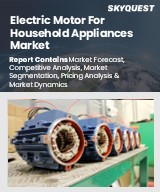
Electric Motor For Household Appliances Market
Report ID: SQMIG25H2063
Report ID: SQMIG25H2063
[email protected]
USA +1 351-333-4748
Report ID:
SQMIG25H2063 |
Region:
Global |
Published Date: January, 2026
Pages:
191
|Tables:
88
|Figures:
71


Global Electric Motor For Household Appliances Market size was valued at USD 8.18 Billion in 2024 and is poised to grow from USD 8.58 Billion in 2025 to USD 12.58 Billion by 2033, growing at a CAGR of 4.9% during the forecast period (2026–2033).
The foremost driver of the global electric motor for household appliances market is the growing emphasis on energy efficiency. With rising electricity costs and stricter government regulations on energy consumption, consumers are actively seeking appliances that reduce power usage without compromising performance. This has led manufacturers to adopt advanced motor technologies, such as brushless DC motors and variable frequency drives, which deliver superior efficiency, durability, and quieter operation. The cause-and-effect relationship is clear: as the demand for eco-friendly and cost-effective appliances grows, the adoption of energy-efficient electric motors accelerates, fueling steady market expansion.
A key trend driving the global electric motor for household appliances sector is the rapid pace of urbanization worldwide. As more people migrate to cities, the demand for modern housing and improved living standards rises significantly. Urban households increasingly rely on appliances such as refrigerators, washing machines, dishwashers, and air conditioners to support fast-paced lifestyles. This surge in appliance adoption directly boosts the need for reliable and high-performance electric motors. The effect is amplified by growing disposable incomes in urban areas, enabling greater appliance ownership. Thus, the global expansion of urban populations acts as a catalyst, ensuring consistent demand for electric motors across diverse household applications.
How do AI Systems Analyze Real-Time Data on Usage Patterns and Energy Consumption?
Artificial Intelligence (AI) is increasingly influencing the global electric motor for household appliances market by enabling smarter, more efficient, and predictive appliance operations. AI-powered systems analyze real-time data on usage patterns, energy consumption, and performance, allowing motors in appliances like washing machines, refrigerators, and HVAC systems to adjust speed, torque, and power output dynamically. This improves energy efficiency, extends motor lifespan, and enhances user convenience. A notable development is LG’s use of AI-enabled Direct Drive motors in washing machines, which optimize drum movement based on fabric type. As AI integration expands, demand for advanced electric motors tailored for intelligent appliances continues to grow.
In 2024, Crompton launched its AI- and IoT-enabled BLDC motor platform “Nucleus,” designed for household appliances like fans and geysers. By analyzing runtime and energy consumption data, the system uses AI to predict anomalies, optimize efficiency, and extend motor lifespan, advancing intelligent, energy-saving home appliance performance globally.
Market snapshot - 2026-2033
Global Market Size
USD 7.8 billion
Largest Segment
AC Motors
Fastest Growth
DC Motors
Growth Rate
4.9% CAGR
To get more insights on this market click here to Request a Free Sample Report
Global Electric Motor For Household Appliances Market is segmented by Motor Type, Application, Power Output and region. Based on Motor Type, the market is segmented into AC Motors, DC Motors and Universal Motors. Based on Application, the market is segmented into Major Household Appliances and Small Household Appliances. Based on Power Output, the market is segmented into Low Power Motors, Medium Power Motors and High Power Motors. Based on region, the market is segmented into North America, Europe, Asia Pacific, Latin America and Middle East & Africa.
AC motors dominate the global electric motor for household appliances market due to their reliability, affordability, and compatibility with standard household power supplies. They are extensively used in refrigerators, washing machines, and air conditioners, where consistent torque and performance are essential. Recent innovations include inverter-driven AC motors, enabling variable speed control and enhanced energy efficiency. Their dominance is reinforced by cost-effectiveness, long operational life, and suitability for high-demand household applications worldwide.
DC motors are projected to be the fastest growing in the global electric motor for household appliances market due to their superior energy efficiency, compact design, and precise speed control. Increasing adoption of brushless DC motors in premium appliances enhances performance, reduces noise, and extends lifespan, aligning with rising consumer demand for smart, energy-saving solutions.
Based on the global electric motor market forecast, major household appliances are dominating the industry and being driven by innovations such as brushless DC motors, inverter technology, and energy-efficient designs that enhance performance while reducing power consumption and noise. Major household appliances—including refrigerators, washing machines, and air conditioners—dominate this market due to their high energy demands, continuous operation, and need for reliable, durable motors, making them the primary segment for manufacturers to focus on.
Small household appliances are set to be the fastest-growing application in the global electric motor for household appliances market, driven by rising urban lifestyles and increasing consumer demand for convenience-focused products like vacuum cleaners, blenders, and coffee machines. Compact, efficient motors enable portability and performance, aligning with trends toward smart, multifunctional, and energy-saving appliances.
To get detailed segments analysis, Request a Free Sample Report
As per the global electric motor for household appliances market analysis, North America is expanding in the industry due to strong demand for energy-efficient and smart home appliances. The region benefits from mature adoption of refrigerators, washing machines, and HVAC systems, all requiring reliable motors. Strict government regulations, including ENERGY STAR programs, push manufacturers toward high-efficiency motor technologies. Growing integration of IoT and AI in appliances further supports market growth, reinforcing North America as a leading contributor globally.
The United States contributes significantly to North America’s electric motor for household appliances market due to its large consumer base, advanced manufacturing capabilities, and strong demand for energy-efficient appliances. With widespread adoption of smart home technologies and stringent energy regulations, U.S. appliance manufacturers increasingly rely on high-performance motors. Continuous innovation, coupled with consumer preference for premium, feature-rich appliances, ensures the country remains a dominant force driving market growth across various household appliance categories.
Canada’s electric motor for household appliances market contribution is shaped by rising urbanization, growing disposable incomes, and increasing demand for sustainable, energy-efficient household appliances. Canadian consumers prioritize environmentally friendly solutions, driving adoption of appliances powered by advanced, efficient electric motors. Supportive government policies promoting energy conservation and incentives for eco-friendly appliances further boost demand. Additionally, Canada’s steady uptake of smart and compact appliances contributes to expanding motor usage, positioning the country as a vital player within the regional market.
Europe's electric motor for household appliances market is driven by stringent energy-efficiency regulations, such as the EU Ecodesign Directive, and growing consumer demand for smart, eco-friendly appliances. High adoption of washing machines, refrigerators, and air conditioners equipped with energy-efficient AC and BLDC motors fuels market growth. Continuous technological advancements, focus on sustainability, and increasing awareness of energy conservation position Europe as a key region contributing to the global electric motor market.
Germany is a major contributor to the Europe electric motor for household appliances market due to its strong engineering expertise, advanced manufacturing infrastructure, and emphasis on energy-efficient solutions. High consumer demand for durable, smart, and eco-friendly appliances, such as washing machines and refrigerators, drives adoption of AC and BLDC motors. Government initiatives promoting energy conservation and sustainable technology further accelerate innovation, ensuring Germany remains a leading force in shaping the global appliance motor market.
France plays a significant role in the Europe electric motor market for household appliances, driven by growing demand for energy-efficient and smart appliances in residential and commercial sectors. Adoption of high-performance AC and DC motors in refrigerators, washing machines, and air conditioners is increasing. Supportive government policies, environmental regulations, and consumer awareness of sustainability encourage manufacturers to integrate innovative motor technologies, positioning France as a key contributor to the regional and global market growth.
The UK contributes substantially to the Europe electric motor for household appliances market, fueled by rising consumer preference for energy-efficient and smart appliances. Growing adoption of washing machines, refrigerators, and HVAC systems equipped with advanced AC and BLDC motors drives demand. Government incentives for energy conservation, environmental regulations, and investments in R&D encourage innovation in motor technology, making the UK a pivotal player in promoting sustainable and high-performance household appliances globally.
Asia Pacific’s electric motor for household appliances market is rapidly expanding due to rising urbanization, growing disposable incomes, and increasing household appliance adoption. Countries like China, India, and Japan drive demand for refrigerators, washing machines, and air conditioners powered by energy-efficient AC and BLDC motors. Technological advancements, government incentives for energy conservation, and rising awareness of smart, eco-friendly appliances position the region as a high-growth market globally.
Japan significantly contributes to the Asia Pacific electric motor for household appliances market through its focus on innovation, energy efficiency, and smart appliance integration. Japanese manufacturers lead in developing high-performance AC and BLDC motors used in refrigerators, washing machines, and air conditioners. Strong consumer demand for durable, technologically advanced, and eco-friendly appliances, coupled with government policies promoting energy conservation, ensures Japan remains a key driver of global market growth and technological advancement.
South Korea’s contribution to the Asia Pacific electric motor for household appliances market is driven by its advanced manufacturing capabilities, high adoption of smart home appliances, and focus on energy-efficient technologies. Companies integrate AC and BLDC motors in washing machines, refrigerators, and air conditioners to enhance performance and reduce energy consumption. Rising consumer preference for intelligent, durable appliances, along with government incentives for sustainability, positions South Korea as a significant player in the global market.
To know more about the market opportunities by region and country, click here to
Buy The Complete Report
Rising Demand for Energy-Efficient Appliances
Increasing Adoption of Smart and Connected Appliances
Consumer Preference for Low-Cost Appliances
Maintenance and Technical Expertise Requirements
Request Free Customization of this report to help us to meet your business objectives.
The global electric motor for household appliances market outlook is highly competitive, with major players like Nidec Corporation, Siemens AG, Bosch Group, Johnson Electric, and Panasonic Corporation leading the industry. Companies focus on energy-efficient, smart, and durable motor technologies. Nidec emphasizes high-efficiency motors in emerging markets, Siemens integrates digitalization and connectivity, Bosch pursues strategic acquisitions, Johnson Electric develops brushless DC motors, and Panasonic invests in R&D to enhance performance and reduce costs, strengthening global market positions.
As per the global electric motor for household appliances industry analysis, the market is witnessing a surge of innovative startups developing energy-efficient, compact, and intelligent motor solutions. These startups focus on reducing energy consumption, enhancing appliance performance, and integrating smart technologies. By offering alternatives to traditional motor designs, they drive rapid market evolution. Their emphasis on R&D, sustainability, and user-centric designs positions them as key contributors to the future growth of household appliance motors worldwide.
SkyQuest’s ABIRAW (Advanced Business Intelligence, Research & Analysis Wing) is our Business Information Services team that Collects, Collates, Correlates, and Analyses the Data collected by means of Primary Exploratory Research backed by robust Secondary Desk research.
As per SkyQuest analysis, the global electric motor for household appliances industry is experiencing robust growth, driven by rising demand for energy-efficient and smart appliances. Consumer preference for eco-friendly, cost-effective solutions is prompting manufacturers to adopt advanced AC and brushless DC motors, while AI integration enhances performance, energy efficiency, and predictive maintenance.
Rapid urbanization, increasing disposable incomes, and rising smart home adoption further accelerate demand across both major and small household appliances. Technological innovations, supportive government regulations, and continuous R&D by established players and startups ensure consistency in the global electric motor for household market strategies. With AC motors dominating due to reliability and DC motors growing rapidly for compact, efficient designs, the market is poised for sustained, innovation-driven growth globally.
| Report Metric | Details |
|---|---|
| Market size value in 2024 | USD 8.18 Billion |
| Market size value in 2033 | USD 12.58 Billion |
| Growth Rate | 4.9% |
| Base year | 2024 |
| Forecast period | 2026-2033 |
| Forecast Unit (Value) | USD Billion |
| Segments covered |
|
| Regions covered | North America (US, Canada), Europe (Germany, France, United Kingdom, Italy, Spain, Rest of Europe), Asia Pacific (China, India, Japan, Rest of Asia-Pacific), Latin America (Brazil, Rest of Latin America), Middle East & Africa (South Africa, GCC Countries, Rest of MEA) |
| Companies covered |
|
| Customization scope | Free report customization with purchase. Customization includes:-
|
To get a free trial access to our platform which is a one stop solution for all your data requirements for quicker decision making. This platform allows you to compare markets, competitors who are prominent in the market, and mega trends that are influencing the dynamics in the market. Also, get access to detailed SkyQuest exclusive matrix.
Table Of Content
Executive Summary
Market overview
Parent Market Analysis
Market overview
Market size
KEY MARKET INSIGHTS
COVID IMPACT
MARKET DYNAMICS & OUTLOOK
Market Size by Region
KEY COMPANY PROFILES
Methodology
For the Electric Motor For Household Appliances Market, our research methodology involved a mixture of primary and secondary data sources. Key steps involved in the research process are listed below:
1. Information Procurement: This stage involved the procurement of Market data or related information via primary and secondary sources. The various secondary sources used included various company websites, annual reports, trade databases, and paid databases such as Hoover's, Bloomberg Business, Factiva, and Avention. Our team did 45 primary interactions Globally which included several stakeholders such as manufacturers, customers, key opinion leaders, etc. Overall, information procurement was one of the most extensive stages in our research process.
2. Information Analysis: This step involved triangulation of data through bottom-up and top-down approaches to estimate and validate the total size and future estimate of the Electric Motor For Household Appliances Market.
3. Report Formulation: The final step entailed the placement of data points in appropriate Market spaces in an attempt to deduce viable conclusions.
4. Validation & Publishing: Validation is the most important step in the process. Validation & re-validation via an intricately designed process helped us finalize data points to be used for final calculations. The final Market estimates and forecasts were then aligned and sent to our panel of industry experts for validation of data. Once the validation was done the report was sent to our Quality Assurance team to ensure adherence to style guides, consistency & design.
Analyst Support
Customization Options
With the given market data, our dedicated team of analysts can offer you the following customization options are available for the Electric Motor For Household Appliances Market:
Product Analysis: Product matrix, which offers a detailed comparison of the product portfolio of companies.
Regional Analysis: Further analysis of the Electric Motor For Household Appliances Market for additional countries.
Competitive Analysis: Detailed analysis and profiling of additional Market players & comparative analysis of competitive products.
Go to Market Strategy: Find the high-growth channels to invest your marketing efforts and increase your customer base.
Innovation Mapping: Identify racial solutions and innovation, connected to deep ecosystems of innovators, start-ups, academics, and strategic partners.
Category Intelligence: Customized intelligence that is relevant to their supply Markets will enable them to make smarter sourcing decisions and improve their category management.
Public Company Transcript Analysis: To improve the investment performance by generating new alpha and making better-informed decisions.
Social Media Listening: To analyze the conversations and trends happening not just around your brand, but around your industry as a whole, and use those insights to make better Marketing decisions.
REQUEST FOR SAMPLE
 REQUEST FREE CUSTOMIZATION


Want to customize this report? This report can be personalized according to your needs. Our analysts and industry experts will work directly with you to understand your requirements and provide you with customized data in a short amount of time. We offer $1000 worth of FREE customization at the time of purchase.
Feedback From Our Clients


 USA (+1) 351-333-4748

