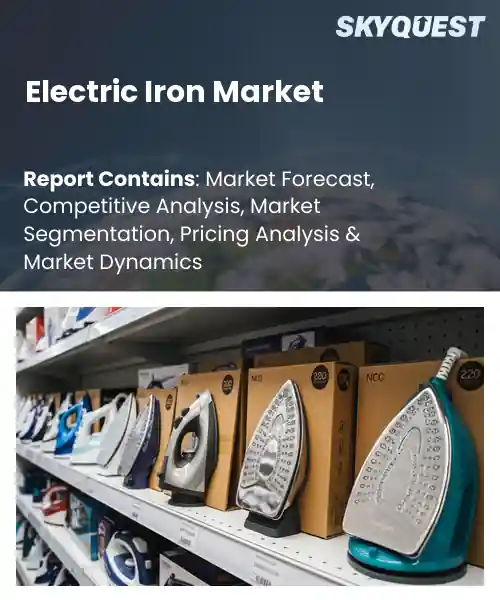
Electric Iron Market
Report ID: SQMIG25H2083
Report ID: SQMIG25H2083
[email protected]
USA +1 351-333-4748
Report ID:
SQMIG25H2083 |
Region:
Global |
Published Date: May, 2026
Pages:
157
|Tables:
119
|Figures:
77


Global Electric Iron Market size was valued at USD 5.52 Billion in 2024 and is poised to grow from USD 5.82 Billion in 2025 to USD 8.85 Billion by 2033, growing at a CAGR of 5.42% during the forecast period (2026-2033).
Rising consumer demand for efficient home appliances, rapid urbanization, growing dual-income households, increasing disposable incomes, and continuous technological advancements are driving sales of electric irons.
Rising consumer demand for efficient and time-saving home appliances is expected to primarily drive electric iron market growth. The factors such as rapid urbanization, active engagement of women in the workplace, and an increase in dual-income families encourage people to purchase products that ease domestic work. The electric iron is a very important product for the maintenance of clothes, which has undergone much development from the traditional methods of pressing clothes through coal and gas irons to steaming irons and lighter and energy-saving irons made of ceramic sole plates and advanced temperature controls. Further development of technology in terms of energy saving and intelligent features has been driving the growth of the market.
On the contrary, high costs of premium smart electric irons, availability of low-cost alternatives, durability and maintenance concerns, and intense market competition are anticipated to slow down electric iron market penetration across the study period and beyond.
How is IoT Improving Energy Efficiency In Electric Irons?
IoT technology plays a significant role in improving energy efficiency within the industry through the use of smart sensors and controls that control the heat and steam as per the needs of the fabric. The adoption of smart temperature sensors as well as activity sensors reduces wastage of energy when the iron is not used because it prevents wastage of time due to excessive heating of the iron during standby. In both personal and professional areas, manufacturers of electric irons have started incorporating smart controls as well as intelligent fabric identification sensors to enhance energy efficiency and increase ironing efficiency.
Market snapshot - (2026-2033)
Global Market Size
USD 5.52 Billion
Largest Segment
Steam Iron
Fastest Growth
Steam Generator Iron
Growth Rate
5.42% CAGR
To get more insights on this market click here to Request a Free Sample Report
Global electric iron market is segmented by product type, distribution channel, end-user, price range, and region. Based on product type, the market is segmented into dry iron, steam iron, cordless iron, and steam generator iron. Based on distribution channel, the market is segmented into online retail, supermarkets & hypermarkets, electronics specialty stores, and department stores. Based on end-user, the market is segmented into residential and commercial (laundry, hotels). Based on price range, the market is segmented into economy, mid-range, and premium. Based on region, the market is segmented into North America, Europe, Asia Pacific, Latin America, and Middle East & Africa.
The steam generator iron segment is slated to account for the highest global electric iron market share going forward. It provides efficient high-performance steam ironing that caters to the demands of professionals as well as those who use the machine extensively at home, allowing for quick elimination of wrinkles. There is an emphasis on R&D by manufacturers in terms of boilers as well as soleplates in their irons. This saves users from having to exert extra effort and makes it a preferred choice for consumers looking for efficiency as well as fabric safety.
Nonetheless, cordless iron seems set to become the fastest growing segment owing to increasing efficiencies in batteries coupled with increased consumer preferences for mobility and convenience. Ease in design and simplification of the charging ecosystem have significantly reduced barriers to use, thereby allowing companies to continually launch updated models that provide opportunities for innovation.
The online retail segment is forecasted to spearhead the global electric iron market revenue generation over the coming years. Digital storefronts offer unbeatable visibility when it comes to the range of offerings, instant price comparisons, and plenty of user feedback to make purchasing decisions easy. The retailers spend money on relevant content, bundle deals, and personalized suggestions, increasing conversions regardless of the type of item or the price level. The convenience of doorstep delivery and return policy also contribute to the consumers' inclination towards shopping online.
However, electronics specialty stores are witnessing the strongest growth momentum as per this electric iron industry analysis. Retail experience and post-purchase services appeal to consumers who want demonstrations of high-end irons. The in-store offerings of a well-curated line-up of products and skilled technicians promote trials of innovative product lines such as steam generators and cordless irons, leading to greater consumer value and localized growth of dealerships.
To get detailed segments analysis, Request a Free Sample Report
Robust manufacturing strength, concentrated consumer demand, and robust supply chain ecosystems are helping this region maintain its dominance. Manufacturers in Asia Pacific are at the forefront of creating parts and developing new designs for the electric iron so that they can quickly diversify their products and buy parts at a low cost. These companies have strong distribution networks and well-known appliance brands providing them with a broad retail presence in urban and periurban areas. The preferences of consumers in Asia Pacific are for reliable, feature-rich and energy efficient electric irons, which drives continual improvement in the products on the shelf. Commercial and home demand for electric irons is supported by large garment and textile industries, and by localised after sales and repair service networks that create brand loyalty. Collaboration between suppliers, contract manufacturers and technology companies speeds up innovation in material and heating technologies, which solidifies Asia Pacific’s competitive advantage and its export capability. Integrated logistics and proximity to component manufacturing locations reduce lead times and increase the speed at which suppliers can respond to their customers in Asia Pacific.
Electric iron demand in Japan is characterized by consumer demand for compact, efficient and engineered appliances. Japanese manufacturers value product quality along with temperature regulation and security features, thanks to home-made components and precise production methods. The retail distribution system emphasizes high-quality and special products, whereas the maintenance system is concerned about sustainability. This approach to product ergonomics and energy-saving technology meets the demands of urban households and businesses alike.
Consumers oriented towards technology and manufacturers who emphasize features and style have been instrumental in creating the demand for electric irons in South Korea. The domestic manufacturers focus on innovations related to digital controls, usage of advanced materials, and efficient heating mechanisms, and all of these are made possible due to top-notch electronic manufacturing capabilities. Marketing and online marketing ensure increased awareness, while service ensures consumer trust.
Consumer expectations for energy efficient and safety compliant appliances, active refurbishment in household appliance portfolios, and strong product differentiation by established brands are helping create new business scope in the region. Government regulations regarding performance and appliance labelling are driving consumers’ demand for premium and certified products, while urban lifestyles and the care of professional wardrobes will continue to support the use of electric irons. A variety of retail ecosystems, consisting of specialist retailers and digital channels, will increase the ability of customers to access electric irons. The heritage of German engineering and the capabilities of German manufacturers will continue to provide the high-quality product introductions necessary to influence regional trends. The emphasis by consumers on receiving products with appealing designs and durable construction, along with strong after-sales services, should continue to enhance brand loyalty, allowing manufacturers to increase their product offerings and their market penetration across many different countries. Collaboration between the electrical appliance and textile/professional laundry industries will help to increase the development of tailored product solutions to meet the needs of their respective user groups.
Electric iron market in Germany is characterized by engineering driven offerings, rigorous quality standards and a preference for durable appliances. The retail and professional distribution channels promote only the high-performance versions. The importance of the industrial sector drives product testing and innovations and determines customer expectations for European markets. German manufacturers excel in producing reliable products with superior temperature regulation and safety systems, due to their connections with precision component makers.
Electric iron sales in united Kingdom are shaped by retail shifts and consumer receptivity to online and convenience led purchasing. Local and global firms use digital marketing along with their product lines and services to connect with the urban household segment. The focus on efficient, eco-friendly, and aesthetically designed models is a response to the preferences of the consumer segment. Professional as well as leisure wear ensures that consumers look for quality performance from their products.
Electric iron market in France is emerging with emphasis on sustainability, aesthetics and energy mindful operation. Retailers of specialty appliances and repair and service organizations help boost consumer confidence. The current trend favors small and convenient appliances that appeal to urban buyers. The French market is characterized by an appreciation for products that combine design aesthetics and environmental awareness, pushing companies to adopt quality materials and low-energy technology.
Strategic considerations regarding the importance of product differentiation, compliance, and diversification of distribution channels are aiding in the creation of new business opportunities within the region. The manufacturing organizations and brands have developed electric irons that are built to be durable, user-friendly, and have safety features incorporated into them, which makes these products attractive for household use as well as for small businesses. There are three types of retail systems: big-box retailers, specialty retailers, and e-retailers. All of them work together to ensure product accessibility and promotional opportunities. Energy-efficient, ergonomic design, and customer service have become more important, driving the premiumization of products in the electric iron market. The use of collaborative arrangements between manufacturers and suppliers of textiles and appliances will also provide synergies through the greater integration of features. After-sale networks and localized manufacturing or assembly will help to reduce lead time and support local product availability. Together with being more competitive through their localized product offering, localized manufacturing and assembly will also support competitive positioning of the North American region with respect to both the domestic replacement market and select export niches. Investment in research partnerships and consumer-based product testing will further refine the product's market fit and ease of adoption.
Demand for electric iron in the United States is shaped by broad consumer demand for versatile, reliable appliances that address household needs. The important aspect of convenience, ergonomics, and saving energy determines development and strategy. Premium brands have intelligent control systems, security mechanisms, and advanced material technology; meanwhile, retailers create their own lines of products using mass, specialized, and Internet distribution channels. Sales and support networks, together with collaboration with laundry services businesses, help to introduce the technology in the business world.
Sales of electric iron in Canada reflect consumer preference for reliable, energy mindful and easy to use appliances suited to household contexts. Regional supply chains and local assembly help in creating a comprehensive product range. Environmental awareness and user-friendliness determine the manufacturing of products. Brands consider issues like durability, features, and material quality, all based on the network of services provided and specialized stores that keep in mind regional needs.
To know more about the market opportunities by region and country, click here to
Buy The Complete Report
Rising Demand For Energy Efficiency
Adoption Of Smart Home Integration
High Raw Material Prices
Safety And Certification Challenges
Request Free Customization of this report to help us to meet your business objectives.
Competition in the global electric iron market is driven by product differentiation and channel consolidation as incumbents use acquisitions, brand partnerships, and smart appliance launches to protect market share. Examples include Rowenta and Groupe SEB rolling out advanced steam technologies and Philips integrating connected appliance capabilities. These moves force smaller firms to pursue niche innovation and retail alliances to remain competitive.
SkyQuest’s ABIRAW (Advanced Business Intelligence, Research & Analysis Wing) is our Business Information Services team that Collects, Collates, Correlates, and Analyses the Data collected by means of Primary Exploratory Research backed by robust Secondary Desk research.
As per SkyQuest analysis, rising consumer demand for efficient home appliances, rapid urbanization, growing dual-income households, and continuous technological advancements are anticipated to drive the demand for electric irons going forward. However, high costs of premium smart electric irons, availability of low-cost alternatives, and durability and maintenance concerns are slated to slow down the adoption of electric irons in the future. Asia Pacific is slated to spearhead the demand for electric irons owing to rapid urbanization, rising disposable incomes, growing household appliance adoption, and the presence of large consumer electronics manufacturing hubs. Development of IoT-enabled smart irons, integration of AI-based fabric recognition technologies, and advancements in energy-efficient heating systems are anticipated to be key trends driving the electric iron industry through 2033.
| Report Metric | Details |
|---|---|
| Market size value in 2024 | USD 5.52 Billion |
| Market size value in 2033 | USD 8.85 Billion |
| Growth Rate | 5.42% |
| Base year | 2024 |
| Forecast period | (2026-2033) |
| Forecast Unit (Value) | USD Billion |
| Segments covered |
|
| Regions covered | North America (US, Canada), Europe (Germany, France, United Kingdom, Italy, Spain, Rest of Europe), Asia Pacific (China, India, Japan, Rest of Asia-Pacific), Latin America (Brazil, Rest of Latin America), Middle East & Africa (South Africa, GCC Countries, Rest of MEA) |
| Companies covered |
|
| Customization scope | Free report customization with purchase. Customization includes:-
|
To get a free trial access to our platform which is a one stop solution for all your data requirements for quicker decision making. This platform allows you to compare markets, competitors who are prominent in the market, and mega trends that are influencing the dynamics in the market. Also, get access to detailed SkyQuest exclusive matrix.
Table Of Content
Executive Summary
Market overview
Parent Market Analysis
Market overview
Market size
KEY MARKET INSIGHTS
COVID IMPACT
MARKET DYNAMICS & OUTLOOK
Market Size by Region
KEY COMPANY PROFILES
Methodology
For the Electric Iron Market, our research methodology involved a mixture of primary and secondary data sources. Key steps involved in the research process are listed below:
1. Information Procurement: This stage involved the procurement of Market data or related information via primary and secondary sources. The various secondary sources used included various company websites, annual reports, trade databases, and paid databases such as Hoover's, Bloomberg Business, Factiva, and Avention. Our team did 45 primary interactions Globally which included several stakeholders such as manufacturers, customers, key opinion leaders, etc. Overall, information procurement was one of the most extensive stages in our research process.
2. Information Analysis: This step involved triangulation of data through bottom-up and top-down approaches to estimate and validate the total size and future estimate of the Electric Iron Market.
3. Report Formulation: The final step entailed the placement of data points in appropriate Market spaces in an attempt to deduce viable conclusions.
4. Validation & Publishing: Validation is the most important step in the process. Validation & re-validation via an intricately designed process helped us finalize data points to be used for final calculations. The final Market estimates and forecasts were then aligned and sent to our panel of industry experts for validation of data. Once the validation was done the report was sent to our Quality Assurance team to ensure adherence to style guides, consistency & design.
Analyst Support
Customization Options
With the given market data, our dedicated team of analysts can offer you the following customization options are available for the Electric Iron Market:
Product Analysis: Product matrix, which offers a detailed comparison of the product portfolio of companies.
Regional Analysis: Further analysis of the Electric Iron Market for additional countries.
Competitive Analysis: Detailed analysis and profiling of additional Market players & comparative analysis of competitive products.
Go to Market Strategy: Find the high-growth channels to invest your marketing efforts and increase your customer base.
Innovation Mapping: Identify racial solutions and innovation, connected to deep ecosystems of innovators, start-ups, academics, and strategic partners.
Category Intelligence: Customized intelligence that is relevant to their supply Markets will enable them to make smarter sourcing decisions and improve their category management.
Public Company Transcript Analysis: To improve the investment performance by generating new alpha and making better-informed decisions.
Social Media Listening: To analyze the conversations and trends happening not just around your brand, but around your industry as a whole, and use those insights to make better Marketing decisions.
REQUEST FOR SAMPLE
 REQUEST FREE CUSTOMIZATION
Global Electric Iron Market size was valued at USD 5.52 Billion in 2024 and is poised to grow from USD 5.82 Billion in 2025 to USD 8.85 Billion by 2033, growing at a CAGR of 5.42% during the forecast period (2026-2033).
Competition in the global electric iron market is driven by product differentiation and channel consolidation as incumbents use acquisitions, brand partnerships, and smart appliance launches to protect market share. Examples include Rowenta and Groupe SEB rolling out advanced steam technologies and Philips integrating connected appliance capabilities. These moves force smaller firms to pursue niche innovation and retail alliances to remain competitive. 'Philips (Versaglide)', 'Tefal (Groupe SEB)', 'Rowenta (Groupe SEB)', 'Black+Decker (Stanley)', 'Morphy Richards', 'Hamilton Beach Brands', 'Usha International', 'Bajaj Electricals', 'Havells India', 'Sunbeam Products (Jarden)', 'Braun (Procter & Gamble)', 'Panasonic Corporation', 'National/Panasonic', 'Toshiba Lifestyle', 'LAURASTAR SA', 'Reliable Corporation', 'Oliso (Innovation Technology)', 'Cuisinart (Conair)', 'CHI (Farouk Systems)', 'Singer Corporation'
Demand for energy efficient household appliances encourages manufacturers to prioritize electric irons that consume less power and deliver consistent performance, prompting innovation in heating elements and insulation. As consumers seek lower operating costs and environmentally responsible choices, producers focus on design improvements and materials that enhance efficiency while maintaining usability. Retailers respond by featuring efficient models, and marketing emphasizes lifecycle benefits, which collectively increases product development investment and consumer acceptance, thereby expanding market availability and supporting sustained growth across regions globally.
Smart Appliance Integration: Consumer demand is shifting toward irons that connect seamlessly with smart home ecosystems, enabling remote control, usage monitoring, and personalized ironing profiles. Manufacturers are leveraging app interfaces and voice assistant compatibility to enhance convenience and deliver differentiated experiences. This trend encourages partnerships with platform providers and pushes product roadmaps toward software-enabled features, subscription services, and over-the-air updates, ultimately strengthening brand engagement and creating new aftersales revenue opportunities while raising consumer expectations for interoperability and ease of use and market differentiation.
Why does Asia Pacific Dominate the Global Electric Iron Market? |@12


Want to customize this report? This report can be personalized according to your needs. Our analysts and industry experts will work directly with you to understand your requirements and provide you with customized data in a short amount of time. We offer $1000 worth of FREE customization at the time of purchase.
Feedback From Our Clients


 USA (+1) 351-333-4748

