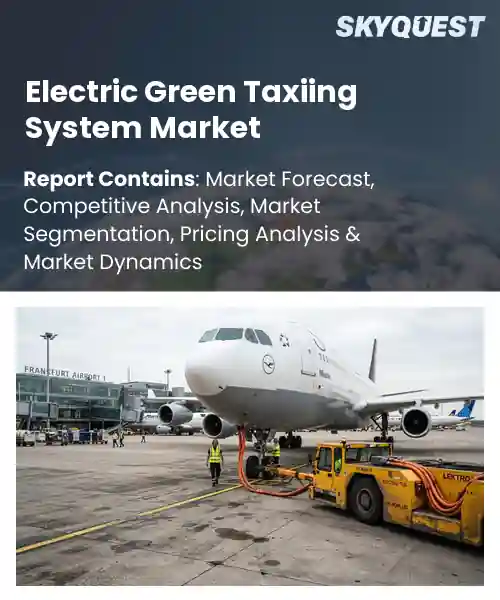
Electric Green Taxiing System Market
Report ID: SQMIG20A2945
Report ID: SQMIG20A2945
[email protected]
USA +1 351-333-4748
Report ID:
SQMIG20A2945 |
Region:
Global |
Published Date: November, 2026
Pages:
157
|Tables:
118
|Figures:
77


Global Electric Green Taxiing System Market size was valued at USD 280.0 Million in 2024 and is poised to grow from USD 320.88 Million in 2025 to USD 954.6 Million by 2033, growing at a CAGR of 14.6% during the forecast period (2026-2033).
The electric green taxiing system market includes battery‑powered tugs, electric auxiliary power units, and software that move aircraft on the ground without jet fuel. Its rise stems from environmental regulations and airport carbon‑reduction goals that force airlines to cut emissions during the taxi phase. Early pilots in Europe and Asia showed that swapping conventional auxiliary power units for electric versions could lower fuel use by up to 15 percent per flight. Heathrow and Singapore Changi have installed charging stations, prompting carriers to adopt technology. Thus the market has shifted from niche prototypes in early 2010s to a billion‑dollar segment today. The dominant growth driver is the convergence of airline cost pressures and battery density, which together make taxiing viable. Rising fuel prices push carriers to calculate that minute saved on auxiliary power yields measurable savings, encouraging investment in lithium‑ion packs capable of sorties before recharge. Dubai International’s electric tug fleet exemplifies this impact, cutting fuel use by 2,000 tonnes annually and freeing capital for aircraft renewal. Government incentives for ground operations improve business case, prompting manufacturers to broaden product lines and scale production. As unit costs fall, adoption expands, creating economies of scale that open opportunities at secondary airports worldwide.
How is AI and IoT integration driving growth in the electric green taxiing system market?
AI and IoT integration is reshaping the electric green taxiing system market by linking sensors, data analytics and autonomous control. Real time monitoring of battery health, power consumption and ground traffic enables operators to schedule taxi operations more efficiently. Machine learning predicts optimal power distribution and reduces wear on components. Connected platforms allow fleets to share performance data, improving maintenance planning and extending vehicle life. The current landscape sees airports adopting electric taxi vehicles to cut emissions and lower fuel costs while regulators encourage greener ground operations. These technological advances create a compelling value proposition that drives investment and adoption across the sector.SkyTug March 2024, launched an AI powered power management module that dynamically balances battery output during taxi, reducing idle time and extending range. This innovation demonstrates how AI and IoT together enhance operational efficiency and accelerate market growth by delivering reliable low emission ground movement.
Market snapshot - (2026-2033)
Global Market Size
USD 280.0 Million
Largest Segment
Wheel-Mounted Electric Taxiing Systems
Fastest Growth
Electric Taxiing Systems Integrated with Aircraft Propulsion
Growth Rate
14.6% CAGR
To get more insights on this market click here to Request a Free Sample Report
Global electric green taxiing system market is segmented by system type, aircraft type, component, end user and region. Based on system type, the market is segmented into Wheel-Mounted Electric Taxiing Systems and Electric Taxiing Systems Integrated with Aircraft Propulsion. Based on aircraft type, the market is segmented into Narrow-Body Aircraft, Wide-Body Aircraft, Regional Aircraft and Other Aircraft Types. Based on component, the market is segmented into Electric Motors, Power Electronics & Control Units, Energy Storage & Power Supply Systems and Mechanical Drive Systems. Based on end user, the market is segmented into Commercial Airlines, Aircraft Leasing Companies and Military & Government Operators. Based on region, the market is segmented into North America, Europe, Asia Pacific, Latin America and Middle East & Africa.
Wheel‑Mounted Electric Taxiing Systems segment dominates because they can be retrofitted onto existing fleets without major redesign, offering immediate fuel savings and emission reductions. Their modular architecture aligns with airlines’ operational constraints, enabling quick installation during routine maintenance. The straightforward integration reduces certification hurdles and leverages proven ground‑based power sources, making them the preferred choice for immediate green‑taxiing adoption and supporting airlines’ sustainability targets while minimizing downtime.
However, Electric Taxiing Systems Integrated with Aircraft Propulsion segment is witnessing the strongest growth momentum because manufacturers embed propulsion‑based electric drives into aircraft architecture, unlocking higher energy efficiency and reducing reliance on external ground power. This integration is spurred by regulatory pushes for zero‑emission operations and the promise of seamless taxi‑to‑takeoff power continuity.
Electric Motors segment dominates because they directly convert electrical energy into thrust during ground movement, offering the most efficient propulsion method for taxi operations. Their high torque density and responsive control align with aircraft ground handling requirements, enabling rapid acceleration and deceleration while minimizing energy loss. Established motor technologies benefit from mature manufacturing, facilitating cost‑effective scaling and confidence among operators, and supporting airline sustainability initiatives which further drives investment decisions.
Meanwhile, Energy Storage & Power Supply Systems segment is emerging as the key high‑growth area because battery advances and modular power units extend runway endurance while lowering weight penalties for electric taxiing. Operators value plug‑in capability and regenerative energy capture, which fuels broader adoption and drives deeper system integration.
To get detailed segments analysis, Request a Free Sample Report
North America benefits from a mature aviation ecosystem that combines extensive airport networks with deep engineering expertise. Robust policy frameworks encourage low‑carbon operations, while major aircraft manufacturers and tier‑one suppliers are headquartered in the region, fostering rapid prototype development and scaling. Collaborative research initiatives between universities, government labs, and industry accelerate technology validation and integration. Significant capital availability supports infrastructure upgrades at key hubs, enabling early adoption of electric taxiing solutions. Customer demand for operational efficiency and reduced noise aligns with sustainability targets, reinforcing market leadership. The convergence of regulatory support, technical capability, and strategic investment positions North America as the benchmark for electric green taxiing deployment worldwide.
Electric Green Taxiing System Market in the United States is propelled by extensive federal incentives that prioritize emissions reductions across major carriers. Leading aerospace firms collaborate with research institutions to refine battery management and power‑train reliability. Major airports incorporate dedicated charging zones, creating a seamless operational environment. Industry coalitions drive standard‑setting, ensuring interoperability across fleets. The combination of policy backing, supplier depth, and proactive airport planning creates a compelling ecosystem for widespread adoption.
Electric Green Taxiing System Market in Canada benefits from progressive environmental regulations that emphasize carbon neutrality in air transportation. Provincial aviation authorities work closely with manufacturers to pilot electric taxiing trials at key airports. Strong renewable electricity grids support low‑impact charging infrastructure, reinforcing sustainability goals. Collaborative funding mechanisms encourage small and medium‑size enterprises to innovate in power‑train design. The alignment of policy, clean energy access, and industry partnership nurtures a supportive landscape for market growth.
Europe’s expansion is fueled by ambitious climate commitments that place decarbonisation at the core of aviation strategies. Integrated policy frameworks across member states incentivize adoption of electric taxiing through funding schemes and airport level targets. An established network of research consortia links universities, aerospace firms, and government bodies, accelerating technology maturation. Harmonised standards facilitate cross‑border equipment compatibility, reducing entry barriers for operators. Growing public awareness of noise and emission impacts strengthens stakeholder resolve. Together, these dynamics create a cohesive environment where investment, innovation, and regulation converge, propelling Europe to the forefront of electric green taxiing deployment.
Electric Green Taxiing System Market in Germany is anchored by a strong engineering tradition and a robust automotive supply chain that readily adapts to aerospace applications. Federal programs allocate resources to joint ventures between aircraft manufacturers and battery specialists, fostering rapid prototype testing at major airports. Industry clusters promote knowledge sharing, ensuring continuous improvement in power‑train efficiency. The country's emphasis on sustainable mobility extends to aviation, reinforcing market momentum.
Electric Green Taxiing System Market in the United Kingdom is experiencing accelerated uptake due to proactive government policies that embed green taxiing into national aviation roadmaps. Leading research universities partner with airlines to trial electric tow systems, delivering valuable operational insights. Airport operators invest in dedicated charging bays, facilitating seamless integration into daily routines. A vibrant start‑up ecosystem contributes innovative battery and control solutions, positioning the United Kingdom as a fast‑moving hub for technology scaling.
Electric Green Taxiing System Market in France is emerging through coordinated efforts between civil aviation authorities and regional airport groups. Funding mechanisms support pilot projects that showcase emission reductions and cost efficiencies. Collaborative platforms bring together aircraft manufacturers, energy providers, and ground handling firms to define best practices. The growing emphasis on environmental stewardship within the French aviation sector encourages early adoption and market experimentation.
Asia Pacific advances its position by leveraging rapid airport modernization and a growing emphasis on sustainable operations across the region. Governments prioritize green infrastructure as part of broader transport transformation plans, providing policy incentives for electric ground‑handling equipment. Strong electronics and battery manufacturing capabilities within the region enable cost‑effective component supply and localised production. Collaborative pilot programmes at flagship hubs generate valuable data that informs broader roll‑out strategies. The convergence of supportive regulation, manufacturing expertise, and strategic airport investments amplifies the region’s capacity to scale electric taxiing solutions and set new benchmarks for operational efficiency.
Electric Green Taxiing System Market in Japan benefits from a well‑established high‑tech manufacturing base that delivers precision components for electric power‑trains. National aviation authorities promote low‑emission initiatives, encouraging airlines to trial electric taxiing at major terminals. Partnerships between aircraft OEMs and local technology firms accelerate system integration and reliability testing. The synergy of policy direction and advanced manufacturing underpins market progress.
Electric Green Taxiing System Market in South Korea is driven by strong governmental support for green aviation and a vibrant electronics sector that supplies cutting‑edge battery technology. Leading airports collaborate with domestic aerospace companies to pilot electric taxi solutions, generating operational insights. Incentive programs motivate airlines to adopt low‑carbon ground operations. The alignment of policy, technological expertise, and industry commitment propels market development.
To know more about the market opportunities by region and country, click here to
Buy The Complete Report
Increasing Environmental Regulation
Advancements In Battery Technology
High Initial Capital Expenditure
Limited Airport Infrastructure Compatibility
Request Free Customization of this report to help us to meet your business objectives.
Top Player’s Company Profile
Recent Developments
SkyQuest’s ABIRAW (Advanced Business Intelligence, Research & Analysis Wing) is our Business Information Services team that Collects, Collates, Correlates, and Analyses the Data collected by means of Primary Exploratory Research backed by robust Secondary Desk research. As per SkyQuest analysis, the electric green taxiing market is being propelled primarily by tightening environmental regulations that push airlines and airports to replace fuel‑burning push‑backs with zero‑emission solutions, while the rapid progress in battery technology serves as a second catalyst by extending range and cutting charging times. The wheel‑mounted electric taxiing systems segment leads the market because it can be retrofitted to existing fleets with minimal downtime. North America remains the dominant region, benefitting from mature aviation infrastructure, strong supplier bases and supportive policies. However, the high upfront capital required for charging stations and specialized ground equipment acts as a notable restraint, slowing adoption at smaller airports.
| Report Metric | Details |
|---|---|
| Market size value in 2024 | USD 280.0 Million |
| Market size value in 2033 | USD 954.6 Million |
| Growth Rate | 14.6% |
| Base year | 2024 |
| Forecast period | (2026-2033) |
| Forecast Unit (Value) | USD Million |
| Segments covered |
|
| Regions covered | North America (US, Canada), Europe (Germany, France, United Kingdom, Italy, Spain, Rest of Europe), Asia Pacific (China, India, Japan, Rest of Asia-Pacific), Latin America (Brazil, Rest of Latin America), Middle East & Africa (South Africa, GCC Countries, Rest of MEA) |
| Companies covered |
|
| Customization scope | Free report customization with purchase. Customization includes:-
|
To get a free trial access to our platform which is a one stop solution for all your data requirements for quicker decision making. This platform allows you to compare markets, competitors who are prominent in the market, and mega trends that are influencing the dynamics in the market. Also, get access to detailed SkyQuest exclusive matrix.
Table Of Content
Executive Summary
Market overview
Parent Market Analysis
Market overview
Market size
KEY MARKET INSIGHTS
COVID IMPACT
MARKET DYNAMICS & OUTLOOK
Market Size by Region
KEY COMPANY PROFILES
Methodology
For the Electric Green Taxiing System Market, our research methodology involved a mixture of primary and secondary data sources. Key steps involved in the research process are listed below:
1. Information Procurement: This stage involved the procurement of Market data or related information via primary and secondary sources. The various secondary sources used included various company websites, annual reports, trade databases, and paid databases such as Hoover's, Bloomberg Business, Factiva, and Avention. Our team did 45 primary interactions Globally which included several stakeholders such as manufacturers, customers, key opinion leaders, etc. Overall, information procurement was one of the most extensive stages in our research process.
2. Information Analysis: This step involved triangulation of data through bottom-up and top-down approaches to estimate and validate the total size and future estimate of the Electric Green Taxiing System Market.
3. Report Formulation: The final step entailed the placement of data points in appropriate Market spaces in an attempt to deduce viable conclusions.
4. Validation & Publishing: Validation is the most important step in the process. Validation & re-validation via an intricately designed process helped us finalize data points to be used for final calculations. The final Market estimates and forecasts were then aligned and sent to our panel of industry experts for validation of data. Once the validation was done the report was sent to our Quality Assurance team to ensure adherence to style guides, consistency & design.
Analyst Support
Customization Options
With the given market data, our dedicated team of analysts can offer you the following customization options are available for the Electric Green Taxiing System Market:
Product Analysis: Product matrix, which offers a detailed comparison of the product portfolio of companies.
Regional Analysis: Further analysis of the Electric Green Taxiing System Market for additional countries.
Competitive Analysis: Detailed analysis and profiling of additional Market players & comparative analysis of competitive products.
Go to Market Strategy: Find the high-growth channels to invest your marketing efforts and increase your customer base.
Innovation Mapping: Identify racial solutions and innovation, connected to deep ecosystems of innovators, start-ups, academics, and strategic partners.
Category Intelligence: Customized intelligence that is relevant to their supply Markets will enable them to make smarter sourcing decisions and improve their category management.
Public Company Transcript Analysis: To improve the investment performance by generating new alpha and making better-informed decisions.
Social Media Listening: To analyze the conversations and trends happening not just around your brand, but around your industry as a whole, and use those insights to make better Marketing decisions.
REQUEST FOR SAMPLE
 REQUEST FREE CUSTOMIZATION


Want to customize this report? This report can be personalized according to your needs. Our analysts and industry experts will work directly with you to understand your requirements and provide you with customized data in a short amount of time. We offer $1000 worth of FREE customization at the time of purchase.
Feedback From Our Clients


 USA (+1) 351-333-4748

